
Leadership coaching is a structured, goal-focused developmental relationship designed to improve leadership effectiveness through targeted behavioral change and measurable progress toward goals. Research confirms this is not a soft intervention. Meta-analyses show a moderate positive effect size of Hedges’ g ≈ 0.58 across professional performance, goal attainment, and self-awareness outcomes. Leaders who engage in formal coaching programs see 20 to 40% improvements in goal execution and deadline consistency. Those numbers reflect why leadership coaching works at a level that training programs and mentoring alone rarely achieve.
What does the research say about leadership coaching effectiveness?
The scientific case for leadership coaching is built on meta-analyses and randomized controlled trials, not anecdote. A comprehensive meta-review found that coaching produces significant gains in professional performance, self-awareness, and emotional competence across industries and leadership levels. An effect size of 0.58 places coaching in the same effectiveness range as evidence-based medical interventions. That comparison matters because it signals that coaching is a repeatable, predictable process when applied correctly.
What coaching changes in leaders
The behavioral outcomes most consistently improved through coaching include communication clarity, decision-making quality, and team performance. These are not abstract qualities. They show up in meeting dynamics, feedback conversations, and the way leaders respond under pressure. Coaching supports self-reflective capabilities and deliberate decision-making that underpin transformational leadership, which means the changes compound over time rather than fading after a workshop.

How coaching compares to other development methods
| Method | Primary Strength | Primary Limitation |
|---|---|---|
| Formal training | Builds knowledge and frameworks quickly | Rarely translates to sustained behavior change |
| Mentoring | Provides career guidance and organizational context | Dependent on mentor availability and relationship quality |
| Leadership coaching | Translates knowledge into on-the-job behavioral change | Requires time, commitment, and organizational support |
| Coaching after training | Strongest outcomes in sustained performance | Requires coordinated investment from HR and leadership |
The table above reflects a consistent research finding: no single method dominates across all outcomes. Coaching’s specific advantage is behavioral transfer. It takes what a leader already knows and turns it into what they do.
What factors determine whether leadership coaching succeeds or fails?
Leadership coaching effectiveness is not uniform. The conditions surrounding a coaching engagement predict outcomes as much as the coaching itself. Organizations that treat coaching as a checkbox activity consistently see weaker results than those that treat it as a deliberate culture investment.
The most significant factors include:
-
Goal specificity. Vague goals reduce coaching effectiveness significantly. Leaders who arrive with clear, measurable behavioral targets get more from every session. A goal like “become a better communicator” produces far less progress than “deliver structured feedback to each direct report within 48 hours of a performance event.”
-
Coachee motivation. Coaching mandated as a remedial response to poor performance produces weaker outcomes than coaching chosen as a growth investment. Genuine commitment from the leader being coached is a non-negotiable condition for progress.
-
Coach-coachee fit. A strong working alliance between coach and coachee is one of the most reliable predictors of coaching success. Organizations that invest in a deliberate selection process, rather than assigning coaches arbitrarily, see measurably better outcomes.
-
Organizational alignment. Unsupportive organizational cultures that reward individual heroics over collaboration actively undermine progress in coaching. When the reward system conflicts with the coaching goals, leaders face a structural barrier that no coach can overcome alone.
Pro Tip: Before launching a coaching engagement, map the organizational reward system. If the behaviors being coached are not recognized or reinforced by the culture, address that misalignment first. Otherwise, you are coaching against the current.
Understanding why leadership development programs fail often comes down to exactly these conditions. The coaching itself is rarely the problem. The environment around it usually is.
How does leadership coaching complement formal training?
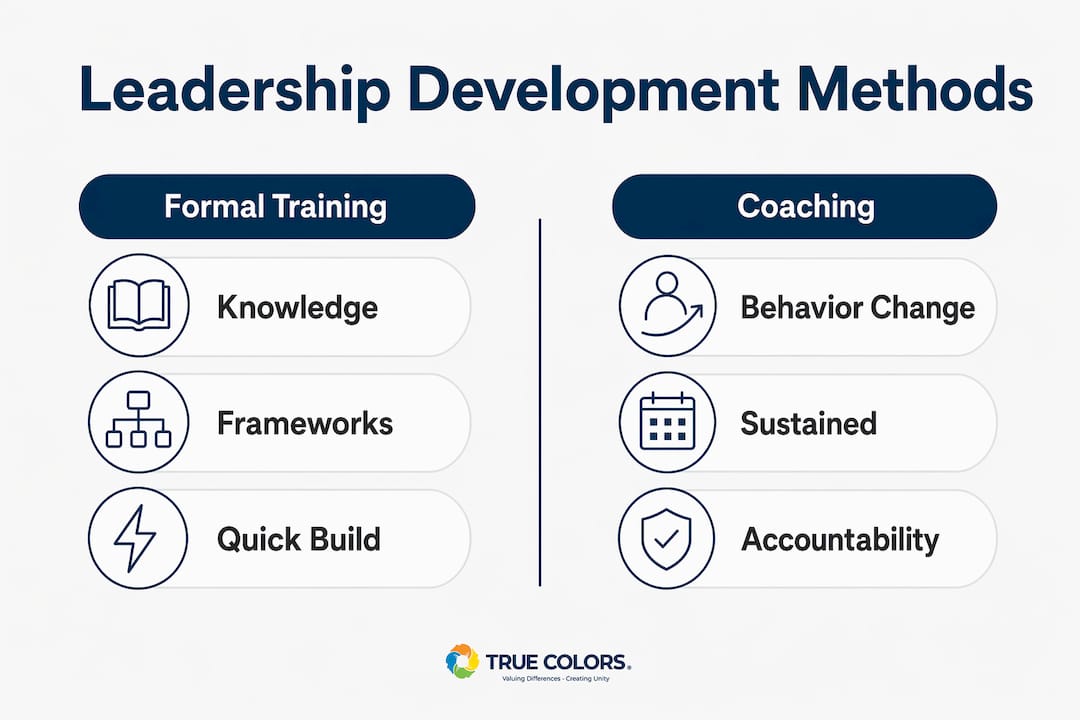
The 70/20/10 framework for leadership development assigns 70% of learning to on-the-job experience, 20% to relationships and feedback, and 10% to formal training. Coaching sits at the intersection of all three, but its most critical role is reinforcing the 10% so it does not evaporate. Training builds knowledge while coaching translates it into application. Without that translation layer, most leadership training produces awareness without behavior change.
Why training alone rarely sticks
A leader can complete a two-day workshop on psychological safety, understand the research, and return to their team on Monday, only to behave exactly as they did the week before. This is not a failure of intelligence or intention. It is a failure of reinforcement. The gap between knowing and doing is where most leadership development investment is lost. Coaching closes that gap by creating a structured accountability relationship tied directly to the leader’s real work context.
The combined approach in practice
The strongest outcomes in sustained behavior change come from combining leadership training with coaching. A practical sequence looks like this: leaders complete a structured training program to build a shared framework and vocabulary, then enter a coaching engagement where they apply those frameworks to specific challenges they are currently facing. The coach does not re-teach the content. The coach holds the leader accountable for using it.
Pro Tip: Schedule the first coaching session within two weeks of completing any leadership training program. The longer the gap, the more the training fades. Coaching is most effective when the learning is still active.
Truecolorsintl’s approach to building leadership development curriculum reflects this exact sequence, connecting behavioral frameworks with ongoing reinforcement rather than treating training as a standalone event.
How do organizations get the most out of leadership coaching?
Translating coaching research into organizational practice requires deliberate design. The following sequence reflects what high-performing organizations do differently when deploying coaching at scale.
-
Define behavioral outcomes before selecting a coach. Identify the specific leadership behaviors the organization needs to see change. These become the coaching goals. Without this step, coach selection becomes a personality match rather than a performance investment.
-
Select coaches based on fit and credentialed methodology. Coach-coachee fit predicts outcomes. Use a structured selection process that includes a trial session. Organizations like Eisemann Consulting document how deliberate coach matching drives measurably stronger leadership results.
-
Set engagement duration with milestones. Six to twelve months is the standard range for meaningful behavior change. Shorter engagements often produce awareness without the repetition needed to change habits. Build in formal check-ins at 90-day intervals.
-
Integrate coaching with culture, not just performance reviews. Coaching supports the evolution of leadership identity and cultural alignment. When coaching goals mirror the organization’s stated values and observable behaviors, the impact extends beyond the individual leader to the team and department level.
-
Measure retention and engagement as coaching outcomes. Well-structured coaching programs show an average ROI of 529% when accounting for productivity and retention benefits. That figure reflects the downstream effect of better managers. People leave managers, not companies, and coaching reduces voluntary attrition by improving the quality of day-to-day management behavior.
Culture is not what is said. It’s what is repeated.” When coaching reinforces the behaviors an organization claims to value, it becomes one of the most powerful culture-building tools available.
Coaching also serves as ongoing support that adapts to evolving workplace challenges. A leader navigating a team restructure, a new reporting relationship, or a shift in organizational strategy benefits from a coaching relationship that can flex with those changes rather than a fixed training curriculum that cannot.
Key takeaways
Leadership coaching works because it combines behavioral science, goal specificity, and sustained accountability into a process that training and mentoring cannot replicate alone.
| Point | Details |
|---|---|
| Evidence-backed effectiveness | Coaching produces a Hedges’ g ≈ 0.58 effect size, with 20 to 40% improvement in goal execution. |
| Goal specificity drives results | Specific, measurable behavioral goals are the single strongest predictor of coaching success. |
| Organizational alignment matters | Cultures that reward the behaviors being coached amplify outcomes; misaligned cultures undermine them. |
| Training plus coaching outperforms either alone | Coaching translates training knowledge into sustained on-the-job behavior change. |
| ROI extends beyond the individual | Well-structured programs average 529% ROI through productivity gains and reduced voluntary attrition. |
What I’ve learned about why coaching transforms leaders
I have worked with enough organizations to know that the most common mistake is treating coaching as a reward for high performers or a corrective measure for struggling ones. Both framings miss the point. Coaching works best when it is positioned as a normal part of how leaders grow, not as a signal that something is either exceptional or broken.
The leaders I have seen benefit most from coaching share one trait: they arrive with a genuine question they cannot answer alone. Not a vague desire to “be better,” but a specific tension they are living with. How do I give honest feedback without damaging trust? How do I hold my team accountable without micromanaging? Those specific questions create the traction that makes coaching worth the investment.
I also think the organizational environment piece is underestimated. You can have a world-class coach and a motivated leader, and still see minimal change if the culture rewards the old behaviors. Coaching does not happen in a vacuum. It happens inside a system. When Truecolorsintl works with organizations on corporate coaching solutions, the first conversation is always about alignment. What does the organization reinforce day-to-day? That answer shapes everything that follows.
The leaders who dismiss coaching as too soft or too slow are usually the ones who have experienced it poorly. Vague goals, mismatched coaches, no organizational follow-through. That is not a coaching failure. That is a design failure. When the conditions are right, coaching is one of the most precise leadership development tools available.
— Theresa Stairs
Build stronger leaders with Truecolorsintl

Truecolorsintl helps organizations move beyond one-time training events and build the conditions where leadership coaching sticks. Through the Connected Leadership Program and broader leadership development programs, Truecolorsintl connects behavioral frameworks with ongoing reinforcement, so the progress leaders make in coaching sessions shows up in their day-to-day team leadership. If your organization is ready to align coaching goals with its culture and achieve measurable behavior change, Truecolorsintl has the tools and experience to make it happen.
FAQ
What is leadership coaching and how does it differ from mentoring?
Leadership coaching is a structured, goal-focused relationship designed to improve specific leadership behaviors through accountability and reflection. Mentoring provides career guidance and organizational context but does not typically target measurable behavior change with the same precision.
How long does leadership coaching take to show results?
Most research supports a six to twelve-month engagement for sustained behavior change. Shorter programs can build awareness but rarely produce the habit-level shifts that affect team performance and retention.
Does leadership coaching improve employee retention?
Yes. Managers who receive coaching in feedback delivery and obstacle removal reduce voluntary attrition on their teams. Research shows well-structured coaching programs average 529% ROI when productivity and retention benefits are included.
What makes leadership coaching fail?
Coaching fails most often due to vague goals, poor coach-coachee fit, or an organizational culture that rewards behaviors the coaching is trying to change. All three conditions are addressable with deliberate program design before the engagement begins.
How does leadership coaching support organizational culture?
Coaching reinforces the observable behaviors that define a culture. When coaching goals align with the organization’s stated values and reward systems, individual leader development compounds into team-level and department-level culture change over time.