
Culture add hiring means recruiting people who share an organization's core values while bringing new perspectives, skills, or ways of thinking that expand what the team can do. It matters because homogenous teams plateau while diverse ones innovate and outperform. Any HR leader ready to move past "would they fit in" should start with a defined cultural baseline, then build the hiring framework detailed below.
TL;DR:
- Defining a clear cultural baseline helps organizations hire for specific gaps aligned with core values, preventing hiring for difference without purpose.
- Using structured, contribution-focused job descriptions and objective scoring rubrics reduces bias and ensures consistency in evaluating culture add potential.
- Asking targeted interview questions about diverse perspectives and problem-solving demonstrates whether a candidate can genuinely expand the team's capabilities.
- Onboarding must invite input from culture add hires early and set milestones that promote unique contributions, rather than confirming conformity.
- Implementing a behavior-based assessment system and ongoing leadership training sustains culture add practices across hiring and team development.
Table of Contents
- What Is Culture Add Hiring vs. Culture Fit?
- The Business Case: Why Culture Add Hiring Drives Real Results
- Building a Hiring Framework That Actually Operationalizes Culture Add
- Interview Questions That Reveal Culture Add Potential
- Reducing Bias with Objective Assessments and Scoring
- Onboarding Culture-Add Hires So They Actually Contribute
- How True Colors International Puts Culture Add Into Practice
- Why Most Culture Add Advice Skips the Hard Part
- Build a Culture Add Hiring Program That Holds Up Over Time
- Sources
What Is Culture Add Hiring vs. Culture Fit?
Culture fit hiring asks whether a candidate resembles the people already on the team. Culture add hiring asks a different question: does this person hold your non-negotiable values while bringing something the team currently lacks? The distinction sounds subtle. In practice, it changes who gets hired.
Culture add focuses on recruiting what practitioners call "culture contributors," people who uphold an organization's core values while adding new perspectives and capabilities the existing team doesn't have. That last part is the piece most hiring managers skip. Culture add only works when it sits on top of a defined baseline, not instead of one.

Consider two candidates for a marketing role. One has run the exact playbook your team already runs. The other has never worked in your industry but has scaled community-led growth at a company nothing like yours, and shares your organization's commitment to direct customer feedback. The second candidate is culture add. The first is culture fit wearing a nicer suit.
A workable definition splits into two parts:
- Values alignment covers behaviors and principles that don't bend, regardless of who is hired.
- Contribution potential covers the skills, backgrounds, and viewpoints a candidate brings that the current team doesn't already have.
Skip the first part and culture add becomes an excuse to hire for difference alone, with no anchor to what the organization actually stands for.
The Business Case: Why Culture Add Hiring Drives Real Results
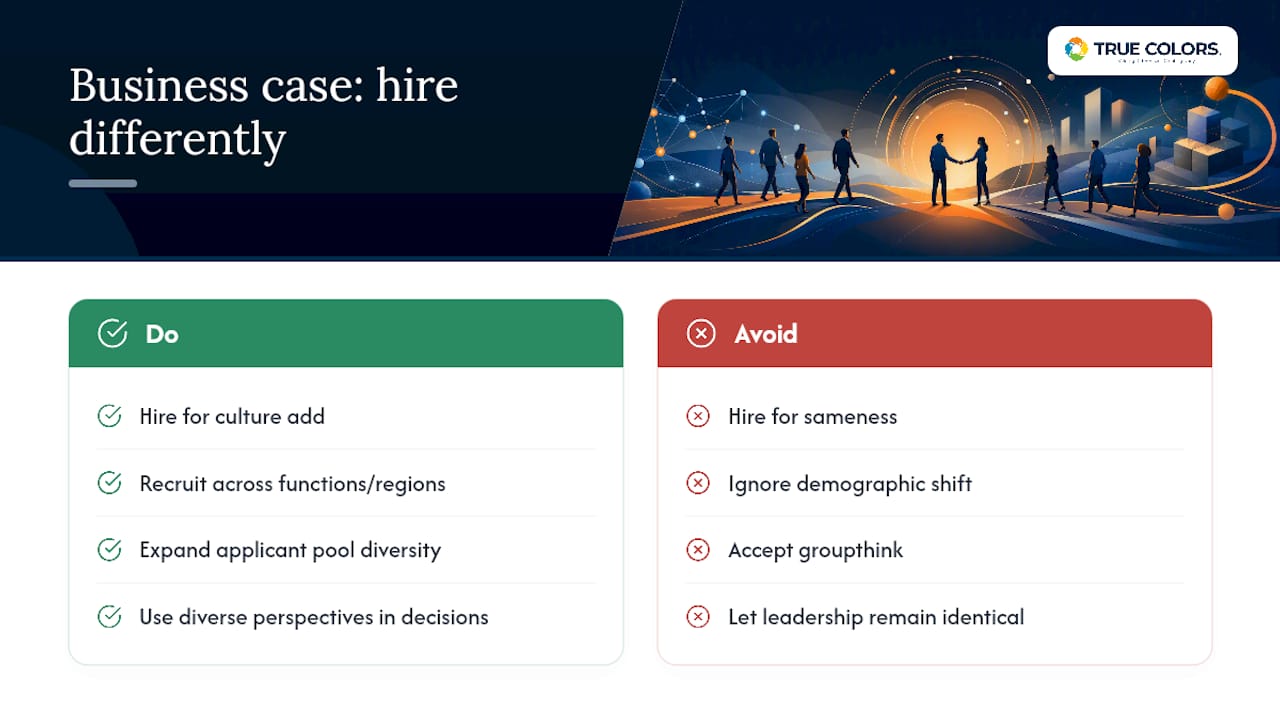
The strongest argument for culture add hiring isn't philosophical. It's operational. Teams that only hire people who think alike tend to make the same mistakes together, miss the same blind spots, and solve problems with the same three approaches on repeat.
Statistic Callout: Organizations with diverse teams are more likely to outperform their peers on innovation and financial performance, according to research summarized by McKinsey. The pattern holds across industries and team sizes, which suggests the advantage comes from the mechanism itself, not from any single sector's dynamics.
Culture add expands what a team can see and do. A hire who came up through a different function, a different region, or a different customer segment brings pattern recognition your current team doesn't have. That shows up in product decisions, in customer conversations, in how a team spots a risk three competitors missed.
The demographic shift underway makes this more urgent than optional. Post-millennial cohorts are on track to be the most diverse and best-educated generation in the workforce's history. Organizations still hiring for sameness are narrowing their applicant pool right as that pool is becoming more varied.
Ignore culture add and the risk isn't neutral. It's groupthink, slower innovation cycles, and a leadership bench that looks and thinks like it did five years ago.
Building a Hiring Framework That Actually Operationalizes Culture Add
Most culture add advice stops at "look for diverse candidates who share your values." That's a sentiment, not a process. HR leaders need a sequence they can run every quarter, not a mindset to hold onto.
- Define the cultural baseline first. Write down the three to five behaviors and values that will not change regardless of who you hire. If you can't name them specifically, defining corporate culture and values before you touch a job description will save you from hiring for difference with no anchor.
- Run a gap audit. Map your current team's skills, perspectives, and backgrounds against where the business is headed. Where is everyone the same age, the same background, the same functional history? That's your gap, and it tells you exactly what to hire for next.
- Rewrite job descriptions around contribution, not resemblance. If your team is weak in data fluency, name that explicitly in the posting instead of writing generic language that only attracts people who look like your last five hires.
- Widen your sourcing channels. Referral-heavy pipelines replicate your existing team. Add sourcing channels, partnerships, and outreach that reach candidates outside your usual network.
- Structure the interview panel and process before you post the role. Decide who sits on the panel, what each interviewer scores, and how long the process takes, before candidates start applying.
Harver's research on implementing culture add outlines a similar sequence: evaluate your current culture, review your stated values against actual behavior, hire deliberately for value alignment, and shift the hiring mindset organization-wide rather than leaving it to one hiring manager.
The sourcing and job description work connects directly to how talent acquisition aligns with culture more broadly. Culture add hiring isn't a separate initiative bolted onto recruiting. It's recruiting done with a sharper lens.
Pro Tip: When you name a specific capability gap in a job posting, watch what happens to your applicant pool. Naming "we need someone who can build our first data function" attracts a completely different candidate than "strong analytical skills preferred." Specificity does the sourcing work for you.
Interview Questions That Reveal Culture Add Potential
Standard interview questions surface culture fit almost by accident. "Tell me about a time you worked on a team" invites candidates to describe how well they blended in. Culture add questions ask something different: how would you challenge or expand what we already do?
LinkedIn's guidance on assessing culture add offers sample questions and practical framing built around this exact shift. Questions worth adapting into your own rubric:
- "Describe a time you disagreed with a team's approach and how you handled it."
- "What's a perspective or skill you bring that your last team didn't have?"
- "Tell me about a project where your background gave you an angle no one else on the team had."
- "How do you build trust with a team before you've earned a track record with them?"
- "What's a value you won't compromise on, even under pressure to move fast?"
A strong answer to the second question names something specific: a technical skill, an industry background, a way of framing problems. A weak answer stays vague ("I bring fresh energy") with no concrete example behind it. Strong candidates also describe how they introduced a new idea without steamrolling the existing team, which signals they can add without fragmenting.
Follow up every answer with "what happened next?" Candidates who talk about influence in the abstract usually haven't actually done it.
Reducing Bias with Objective Assessments and Scoring
Interview instinct is where affinity bias hides. Hiring managers gravitate toward candidates who remind them of themselves, and culture add conversations can become a backdoor for the same bias with better branding. Objective structure is the fix.
Build a rubric that separates two categories, since treating values and contribution as one blended score is where most culture add processes quietly break down:
- Values alignment, scored pass/fail. This is non-negotiable and shouldn't be averaged against anything else.
- Contribution potential, scored on a graded scale that rewards specific, differentiated skills and perspectives.
Practical frameworks recommend competency-based interviews and standardized scoring as the core defense against affinity bias, paired with a short panel calibration session before interviews begin.
Calibration doesn't need to be elaborate. Gather the panel for 20 minutes, walk through two or three past candidate profiles together, and agree on what a 3 versus a 4 looks like on the contribution scale. Calibration sessions like this measurably reduce affinity bias and raise inter-rater reliability across the panel.
Work samples and structured psychometric assessments fit best as a complement to interviews, not a replacement. They're most useful for surfacing contribution potential objectively, since a portfolio or a structured exercise reveals a skill gap or a strength an interview conversation might miss entirely. A competency-based hiring playbook can help HR teams build these rubrics without starting from a blank page.
Onboarding Culture-Add Hires So They Actually Contribute
Hiring for culture add and then onboarding for conformity cancels out the entire point. New hires brought in specifically to expand the team's thinking need an onboarding process that invites their perspective early, not one that spends 90 days teaching them to blend in.
- Repeat the baseline values explicitly, then invite input. New hires should hear what won't change in week one, followed directly by a real invitation to question how things get done.
- Assign a peer partner, not just a manager. A peer contact gives the new hire a lower-stakes way to test ideas before bringing them to the whole team.
- Set 30/60/90 contribution milestones, not just ramp-up milestones. Ask what they'd change by day 60, not just whether they've learned the systems.
- Build in structured feedback loops. Weekly manager check-ins in the first quarter surface friction while it's still small and easy to address.
Behavioral onboarding practices built around peer partnerships and early contribution goals help culture-add hires integrate without diluting their perspective into silence. The goal isn't a smooth first 90 days. It's a new hire who's said something useful by day 60 that no one else on the team would have thought to say.
How True Colors International Puts Culture Add Into Practice
True Colors International built its behavior-based assessments specifically to make culture actionable instead of aspirational. Organizations use these tools to define the baseline values described earlier, then apply talent-alignment consulting to translate that baseline into hiring criteria, interview rubrics, and scoring practices that hold up under scrutiny.
The work doesn't stop at the hire. True Colors' onboarding programs and ongoing reinforcement systems help new employees move from personal awareness of team dynamics to real, aligned contribution, backed by hiring practices focused on culture and contribution rather than resume-matching. For HR leaders who've defined a baseline but need help operationalizing gap audits, panel calibration, or scoring design, that's exactly where an outside system earns its place.
Why Most Culture Add Advice Skips the Hard Part
The conventional advice on culture add hiring stops at intention. Hire for diversity of thought, the articles say, and stay open-minded in interviews. That advice isn't wrong, but it treats culture add as an attitude rather than a program, and attitudes don't survive a hiring manager's Tuesday afternoon when they're down to the wire on headcount.
What the research actually supports is narrower and more useful: culture add only works when it's anchored to a defined baseline and measured with the same rigor as any other hiring criterion. Skip the baseline and you're hiring for difference with no compass. Skip the scoring rubric and you're back to gut-feel interviews with a diversity label attached.
If there's one place to start, it's the gap audit. Most organizations haven't actually named what their team is missing. They jump straight to sourcing broader candidate pools without first identifying which specific capability, perspective, or background gap they're solving for. That step takes an afternoon and changes every decision that follows it, from job description language to interview questions to who sits on the panel.
Culture doesn't move because someone wrote a values statement. It moves because behavior, hiring included, gets repeated consistently enough to become the norm.
— Theresa
Build a Culture Add Hiring Program That Holds Up Over Time
Most HR teams can write the culture add philosophy in an afternoon. Building the baseline, the rubric, and the calibration process that make it stick across every hiring manager and every quarter is the harder work, and it's exactly where Truecolorsintl operates. Rather than leaving culture add hiring to individual interviewer instinct, Truecolorsintl gives organizations a behavior-based system that defines values, trains hiring teams to score consistently, and reinforces the standard long after the job posting closes.
That system extends past the hire itself. Organizations working with Truecolorsintl's Connected Leadership Program get the leadership alignment and communication training that keeps culture-add hires contributing instead of quietly assimilating within their first year. If your organization is ready to move from a values statement to a hiring program that actually holds leaders and panels accountable, start by reviewing True Colors' consulting and training solutions to see which engagement fits your team's current gaps.
Sources
- What are cultural fit and cultural add?
- Why diversity matters
- How to assess for culture add | LinkedIn
- Culture Fit Versus Culture Add: Hiring For Growth