
Yes. Higher organizational trust reliably drives stronger engagement, lower turnover, higher productivity, and higher revenue. This is not a soft claim dressed up in HR language. It is measurable, and the measurement has gotten a lot more precise over the past several years.
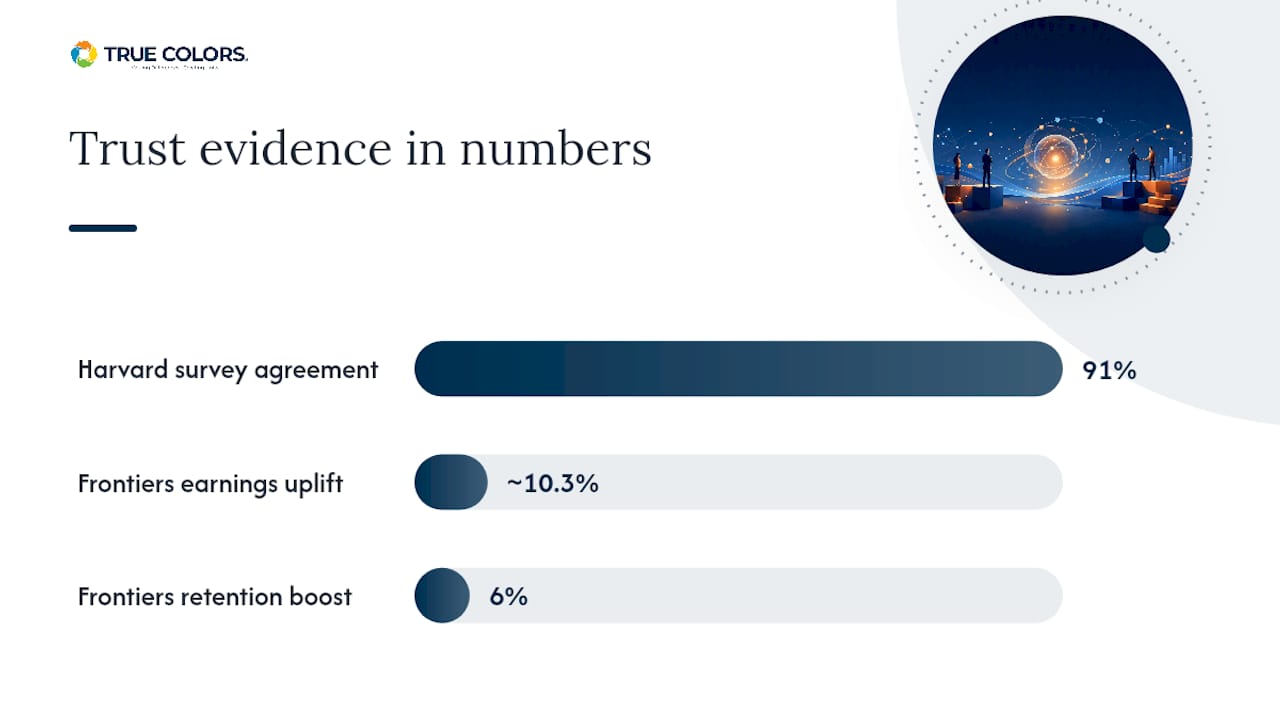
A 2023 executive survey found that 91% of business executives agree their ability to earn and maintain trust improves the bottom line, and half of them strongly agree. That is not a fringe opinion inside HR departments. It is a near-consensus view among the people who own the P&L.
The research backing that consensus is specific. A field study on organizational trust found that employees in the highest trust quintile earn roughly 10.3% more than those in the middle quintile, and a targeted intervention raised trust by about 6% while improving retention in the tested division. Separate working-paper research shows trust amplifies the return on intangible investments, particularly in knowledge-intensive industries where good management alone isn't enough to unlock productivity gains.
When trust rises inside an organization, leaders should expect movement in four areas:
- Employee engagement and discretionary effort climb because people stop protecting themselves and start contributing ideas.
- Retention improves as the emotional cost of leaving a trusted environment goes up.
- Productivity per employee increases, especially in roles that depend on judgment rather than routine tasks.
- Customer loyalty and lifetime value strengthen, because trusted organizations make fewer of the small breaches that erode repeat business.
Key Takeaways
Organizational trust is a measurable driver of engagement, retention, productivity, and revenue, and it moves through specific, coachable leader behaviors rather than through slogans or values statements.
| Point | Details |
|---|---|
| Trust drives measurable outcomes | 91% of executives agree trust improves the bottom line, and field data ties trust gains directly to retention. |
| Mechanisms matter more than messaging | Information flow, delegation, discretionary effort, and customer trust are the real levers behind KPI movement. |
| Measure with a dedicated trust index | Use short pulse surveys on integrity, consistency, and psychological safety, run quarterly, segmented by team. |
| Trust has limits without governance | Interorganizational trust can plateau or reverse without enough oversight, especially in buyer-supplier dependency. |
| Truecolorsintl builds the system | Truecolorsintl's leadership development and employee experience survey programs turn this research into a coached, measured 90-day and 12-month rollout. |
Table of Contents
- How Trust Affects Business Outcomes: What the Evidence Shows
- What Mechanisms Turn Trust Into Business Results?
- Which KPIs Move When Organizational Trust Improves?
- How Do You Measure Trust Inside an Organization?
- What Should Leaders and HR Do First to Build Trust?
- What Erodes Trust and How Do You Fix It Fast?
- Where Does Trust Deliver the Biggest Return, and Where Does It Plateau?
- How Does a Culture System Turn Trust Research Into Results?
- Why External Stakeholder Trust Matters as Much as Internal Trust
- Building Trust Across Culturally Diverse and Global Teams
- Using Organizational Network Analysis to Diagnose Trust Gaps
- Why Trust Should Be a 2026 Leadership Priority, Not a Soft Initiative
- How Truecolorsintl Helps Leaders Put This Research Into Practice
- Frequently Asked Questions
- Sources
How Trust Affects Business Outcomes: What the Evidence Shows
The clearest evidence comes from three different angles: executive sentiment, field intervention data, and firm-level financial analysis. Each one lands on the same conclusion from a different direction, which is what makes the case hard to dismiss as correlation dressed up as causation.
Start with scale. The Harvard-published trust survey surveyed business executives directly and found 91% agreement that trust improves the bottom line. That figure matters because it reflects belief at the level where capital allocation decisions get made. When 91% of executives already believe this, the harder question for HR and culture leaders isn't "how do we convince the board this matters," it's "how do we prove it's happening here."
The Frontiers field study answers the "does this actually work" question with a real intervention, not just a survey. That's a controlled comparison inside a live business, not a hypothetical model.
Firm-level financial research adds a third layer. A bi-directional study of trust and firm performance used an objective trust proxy drawn from company filings and found that current trust predicts future performance, and current performance predicts future trust growth. That two-way relationship is worth sitting with, because it means trust isn't just an input leaders fund once. It's a resource that compounds or decays depending on how performance is handled after it improves.
| Source | Headline Finding | Practical Implication for Leaders |
|---|---|---|
| Harvard trust survey | 91% of executives agree trust improves the bottom line | Board-level buy-in for trust initiatives is unlikely to be the obstacle |
| Frontiers field study | Top trust quintile earns ~10.3% more; 6% trust gain improved retention | Targeted interventions produce measurable division-level results within months |
| Productivity working paper | Trust amplifies returns on intangible investment | Trust-building pays off most in knowledge-intensive, judgment-heavy roles |
| Firm-level bi-directional study | Trust and performance predict each other over time | Early wins in trust need reinforcement or the gains reverse |
What Mechanisms Turn Trust Into Business Results?
Trust doesn't change a P&L directly. It changes behavior first, and behavior changes systems, which is where the financial results eventually show up. Understanding the mechanism matters because it tells leaders where to intervene instead of just hoping culture surveys improve.
Four mechanisms do most of the work:
- Information flows more freely. When people trust leadership, they surface bad news early instead of burying it. A manufacturing supervisor who trusts their plant leader will report a quality problem the day it appears, not the week before the audit.
- Delegation replaces monitoring. Trusted teams need less oversight, which frees management time and cuts the administrative drag of approval chains. A regional sales director with a trusted team can approve discount authority at the account level instead of routing every deal through headquarters.
- Discretionary effort and voice increase. Employees who trust the organization contribute ideas they'd otherwise keep to themselves. A frontline employee who trusts that raising a process flaw won't get them blamed will actually raise it.
- Customer relationships deepen. Internal trust shows up externally, because employees who trust their employer represent it more consistently to customers. A support agent operating in a high-trust culture is more likely to make a judgment call that keeps a customer, rather than defaulting to a rigid script out of fear of being second-guessed.
Picture a simple chain: trust changes daily behaviors, those behaviors show up in operational KPIs, and the KPIs eventually surface in financial outcomes. Skip a link in that chain, and a culture initiative becomes a slogan instead of a system.
Which KPIs Move When Organizational Trust Improves?
Trust is often treated as unmeasurable, which is precisely the mistake that keeps it out of quarterly business reviews. It maps to specific, trackable KPIs that fit inside existing dashboards.
| KPI | What Improvement Looks Like | Measurement Cadence | Benchmark |
|---|---|---|---|
| Employee engagement score | Upward trend on pulse survey composite scores | Quarterly or monthly pulse | Track trend, not a single absolute number |
| Voluntary turnover | Fewer regretted exits, especially among high performers | Monthly, rolling 12-month view | Compare against division and industry norms |
| Productivity per FTE | Output or revenue per employee rises without added headcount | Quarterly | Compare pre/post intervention within same team |
| Customer retention / LTV | Repeat purchase rate and account tenure both extend | Quarterly | Track cohort-based retention curves |
| Absenteeism | Unplanned absences decline | Monthly | Compare team-level trends over time |
Here's how the ROI framing works in practice. If a mid-sized division with 200 employees and 18% annual turnover reduces turnover by even a few points through a trust intervention, the savings show up in reduced recruiting, onboarding, and lost-productivity costs, all of which most HR teams already track. Pair that with the Frontiers study's finding that a 6% trust increase improved retention in a real division, and the business case writes itself: leaders don't need a new metric, they need to connect the trust intervention to the metric they already report on. A resource like 8 Ways to Retain Your Best People breaks down retention levers that align directly with this framing.
How Do You Measure Trust Inside an Organization?
Most organizations either skip measuring trust entirely or bury it inside a generic engagement survey where it gets diluted by unrelated questions. A short, dedicated trust index gets a cleaner signal.
- Leadership integrity: "Leaders here do what they say they will do." Rate 1 to 5.
- Consistent messaging: "What leadership tells my team matches what leadership tells other teams." Rate 1 to 5.
- Psychological safety: "I can raise a concern or mistake without fear of punishment." Rate 1 to 5.
- Follow-through on commitments: "Promises made during change initiatives are kept." Rate 1 to 5.
- Transparency of decisions: "I understand why major decisions get made, even when I disagree with them." Rate 1 to 5.
Run this as a short pulse, not a once-a-year census. Quarterly cadence works for most organizations, with a lighter monthly check-in during active change periods like a reorg or leadership transition. Segment results by team, geography, and job family. A trust score that looks fine at the company level can hide a division in crisis, particularly where remote or frontline teams report separately from headquarters staff.
Common measurement pitfalls to avoid:
- Treating a single annual survey as sufficient, when trust erodes and recovers faster than that cadence can catch.
- Averaging scores across very different job families, which flattens real problems in specific teams.
- Ignoring employee Net Promoter Score (eNPS) as a complementary signal alongside the trust index items above.
- Skipping organizational network analysis, which shows who employees actually go to for information versus who the org chart says they should trust.
A tool like Truecolorsintl's employee experience survey can structure this kind of measurement so results feed directly into leadership coaching rather than sitting in a slide deck nobody revisits.
What Should Leaders and HR Do First to Build Trust?
Trust-building fails most often because organizations treat it as an event instead of a phased system. A realistic playbook spreads action across three time horizons.
- First 30 days: Run a baseline trust pulse across the organization or a pilot division. Identify the two or three teams with the lowest scores and the specific drivers behind them.
- Next 90 days: Deliver leader coaching focused on the behaviors that moved the needle in the baseline data, typically consistency of messaging and follow-through on commitments. Pair coaching with a visible, low-risk decision where leadership demonstrates the new behavior publicly.
- 6 to 12 months: Re-measure trust against baseline, expand the intervention to additional divisions, and build trust metrics into standard performance review cycles so the work doesn't quietly disappear after the initial push.
Specific leader behaviors matter more than communication campaigns. Consistency between what a leader says in a town hall and what they actually reward in performance reviews builds more trust than any single announcement. HR policies need the same alignment: onboarding programs should model the transparency leaders claim to value, remote work guidelines should avoid surveillance-heavy monitoring that contradicts stated trust in employees, and performance reviews should reflect the same standards leadership applies to itself.
Cross-functional sponsorship matters here. A trust initiative that lives only inside HR rarely survives contact with a business unit leader who doesn't see it as their problem. Build in measurement gates, specific points where leaders review pulse data together, and flag quick wins early to keep momentum before the 6 to 12 month mark. Guidance from How to Hire People You Can Trust applies directly here, since hiring decisions set the trust baseline before onboarding even begins.
Pro Tip: Pick one visible, low-stakes decision in the first 90 days where leadership can demonstrate new behavior publicly. A single credible example does more for trust than a written values statement ever will.
Watch for change-management risks along the way. Rolling out a trust initiative without leadership modeling the target behavior first is the single most common way these programs stall. A resource like Leadership Team Trust Building Practices That Work covers the specific practices that separate initiatives that stick from ones that fade after the launch announcement.
What Erodes Trust and How Do You Fix It Fast?
Trust erosion tends to follow a small set of repeatable patterns. Recognizing them early is the difference between a quick correction and a multi-year rebuild.
- Mixed messages between what leadership says publicly and what actually gets rewarded or punished internally.
- Secretive decision-making, especially around layoffs, reorganizations, or compensation changes.
- Punitive monitoring of remote or hybrid employees, which signals distrust even when the stated intent is productivity tracking.
- Missed commitments, particularly promises made during change initiatives that quietly get dropped.
Each red flag needs a specific remediation path, not a generic apology tour:
- Mixed messages: The leader who caused the inconsistency should address it directly, not delegate the correction to HR. Short-term, acknowledge the gap publicly. Longer-term, build a review step where major announcements get checked against actual reward and discipline patterns before they go out.
- Secretive decisions: Increase the amount of context shared before a decision lands, even when the full rationale can't be disclosed. A short explanation of the decision-making process rebuilds more trust than a polished final announcement with no context.
- Punitive monitoring: Replace surveillance-heavy tools with outcome-based accountability. If a remote employee's output is strong, monitoring their keystrokes sends a signal that contradicts the results in front of you.
- Missed commitments: Track commitments made during change initiatives the same way you'd track a project deliverable, with an owner and a deadline, so they don't quietly disappear.
Consider a common scenario: a company shifts to hybrid work and installs activity-monitoring software on remote employees' laptops, framed internally as a "productivity visibility" measure. Engagement scores drop within a quarter, even among employees whose output hasn't changed. The remediation path isn't more communication about why the monitoring exists. It's removing the monitoring and replacing it with a results-based check-in cadence that actually reflects what leadership claims to value.
Where Does Trust Deliver the Biggest Return, and Where Does It Plateau?
The relationship between trust and performance is bi-directional, which is a more useful frame than treating trust as a one-way input. A firm-level analysis using MD&A filing data found that current trust predicts future performance, and current performance predicts future trust growth. That means an early win in a trust initiative needs reinforcement through visible results, or the gain can quietly reverse.
Trust's payoff also isn't uniform across industries. Productivity research shows trust amplifies returns on intangible investments most strongly in knowledge-intensive industries, where judgment, discretion, and information sharing carry more weight than in highly routinized operations. A software engineering team benefits more from a trust intervention than an assembly line running a fixed process, though even routinized environments see gains through lower absenteeism and better safety reporting.
There are limits worth naming honestly. A longitudinal B2B relationship study found trust boosts performance within the same period, but that positive effect can weaken across later relationship stages, meaning trust-building isn't a one-time investment that pays out indefinitely without reinforcement. Separate research on interorganizational trust found an inverted-U relationship in buyer-supplier contexts: trust that grows past a certain point without any oversight can create dependency risks that actually reduce performance, particularly when market uncertainty is low and one party becomes structurally reliant on the other.
Trust is not a dial you turn up indefinitely and expect linear returns. It behaves more like a relationship that needs periodic reinforcement, paired with enough structure that dependency doesn't quietly become vulnerability.
For leaders, this translates into a decision rule: prioritize trust-building investment in roles and relationships where judgment and information flow drive value, and pair high-trust arrangements with enough governance that neither side becomes structurally exposed if the relationship changes.
How Does a Culture System Turn Trust Research Into Results?
Evidence is only useful if an organization has a repeatable way to act on it. A behavior-to-action system takes the research above, the productivity data, the retention findings, the mechanism chain, and converts it into a sequence leaders can actually run.
The process generally follows five steps:
- Diagnose current trust levels and specific behavior gaps using a structured assessment rather than a generic engagement survey.
- Prioritize the two or three behaviors most likely to move the needle, instead of trying to fix everything simultaneously.
- Coach leaders directly on those specific behaviors, since culture change starts at the leadership layer or it doesn't start at all.
- Measure progress against the original baseline on a fixed cadence, not an annual afterthought.
- Reinforce the gains through ongoing check-ins, so early wins compound instead of fading once attention moves elsewhere.
Picture this as a loop rather than a straight line: diagnosis feeds prioritization, prioritization feeds coaching, coaching feeds measurement, and measurement feeds back into diagnosis for the next cycle. Organizations that run this loop consistently tend to see movement in engagement scores and retention within two to three quarters, with productivity gains following as the behavior changes solidify into habit.
Pro Tip: Don't wait for a perfect baseline before starting. A rough diagnosis paired with a fast first coaching cycle beats a flawless survey that takes six months to analyze.
Explore examples of this process in action through True Colors' case studies, which walk through how organizations have applied the diagnose-prioritize-coach-measure-reinforce sequence to real teams.
Why External Stakeholder Trust Matters as Much as Internal Trust
Trust inside an organization is only half the equation. Partners, suppliers, and investors form judgments about a company's reliability that directly affect deal terms, contract flexibility, and capital costs.
A supplier who trusts a buyer's payment discipline and forecasting accuracy will extend better terms and prioritize that account during supply shortages. An investor who trusts management's transparency during downturns is less likely to demand punitive covenants during the next round of financing. A distribution partner who trusts a manufacturer's quality control will take on more inventory risk, directly affecting how fast products reach customers.

This external trust often mirrors internal trust more closely than executives expect. Employees who don't trust leadership rarely represent the company convincingly to external partners, and inconsistent internal messaging tends to leak into vendor negotiations and investor updates as vague or contradictory communication. Building external trust starts with the same behaviors that build internal trust: consistency, transparency about limitations, and follow-through on commitments made during negotiations.
Building Trust Across Culturally Diverse and Global Teams
Trust-building tactics that work inside a single-culture, single-location team often fail when applied unchanged to a global or culturally diverse workforce, because the signals people associate with trustworthiness aren't universal.
Direct feedback that reads as honest and trust-building in one cultural context can read as disrespectful or destabilizing in another. Leaders managing distributed teams need to calibrate communication style by context rather than applying a single global playbook. A few interventions matter specifically for diverse and global teams:
- Localize feedback norms rather than exporting a single headquarters style across every region.
- Build in async trust signals for distributed teams, since trust built primarily through in-person interaction disadvantages remote or overseas colleagues who rarely get facetime with leadership.
- Train leaders explicitly on cross-cultural trust cues, since assumptions about what counts as transparency or follow-through vary by region.
- Create structured, recurring touchpoints for global teams so trust isn't accidentally concentrated among employees who happen to share a time zone with leadership.
Programs like those referenced in Why DEIB? Because Your People Are Your Greatest Asset speak directly to this dynamic, since inclusion and trust reinforce each other in genuinely diverse organizations.
Using Organizational Network Analysis to Diagnose Trust Gaps
Standard engagement surveys tell you how people feel about trust in the aggregate. They rarely show you where the actual trust network breaks down, which is a structural problem, not just a sentiment problem.
Organizational network analysis (ONA) maps who employees actually turn to for information, decisions, and support, independent of what the formal org chart says should happen. It frequently reveals that trust flows through a handful of informal connectors rather than through the management hierarchy, and that some teams are structurally isolated from the information and support networks that drive performance.
Combining ONA with the trust index items covered earlier gives a more complete diagnostic. The survey scores show how trust feels; the network map shows where it structurally exists or doesn't. A team with strong survey scores but poor network connectivity might be trusting their immediate manager while remaining cut off from cross-functional information flows that matter for their actual output. This combination approach, sentiment plus structure, gives HR and leadership a much sharper picture of where to target coaching and intervention resources than either method alone.

Why Trust Should Be a 2026 Leadership Priority, Not a Soft Initiative
The research on trust and performance keeps landing on the same uncomfortable truth for leaders who prefer clean, linear metrics: trust behaves like a system, not a lever you pull once. It compounds when reinforced, and it decays quietly when leaders assume a single town hall or values statement locks in the gain permanently.
What gets underestimated most is the speed at which trust erosion outpaces trust-building. A single missed commitment or a poorly explained layoff can undo months of consistent leadership behavior, while building trust back up takes deliberate, repeated effort measured in quarters, not weeks. Leaders who treat trust measurement as an annual survey question are working with data that's already stale by the time they act on it.
The organizations that get this right treat trust the way they'd treat any other operational system: diagnose it, prioritize the highest-leverage fixes, coach the specific behaviors that move it, measure on a real cadence, and reinforce the gains before attention moves to the next initiative. That's a culture-as-system approach, not a culture-as-poster approach, and the research increasingly shows it's the only version that produces measurable ROI. If your organization is weighing where to start, the honest answer is smaller than most leaders expect: diagnose one team, run a focused three-month intervention, and measure it against a real baseline before scaling anything wider.
How Truecolorsintl Helps Leaders Put This Research Into Practice
Every mechanism covered here, information flow, delegation, discretionary effort, customer trust, traces back to specific leader behaviors that can be coached and measured. That's the gap Truecolorsintl was built to close: turning trust research into a repeatable operating system instead of a one-time workshop.

The work maps directly onto the playbook above. Leadership development programs target the consistency and follow-through behaviors that the research ties to trust gains. Employee experience surveys give HR a structured way to run the trust index and pulse cadence covered earlier, rather than building one from scratch. Behavior-to-action coaching connects diagnosis to leader-level change, so the trust score movement actually reflects something leaders did differently, not just a seasonal survey fluctuation.
If your organization is ready to move from awareness to measurable action, the Connected Leadership Program is a practical starting point built around exactly this sequence: diagnose, prioritize, coach, measure, reinforce. You can also explore the full range of consulting and coaching programs to find the entry point that fits your organization's current stage, and request a conversation about running a pilot with one team before scaling further.
Frequently Asked Questions
Does higher trust always mean higher profit? Trust reliably correlates with higher productivity, retention, and revenue, but the strength of the effect varies by industry. Research on trust and intangibles shows the biggest gains appear in knowledge-intensive work where judgment and information sharing drive value.
How long does it take to improve organizational trust? Field data from a real intervention showed a measurable trust increase and retention improvement within months, not years. Sustained gains generally require reinforcement over 6 to 12 months to avoid reverting to baseline.
Can too much trust hurt performance? In certain interorganizational contexts, yes. Research on buyer-supplier relationships found an inverted-U pattern where trust without enough oversight created dependency risk that reduced performance. Internal organizational trust doesn't show the same ceiling as clearly, but pairing trust with reasonable governance still matters.
What's the fastest way to start measuring trust? Run a short, dedicated trust index, five items covering integrity, consistency, psychological safety, follow-through, and transparency, on a quarterly cadence, segmented by team rather than averaged company-wide.
How does remote work affect trust-building? Remote and hybrid arrangements make trust more fragile if leaders default to activity monitoring instead of outcome-based accountability. Async communication and structured, recurring touchpoints matter more for distributed teams than for co-located ones.
This article provides general information based on publicly available research and is not a substitute for professional organizational or legal advice specific to your company's situation.
Sources
- The Neuroscience of Organizational Trust and Business Performance: Findings From United States Working Adults and an Intervention at an Online Retailer
- Trust Survey: key findings and lessons for business executives
- Trust, intangibles and productivity (WP053)
- Trust and firm performance: A bi-directional study