
How to identify hidden culture problems in your organization
Culture is not what is posted on the wall. It is what people actually do when no one is watching, and the gap between those two realities is where most organizational dysfunction lives. To identify hidden culture problems in your organization, you need to stop asking whether employees believe in your values and start measuring whether your leaders and teams consistently behave in alignment with them.
The most reliable early warning system is behavioral, not attitudinal. Watch for these signals:
- Decisions get made outside formal channels. When the real choices happen in hallways or private messages rather than in meetings, invisible power channels have replaced the official structure.
- New hires leave within their first year at a higher rate than tenured employees. This pattern almost always points to a gap between what candidates were told and what they actually experienced.
- Teams report very different experiences of the same organization. A company-wide engagement score of 3.9 can mask one team at 4.7 and another at 2.4. Those are two different cultures, not one.
- Feedback flows upward but rarely changes anything. When employees stop raising concerns, it is usually because they learned, through experience, that doing so carries risk.
- Stated priorities and actual resource allocation do not match. Leaders say innovation matters, but every budget conversation defaults to protecting existing programs.
The diagnostic principle here is variance, not average. Aggregating culture data to an organization-wide score produces a number that is easy to report and nearly useless for intervention. The problems live in the outliers.
Pro Tip: Before running any culture survey, map your team-level distribution first. Identify the five highest-performing and five lowest-performing teams by engagement and attrition. The gap between them tells you more about your culture than any company-wide average.
Effective diagnosis also requires multi-dimensional data collection: behavioral signals (recognition cadence, meeting participation, response times), sentiment data from pulse surveys, and outcome data like attrition and internal mobility rates. Collecting all three, reported at the team and manager level rather than the company level, is what separates a useful culture evaluation from a reporting exercise.
How dysfunctional behavioral norms quietly erode your culture
Every organization has norms, the unwritten rules that govern how people actually behave. Most of them were never decided consciously. They accumulated through repetition: a leader who interrupted people in meetings, a team that learned to stay quiet when a senior executive was in the room, a process that rewarded speed over accuracy until accuracy stopped mattering. Over time, these patterns calcify into expectations, and expectations become culture.
The problem is that dysfunctional norms rarely announce themselves. They develop gradually, often under the cover of language that sounds reasonable. "We move fast here" can mean healthy urgency or it can mean that no one has time to think carefully, and the difference only becomes visible when something breaks. Recognizing the distinction requires looking at patterns across teams and over time, not at individual incidents.
Culture is not what is said. It is what is repeated. The norms that shape an organization are not written in the employee handbook — they are written in the behaviors that go unchallenged, the decisions that get rewarded, and the conversations that never happen.
Dysfunctional norms tend to cluster around three areas. First, collaboration norms: teams that have learned to protect their own work rather than share it, often because past collaboration was not recognized or was actively punished. Second, conflict norms: organizations where disagreement is treated as disloyalty, so problems get buried rather than resolved. Third, innovation norms: environments where proposing something new carries more career risk than maintaining the status quo.
Cultural barriers in multicultural teams add another layer of complexity. Communication style differences, hierarchical attitudes, and conflicting decision-making norms can all produce behaviors that look like disengagement or resistance when they are actually the product of mismatched expectations. A leader who interprets silence as agreement may be missing the fact that several team members come from cultures where direct disagreement with authority is considered disrespectful.
The key diagnostic shift is from individual behavior to systemic pattern. One person who avoids conflict is a personality. Six people across three teams who avoid conflict is a norm, and norms require a structural response.
What are the warning signs of a broken organizational culture?
Some culture problems are visible if you know what to look for. Others hide behind metrics that look acceptable on the surface. The following signs tend to indicate deeper systemic issues rather than isolated incidents.
Behavioral warning signs:
- Employees consistently agree in meetings and then do the opposite afterward
- High performers leave without clear external reasons (better title, higher pay elsewhere)
- Managers receive consistently high scores from their own teams but low scores from peers and cross-functional partners
- Recognition is concentrated among a small group of visible contributors while others go unacknowledged
- Conflict avoidance is so pervasive that no one can name a recent decision that involved genuine disagreement
Structural warning signs:
- Exit interviews reveal discrepancies between stated values and actual culture, informal power dynamics, and trust issues that standard surveys never surfaced
- Onboarding attrition is higher than industry norms, suggesting the culture experienced does not match the culture described during recruiting
- Certain teams consistently underperform despite adequate resources and capable people
- Leadership communication is frequent but non-specific, heavy on inspiration and light on accountability
A note on surface fixes: Perks, offsites, and culture decks address the symptom, not the cause. When an organization responds to low engagement with a ping-pong table, it signals to employees that leadership either does not understand the problem or does not want to address it.
The distinction between a surface issue and a systemic one comes down to recurrence and spread. A single team with low morale after a difficult quarter is a surface issue. The same pattern across six teams, persisting across two or three quarters, is a structural problem that requires a different kind of response.
Psychological safety deserves specific attention here. When employees do not feel safe raising concerns, the organization loses its early warning system entirely. Problems that could have been addressed early instead compound until they produce a crisis: a public failure, a wave of departures, or a compliance incident that could have been prevented.
What methods actually work for diagnosing hidden culture issues?
Surface-level surveys rarely surface the real problems. The root causes of cultural dysfunction tend to live in assumptions and informal practices that employees have learned not to discuss openly, particularly when supervisors are present. Effective diagnosis requires a different approach.
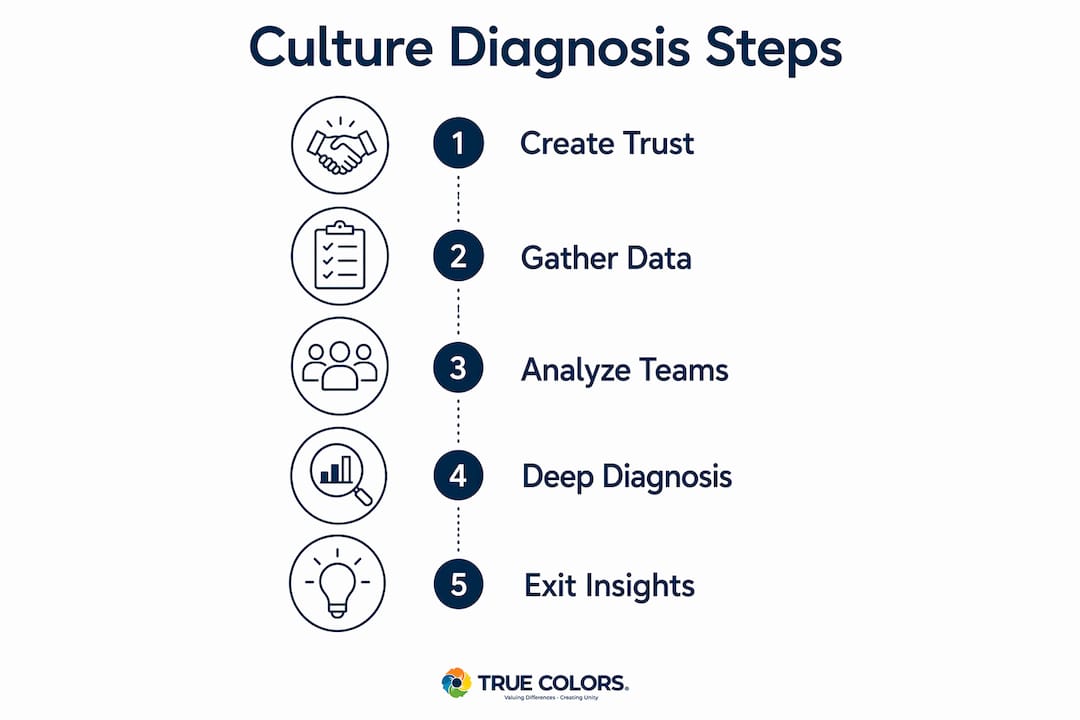
Step 1: Create the conditions for honest disclosure
Confidentiality and the absence of direct supervisors are prerequisites for candid employee disclosure. When people know their manager will see their responses, they report the culture they think leadership wants to hear, not the culture they actually experience. Anonymous pulse surveys, facilitated focus groups without managers present, and one-on-one conversations with a neutral third party all increase the likelihood of getting to the truth.
Step 2: Gather data across three layers
Combine behavioral data (recognition cadence, 1:1 attendance, meeting load, response times), sentiment data from pulse surveys, and outcome data (engagement scores, attrition rates, internal mobility). Each layer tells a different part of the story. Behavioral data shows what people actually do. Sentiment data shows how they feel about it. Outcome data shows what it is producing.

Step 3: Pivot to the team level
Monthly behavioral signals combined with quarterly composites are more effective than annual diagnostics for identifying culture problems early enough to act on them. Report results at the team and manager level, not the company level. Identify the highest-performing and lowest-performing teams, and map the dimensions where the spread is widest.
Step 4: Use deeper diagnostic techniques for entrenched problems
When standard surveys have not surfaced the real issues, repertory grids, storytelling techniques, and decision pathway tracing can reveal the assumptions and informal practices that drive behavior. Ask people to tell stories about a time the organization worked well and a time it did not. The contrast between those stories often surfaces the norms that no one has named explicitly.
Step 5: Conduct thoughtful exit interviews
Exit interviews, when conducted by someone other than the departing employee's manager, are one of the most underused diagnostic tools available. They can expose informal power dynamics, trust breakdowns, and value misalignments that current employees will not report while they still depend on the organization for their livelihood.
What to look for across all data sources:
- Patterns that appear in multiple teams, not just one
- Gaps between what leaders say the culture is and what employees describe experiencing
- Behaviors that are rewarded in practice but not in stated values
- Topics that never come up in formal channels but dominate informal conversation
The goal of diagnosis is not a comprehensive report. It is a specific, actionable finding: which two or three patterns are most prevalent, most damaging, and most addressable in the next 90 days.
How do you actually fix a broken culture?

Culture repair fails most often not because leaders lack good intentions, but because they try to fix everything at once and end up changing nothing. The organizations that make real progress pick two or three high-impact patterns and pursue them with consistency over time.
Step 1: Name the specific patterns, not the general problem
"We need to improve our culture" is not an intervention. "Across six of our teams, recognition behavior is in the bottom quartile and engagement is below 3.0, and five of those six managers have been in role under nine months" is a starting point for a real response. Specificity is what makes culture work credible to the people being asked to change.
Step 2: Align visible leadership behavior with stated priorities
Leaders communicate culture through their behavior far more than through their words. If the stated priority is psychological safety but leaders consistently interrupt, dismiss concerns, or reward agreement over honest input, the stated priority is irrelevant. Organizational transformation requires leaders to model the behaviors they are asking of others, visibly and consistently, before those behaviors spread.
Step 3: Build recognition and accountability into regular rhythms
Culture changes through repetition, not through announcements. Recognition cadence, the frequency and specificity with which leaders acknowledge behavior that aligns with stated values, is one of the most reliable predictors of whether a culture initiative will hold. A quarterly all-hands that includes a decision recap, named accountability, and genuine Q&A does more for culture alignment than a values poster ever will.
Tactics that tend to work:
- Targeted manager coaching for the bottom-quartile cohort, paired with a recognition-cadence intervention
- Quarterly priority recalibration rituals that make decision-making visible at the leadership level
- Re-articulating values as observable behaviors rather than aspirational statements
- Assigning specific owners and timelines to each culture intervention, then reviewing progress at 90 days
Step 4: Measure progress at the team level, not the company level
A culture initiative that produces a one-point improvement in the company-wide engagement score may have done nothing for the teams that were struggling most. Track the specific teams and dimensions that were identified in the diagnostic phase. If the intervention is working, you will see movement in those teams within one to two quarters.
Step 5: Reinforce through consistent follow-through
The single most damaging thing a leader can do after a culture initiative is to let it fade. When employees see that the priorities announced in January are no longer mentioned by March, they draw a conclusion: this was not real. Sustained reinforcement, through regular check-ins, visible recognition, and honest reporting on progress, is what separates culture change from culture theater.
How Truecolorsintl's behavioral approach uncovers what surveys miss
Most culture assessments measure opinion. Truecolorsintl's approach measures behavior, and the distinction matters more than it might initially appear. Opinions about culture are shaped by recency bias, social desirability, and the specific relationship an employee has with their manager. Behaviors, by contrast, leave a pattern that is harder to rationalize away.
The Truecolorsintl system works by mapping observable behavior patterns across individuals and teams, identifying where those patterns create friction, misalignment, or disengagement, and then connecting those findings to specific leadership and team development interventions. The result is not a culture score. It is a diagnostic picture of where the organization is working well and where it is not, grounded in what people actually do rather than what they say they believe.
The most common mistake in culture work is treating awareness as the destination. Knowing that your team has a communication problem is not the same as having a plan to change how people communicate. The gap between insight and aligned action is where most culture initiatives stall.
This approach has particular value for identifying cultural blind spots that standard surveys consistently miss: the informal power dynamics, the unspoken decision rituals, the behavioral norms that have become so embedded that people no longer recognize them as choices. When a team has been operating under a dysfunctional norm for long enough, it stops feeling like a norm and starts feeling like reality.
Pro Tip: When using a behavioral diagnostic, pay close attention to variance within a single team, not just between teams. Two people on the same team with sharply different behavioral profiles often signal a norm conflict that the team has been managing around rather than resolving.
The culture-focused training programs that produce lasting change share a common structure: they move from individual self-awareness to team-level alignment to organizational reinforcement. Awareness without alignment produces interesting conversations. Alignment without reinforcement produces short-term behavior change that fades within a quarter. All three stages are required for the change to hold.
Leadership engagement is the variable that determines whether a behavioral diagnostic produces real change or becomes another report on a shelf. When senior leaders participate in the same diagnostic process as their teams, model the behavior changes the data recommends, and hold themselves accountable to the same standards they set for others, the culture work gains credibility throughout the organization.
How does conflict management fit into culture diagnosis?
Conflict is one of the most reliable diagnostic signals available to HR leaders and executives. Not because conflict itself indicates a broken culture, but because the way an organization handles conflict reveals almost everything about its actual norms, regardless of what the values statement says.
Healthy organizations have conflict. The difference is that in a healthy culture, disagreement surfaces early, gets addressed directly, and produces better decisions. In a dysfunctional culture, conflict goes underground. It shows up as passive resistance, coalition-building, or the kind of polite agreement in meetings that evaporates by the time anyone tries to implement the decision.
The Program on Negotiation at Harvard Law School identifies a useful framework for understanding why conflict patterns differ so dramatically across teams and organizations. Cultures that prize dignity and individual autonomy handle conflict differently from those that emphasize face-saving or honor-based norms. In a multicultural organization, these differences can produce persistent misunderstandings that look like personality clashes but are actually structural incompatibilities in how people were taught to disagree.
For diagnostic purposes, the key question is not whether conflict exists but whether it is discussable. When the undiscussable topics in an organization multiply, when there are subjects everyone knows about but no one raises in formal settings, that accumulation is a direct measure of psychological safety and a leading indicator of cultural dysfunction. Facilitating conversations that surface those undiscussable topics, in a confidential setting without direct supervisors present, is one of the most effective diagnostic interventions available.
Executive coaching can play a meaningful role here, particularly for senior leaders whose own conflict avoidance or conflict escalation patterns are shaping the norms of the entire organization. A leader who shuts down disagreement in leadership team meetings will produce an organization where disagreement gets shut down at every level below them. Addressing that pattern at the source is faster and more effective than trying to build psychological safety from the bottom up.
The practical implication for culture diagnosis is this: map your conflict patterns the same way you map your engagement data. Which teams surface disagreements and resolve them? Which teams appear harmonious but consistently miss deadlines or produce work that requires significant rework? The second pattern often indicates that conflict is present but suppressed, and suppressed conflict is far more damaging to performance than conflict that is handled well.
Truecolorsintl helps you move from diagnosis to real culture change
Diagnosing culture problems is the necessary first step. But the organizations that actually improve their culture are the ones that connect that diagnosis to a clear, behavior-based plan and then follow through with consistent reinforcement. That is the gap Truecolorsintl is built to close.

Truecolorsintl gives HR leaders and executives a practical system for moving from personal awareness to aligned action across the entire organization. Rather than delivering a culture report and leaving the hard work to you, Truecolorsintl works through leadership development programs, team training, employee experience insights, and talent solutions that keep the work moving after the initial diagnostic phase. The behavioral framework at the core of the system makes culture visible in terms of observable actions, not abstract values, so leaders can see exactly where alignment is strong and where it is breaking down.
For organizations that have tried surveys and training programs without seeing lasting change, the difference is usually in the reinforcement layer. Truecolorsintl's approach builds the habits and rhythms that keep culture progress from fading after the first quarter. If you are ready to move beyond diagnosis and into the kind of culture work that actually holds, the employee experience survey is a practical starting point for understanding where your organization stands today.
Key Takeaways
Identifying and addressing hidden culture problems requires behavioral diagnosis at the team level, not opinion surveys aggregated to a company-wide score.
| Point | Details |
|---|---|
| Behavior over opinion | Culture lives in what people repeatedly do, not what they say they believe. |
| Team-level variance | Company-wide averages hide the specific teams where dysfunction is concentrated and intervention is needed. |
| Confidential diagnosis | Removing direct supervisors from diagnostic sessions surfaces the undiscussable truths that standard surveys miss. |
| Focused intervention | Targeting two or three high-impact patterns produces more change than broad culture initiatives spread thin. |
| Truecolorsintl's approach | Truecolorsintl connects behavioral diagnostics to leadership development and reinforcement, moving organizations from awareness to aligned action. |