
When employees resist change, your first move is not a presentation. It is a conversation. Listen to understand the specific driver behind the resistance, identify one visible problem you can fix within two weeks, and let that small win do more persuasive work than any slide deck. Research on frontline change leadership shows that authentic listening followed by a visible micro-win can reduce resistance materially, even in high-skepticism environments.
Here is what to do in the next 72 hours:
- Identify the resistance driver. Schedule a 20-minute 1:1 with one vocal opponent, one informal influencer, and one worried follower. These three conversations give you the widest diagnostic signal fastest.
- Listen without defending. Ask what concerns them most. Take notes. Do not explain the change yet.
- Separate legitimate concerns from emotional reactions. Both matter, but they need different responses.
- Find one fixable problem the resistant employee raised and fix it publicly within two weeks.
- Report back. Tell the employee what you heard and what changed because of it.
- Loop in your executive sponsor so the response carries organizational weight, not just your own.
Pro Tip: When choosing which three employees to approach first, prioritize the informal influencer (the person others watch), the most vocal opponent (whose concerns are often shared but unspoken), and a worried follower (who represents the quiet majority). Their combined input maps the full resistance landscape before you commit to a broader communication plan.
Key Takeaways
Leading resistant employees through organizational change requires diagnosing the specific driver behind the resistance, involving employees in shaping implementation, and reinforcing new behaviors consistently until adoption becomes the default.
| Point | Details |
|---|---|
| Diagnose before communicating | Hold structured 1:1s with vocal opponents, influencers, and worried followers before launching broad messaging. |
| Change fatigue is real | Employee willingness to support change declined substantially between 2016 and 2022, according to Gartner data cited in HBR. |
| Fix legitimate concerns first | Addressing a real process flaw before persuasion converts resistant employees into credible advocates. |
| Measure adoption, not just completion | Track pulse survey sentiment, manager-observed behavior, and process adoption rate weekly for the first 60 days. |
| Truecolorsintl | True Colors' behavior-based system maps resistance drivers to targeted workshops, behavior agreements, and reinforcement to sustain adoption. |
Table of Contents
- Why do employees resist organizational change?
- How does resistance actually show up in your team?
- What steps should you take to lead resistant employees through change?
- What should you say in a 1:1 with a resistant employee?
- How do you measure whether your approach is working?
- When should you listen to resistance, and when should you push through it?
- What manager mistakes make resistance worse?
- How does True Colors' behavior-based approach work with resistant teams?
- What leaders consistently get wrong about resistance
- True Colors can help you turn resistance into aligned action
- Sources
Why do employees resist organizational change?
Resistance is rarely about stubbornness. It is almost always about something the employee stands to lose, or fears losing. HBR's diagnostic framework recommends that leaders identify the specific emotional driver behind resistance and respond to that feeling directly, rather than layering on more information about why the change is necessary.
The principal drivers, and how each typically surfaces:
- Fear of loss. An employee who has built expertise in the current system worries that a new platform makes their knowledge obsolete. They slow-walk adoption and find technical reasons to delay.
- Job security concerns. Restructuring announcements trigger anxiety about role elimination. Employees facing economic pressure often disengage or start interviewing elsewhere before the change even launches.
- Loss of control. A team that was not consulted on the decision feels the change is being done to them. Compliance without commitment follows.
- Lack of trust. If a previous initiative was announced with fanfare and then abandoned, employees have learned that waiting it out is a rational strategy.
- Change fatigue. Gartner data cited in HBR shows the average employee experienced roughly 10 organization-wide strategy shifts in 2022, compared to about 2 in 2016. Over that same period, willingness to support change dropped from approximately 74% to 43%. Employees are not resistant by nature; they are exhausted by volume.
- Legitimate plan flaws. Sometimes the resistance is correct. The change has a real problem the design team missed, and the employee closest to the work spotted it first.
Psychology research on competing commitments adds another layer: employees may genuinely want to support change while simultaneously acting to protect an underlying priority, such as team cohesion or professional identity, that the change threatens. The conflict is rarely conscious, which is why asking "why aren't you on board?" rarely surfaces it.
How does resistance actually show up in your team?
Resistance is not always a raised hand in a town hall. Most of it is quieter, and therefore easier to miss until it has already slowed adoption.
Observable signs to watch for:
- Open pushback in meetings or on Slack channels
- Compliance without commitment: employees complete the required steps but revert to old habits the moment oversight relaxes
- Avoidance: missing training sessions, skipping change-related meetings, delegating change tasks to others
- Productivity drop or increased error rates in the weeks following a change announcement
- Gossip and informal coalition-building against the initiative
- Selective slowdown: delivering on core metrics while quietly deprioritizing change-related tasks
MindTools' guidance on resistance highlights that lower-visibility resistance, particularly quiet noncompliance and selective slowdown, is often the most consequential because it is invisible to standard performance metrics.
Manager watchlist by phase:
- Days 1–30: Monitor attendance at change-related touchpoints, tone in team meetings, and whether employees are asking questions or going silent.
- Days 31–60: Watch for reversion to old workflows, error spikes in new processes, and whether informal conversations are becoming more negative.
- Days 61–90: Track whether early adopters are influencing peers or whether resistant employees are pulling adopters back toward old behaviors.
The 90-day window is where most change initiatives either embed or quietly die. Resistance that looks minor at day 30 can become structural by day 90 if it goes unaddressed.
What steps should you take to lead resistant employees through change?
Managing change in employees requires a sequenced approach. Skipping steps, particularly the diagnostic and involvement steps, is the most common reason change programs stall.
-
Diagnose drivers via structured 1:1s. Before communicating the change broadly, hold individual conversations with the employees most likely to resist. Use open questions (see Section 5) to surface the specific driver. Document what you hear.
-
Involve affected employees in shaping implementation. HBR's research on continuous transformation argues that leaders should convert change into co-created work so employees help shape it rather than only endure it. Assign resistant employees to a working group with a real decision to make, not a rubber-stamp committee.
-
Deliver targeted micro-training and role clarity. CIPD's change management factsheet notes that people aspects of change are chronically under-resourced. Employees need to know not just what is changing but how their specific role changes and what support they will receive. Short, role-specific training sessions outperform all-hands webinars.
-
Run a phased pilot with visible early wins. Choose a team or unit where conditions favor success. Make the results visible: post adoption rates, share a short story from a participant, acknowledge the team publicly. APA research on worker motivation confirms that autonomy and demonstrated competence are powerful motivators; a pilot gives employees both.
-
Reinforce and scale with consistent leadership behavior. Culture is not what is said. It is what is repeated. Leaders who model the new behavior daily, and who hold themselves to the same standard they set for their teams, accelerate adoption faster than any communication campaign.
Pro Tip: Fix legitimate technical concerns before you attempt persuasion. If an employee's resistance is grounded in a real process flaw, addressing the flaw first signals that you are listening. Persuasion after that point lands very differently than persuasion before it.
Communication channels matrix:
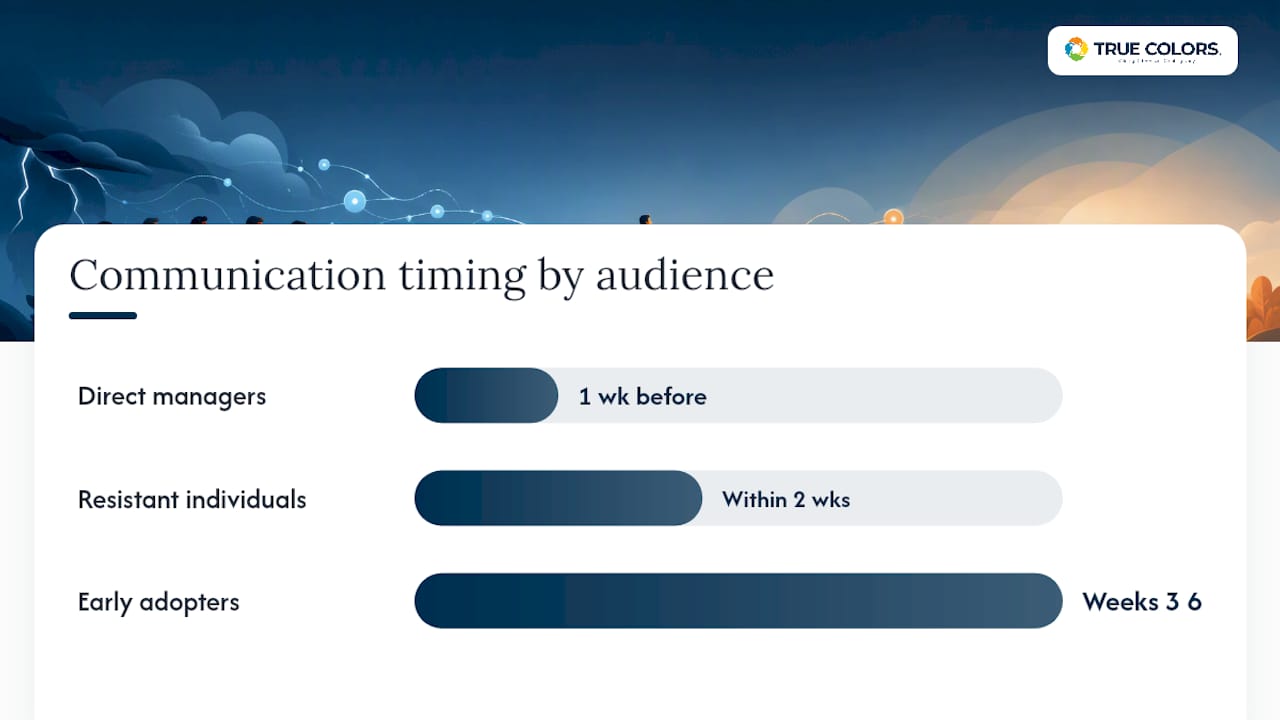
| Audience | Core Message | Channel | Timing |
|---|---|---|---|
| All employees | What is changing and why | Town hall + written summary | Before launch |
| Direct managers | How to answer team questions | Manager briefing + FAQ doc | 1 week before launch |
| Resistant individuals | What we heard from you and what changed | 1:1 conversation | Within 2 weeks of diagnosis |
| Early adopters | Your experience matters; share it | Peer story session or Slack post | Weeks 3–6 |
| Executive sponsors | Adoption metrics and escalation triggers | Dashboard + biweekly check-in | Ongoing |
Pro Tip: Engage informal influencers before the formal launch. A respected peer who says "I've seen this work" carries more weight with a skeptical team than a senior leader saying the same thing.
What should you say in a 1:1 with a resistant employee?
Scripts matter because tone matters. The goal of these conversations is not to convince; it is to understand and then co-create. Practical leadership guidance consistently points to honest, early communication as the most reliable path to reducing resistance.

Opening listening script: "I wanted to check in directly with you about the upcoming changes. I'm not here to sell you on anything. I want to understand what concerns you most, and I want to hear it from you."
Clarifying concerns: "When you say this feels rushed, can you help me understand what specifically worries you? Is it the timeline, the training, or something about how the new process will affect your day-to-day work?"
Surfacing competing commitments: "What would need to be true for you to feel comfortable moving forward? What would have to change about the plan, or about the support you're getting?"
Co-creation invitation: "I'd like your input on how we roll this out on your team. You know the workflow better than anyone in this room. Would you be willing to join a small working group for the next three weeks?"
Commitment conversation: "Based on what we've discussed, here's what I'm going to do on my end. What's one thing you're willing to try before we talk again in two weeks?"
Sample 1:1 dialog:
Manager: "What's your biggest concern about the new system?"
Employee: "Honestly? I've seen three of these rollouts. They always start with big promises and then we're left figuring it out ourselves."
Manager: "That's fair. What would make this one feel different to you?"
Employee: "If someone actually fixed the reporting bug before we go live, instead of promising to fix it later."
Manager: "That's a specific ask. Let me find out if we can get that resolved before launch. I'll come back to you by Thursday."
Diagnostic questions checklist for a 15–20 minute 1:1:
- What concerns you most about this change?
- What do you stand to lose if this goes forward as planned?
- What would need to be true for you to feel supported through this?
- Who else on the team shares your concerns?
- What's one thing we could do in the next two weeks that would make a difference?
- What's one thing you'd be willing to try, even if you're not fully convinced yet?
How do you measure whether your approach is working?
Measurement is where most change programs go wrong. Leaders track completion rates and call it adoption. Completion is not adoption. CIPD's factsheet on change management specifically flags under-investment in measurement as a reason change fails to embed.
KPI tracking matrix:
| KPI | What it indicates | Measurement cadence |
|---|---|---|
| Process adoption rate | Percentage of employees using new workflow consistently | Weekly, first 60 days |
| Error rate in new process | Whether employees have internalized the change or are guessing | Biweekly |
| Pulse survey sentiment | Emotional temperature around the change | Biweekly, then monthly |
| Manager-observed behavior | Whether employees model new behaviors without prompting | Monthly 1:1 notes |
| Training completion rate | Baseline capability to perform the new process | Weekly, first 30 days |
| Voluntary participation | Whether employees engage beyond minimum requirements | Monthly |
30/60/90-day milestones:
- Day 30: At least 60% of affected employees have completed role-specific training. Resistant employees have had at least one structured 1:1. One visible micro-win has been communicated.
- Day 60: Adoption rate is trending upward. Pulse survey sentiment is neutral or improving. At least one resistant employee has shifted to constructive engagement.
- Day 90: New behaviors are observable without prompting. Informal influencers are reinforcing the change peer-to-peer. Remaining resistance is isolated and documented.
If day-30 milestones are missed, do not accelerate the timeline. Diagnose why. Missed milestones almost always trace back to one of three causes: insufficient role clarity, a legitimate process flaw, or a trust deficit with a specific manager.
Qualitative signals matter alongside the numbers. 1:1 notes, change narratives employees share voluntarily, and the tone of informal conversations give you early warning that quantitative metrics will not catch for weeks. An employee experience survey can formalize this signal-gathering and give leaders a structured pulse without relying solely on manager observation.
When should you listen to resistance, and when should you push through it?
Not all resistance deserves the same response. The most effective leaders distinguish between resistance that carries useful information and resistance that is blocking work without a constructive basis.
Constructive resistance: listen and adapt
- The employee identifies a real process flaw the design team missed.
- The concern reflects a risk to customers, compliance, or team safety.
- The pushback reveals a communication gap: employees did not understand the rationale.
- The resistance surfaces a competing priority that leadership had not accounted for.
A useful practice: when a resistant employee raises a concern, ask yourself whether the concern, if true, would change your plan. If yes, investigate before dismissing. University of Arkansas research on resistance as an HR tool argues that engaging the most resistant individuals early and using their input to refine implementation produces stronger outcomes than treating resistance as an obstacle to overcome.
Destructive resistance: address directly
- Repeated noncompliance after documented conversations and clear expectations.
- Active sabotage: deliberately undermining the change, spreading misinformation, or blocking colleagues' participation.
- Refusal to engage in any structured dialogue or working group.
- Behavior that creates legal, safety, or performance risk for the organization.
When resistance crosses into destructive territory, the conversation shifts from listening to expectation-setting. Document the specific behaviors, the conversations that addressed them, and the outcomes expected. This protects both the employee and the organization and preserves trust with the broader team, who are watching how leadership handles noncompliance.
A brief case illustration: a manufacturing team resisted a new quality-tracking system, citing that it added 15 minutes to each shift. The manager investigated and found the concern was accurate. The implementation team had not accounted for shift handover time. Adjusting the workflow before the full rollout removed the friction point and converted several vocal opponents into early adopters. The resistance was the signal that improved the plan.
What manager mistakes make resistance worse?
Leading through change effectively requires as much discipline about what not to do as what to do. Several common leadership behaviors reliably escalate resistance rather than reduce it.
- Defensive listening. Responding to concerns with justifications before the employee has finished speaking signals that the conversation is performative. Employees stop sharing.
- Overloading with slides. More information does not address an emotional concern. A 40-slide deck explaining the business case does not resolve an employee's fear about their role.
- Ignoring early voices. The employees who raise concerns in week one are doing you a favor. Dismissing them publicly teaches everyone else to stay quiet.
- Failing to follow up on promises. If you say you will look into something and then do not report back, you have confirmed the employee's assumption that leadership does not listen.
- Announcing change without visible sponsorship. HBR's reporting on change fatigue reinforces that visible executive sponsorship is one of the most reliable predictors of adoption. A change that lives only in a manager's email has no organizational weight.
Manager behavior: do vs. don't
| Situation | What not to do | What to do instead |
|---|---|---|
| Employee raises a concern | Defend the decision immediately | Acknowledge the concern, ask a follow-up question |
| Training session is poorly attended | Send a reminder email | Find out why attendance is low; fix the barrier |
| Resistance spreads to a second team | Accelerate the timeline to force adoption | Diagnose whether the first team's concerns are shared |
| A promised fix has not happened | Stay silent | Communicate the delay and the revised timeline |
| An informal influencer is skeptical | Exclude them from planning | Bring them into a working group with a real role |
Trust erosion is cumulative and asymmetric. A single broken promise can undo months of credibility-building, and the damage spreads through informal networks faster than any formal communication. Employees talk. When a manager says "we heard you" and then nothing changes, the phrase becomes a signal that resistance is pointless, and disengagement follows.
How does True Colors' behavior-based approach work with resistant teams?
The challenge with most change programs is that they focus on the initiative and treat the people as a secondary variable. True Colors' system inverts that sequence: it starts with how people actually behave, then builds the change strategy around those behavioral patterns.
The process moves through four stages:
- Assessment. Employees and leaders complete a behavior-based assessment that identifies communication styles, stress responses, and motivational drivers. This gives managers a concrete map of who is likely to resist, why, and what kind of support will be most effective for each person.
- Targeted workshops. Rather than a single all-hands training, workshops are segmented by behavioral profile and role. A team member motivated by stability and process receives different framing than one motivated by autonomy and innovation.
- Behavior agreements and conversation cards. Teams co-create specific, observable commitments about how they will communicate during the change, how they will raise concerns, and how they will hold each other accountable. Conversation cards give managers a structured tool for the 1:1s described in this guide.
- Reinforcement and measurement. Progress is tracked through pulse surveys, manager observation logs, and adoption metrics. The system includes structured check-ins that keep reinforcement consistent rather than episodic.
A sample behavior agreement might include commitments such as: "I will raise concerns in a 1:1 before escalating to the team" and "I will complete the new process for 30 days before requesting a change." These are observable, specific, and mutually agreed, which removes the ambiguity that typically fuels resistance.
Organizations that have worked through this process report measurable shifts in team communication and adoption behaviors. True Colors' approach to helping employees deal with change provides additional context on the practical exercises managers can use at each stage.
What leaders consistently get wrong about resistance
The conventional wisdom says resistance is a communication problem. Fix the messaging, and the resistance will follow. That framing is wrong often enough to be dangerous.
Resistance is frequently a relationship problem. Employees resist change from leaders they do not trust, in organizations where previous commitments were not kept, or in cultures where raising a concern has historically been career-limiting. Better slides do not fix any of those conditions.
The more useful reframe is this: resistance is a diagnostic instrument. When employees push back, they are telling you something about the gap between the change as designed and the reality they live in. The leaders who close that gap fastest are the ones who treat the most resistant employees as the most valuable source of implementation intelligence, not as obstacles to manage around.
There is also a timing error that leaders make repeatedly. They invest heavily in the launch, then assume adoption will follow naturally. The real work of overcoming employee resistance happens in weeks 3 through 12, after the announcement energy has faded and the friction of the new process becomes daily reality. That is when reinforcement, visible leadership behavior, and structured feedback loops determine whether the change embeds or quietly reverts.
One experiment worth running this week: identify one employee who has been quietly noncompliant with a recent change. Do not address the noncompliance directly. Instead, ask them what would make the new process easier for them to use. Listen for a specific, fixable answer. Fix it. Then watch whether their behavior shifts. The result of that single conversation will tell you more about your team's resistance drivers than any survey.
True Colors can help you turn resistance into aligned action
Resistance does not have to stall your change initiative. Truecolorsintl gives leaders a practical, behavior-based system to diagnose what is driving pushback, build the communication habits that reduce friction, and reinforce new behaviors until they stick.

Typical engagements include the Connected Leadership program, which builds the specific conversation and coaching skills managers need during transitions; the Employee Experience Survey, which gives leaders structured pulse data to track adoption and sentiment; and Corporate Consulting, which provides hands-on support for organizations navigating systemic or culture-level resistance. Each engagement is designed around your team's actual behavioral patterns, not a generic change framework.
To see how the system works in practice, visit Truecolorsintl to request a discovery call or learn more about the programs available for your organization.
Sources
The following sources informed this guide and are worth reviewing for deeper study:
- Developing Employees Who Thrive Through Continuous Change
- Understand Why Employees Are Resisting Change
- Change management factsheet
- Overcoming negativity and resistance to change
- Leading Through Resistance: How To Drive Change When Your Team Pushes Back