
Sustainable culture change is defined as the intentional, systemic redesign of an organization's behaviors, values, and structures to create lasting transformation that outlasts any single initiative or leadership tenure. The industry term for this process is "sustainable cultural transformation," and it stands apart from general change management by targeting the root causes of how people actually behave at work, not just how they are told to behave. Culture rarely changes overnight; sustained incremental habits create lasting change far more reliably than top-down engineering. For organizational leaders and change agents, understanding this distinction is the difference between a culture that holds and one that quietly reverts the moment attention shifts elsewhere.
What is sustainable culture change, and how does it differ from general change management?
Sustainable culture change targets the underlying causes of behavior, not just the visible symptoms. General change management often focuses on restructuring teams, updating policies, or rolling out new messaging. Sustainable cultural transformation goes deeper. It asks why people behave the way they do and then redesigns the systems that reinforce those behaviors.
Research identifies leadership commitment, stakeholder participation, and transparent communication as the key drivers of lasting change. The barriers are equally well documented: rigid legacy structures and a short-term performance focus consistently undermine culture efforts before they gain traction. These barriers do not disappear with a new values poster or an all-hands meeting.
The clearest way to see the difference is to look at what each approach actually changes:
- General change management adjusts org charts, job descriptions, and process flows.
- Sustainable culture change redesigns the reward systems, accountability structures, and leadership behaviors that shape what people actually do each day.
- General change management treats resistance as a problem to overcome.
- Sustainable culture change treats resistance as a diagnostic signal that reveals where the real cultural friction lives.
- Sustainable cultural transformation embeds new behaviors into daily operations, not just into training programs.
The practical implication is significant. Organizations that treat culture change as a communications project tend to see early enthusiasm followed by slow regression. Those that redesign the systems driving behavior see compounding progress over time.
How do organizational ecosystems influence sustainable culture change?
Culture is the output of an organizational ecosystem, not a standalone variable leaders can adjust in isolation. Every policy, meeting structure, approval process, and performance metric either reinforces or erodes the behaviors an organization says it values. Changing these systems creates sustainable impact. Changing only the messaging does not.
Think of it this way: if your performance metrics reward individual output but your stated values emphasize collaboration, the metrics win every time. The ecosystem always overrides the aspiration.
To shift culture durably, leaders need to identify and redesign the causal factors that currently produce the behaviors they want to change. A practical sequence looks like this:
- Map the current ecosystem. Identify which policies, incentives, and structures currently reinforce the behaviors you want to move away from.
- Prioritize the highest-leverage factors. Redesigning 3–5 systemic factors is more effective than trying to persuade every individual to change.
- Redesign reward and accountability systems. Align recognition, promotion criteria, and performance reviews with the target behaviors.
- Adjust meeting and decision structures. How decisions get made and who gets heard in meetings communicates culture more clearly than any stated value.
- Track behavioral alignment, not just sentiment. Measure whether people are actually behaving differently, not just whether they report feeling better about the culture.
Pro Tip: Before launching any culture initiative, audit your three most powerful organizational systems: how performance is measured, how people are recognized, and how decisions get escalated. If those three systems do not align with your target culture, no amount of training will produce lasting change.
What role do leadership and employee engagement play in sustaining culture change?
Leaders are the single most visible signal of what a culture actually values. When leaders model the target behaviors consistently, they create a reference point the entire organization can orient around. When they do not, every gap between stated values and visible leadership behavior becomes evidence that the culture initiative is not serious.

Creating a critical mass of employees who genuinely own the culture change program builds the momentum that sustains transformation beyond the initial launch energy. This is not about getting everyone to agree. It is about getting enough people at enough levels to actively reinforce the new behaviors in their daily interactions.
Recognition plays a measurable role in this process. 53% of employees cite recognition as a key factor for retention and for repeating desired behaviors. That number signals something leaders often underestimate: people need to see that the new behaviors are noticed and valued before they will commit to them consistently. Understanding how recognition drives engagement is not a soft skill. It is a culture mechanics question.
The leadership behaviors that most directly support sustainable cultural transformation include:
- Modeling target behaviors publicly and consistently, not just in formal settings.
- Communicating transparently about why the culture needs to change and what success looks like.
- Holding themselves and their direct reports accountable to the same behavioral standards.
- Actively involving employees in diagnosing what is working and what is not, rather than delivering culture change as a finished product.
Pro Tip: Ask your senior leaders to name three specific behaviors they have changed in the past 90 days to support the culture shift. If they cannot answer that question concretely, the culture initiative is still a messaging exercise, not a behavior change program.
What practical steps can organizations take to implement sustainable culture change?
Implementing lasting culture change requires a structured approach that connects diagnosis to design to measurement. The following framework reflects what research and practice consistently show works.
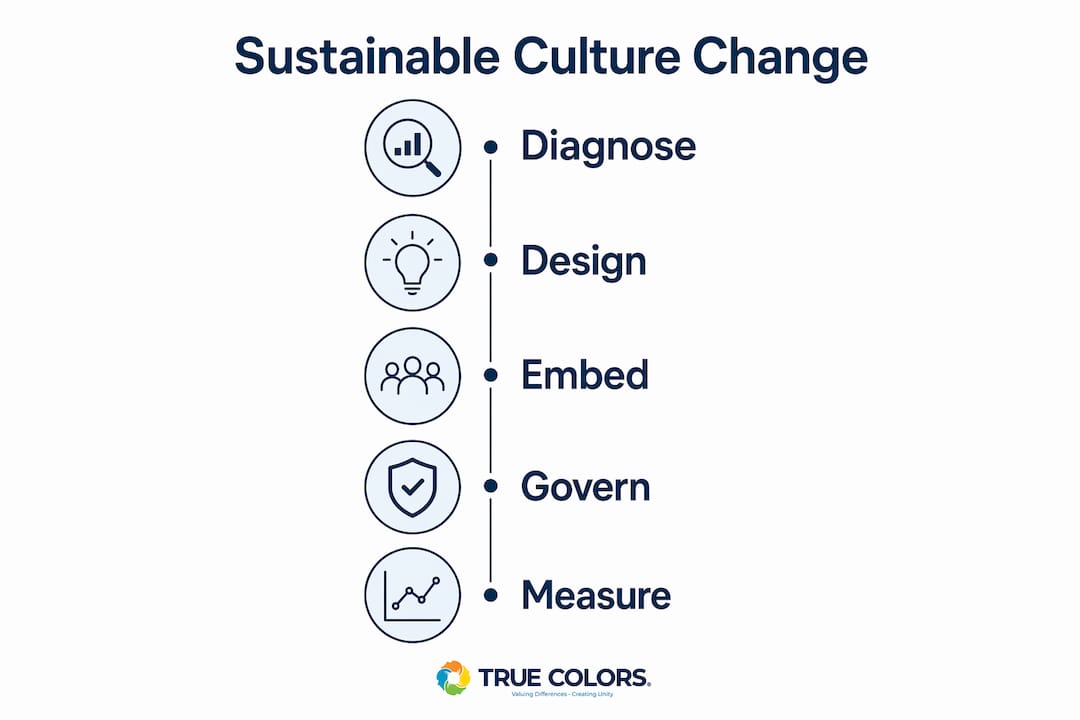
Diagnose before designing
The most common mistake leaders make is designing culture solutions before understanding what is actually driving current behaviors. HR plays a critical role in surfacing these hidden dynamics through structured listening, exit data, and engagement analysis. Without an accurate diagnosis, even well-designed interventions miss the mark.
Embed culture in operations
Culture lives in systems, not statements. Embedding culture into hiring criteria, onboarding processes, performance conversations, and budget decisions makes it operational. When culture is only present in values documents and town halls, it remains aspirational rather than real.
Use adaptive governance
Culture change is not linear. Sustained incremental improvements outperform large-scale, one-time interventions. Build regular review cycles into the change program so leaders can assess what is working, adjust what is not, and communicate progress honestly. Adaptive governance treats the culture initiative as a living system, not a project with a fixed end date.
Measure what matters
Tracking culture effectiveness requires more than annual engagement surveys. Multiple metrics including engagement scores, retention rates, and behavioral alignment to stated values give leaders an accurate picture of whether the culture is actually shifting. Technology platforms that support HR data and insights can help organizations track these indicators consistently over time.
| Implementation Step | What it looks like in practice |
|---|---|
| Ecosystem diagnosis | Audit reward systems, meeting structures, and performance metrics for cultural alignment |
| Behavioral goal setting | Define 3–5 specific, observable behaviors that reflect the target culture |
| Leadership modeling | Senior leaders publicly demonstrate target behaviors in daily decisions |
| Recognition redesign | Align formal and informal recognition with the behaviors the culture requires |
| Continuous measurement | Track engagement, retention, and behavioral alignment quarterly, not annually |
Understanding why leaders fail culture initiatives is as important as knowing what to do. The most common failure point is treating culture change as a finite project rather than an ongoing operating discipline.
Key Takeaways
Sustainable culture change succeeds when leaders redesign the organizational systems that drive behavior, not just the messages that describe it.
| Point | Details |
|---|---|
| Systems over messaging | Culture is shaped by reward systems and accountability structures, not values statements. |
| Leadership modeling is non-negotiable | Leaders must visibly demonstrate target behaviors for the culture shift to be credible. |
| Recognition drives reinforcement | 53% of employees cite recognition as key to repeating desired behaviors and staying. |
| Resistance is diagnostic | Resistance signals where cultural friction lives and guides adaptive adjustments. |
| Measurement sustains progress | Tracking engagement, retention, and behavioral alignment keeps culture change on course. |
What I've learned about culture change that most leaders find uncomfortable
After working with organizations across industries, the pattern I see most often is this: leaders want culture change to be a project. They want a start date, a launch event, a set of deliverables, and an end date. Culture does not work that way.
The organizations that actually achieve lasting cultural transformation are the ones that accept the process is ongoing, nonlinear, and frequently uncomfortable. Resistance is not a sign that the change is failing. It is a sign that the change is real. When people push back, they are telling you exactly where the old system still has a grip. That feedback is more valuable than any engagement survey.
What I have also found is that leaders consistently underestimate how much their own behavior shapes the culture. Not their intentions. Their behavior. The meeting they cut short, the decision they made without explanation, the recognition they forgot to give. Culture is not what is said. It is what is repeated. And what leaders repeat every day is what the culture actually is.
The most durable culture changes I have seen share one characteristic: the leaders involved were willing to be held accountable to the same behavioral standards they were asking of everyone else. That accountability, more than any program or framework, is what makes culture change stick.
— Theresa
How Truecolorsintl supports lasting culture transformation
Organizations that are serious about sustainable cultural transformation need more than a workshop. They need a system that connects personal awareness to team behavior to organizational outcomes.

Truecolorsintl builds that system. Through leadership development programs, team training, and employee experience surveys, Truecolorsintl helps leaders identify what is reinforcing current behaviors and what needs to change. The approach is grounded in human behavior, not theory. It gives leaders the tools to make culture visible, measurable, and repeatable. If your organization is ready to move from culture as aspiration to culture as operating discipline, Truecolorsintl is built for exactly that work.
FAQ
What is sustainable culture change in simple terms?
Sustainable culture change is the process of redesigning an organization's systems, behaviors, and leadership practices so that new values become permanent, not temporary. It targets the root causes of behavior rather than surface-level messaging.
How long does sustainable cultural transformation take?
Lasting culture change is measured in years, not months. Research from the THIS Institute confirms that sustained incremental habits produce more durable results than large-scale, one-time change efforts.
What are the biggest barriers to lasting culture change?
Rigid legacy structures and a short-term performance focus are the most common barriers, according to research published in EIJBMS. These systemic factors consistently undermine culture initiatives that rely on communication alone.
How do you measure whether culture change is working?
Effective measurement tracks engagement scores, retention rates, and behavioral alignment to stated values. Truecolorsintl outlines how to assess culture effectiveness using multiple indicators rather than a single annual survey.
What role does employee recognition play in culture change?
Recognition directly reinforces the behaviors a culture requires. Research shows that 53% of employees cite recognition as a key factor in both retention and repeating desired behaviors, making it a core mechanism in any sustainable culture program.