
Top-down culture transformation is a leadership-driven process in which executives model, enforce, and embed new organizational behaviors until those behaviors become the default way work gets done. The standard industry term for this is executive-led culture change, and it differs from grassroots culture initiatives in one critical way: it requires the people at the top to change first. Three leadership conditions explain over 56% of the success gap in transformation efforts. That number tells you something direct: culture does not change because of a new values poster. It changes because leaders change their behavior and hold that line every day.
What does it take to lead culture transformation top-down?
The foundation of any executive-led culture shift is not a communication plan. It is a set of conditions that leaders must create before any change effort can take hold.
The three conditions that matter most are:
-
Creating the right cultural conditions. Leaders must remove structural and social barriers that make old behaviors feel safer than new ones. This means auditing which processes, incentives, and norms currently reward the behaviors you want to eliminate.
-
Clarifying roles and outcomes. Every leader in the organization needs to know exactly what the new culture requires of them personally. Vague mandates like “be more collaborative” fail. Specific behavioral expectations succeed.
-
Modeling the desired behavior. The CEO’s role in culture is not symbolic. It is operational. When a CEO consistently demonstrates the behaviors the organization is asking of others, it signals that the change is real and non-negotiable.
Vision-led discipline is the fourth prerequisite that most leaders overlook. Vision governs all major decisions when executive teams use the board-mandated vision as the cultural enforcement mechanism. That means every budget decision, every hiring choice, and every project approval gets filtered through the question: does this align with who we are becoming?
Transparency is the final prerequisite. Leaders must be willing to name what is not working before they can credibly ask others to change. Without that honesty, employees read the transformation as performance rather than commitment.

Pro Tip: Before launching any culture initiative, ask your senior team to write down the three behaviors they personally need to change. If they cannot answer that question, the organization is not ready to begin.
Which leadership behaviors drive measurable culture change?
Driving cultural change at scale does not require a complete organizational overhaul. Culture change can occur in weeks by focusing on 2–3 high-impact leadership behaviors rather than attempting broad transformation all at once. That finding reframes the entire effort. The goal is not to change everything. The goal is to change the right things consistently.
The behaviors that produce the most measurable shift follow a clear pattern:
-
Model the new behavior in daily interactions. Leaders who want a culture of direct feedback must provide it in every meeting, not just during formal reviews. Consistency is the mechanism. One inconsistent moment from a senior leader erases weeks of messaging.
-
Reject misaligned work. Operational alignment demonstrates an authentic culture when leadership turns down projects or clients that conflict with the new direction, even at a short-term financial cost. Nothing signals commitment more clearly than a decision that costs money.
-
Build accountability mechanisms. Cultural accountability is not about punishment. It is about making the new behaviors visible and measurable. Leaders who track behavioral alignment the same way they track revenue create cultures where the new norms stick.
-
Use language consistently. Executive storytelling and language consistency unify culture across teams and geographies. When leaders use the same words to describe the same values, employees internalize those values faster.
The role of the executive team in this phase is to act as a single, aligned unit. Fragmentation at the top is the fastest way to stall a transformation. If one executive models the new culture and another does not, employees will default to the path of least resistance.
Pro Tip: Pick one behavior you want the organization to adopt. Practice it publicly and imperfectly for 30 days. Visible effort from leaders gives others permission to try and fail without fear.
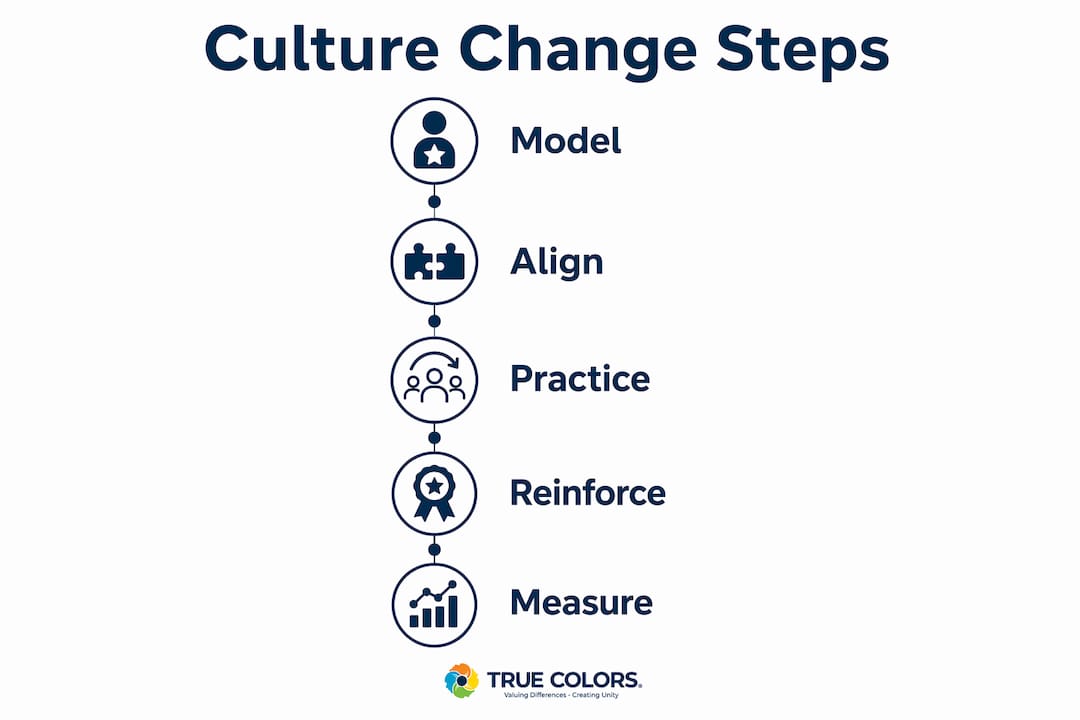
How do you design systems that reinforce new cultural behaviors?
Behavioral change does not survive on willpower alone. Leaders must design the organizational context so that new behaviors become easier to repeat than old ones.
The contrast between old-context and new-context design is stark:
| Design element | Old-context approach | New-context approach |
|---|---|---|
| Recruitment | Hire for skills and experience | Hire for behavioral alignment with culture values |
| Decision-making | Decisions made by seniority | Decisions filtered through cultural vision |
| Communication | Top-down announcements | Two-way dialog with visible leader response |
| Recognition | Reward outcomes only | Reward behaviors that reflect new culture norms |
| Onboarding | Process and role orientation | Culture immersion from day one |
Identifying and removing comforts that make old behaviors easier is the most underused tactic in top-down organizational change. Every organization has social and operational structures that make the old way feel safe. A team that has always avoided conflict will have meeting norms, seating arrangements, and communication channels that protect that avoidance. Leaders must name those structures and redesign them.
Informal cultural carriers are equally important. These are the people inside the organization who already embody the new culture, often in mid-level or frontline roles. Leaders who identify and publicly recognize these individuals accelerate adoption far faster than any training program alone. Culture spreads through people, not policies.
Integrating culture into recruitment is the most durable reinforcement mechanism available. When hiring decisions consistently favor behavioral alignment, the organization gradually self-selects toward the culture it is trying to build.
What pitfalls should leaders avoid when driving culture change?
The most common reason top-down culture efforts fail is that leaders treat culture as a soft HR initiative rather than a behavioral design problem. Transformation failures are rooted in behavioral design oversight and the failure to remove old behavior comforts. That is a structural failure, not a motivation failure.
The pitfalls that consistently derail culture efforts include:
-
Declaring values without transparency. Declaring values without naming existing failures leads to employee fear and resistance. Leaders must say the quiet part out loud. If the current culture has a problem with accountability, name it. Employees already know. Pretending otherwise destroys credibility.
-
Communication-only approaches. Sending a culture memo is not culture change. Operational follow-through, where leaders make decisions that reflect the new values, is what separates real transformation from theater.
-
Treating culture as a project. Culture is not a program with a start and end date. It is an ongoing execution process. Organizations that launch a culture initiative and then declare victory six months later will find the old behaviors returning within a year.
-
Ignoring employee fear. Change creates anxiety. Leaders who skip the emotional reality of their teams and go straight to new expectations will face passive resistance that is hard to diagnose and harder to fix.
Culture is not what is said. It is what is repeated.” Leaders who understand this stop asking how to communicate culture and start asking how to practice it.
Knowing why leaders fail at culture initiatives is as valuable as knowing what to do. Anticipating these failure modes before a transformation begins is one of the clearest signs of leadership readiness.
Key Takeaways
Effective top-down culture transformation requires leaders to model specific behaviors, design systems that reinforce those behaviors, and maintain operational alignment long after the initial announcement.
| Point | Details |
|---|---|
| Leadership conditions drive success | Three conditions explain over 56% of the variance in transformation success: cultural context, role clarity, and behavior modeling. |
| Focus on 2–3 behaviors | Targeting a small number of high-impact behaviors produces faster, more measurable culture change than broad overhauls. |
| Operational alignment is non-negotiable | Rejecting misaligned projects and clients proves culture commitment more than any communication effort. |
| Design context, not just expectations | Remove old-behavior comforts and redesign systems so new behaviors become the path of least resistance. |
| Transparency prevents resistance | Leaders who name existing failures before declaring new values build trust instead of fear. |
What I have learned about leading culture change that most guides miss
By Theresa
After working with leaders across industries on culture transformation, the pattern I see most often is this: leaders invest heavily in the launch and almost nothing in the maintenance. They announce the new values, run the kickoff sessions, and then return to the behaviors that built their careers. The culture reverts. The team notices. Trust erodes.
The leaders who succeed treat culture change as a personal discipline, not an organizational project. They ask themselves every week: Did my behavior this week match the culture I said I wanted? That question is uncomfortable. It is also the only question that matters.
The most powerful moment I have witnessed in a culture transformation was a CEO who stood in front of his senior team and named three specific ways his own behavior had undermined the culture he was asking others to build. That act of vulnerability did more for alignment than any workshop or values statement. It gave everyone else permission to be honest, too.
Culture change is slow at the start and then suddenly fast. The tipping point comes when enough leaders consistently model the new behaviors that the informal carriers in the organization start spreading them without being asked. That is when you know the transformation has moved from initiative to identity.
The practical lesson: choose two behaviors you will practice publicly this quarter. Tell your team what they are. Ask them to hold you accountable. That single act of transparency will do more for your culture than most organizations accomplish in a full year of programming.
— Theresa Stairs
How Truecolorsintl supports leaders building culture from the top
Culture change requires more than good intentions. It requires a practical system that helps leaders identify what drives or blocks performance, align their teams around shared behaviors, and build the habits that make new norms stick over time.

Truecolorsintl works with organizational leaders and change agents to make culture concrete and measurable. Through leadership development programs designed around observable behavior, Truecolorsintl helps executives model the right norms, communicate with clarity, and build teams that reinforce culture at every level. The corporate consulting and coaching services connect strategy to daily behavior, giving leaders the tools to move from vision to execution. If you are ready to build a culture that performs, Truecolorsintl provides the framework to get there.
FAQ
What is top-down culture transformation?
Top-down culture transformation is the process by which senior leaders model, enforce, and embed new organizational behaviors until those behaviors become standard practice. It differs from grassroots change in that it requires executives to change their own behavior first.
How long does culture transformation take?
Culture change can begin producing visible behavioral shifts in weeks when leaders focus on 2–3 high-impact behaviors rather than attempting a full organizational overhaul. Lasting cultural embedding typically takes longer and requires ongoing reinforcement.
Why do most culture change efforts fail?
Most transformation failures result from treating culture as a soft HR initiative rather than a behavioral design challenge. Leaders who declare new values without removing old-behavior comforts or naming existing failures will face employee fear and passive resistance.
What role does transparency play in culture change?
Transparency is a prerequisite for trust. Leaders who openly name organizational failures before announcing new values give employees a credible reason to believe the change is real, reducing fear and increasing engagement.
How can leaders measure progress in culture transformation?
Leaders can track behavioral alignment by measuring observable actions, not just survey scores. Metrics such as how often decisions reflect stated values, how consistently leaders model target behaviors, and how often misaligned work is rejected all signal real progress. Truecolorsintl offers employee experience surveys designed to surface these behavioral signals at scale.