
Leadership training cost typically runs from $35 to $500 per person for self-paced digital courses, $1,000 to $5,000 per person for virtual instructor-led programs, and up to $57,000 per program at flagship executive education institutes. Organizations that skip this markup consistently underfund the follow-through that makes training stick, including customized, reinforcement-focused programs.
TL;DR:
- Customized leadership programs with reinforcement and measurement typically cost 10 times more than basic self-paced courses, which are mainly for foundational knowledge.
- Virtual instructor-led training can deliver comparable results to in-person programs at 30% to 50% lower cost, depending on size and design.
- The total budget for leadership training should include program fees, travel, participant opportunity costs, coaching, evaluation, and contingency, often adding 50% or more to the base fee.
- Spending should align with leadership level, with emerging leaders suited for low-cost workshops and executives benefiting from multi-year, high-end programs costing up to $57,000.
- Effective engagement depends on a three-phase process: design, delivery, and ongoing reinforcement, tailored to address specific organizational friction points rather than using generic solutions.
Table of Contents
- What Does Leadership Training Cost by Delivery Format?
- What Factors Actually Move a Leadership Training Quote?
- How Do You Calculate a Total Leadership Training Budget?
- How Much Should You Budget by Leadership Level?
- How True Colors Structures Investment for Lasting Change
- Scale or Depth: Which Should You Buy First?
- Ready to Scope a Leadership Program That Fits Your Budget?
- Sources
- FAQ
What Does Leadership Training Cost by Delivery Format?
Price scales with how much personal contact, customization, and follow-up a program includes. A pre-recorded course and a residential executive program solve different problems, and the price gap reflects that.
- Self-paced and subscription courses run $35 to $500 per person monthly, or $100 to $500 for a standalone program. These work for building baseline vocabulary around leadership concepts, but they rarely change behavior on their own because nothing holds anyone accountable to apply what they watched.
- Virtual instructor-led training costs $1,000 to $5,000 per person. Well-designed virtual cohorts with live facilitation and spaced touchpoints can rival in-person outcomes, and virtual delivery often runs 30% to 50% less than equivalent in-person programs without sacrificing much impact.
- Single-day workshops typically fall between $500 and $1,500 per participant. These scale well for large groups but leave little room for practice or feedback.
- Multi-day seminars and residential programs run $1,500 to $5,000 per person, with lodging and meals often bundled into the sticker price.
- Multi-month blended programs cost $3,000 to $10,000 per participant, reflecting sustained coaching, spaced learning, and measurement built into the design rather than a single event.
- Executive education anchors the high end. Harvard's Executive Education program lists a published fee of $57,000, covering tuition, materials, accommodations, and most meals. Columbia's Emerging Leader Development Program lists at about $12,600, and Berkeley's Executive Leadership Program sits in similar territory. These sticker prices are useful even when your organization negotiates a custom version at a different rate.
What Factors Actually Move a Leadership Training Quote?
Two organizations asking for "leadership training" can receive quotes that differ by a factor of ten, and the reason almost always traces back to a handful of variables.
- Customization depth. Off-the-shelf content is transparent and cheap per head. A fully customized engagement starts with a design and facilitation base fee that does not scale linearly with headcount, which raises the entry price but lowers the per-person cost as your cohort grows.
- Facilitator seniority. A junior trainer running a licensed curriculum costs far less than a subject-matter expert building original content for your industry.
- Group size. Vendors typically amortize design fees across participants, so a 40-person cohort often costs less per head than a 10-person one running the identical curriculum.
- Program length and coaching inclusion. Adding one-on-one coaching sessions or extending a program from one month to six adds real cost, but it is also where most durable behavior change happens.
- Location and logistics. In-person delivery adds travel, venue, and catering costs that virtual formats avoid entirely.
- Measurement and reporting. Pre- and post-assessments, manager surveys, and formal ROI reporting are frequently quoted as separate line items.
Pro Tip: Ask any vendor to break out the design fee from the per-person delivery fee before you negotiate cohort size. That single number tells you whether adding 15 more seats saves you money or barely moves the needle.
How Do You Calculate a Total Leadership Training Budget?
The published program fee is rarely the real number. A complete budget adds several line items most buyers forget until the invoices arrive.
- Program fee. The base quote from your vendor or the sticker price from a published program.
- Travel and lodging. Add 20% to 50% on top of the program fee for in-person delivery, per aggregated market guidance on total training investment.
- Participant opportunity cost. Multiply each participant's hourly compensation by the hours they will spend away from their role. A director earning $150,000 a year costs roughly $72 an hour; two days out of the office adds close to $1,150 in opportunity cost per person, before the program fee.
- Facilitator design and prep fees. Custom content requires upfront design work, usually billed separately from delivery.
- Coaching add-ons. Individual or small-group coaching following a program typically adds a separate monthly or per-session fee.
- Reinforcement and evaluation. Budget 20% to 30% of the program fee for follow-up coaching, refresher sessions, and measurement, which meaningfully improves behavior change and ROI.
- Contingency. Add 10% for the inevitable schedule change or added session.
Worked example, 5-leader pilot: a $2,500 per-person virtual program totals $12,500, plus roughly $3,000 in reinforcement and evaluation, landing near $15,500.
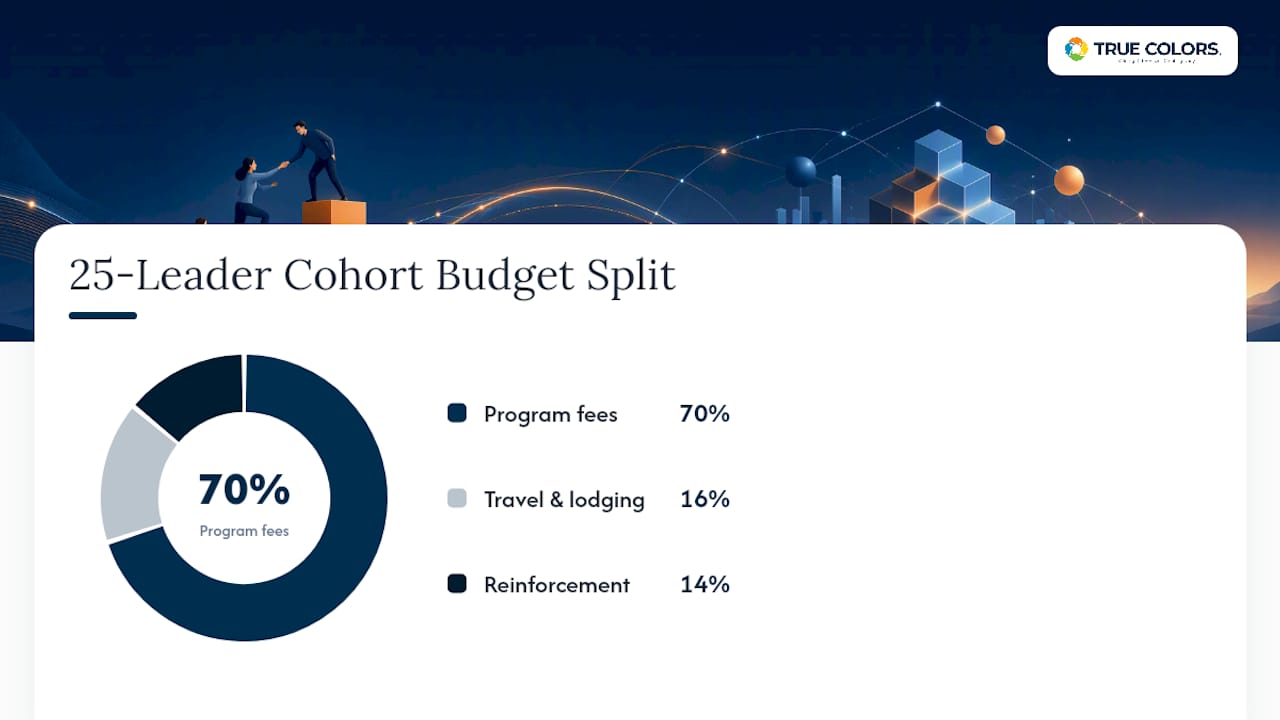
Worked example, 25-leader cohort: a $1,800 per-person program (lower per head thanks to design-fee amortization) totals $45,000, plus travel and lodging near $10,000 for a hybrid format, plus $9,000 in reinforcement, landing near $64,000.
How Much Should You Budget by Leadership Level?
Spending should track the size of the decisions a leader makes, not a flat per-head number across the whole organization.
- Emerging leaders (first-time managers, high-potential individual contributors) fit well in self-paced or single-day workshop formats, generally $500 to $1,500 per person. The goal is foundational skill building, not deep behavior change.
- Mid-level managers benefit most from multi-month blended programs in the $3,000 to $10,000 per-person range, where spaced learning and manager coaching reinforce daily habits.
- Senior and executive leaders justify premium spend: bespoke design, executive coaching, and programs anchored by institutions like Harvard or Columbia, often $9,900 to $57,000 per program. Coaching engagements at this level often run 6 to 12 months, with monthly costs between $1,500 and $5,000 depending on the coach's experience.
- A workable rule of thumb: allocate roughly 1% to 2% of a leader's annual salary to development spend each year, weighted toward the roles with the widest organizational impact.
How True Colors Structures Investment for Lasting Change
Pricing a leadership program only on the event itself misses where the real value gets created. Engagements can be built around a behavior-based system: an assessment that reveals how people actually operate, followed by training that gives teams a shared language, and reinforcement that keeps new habits alive after the workshop ends.
- Assessment-driven design ensures the content addresses real communication and leadership gaps, not generic competencies.
- Programs cover remote leadership, frontline manager development, and communication training built to be reinforced over months, not forgotten after one session.
- Engagements are typically structured in three phases: design, delivery, and ongoing reinforcement, which is why scoping conversations usually start with your organization's specific friction points rather than a fixed catalog price.
- Typical outcomes include clearer expectations between managers and teams and communication that holds up under pressure, not just during the workshop.
Organizations weighing a custom corporate engagement should request a scoped quote rather than compare against a generic per-person average, since the price reflects the depth of reinforcement built into the design.
Scale or Depth: Which Should You Buy First?
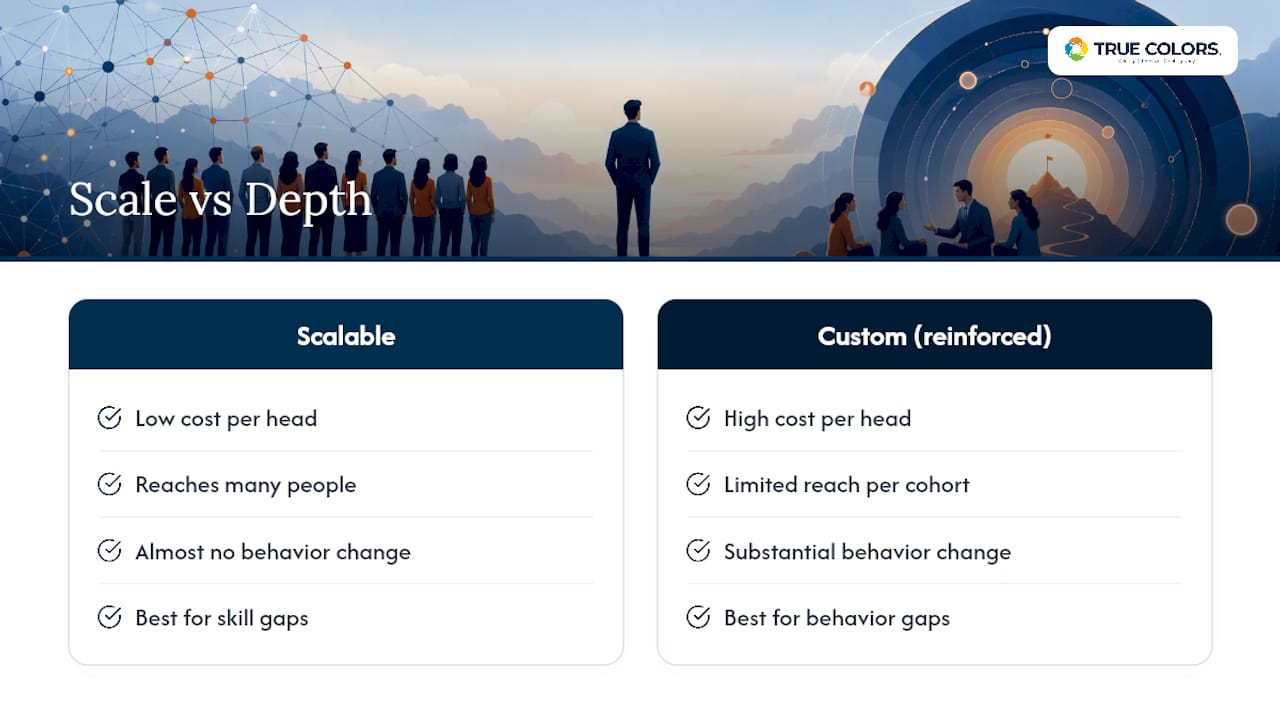
Here is the trade-off nobody puts in a pricing table: cheap, scalable training reaches more people and changes almost no behavior, while custom, reinforced programs cost more per head and change quite a lot of it. Neither is wrong. They solve different problems.
If this is your organization's first real investment in leadership development, do not commit the full budget to one bet. Pilot a small cohort, measure what shifts in communication and manager confidence, then decide whether to scale the low-cost version or expand the custom one. A short checklist helps: does the problem involve a skill gap (buy scalable) or a behavior gap (invest in customization and reinforcement)? Is there a manager sponsor ready to reinforce the training on the job? If not, no price point will fix that.
— Theresa
Ready to Scope a Leadership Program That Fits Your Budget?
Some organizations price engagements around what actually changes behavior, not around a fixed catalog fee, which means budgets go toward reinforcement and measurement instead of a one-time event that fades in six weeks. Whether you need frontline manager training, communication training for cross-functional teams, or a fully customized rollout, the True Colors programs portfolio covers the common starting points most HR and L&D leaders ask for.

The typical next step is a discovery conversation where a specialist scopes a pilot cohort against your goals and gives you a sample budget before you commit to a full rollout. If you are budgeting for a company-wide initiative, start with a corporate consulting quote or explore individual assessment and consultation options if you want to pilot with a single team first.
Sources
- Program for Leadership Development | Executive Education
- Emerging Leader Development Program | Columbia Business School ExecEd
- How Much Does Leadership Training Really Cost in 2026?
FAQ
How much should I charge for leadership training?
Pricing depends heavily on format and customization: single-day workshops commonly land at $500 to $1,500 per participant, while multi-month custom programs run $3,000 to $10,000 per participant. Consultants and internal L&D teams should price based on design complexity, facilitator expertise, and how much reinforcement is included, not a flat industry average — this is explained in detail by Consultant SEO Services | Show Authority & Win More Business.
What is the 70-20-10 rule for leadership?
It is a common framework for deciding how much budget to put toward structured programs versus coaching and stretch assignments.
How much does leadership coaching typically cost?
Executive coaching engagements often run 6 to 12 months, with monthly costs ranging from $1,500 to $5,000 depending on the leader's seniority and the coach's experience. Coaching costs typically sit outside the base program fee and get budgeted as a separate line item.
Are there any free leadership courses?
Free or low-cost self-paced courses exist and can build basic vocabulary around leadership concepts, generally falling at the very bottom of the $35 to $500 self-paced price range or below it. They rarely include the coaching, accountability, or reinforcement that drive actual behavior change, so most organizations pair them with a paid follow-up program rather than relying on them alone.