
OKR alignment means every team's objectives reinforce the company's strategic direction across three dimensions: vertical (team to executive), horizontal (peer team to peer team), and individual (person to team). The one move that fixes most broken alignment starts before the quarter does: name an accountable owner for every cross-functional outcome, require a shared Key Result, and demand a written "Why now" before any objective gets sign-off. Everything else in this playbook supports that single decision.
TL;DR:
- Clear accountability and shared Key Results are essential before planning begins to ensure cross-functional outcomes are aligned with company priorities.
- Misalignment often manifests as goal conflicts, duplicate efforts, or objectives that have no connection to higher-level goals, not just poor communication.
- Building and maintaining alignment requires early context sharing, explicit ownership, dependency mapping, and regular check-ins focused on decisions and blockers.
- Software tools support visibility but cannot resolve conflicts or decide success definitions, making governance structures and decision rights critical.
- Fostering a culture of responsible decision-making, reinforced through facilitation and behavioral programs, is vital for sustaining effective OKR alignment.
Table of Contents
- What OKR Alignment Actually Means (and What It Is Not)
- How Do You Know When OKRs Are Misaligned?
- How to Build and Maintain OKR Alignment Through a Cycle
- Cascade vs. Alignment: Choosing the Right Model
- What Governance Structure Keeps OKRs Aligned?
- Which Rituals Keep Alignment Alive After Planning Ends
- How True Colors Turns Alignment Rules Into Daily Behavior
- Common Challenges in Achieving OKR Alignment
- Tools and Software That Support OKR Alignment
- How OKR Alignment Affects Performance and Engagement
- What Successful OKR Alignment Looks Like in Practice
- Author Perspective: Governance First, Tooling Second
- How Truecolorsintl Helps Leaders Make Alignment Stick
- Sources
- FAQ
What OKR Alignment Actually Means (and What It Is Not)
OKR alignment is the discipline of connecting every team's objectives back to a company strategy, and it operates on three separate levels. Confusing them is where most alignment work goes wrong.
- Vertical alignment: a team's objective clearly advances a level above it, like a support team's "reduce resolution time" tied to the company's "improve retention."
- Horizontal alignment: peer teams coordinate on shared outcomes, like Sales and Marketing both owning a Key Result for qualified pipeline instead of competing metrics for the same funnel stage.
- Individual alignment: a person's quarterly focus maps to their team's objective, not just to their job description.
None of this is the same as visibility. Publishing every OKR in a shared tracker so leaders can see them is not alignment. It is a directory. Real alignment shows up as fewer duplicate initiatives, faster cross-team delivery, and objectives that actually move a number someone above them cares about. Alignment quality, not just OKR adoption, is what the OKR Institute ties most closely to program success.
How Do You Know When OKRs Are Misaligned?
Misalignment rarely announces itself. It shows up as friction that leaders misdiagnose as a communication problem when it is really a structural one.
Watch for these four symptoms:
- Goal collision: two teams pursue objectives that actively work against each other, like Growth chasing sign-up volume while Support optimizes for fewer, higher-quality accounts.
- Parallel work: two teams build the same capability independently because neither knew the other had it on their roadmap.
- Orphan objectives: a team sets a goal that connects to nothing above it, meaning it might be busywork dressed up as strategy.
- Conflicting Key Results: one team's KR success directly undermines another's, most often between Sales and Marketing over lead definitions or between Product and Engineering over scope versus speed.
A classic Product ↔ Engineering collision: Product commits to a Key Result for shipping five new features, while Engineering's KR targets a 30% reduction in technical debt. Nobody planned for the two to fight over the same sprint capacity, but they do, every time.
Pro Tip: Run this test on every published objective: does this Key Result move at least one Key Result above it? If the honest answer is no, the objective is either mislabeled work or it needs a new home in the hierarchy.
How to Build and Maintain OKR Alignment Through a Cycle
Alignment is built during planning and defended during execution. Skip either half and it decays by week three.
- Publish company objectives with context, not just metrics. A number without a rationale invites teams to guess at intent, and guesses rarely match strategy.
- Require "Why" and "Why now" documentation for every team objective. Practitioner guidance from What Matters recommends this over relying on visual lineage alone, because a clean-looking parent-child link can still mask a team pursuing the wrong priority for the right-sounding reason.
- Default to directional alignment, not automatic cascade. Set the top-level priority, then let teams propose how they contribute. Reserve explicit cascade for the handful of goals that are genuinely cross-functional and time-critical.
- Map dependencies and require at least one shared Key Result on any cross-functional outcome. A shared KR forces two teams to agree on what "done" means before either starts work, which prevents the "shipped versus adopted" mismatch that quietly kills otherwise good initiatives.
- Name a single accountable owner and define the tie-breaker rule in advance. When Sales and Product disagree mid-quarter, the organization needs to already know who decides, not debate it while the deadline burns.
- Set a check-in cadence built around blockers and decisions, not status updates. A biweekly review that only reports percentage complete wastes everyone's time; one that surfaces "this is blocked and here's who needs to decide" earns its slot on the calendar.
The sequence matters. Publish context first, then rationale, then structure, then ownership, then cadence. Reversing the order, especially jumping straight to cascade before context is set, is how organizations end up with technically-linked OKRs that nobody actually believes in.
Cascade vs. Alignment: Choosing the Right Model
Cascading and aligning are not synonyms, and treating them as interchangeable is one of the most common planning mistakes leaders make. Cascading pushes a goal down through layers of the org chart. Alignment lets teams propose how they contribute to a shared direction.
Practitioner analysis from Jeff Gothelf makes the trade-off explicit: strict top-down cascading tends to produce compliance, not ownership, because teams execute someone else's plan instead of solving the problem themselves. Loose, bottom-up alignment without any cascade risks the opposite failure: fragmentation, where every team optimizes locally and nobody owns the cross-functional outcome.
Use this filter during planning:
- Cascade explicitly when the priority is genuinely cross-functional, time-critical, and leadership is willing to actively govern it (not just announce it and walk away).
- Align directionally for everything else, letting teams define their own contribution to a stated company priority.
- Reserve selective cascade for the small number of enterprise-level priorities that require coordinated, simultaneous movement across departments, a pattern Okrs recommends as a deliberate governance choice rather than a default structure.
Most organizations get this backward: they cascade everything because it feels orderly, then wonder why local ownership evaporates by month two.
What Governance Structure Keeps OKRs Aligned?
Alignment fails less often from bad goals than from missing decision rights. Before sign-off, leaders need to lock four governance decisions, according to guidance from the OKR Institute:
- Who resolves cross-functional conflicts when two teams' Key Results genuinely compete.
- How fast escalation happens, meaning a defined window rather than an open-ended "raise it in the next meeting."
- What the tie-breaker rule is when the conflict owner and both teams still disagree.
- Who translates strategy into team-level language so objectives don't drift into abstraction by the third layer down.
Pair those decisions with a lightweight alignment forum: a small group with actual decision authority, one representative per major function, and a fixed cadence, not an ad hoc meeting that only convenes when something is already on fire. A forum with too many voices and no authority is the single fastest way to turn governance into theater.
Pro Tip: Require a RAID table (Risks, Assumptions, Issues, Dependencies) as a planning artifact before any cross-team OKR gets approved. It forces teams to name blockers and decision dates while there's still time to act on them, not after the quarter is half gone.
Which Rituals Keep Alignment Alive After Planning Ends
Planning-day alignment decays fast without rituals that refresh it. The organizations that hold alignment through a full quarter build a short, repeatable rhythm around two things: cross-team reviews and honest check-ins.
- Cross-team OKR reviews at cycle start, where dependent teams walk through their shared Key Results together instead of reading about them in a shared document later.
- Weekly or biweekly alignment check-ins focused specifically on blocked dependencies and the decisions needed to unblock them.
- Public "Why/Why now" notes attached to each objective, so anyone joining a project mid-quarter understands the rationale without a meeting.
- Shared KR links visible to both owning teams, not buried in one team's private dashboard.
On tooling: Microsoft's guidance for Viva Goals recommends linking OKRs "up, down, and across" and using shared KR connections to surface relationships between teams. That guidance also concedes the obvious limit: tools surface connectivity, but they do not resolve conflicts. A dashboard showing two teams' KRs pointing in opposite directions is useful information, but it is not a decision. Governance still has to make the call.
How True Colors Turns Alignment Rules Into Daily Behavior
Governance structures and shared Key Results only work if people actually behave differently in the room where decisions get made. That is where most alignment efforts quietly fail, and it is the gap Truecolorsintl's facilitated work is built to close. Rather than a one-time training on how to write OKRs, facilitated alignment workshops and leadership development programs focus on the recurring behaviors, decision habits, and communication patterns that keep cross-team commitments honest quarter after quarter. Pairing that with an employee experience survey gives leaders a read on whether teams actually trust the governance model or are quietly working around it. Reinforcement over time, not a single session, is what makes the difference stick.
Common Challenges in Achieving OKR Alignment
Three failure patterns show up again and again, regardless of company size or industry.
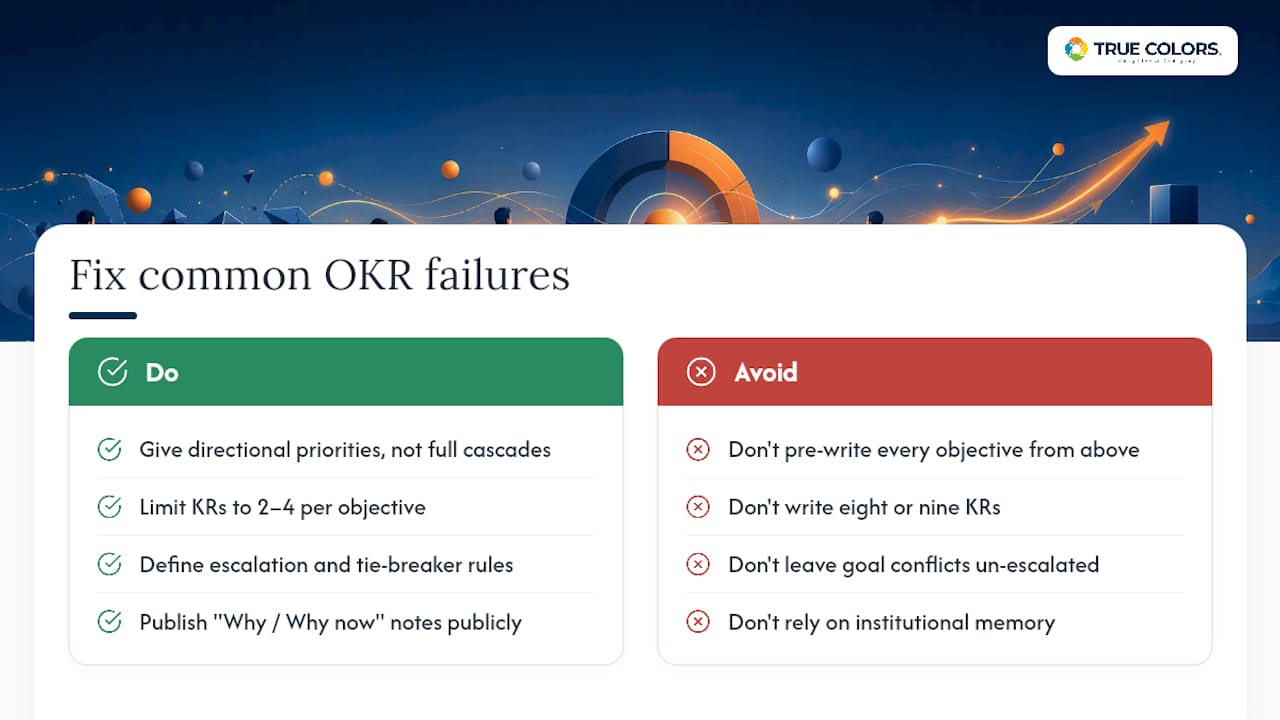
The first is cascade fatigue, where teams treat OKRs as a compliance exercise because every objective arrived pre-written from above. The fix is directional alignment: state the priority, let teams propose the contribution, and reserve explicit cascade for the few goals that truly require it.
The second is KR overload, where teams write eight or nine Key Results per objective because they're afraid of missing something. Dense KR lists dilute focus and make cross-team dependency mapping nearly impossible, since nobody can tell which of nine metrics actually matters to a partner team. Fewer, sharper Key Results, ideally two to four per objective, make shared ownership legible.
The third is silent conflict, where two teams know their goals collide but neither escalates because there's no defined path to do so. This is a governance gap, not a communication failure, and it is exactly what the escalation and tie-breaker rules from the governance checklist are meant to close.
A fourth, quieter challenge is rationale decay: the "Why now" behind an objective made sense in planning week but nobody wrote it down, so by week six a new hire or a shifted priority makes the objective look arbitrary. Public "Why/Why now" notes, kept visible and current, solve this directly rather than relying on institutional memory.
Tools and Software That Support OKR Alignment
Software helps alignment become visible; it does not create alignment on its own. Enterprise platforms like Viva Goals let teams link objectives up, down, and across the org chart, and most dedicated OKR platforms on the market offer similar shared-KR linking and dependency tagging.
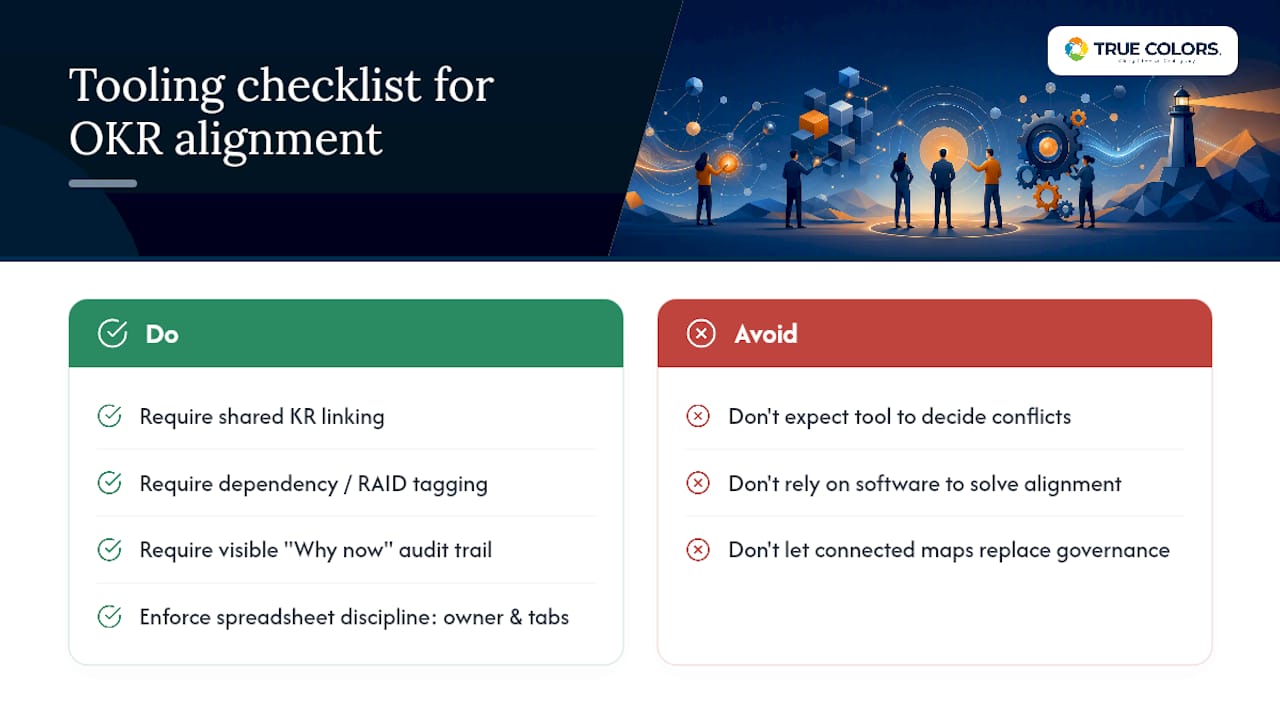
The practical guidance for choosing among them is simple: look for three capabilities and treat everything else as secondary. First, shared Key Result linking, so two teams can point at the same metric instead of tracking duplicate versions. Second, dependency or RAID-style tagging, so blockers surface in the same place the objectives live. Third, a visible audit trail for "Why now" notes, so rationale doesn't live only in someone's memory of a planning meeting.
What tooling cannot do is resolve a conflict, assign a tie-breaker, or decide which of two competing Key Results wins scarce engineering capacity. That is a governance forum's job, not a dashboard's. Organizations that buy an OKR platform expecting it to fix alignment on its own usually end up with a beautifully connected map of objectives that still collide in practice. The software surfaces the problem faster. It never solves it.
For teams still relying on spreadsheets, that's a legitimate starting point, provided the spreadsheet enforces the same discipline: one shared tab per cross-functional Key Result, a visible owner column, and a linked "Why now" note. The tool matters less than whether the governance habits are actually followed inside it.
How OKR Alignment Affects Performance and Engagement
Alignment quality correlates directly with program success, and the mechanism is not mysterious. When teams can see how their work connects to a result leadership actually cares about, they make faster decisions because they're not waiting for permission to know if a trade-off is worth making.
The performance effect shows up first in reduced duplication. Two teams that would have quietly built the same capability in parallel instead discover the overlap during planning, when it's cheap to fix, instead of during a retrospective, when it's expensive to unwind.
The engagement effect is less obvious but arguably larger. Orphan objectives, the goals that connect to nothing above them, are demoralizing in a specific way: people can tell when their quarter's work doesn't matter to anyone above their manager. A team member working toward a Key Result that visibly moves a company priority experiences their work differently than one grinding through a checklist nobody above them will ever look at again.
This is also where alignment intersects with culture more broadly than most OKR guides acknowledge. Objectives connected to strategy build trust in leadership's direction. Objectives that look connected on paper but collide in practice, or that get quietly abandoned mid-quarter without explanation, erode that trust faster than almost anything else a leadership team does. Alignment, done honestly, is a culture signal as much as a planning mechanic.
What Successful OKR Alignment Looks Like in Practice
The clearest examples of working alignment share a common trait: they resolve conflict through a named forum, not through more documentation.
Consider the recurring Sales-Marketing pattern. Both teams typically own pipeline goals, but Sales measures success in closed revenue while Marketing measures qualified leads delivered. Left alone, these two metrics drift apart, since Marketing can hit its number by generating volume that Sales considers unqualified. The fix that works in practice is a single shared Key Result, something like "revenue from marketing-sourced pipeline," that forces both teams to agree on the definition of a qualified lead before the quarter starts, not argue about it in week six.
The Product-Engineering pattern resolves similarly. Instead of Product owning a feature-count Key Result and Engineering owning a technical-debt Key Result in isolation, a functioning alignment model puts a shared Key Result on release stability or adoption, something both teams jointly own and jointly report on. Neither team can hit their number by quietly undermining the other's.
What both examples have in common is the governance principle that shared Key Results align incentives by forcing a common success definition. Neither example required elaborate software. Both required a decision, made explicitly during planning, about what "success" meant to both parties at once. That decision, more than any dashboard, is what separated alignment that held from alignment that looked good in a kickoff deck and fell apart by the second check-in.
Author Perspective: Governance First, Tooling Second
Alignment succeeds or fails on governance choices, not on how clean the OKR map looks in a dashboard. Visibility without decision authority is visibility theater. If there's one next step worth taking this week, it's running a RAID mapping session with named owners before the next planning cycle locks in.
— Theresa
How Truecolorsintl Helps Leaders Make Alignment Stick
Governance rules and shared Key Results only hold up when the humans running them actually change how they show up in the room, and that's the gap most OKR programs never close. There are practical culture and behavior systems built to help organizations move from personal awareness to aligned action, stronger leadership, better communication, and reinforced culture over time, instead of leaving alignment to a single planning-day workshop that fades by week four.

If your leadership team needs a facilitated session to work through decision rights, escalation rules, and tie-breakers before your next OKR cycle, the Consulting & Coaching Programs page walks through how those engagements are structured. Teams that need a clearer read on whether current culture is helping or hurting cross-functional cooperation can start with an Employee Experience Survey, which diagnoses the behavioral friction behind stalled alignment before it derails another quarter. For a starting conversation about which engagement fits your organization, reach out through Truecolorsintl's corporate consulting page and describe where your current alignment effort is breaking down.
Sources
- OKR Institute — OKR alignment
- What Matters — Four Different Ways OKRs Align
- Jeff Gothelf — Aligning not cascading OKRs with an OKR lineage
FAQ
What Does OKR Stand For?
OKR stands for Objectives and Key Results, a goal-setting framework pairing a qualitative objective with measurable Key Results that track progress toward it.
What Are the Five Elements of OKR?
Definitions vary by practitioner, but a common version includes the objective, two to five Key Results, an owner, a defined cadence for check-ins, and a documented rationale ("Why now") connecting the goal to strategy.
What Is a Good OKR Alignment Example?
A shared Key Result like "revenue from marketing-sourced pipeline," jointly owned by Sales and Marketing, is a strong example because it forces both teams to agree on a single success definition instead of tracking conflicting metrics.
What Are Common OKR Mistakes Leaders Make?
The most common mistakes are cascading every objective instead of aligning directionally, writing too many Key Results per objective, and skipping the "Why now" rationale that gives an objective context beyond the number itself.
Can Truecolorsintl Help With OKR Alignment Directly?
Truecolorsintl doesn't sell OKR software; it supports the behavioral and cultural side of alignment through facilitated workshops, leadership development, and employee experience surveys that help leaders sustain the governance decisions alignment depends on.