
Accountability in leadership is defined as the willingness to own your actions, decisions, and outcomes while creating the conditions that allow others to do the same. This definition, grounded in standard leadership practice, goes well beyond personal responsibility. The role of accountability in leadership shapes trust, drives team performance, and determines whether an organization's culture is built on ownership or blame. Leaders who treat accountability as a daily practice rather than a reactive correction create measurably stronger teams. This guide breaks down what that practice looks like, why it matters, and how to build it deliberately.
What does accountability look like in effective leadership practice?
Effective accountability is not a policy. It is a set of observable behaviors that leaders repeat consistently until they become the norm.
The most overlooked part of leadership accountability is what Psychology Today calls "invisible work." Leaders do daily work to provide clarity, allocate resources, and create psychological safety before they ever hold anyone responsible for results. Without that foundation, accountability becomes a performance review conversation that nobody trusts.

Effective leaders also distinguish between mandating accountability and enabling it. Accountability must be chosen, not imposed. When leaders co-create expectations with their teams rather than handing them down, people feel genuine ownership over outcomes. That ownership is what drives follow-through when no one is watching.
The behavioral difference shows up in communication. Leaders who enable accountability ask "What do you need to move forward?" before they ask "Why isn't this done?" They use feedforward techniques, focusing on future improvements rather than past failures. Asking what was learned instead of assigning blame increases collaboration and personal ownership across the team.
Key behaviors that define accountable leadership include:
- Setting clear, shared expectations at the start of every project or cycle
- Confirming that team members have the authority and resources to deliver
- Creating psychological safety so people raise problems early, not late
- Using growth mindset language in feedback conversations
- Celebrating ownership behaviors, not just outcomes
- Maintaining visibility into constraints before they become failures
Pro Tip: The most common pitfall leaders face is confusing activity monitoring with accountability. Tracking tasks tells you what people are doing. Accountability conversations tell you whether people have what they need to succeed. Shift your check-ins from status updates to constraint removal.
Why is accountability essential for leadership and team performance?
Accountable leadership strengthens trust, employee engagement, and creates the conditions for sustainable performance improvement. That correlation is not incidental. It reflects a direct cause-and-effect relationship between how leaders behave and how teams respond.
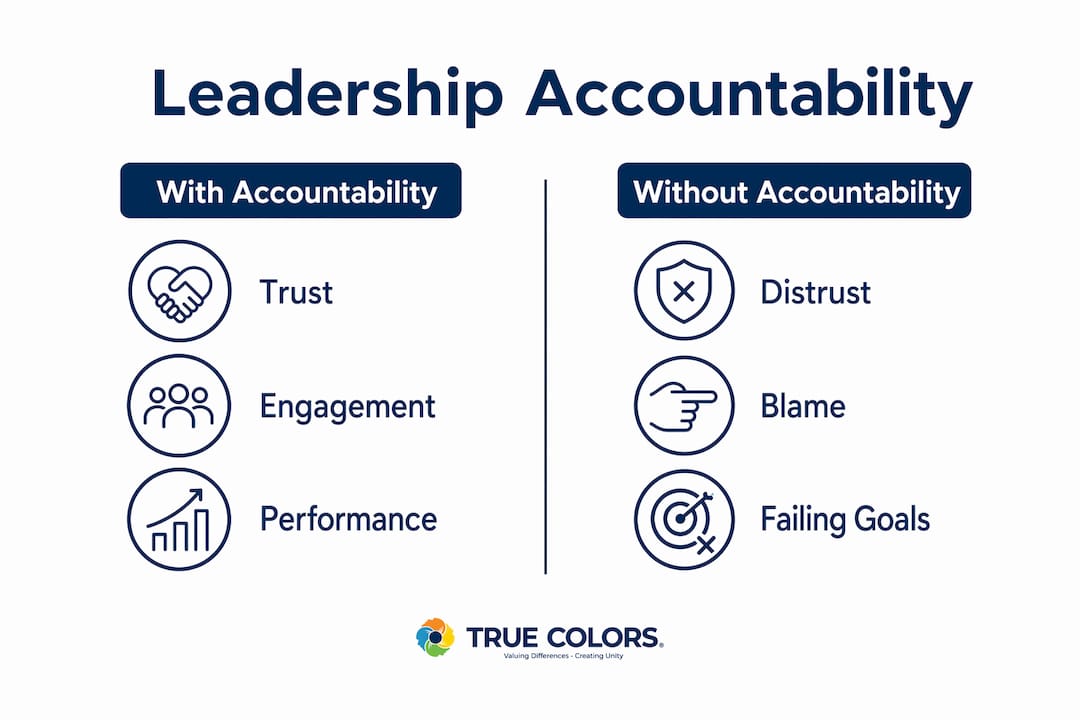
When leaders model ownership, teams mirror it. When leaders deflect or blame, teams learn to protect themselves rather than perform. The culture that results from consistent leadership behavior is not what is written in a values statement. It is what gets repeated in meetings, decisions, and difficult conversations.
The absence of accountability produces predictable failures. Delays accumulate. Excuses replace progress reports. Avoidance becomes the default response to hard problems. These symptoms are not caused by lazy employees. They are caused by structural and interpersonal barriers that leaders failed to remove.
The table below contrasts outcomes in organizations with strong leadership accountability versus those without it.
| Dimension | With leadership accountability | Without leadership accountability |
|---|---|---|
| Trust | High, built through consistent behavior | Low, eroded by blame and deflection |
| Engagement | Employees feel ownership and purpose | Employees comply but disengage |
| Innovation | Teams surface problems and ideas early | Teams hide problems to avoid blame |
| Performance | Sustained improvement over time | Short bursts followed by regression |
| Culture | Ownership is the norm | Compliance is the ceiling |
Leadership accountability also directly affects talent retention. Teams led by accountable managers report higher motivation and a stronger sense of purpose. Choosing accountability rather than enforcing it from the top down produces higher motivation and better results compared to compliance-based management. That distinction matters especially for organizations trying to build cultures that outlast any single leader.
What are the most common challenges and misconceptions about accountability in leadership?
The biggest misconception about accountability is that it is punitive. Most leaders learn accountability in environments where it meant consequences for failure. That framing produces fear, not ownership.
When accountability is treated as a disciplinary tool, teams respond with self-protection. People stop raising problems early because early disclosure feels like admitting failure. They wait until a situation is critical, which makes it harder to fix and more costly to the organization. Tightening controls when performance drops is the most common leadership mistake, and it consistently backfires.
A second challenge is compliance without commitment. Leaders who mandate accountability through policies, scorecards, and performance improvement plans often see short-term behavior change. The underlying ownership never develops. People do what is required to avoid consequences, not what is needed to drive results.
Common accountability breakdowns leaders should recognize:
- Unclear authority: team members are held responsible for outcomes they cannot control
- Missing resources: people are expected to deliver without the tools or support to do so
- Absent psychological safety: problems surface too late because raising them feels risky
- Invisible work ignored: leaders skip the enabling steps and jump straight to enforcement
Pro Tip: Shift from task management to results leadership. Instead of monitoring whether someone completed a step, ask whether the outcome is on track and what barriers exist. That single shift moves the conversation from compliance to ownership.
Understanding why accountability problems are often communication problems is the first step toward fixing them. Clarity, not pressure, is the primary driver of accountable behavior.
How can leaders build a culture where accountability is chosen?
A culture of chosen accountability does not emerge from a single initiative. It is built through repeated leadership behaviors that signal what the organization actually values.
Start with shared clarity
Clarity is the foundation. Leaders who co-create goals with their teams produce stronger alignment than those who assign targets from above. When people help define what success looks like, they feel responsible for reaching it. Shared clarity also reduces the ambiguity that allows excuses to take root.
Confirm resources, authority, and safety
Effective accountability requires that leaders confirm three things before holding anyone responsible: the person has the resources to deliver, the authority to make necessary decisions, and the psychological safety to raise problems without fear. Skipping any one of these creates a structural barrier that no amount of pressure will overcome.
Use feedforward conversations regularly
Feedforward replaces the backward-looking performance review with a forward-looking growth conversation. Instead of "Here is what went wrong," the leader asks "What would you do differently, and what do you need from me?" This approach, grounded in a growth mindset, shifts accountability from blame to development. Teams that experience feedforward conversations consistently report higher ownership and stronger collaboration.
Build feedback loops and celebrate ownership
Regular check-ins that focus on constraints rather than status keep accountability visible without making it feel punitive. Celebrating moments when team members proactively raise problems or take ownership of difficult outcomes reinforces the behavior the organization wants to see repeated. Culture is not what is said. It is what is repeated.
The table below compares environments with and without a proactive accountability culture.
| Factor | Proactive accountability culture | Reactive accountability culture |
|---|---|---|
| Goal-setting | Co-created with team input | Assigned from leadership |
| Problem-raising | Encouraged and rewarded | Avoided due to fear of blame |
| Feedback style | Feedforward, growth-focused | Backward-looking, corrective |
| Leadership behavior | Enables and removes barriers | Monitors and enforces |
| Team motivation | Intrinsic, ownership-driven | Extrinsic, compliance-driven |
Integrating accountability into leadership development programs ensures that these behaviors are reinforced over time, not just introduced in a workshop. Organizations that treat accountability as a culture-building practice rather than a performance management tool see the most durable results. Leaders who want to lead culture transformation from the top down must model chosen accountability before they can expect it from their teams.
Key Takeaways
Accountability in leadership is a proactive, daily practice of enabling ownership through clarity, resources, and psychological safety, not a reactive enforcement tool.
| Point | Details |
|---|---|
| Accountability is enabling, not enforcing | Leaders must provide clarity, resources, and safety before holding people responsible. |
| Mandating accountability backfires | Compliance without commitment produces short-term behavior and long-term disengagement. |
| Feedforward drives ownership | Growth-focused conversations replace blame with collaboration and personal responsibility. |
| Culture reflects repeated behavior | What leaders do consistently, not what they say, defines the accountability culture. |
| Chosen accountability outperforms compliance | Teams that own their goals voluntarily deliver stronger, more sustained results. |
Accountability as the invisible work leaders rarely talk about
Most leadership conversations about accountability focus on the visible part: the conversation after something goes wrong, the performance review, the corrective action plan. In my experience working with leaders across industries, that is exactly the wrong place to focus.
The real work of accountability happens before anything goes wrong. It happens when a leader takes time to confirm that a team member actually has the authority to make the decision they are being held responsible for. It happens when a leader creates enough psychological safety that a struggling employee raises a problem in week two instead of week eight. That invisible, proactive work is what separates leaders who build accountable teams from those who simply manage consequences.
I have also seen how quickly accountability culture collapses when leaders skip the enabling steps. A team that once operated with strong ownership can revert to compliance mode within a quarter if leadership changes and the new manager defaults to monitoring rather than enabling. That tells you something important: accountability is not a team trait. It is a leadership output.
The leaders I respect most treat accountability as part of their identity, not their toolkit. They do not reach for it when performance drops. They practice it daily through the questions they ask, the safety they create, and the ownership they model. That consistency is what makes it real.
— Theresa
How Truecolorsintl helps leaders build accountable teams
Building a culture of chosen accountability requires more than good intentions. It requires a practical system that helps leaders understand their own behavior patterns, communicate more effectively, and create the conditions where teams genuinely own their work.

Truecolorsintl works with organizations to make culture observable and repeatable. Through leadership development programs and corporate consulting solutions, Truecolorsintl helps leaders identify the behaviors that are helping or hurting performance, strengthen communication across teams, and build the habits that sustain accountability over time. The approach is grounded in human behavior, not theory, which means leaders leave with tools they can use the next day. If you are ready to move from compliance to ownership, Truecolorsintl provides the framework to get there.
FAQ
What is the role of accountability in leadership?
Accountability in leadership means owning your actions and outcomes while creating the conditions that allow others to do the same. It directly shapes trust, team performance, and organizational culture.
How does accountability affect team performance?
Accountable leadership strengthens engagement, reduces blame culture, and produces sustained performance improvement. Teams led by accountable managers report higher motivation and stronger ownership of results.
What is the difference between accountability and blame?
Accountability focuses on ownership and future improvement. Blame assigns fault without enabling growth. Leaders who use feedforward techniques shift their teams from self-protection to collaboration.
Why do accountability initiatives fail in organizations?
Most accountability initiatives fail because leaders skip the enabling work. Without clarity, resources, and psychological safety, accountability becomes a compliance exercise rather than a culture of genuine ownership.
How can a leader start building accountability in their team today?
Start by co-creating goals with your team, confirming they have the authority and resources to deliver, and replacing status-check conversations with constraint-removal conversations. Chosen accountability begins with the leader's behavior, not the team's.