
You reduce executive team conflict by combining immediate de-escalation with clarified decision rights, targeted structural fixes, and behavior-based capability building, all started in the same week you notice the pattern. Waiting for a crisis makes every one of these interventions harder and more expensive. Executive-team conflict is not a personality problem to be smoothed over. Left unaddressed, it becomes a decision-speed problem, then a trust problem, then a talent problem.
Vibhas Ratanjee's research for Forbes makes a point worth internalizing before you touch anything else: the goal is never uniform agreement. Top teams treat disagreement as strategic fuel, and forcing "artificial agreement" quietly kills the debate that would have caught a bad decision. That reframes the whole exercise. You are not eliminating conflict. You are separating the productive kind from the kind that erodes trust and stalls execution, then applying the right fix to each.
Here is the roadmap in three windows:
- Days 1 to 30: Stop the bleeding. Pause public escalation, run private diagnostic conversations, and re-establish basic meeting norms.
- Days 31 to 60: Fix the structure. Clarify decision rights, draft or refresh a team charter, and redesign how high-stakes meetings are run.
- Days 61 to 90 and beyond: Build the habit. Introduce coaching or facilitated sessions, measure trust and decision speed, and set a reinforcement cadence so gains hold.
For the next 24 to 72 hours, work through this short list before anything else:
- Identify whether the conflict is about facts, priorities, roles, resources, or personal behavior.
- Talk to each party privately before any group conversation.
- Name, out loud, who actually owns the decision that triggered the dispute.
- Decide whether this needs mediation or a structural fix. Those are not the same tool.
Pro Tip: Resist the urge to fix the relationship before you've diagnosed the source. A behavioral fix layered onto a structural problem, like unclear budget authority, will not hold. Programs like Truecolorsintl's behavior-based approach exist precisely because awareness alone rarely survives contact with an unresolved power imbalance.
Key Takeaways
Reducing executive team conflict requires immediate de-escalation, clear decision rights, redesigned meetings, and a behavior-based capability program that gets reinforced past the 90-day mark.
| Point | Details |
|---|---|
| Diagnose before you intervene | Identify whether the source is facts, priorities, roles, resources, or behavior before choosing a fix. |
| Separate mediation from governance | Behavioral fixes alone often fail when the real problem is a power or resource imbalance. |
| Redesign meetings around evidence | Use pre-reads, pre-mortems, and time-boxed debate to keep discussion focused on data, not personality. |
| Reinforce past the quiet period | Sustain quarterly checkpoints, since pulling back oversight too early is the most common cause of relapse. |
| Build capability with True Colors International | Truecolorsintl's behavior-based coaching and facilitation programs help teams turn a diagnostic into lasting habits. |
Table of Contents
- Why Does Executive Team Conflict Happen in the First Place?
- What Should a CEO Do in the First 24 to 72 Hours?
- Which Structural Fixes Actually Prevent Recurring Conflict?
- How Should Meetings Be Designed to Reduce Conflict?
- When Should You Invest in Coaching or Facilitated Team Development?
- How Do You Measure Whether Conflict Interventions Are Working?
- What Does a 30/60/90 Action Plan Look Like in Practice?
- What We've Seen Work When Executive Teams Actually Change
- How True Colors International Supports Executive Teams Through Conflict
- Frequently Asked Questions
- Sources
Why Does Executive Team Conflict Happen in the First Place?
Most executive conflict traces back to one of six sources: role ambiguity, unclear decision rights, resource dependence, information asymmetry, misaligned KPIs, or plain personal behavior. Harvard Business Review frames this well: conflict is often necessary, because a team without a range of well-informed, sometimes clashing opinions is a team drifting toward groupthink. The mistake most CEOs make is treating every disagreement as a symptom of the same disease.
It usually is not. A CFO and CRO arguing about a pricing model might be surfacing a genuine information gap. A COO and CHRO clashing over a reorg might be fighting over resource dependence dressed up as a philosophical disagreement. Misdiagnosing either one wastes weeks.
Disagreement becomes an asset, not a liability, when it is structured. Ratanjee's research on productive divergence describes high-performing teams that let members move at different speeds and hold different views without treating that as disloyalty. The team still ships a unified decision. It just gets there by stress-testing the idea first, rather than rubber-stamping whoever spoke loudest or last.
Alignment does not require forced agreement. The strongest strategic decisions often come from teams that let disagreement run its course before converging, rather than teams that suppress dissent to look unified in the room.
Watch for these signals that conflict has crossed from productive to destructive:
- Decisions get made in the room, then quietly reversed in side conversations afterward.
- Two executives stop looping each other into decisions that affect both their functions.
- Meetings grow shorter and quieter, not because problems are resolved but because people have stopped raising them.
- The same disagreement resurfaces in three consecutive meetings without ever getting resolved.
What Should a CEO Do in the First 24 to 72 Hours?
When two executives are visibly at odds, your first job is containment, not resolution. Resolving the underlying issue on the spot, in front of the rest of the team, almost always makes things worse. It forces people to defend positions publicly instead of examining them honestly.
Follow a staged sequence instead. Wingmind's guidance for CEOs on handling executive conflict lays out a version of this that works in practice:
- Pause the public debate. Table it explicitly rather than letting it die awkwardly.
- Meet each executive one-on-one within 48 hours, separately, before any joint conversation.
- Ask each person the same three questions: what happened, what do you need, what would resolution look like.
- Re-state the decision-making norm for the team, even if it feels redundant.
- Set a firm date for a structured follow-up conversation, ideally within a week.
A short script helps here. Opening a one-on-one with, "I want to understand what you saw happen, not assign blame," changes the tenor of the entire conversation. It signals you are diagnosing, not adjudicating.
Escalate immediately, skipping the diagnostic phase, if you see behavioral toxicity (public humiliation, threats, sabotage), any customer or board-facing fallout, or a high-stakes decision that has now stalled for more than a week.
Pro Tip: Run the one-on-ones as neutral, time-boxed diagnostic interviews rather than mediation sessions. Research on resolving leadership standoffs shows that structured interviews often surface a hidden driver, like resource dependency or a quiet power imbalance, that a premature mediation session would have papered over entirely.
Which Structural Fixes Actually Prevent Recurring Conflict?
Behavioral fixes calm the immediate flare-up. Structural fixes stop it from coming back. If the same two executives keep fighting over the same territory every quarter, the problem is not their communication style. It is an undefined decision right.
Three decision frameworks solve different problems:
| Framework | Best for | Limitation |
|---|---|---|
| RACI | Clarifying who is Responsible, Accountable, Consulted, and Informed on recurring processes | Can become bureaucratic if applied to every small decision |
| DACI | Fast, high-stakes decisions needing one clear Driver, Approver, and Contributors | Requires discipline to name a single Approver, which some teams resist |
| Disagree and Commit | Situations where full consensus is impossible but a decision must move | Only works if the team genuinely commits afterward, not just complies |
Boldedge Leadership's analysis of executive alignment points to a simple shift that underlies all three: moving the team from trying to "win" the argument to trying to "solve" the problem. That shift is a lot easier when everyone already knows who holds final authority.
Role clarity matters just as much as the decision framework itself. Overlapping reporting lines and ambiguous budget authority are two of the most common root causes of recurring turf wars between executives who otherwise respect each other.
A written team charter, revisited annually, should cover:
- Decision rights by category (who owns pricing, hiring, product roadmap, and so on).
- Meeting norms, including how disagreement gets raised and resolved.
- Escalation rules for when the team cannot reach consensus.
- Reporting-line clarity and budget authority by function.
One warning worth taking seriously: soft fixes alone, like a behavioral operating agreement asking people to "communicate better," frequently fail. They tend to hold only when paired with at least one system-level change, such as a reporting-line adjustment or a budget reallocation. If the underlying power imbalance stays untouched, the agreement erodes within a quarter.
How Should Meetings Be Designed to Reduce Conflict?
Most destructive conflict is not caused by the disagreement itself. It is caused by meetings that let personality dominate over evidence. Fixing the meeting design fixes a surprising amount of the friction.
Before a high-stakes meeting, assign pre-reads and specific data-ownership roles so debate starts from shared facts rather than competing assumptions. HBR's guidance on structuring executive disagreement points to pre-mortems, red-team reviews, and data anchors as concrete techniques that pull discussion away from who argues best and toward what the evidence actually shows.
A workable agenda template for contentious decisions:
- Open with the decision to be made and who owns it, stated plainly.
- Present the data first, before opinions.
- Run a time-boxed round where each executive states a position in under two minutes.
- Assign someone to argue the counter-case deliberately, even if they do not hold it personally.
- Close with a clear decision, owner, and next checkpoint.
A short pre-mortem exercise, imagining the decision failed and asking why, often surfaces the real objection someone was too polite to raise directly.
Move a discussion offline or bring in a neutral facilitator when the same disagreement has resurfaced twice without resolution, or when two executives can no longer discuss the topic without the conversation becoming personal. Structured, facilitated conversations tend to unlock progress that a third meeting in the same format will not.

When Should You Invest in Coaching or Facilitated Team Development?
Meeting redesign and decision frameworks fix the mechanics. They do not, by themselves, change how people habitually behave under pressure. That requires a different kind of investment: coaching, facilitation, and reinforced practice over time.
This is where behavior-based systems like Truecolorsintl's approach differ from a one-off workshop. A single session on communication styles rarely survives the next high-pressure quarter. What sticks is a repeatable cycle: diagnose the team's actual behavioral patterns, coach individuals on their specific blind spots, run facilitated simulations of the exact scenarios that trigger conflict, then reinforce the new habits on a set cadence.
Awareness without repeated practice fades within weeks. The teams that sustain change are the ones that turn a single diagnostic insight into a habit they revisit every quarter, not a slide they saw once.
An effective capability program typically includes:
- A behavioral diagnostic that maps how each executive communicates, decides, and handles pressure.
- Individual coaching targeted at the specific friction points the diagnostic surfaced.
- Facilitated role-based simulations that let the team practice the actual disagreements they tend to have.
- A reinforcement cycle, often quarterly, that keeps the new norms from quietly reverting.
Use this rough decision flow when choosing the lever: reach for coaching when the issue is individual behavior under pressure, facilitation when it is a team-level communication pattern, and governance change when the diagnostic points to a genuine power or resource imbalance. Executive team coaching becomes especially valuable once the CEO notices they've become the default arbiter for decisions that should belong to someone else. That pattern, more than any single conflict, is usually the clearest sign a structural or capability gap needs attention. Coaching accountability platforms like ClickCoach can help track whether commitments made in a coaching session actually turn into changed behavior between sessions, which is often where good intentions quietly stall.
How Do You Measure Whether Conflict Interventions Are Working?
Track a small set of concrete signals rather than relying on gut feel about whether "things seem better."
- Decision speed: how many days pass between a decision surfacing and it being finalized.
- Escalation frequency: how often disputes reach the CEO instead of resolving at the functional level.
- Cross-functional delivery rates: whether joint projects are hitting deadlines that require two or more executives to cooperate.
- Trust survey signals: pulse data specifically on psychological safety and willingness to disagree openly.
- Backchannel volume: how often decisions get quietly relitigated outside the room where they were made.
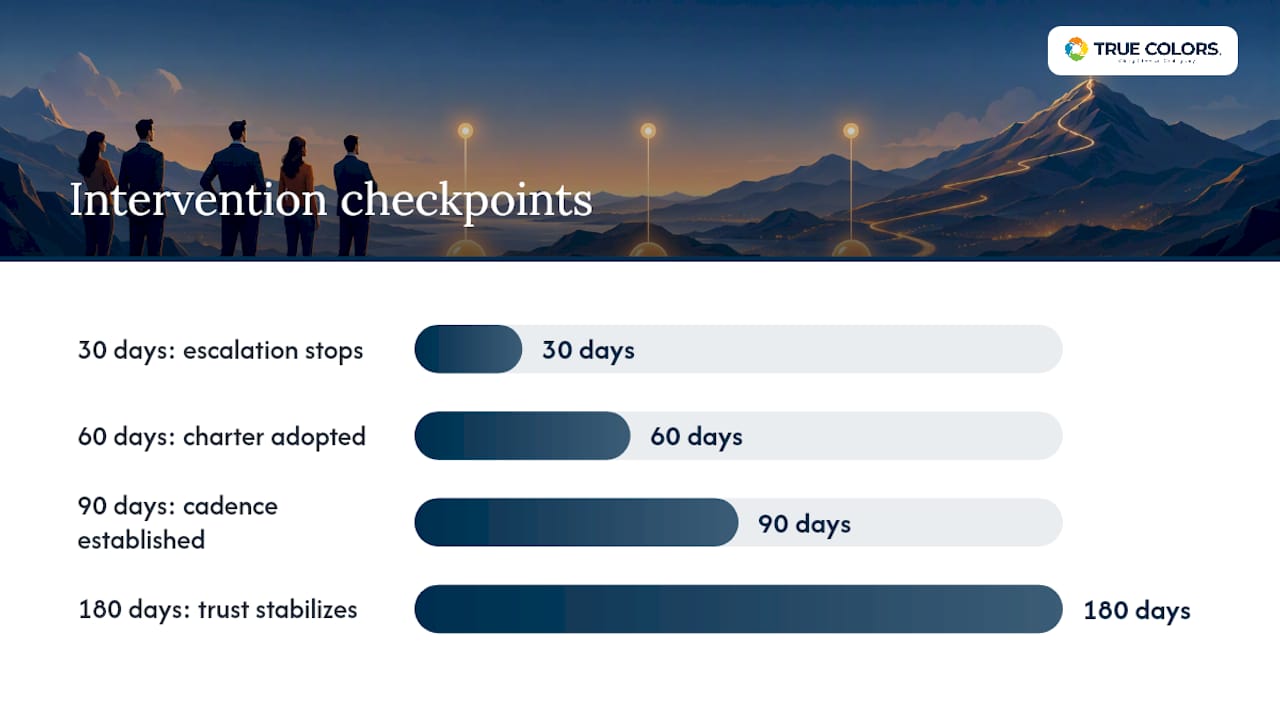
| Timeframe | What to expect | Relapse risk |
|---|---|---|
| 30 days | Public escalation stops; private diagnostics reveal root causes | Team reverts to old patterns if oversight drops too soon |
| 60 days | Decision rights and charter are drafted and adopted; meeting redesign underway | New norms feel forced without consistent facilitation |
| 90 days | Coaching or facilitation cadence established; decision speed measurably improves | Momentum stalls without a reinforcement checkpoint |
| 180 days | Trust survey signals stabilize; conflict resolves at lower levels without CEO involvement | Leadership turnover or a new high-stakes decision can reopen old fault lines |
Budget expectations vary widely by organization size and the depth of the intervention, but the shape is consistent: a diagnostic phase, followed by short-term facilitation, followed by ongoing coaching or reinforcement. Think of the diagnostic as the smallest, highest-leverage spend. Skipping it to jump straight to coaching is the single most common way this investment underdelivers.
The Employee Experience Survey approach applies here too: measuring trust and engagement signals after an intervention tells you whether the fix actually held, rather than assuming it did because the loudest arguments stopped.
What Does a 30/60/90 Action Plan Look Like in Practice?
A plan only works if someone specific owns each phase. Vague ownership is how good diagnostics turn into forgotten PDFs.
| Phase | Primary owner | Checkpoint |
|---|---|---|
| Diagnostic (Days 1 to 30) | CEO, with HR or an outside facilitator | Root cause identified and documented for each active conflict |
| Structural fixes (Days 31 to 60) | CEO plus affected function heads | Team charter and decision framework adopted in writing |
| Capability building (Days 61 to 90) | HR or L&D lead, with external coaching support | Coaching or facilitation cadence scheduled and first cycle complete |
- Week 1: Run diagnostic interviews with each executive involved in active friction.
- Week 2 to 4: Identify root cause per HBR's framework: facts, priorities, roles, resources, or behavior.
- Week 5 to 8: Draft or revise the team charter and assign explicit decision rights.
- Week 9 to 12: Launch coaching or facilitated sessions targeted at the specific behavior patterns identified.
For communication, keep it short and consistent. A town hall line: "We're investing in how this leadership team makes decisions together, not because something is broken, but because how we decide affects everyone here." An executive meeting opener: "Today we're deciding X. [Name] owns this decision. Let's get the data on the table before opinions." A follow-up email after a tense session: "Thank you for the direct conversation today. Here's what we agreed and who owns the next step."
Triage the lever based on what the diagnostic actually shows. If the root cause is unclear roles, fix the charter first. If it's a power imbalance dressed up as a communication issue, do not skip straight to a workshop. Consider whether talent or team composition needs a second look before investing further in the current configuration.
What We've Seen Work When Executive Teams Actually Change
The diagnostics that matter most rarely look dramatic from the outside. A team that keeps clashing over budget allocation often isn't fighting about money at all. It's fighting because nobody formally owns the tradeoff between two competing priorities, so every budget cycle reopens the same unresolved argument.
The most common mistake we see is not choosing the wrong lever. It's pulling back oversight the moment the public conflict quiets down. A charter gets signed, a coaching engagement wraps, and everyone assumes the work is done. Three months later the same pattern resurfaces, usually because nobody kept measuring the signals that mattered.
The durable outcomes share one trait: a maintenance routine that outlasts the initial engagement. A quarterly pulse check on trust and decision speed. A standing five-minute agenda item reviewing whether the charter's decision rights still match how the team actually operates. Neither is glamorous. Both are the difference between a fix that holds and one that quietly reverses by the following fiscal year.
How True Colors International Supports Executive Teams Through Conflict
Diagnosing the root cause of executive friction is only half the job. Making the fix stick, so the same argument doesn't resurface next quarter, is where most interventions quietly fail. Truecolorsintl builds programs around that second half specifically: turning a diagnostic insight into a repeatable behavior that survives beyond the workshop.

The Connected Leadership Program is built for executive teams working through exactly the pattern this article describes: role friction, decision-rights ambiguity, and communication breakdowns that resist a single conversation. Executive team coaching pairs individual behavioral diagnostics with facilitated sessions targeting the specific triggers your team actually faces, not a generic communication-styles workshop. For teams that want a measurable read on whether trust and collaboration are actually improving, the Employee Experience Survey gives you a baseline and a way to track progress at 90 and 180 days. If your team recognizes itself in the patterns above, start with a conversation on the corporate consulting page to scope a diagnostic before committing to a full program.
Frequently Asked Questions
How long does it take to reduce executive team conflict? Public de-escalation typically happens within 30 days. Structural fixes like decision rights and a team charter take another 30 to 60 days to adopt. Behavior change from coaching or facilitation usually needs 90 to 180 days to stabilize, and it relapses quickly without ongoing reinforcement.
What is the difference between productive and destructive executive conflict? Productive conflict surfaces real trade-offs, stays focused on the decision at hand, and ends with a commitment everyone honors. Destructive conflict erodes trust, resurfaces the same argument repeatedly, and pushes disagreement into backchannel conversations instead of the room where the decision gets made.
Should the CEO mediate conflict between two executives directly? The CEO should diagnose and clarify decision rights, not become the standing mediator. Persistent reliance on the CEO to arbitrate disputes usually signals a structural gap, like unclear ownership, that needs a governance fix rather than more mediation.
What is a team charter and does an executive team really need one? A team charter is a written document defining decision rights by category, meeting norms, and escalation rules. Teams with recurring turf conflicts over the same decisions almost always benefit from one, since it removes the ambiguity that fuels repeat disputes.
Sources
Several sources shaped the framework in this article, each supporting a distinct claim.
- Divergence Is Not A Detour: How Top Teams Turn Conflict Into Strategy
- Managing Conflict on Your Executive Team
- How Should a CEO Handle Conflict in the Executive Team? | WINGMIND
- How to assess and resolve your most difficult leadership standoffs | Judgment Call
- Boldedgeleadership