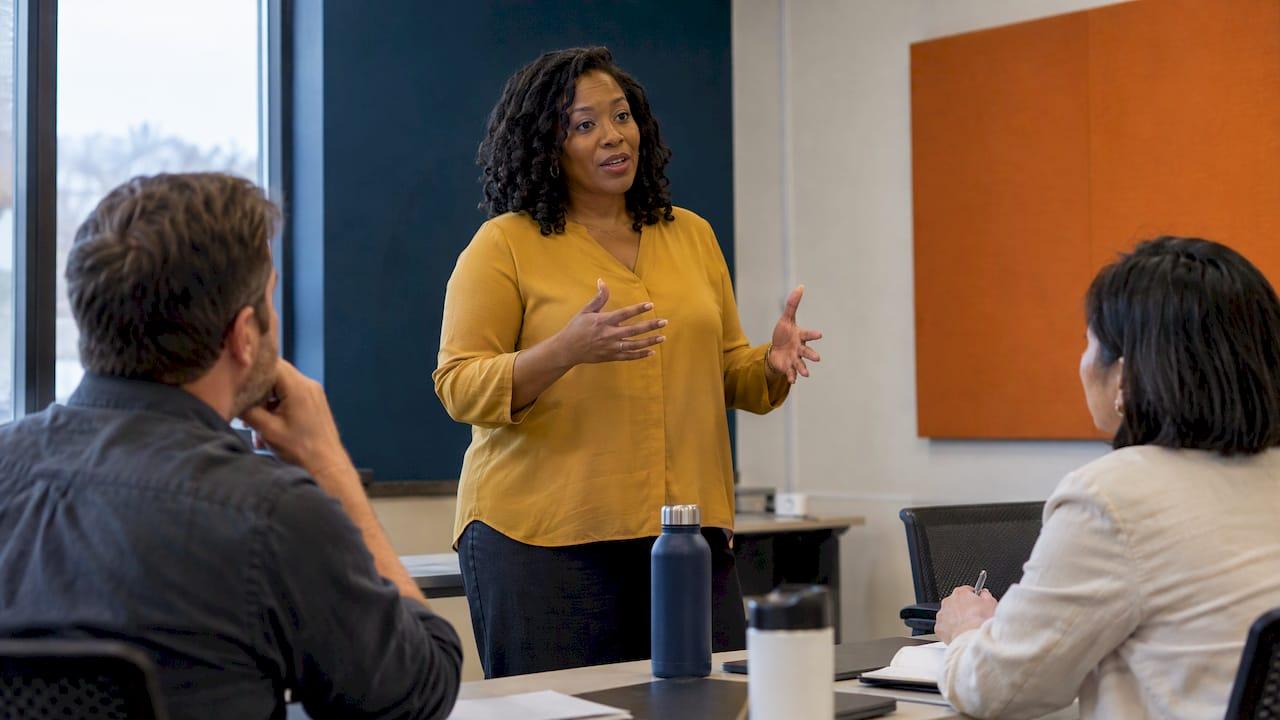
A leadership train-the-trainer program prepares selected leaders, managers or HR and learning professionals to teach leadership skills to others inside your organization. It works when you certify facilitators around one shared behavioral framework, give them practice and feedback, and measure what changes on the job. We built our facilitator certification pathways around this idea: a common language, delivered by people your teams already know and trust.
TL;DR
- Train-the-trainer turns a one-time leadership event into an internal capability: your own facilitators deliver, reinforce and adapt the content.
- Choose participants for credibility and willingness to teach, not only for title. Voluntary attendance is associated with stronger training results.
- Effective programs combine information, demonstration and practice, with feedback built in, rather than lecture alone.
- Start from a needs assessment tied to strategic goals, then evaluate against the same objectives.
- A behavioral assessment gives facilitators observable, changeable material to work with. That makes it a practical backbone for leadership development.
Table of Contents
- What a leadership train-the-trainer program is
- Who should be in the room
- What a leadership facilitator needs to know and do
- How to design the program: five steps
- Personality or behavioral assessment: which belongs in the program?
- Common failure points
- Where True Colors fits
- Our perspective
- FAQ
- Sources
What a leadership train-the-trainer program is
In a standard training model, an outside expert delivers a workshop and leaves. In a train-the-trainer model, you prepare a group of internal people to deliver the program themselves, to new cohorts, new hires and new managers, long after the first rollout.
For a C-suite sponsor, the appeal is scale and consistency. For HR and learning directors, it is control over cadence: you can run a session when a team needs it rather than when a vendor calendar allows. For the facilitators themselves, it is a development path that builds presence, coaching and group-management skills.
Two roles are worth separating, because organizations often blur them:
- The trainer teaches defined content: concepts, models, skills and the practice exercises that go with them.
- The facilitator manages the group's learning process. A 2024 framework in Humanities and Social Sciences Communications describes the facilitator as an active partner who guides reflection, explains concepts, challenges assumptions and builds learners' confidence. The International Association of Facilitators lists diagnosing client needs, managing group dynamics and guiding groups toward useful outcomes among its core competencies.
Leadership development needs both. Participants have to learn a model and then discuss how it plays out in their own teams. A person who can only present slides will not get there.
Who should be in the room
The strongest candidates usually fall into four groups:
- HR business partners and learning professionals, who already own development calendars and can embed the program in onboarding and manager training.
- Respected line leaders, whose stories carry weight with their peers.
- High-potential managers, for whom teaching is itself a leadership stretch.
- Executive sponsors, who do not need to facilitate but need to model the language and behaviors.
Select for credibility, communication ability and genuine interest. The meta-analysis of leadership training by Lacerenza and colleagues found that voluntary attendance was associated with larger training effects, which argues for inviting volunteers over drafting reluctant managers. Role and seniority matter less than whether colleagues will listen to the person at the front of the room.
What a leadership facilitator needs to know and do
The International Finance Corporation's guide to facilitating learning is a useful checklist for what your program must build. It says facilitators should know the content and the organization, communicate clearly, ask questions, lead activities, coach participants and debrief. It also recommends rehearsing difficult components, adapting for online tools and, when several facilitators will deliver one course, holding preparation sessions so they coordinate roles and logistics.
Translated into a curriculum for your internal facilitators, that means five competencies:
| Competency | What it looks like in practice | How to build it |
|---|---|---|
| Content mastery | Explains the leadership model and answers questions without reading from slides | Certification training plus observed delivery |
| Group management | Redirects tangents, draws out quiet participants, handles conflict in the room | Practice sessions with peer feedback |
| Debriefing | Turns an activity into a lesson tied to participants' real work | Scripted debrief questions, then coached improvisation |
| Adaptation | Adjusts for virtual groups, executive audiences or new hires | Rehearsal of the hardest segments |
| Coordination | Aligns with co-facilitators and HR on objectives, roles and logistics | Shared facilitator guides and prep meetings |
Notice what is missing: the leadership content itself is only one row. Programs that spend all their time on the model and none on delivery produce well-informed people who cannot run a good session.
How to design the program: five steps
SHRM's training and development materials follow the ADDIE sequence and begin with needs assessment and objectives linked to strategic goals, then move through design, delivery and evaluation. Applied to a leadership train-the-trainer program, that gives you five steps.
1. Define the problem the program solves
Start with performance, not content. Are managers struggling with feedback conversations, cross-team communication, conflict, or turnover on specific teams? An employee experience survey can show where the gaps sit. Our training needs assessment checklist for HR leaders walks through how to frame this before you commit budget.
Write two or three objectives in observable terms: what a manager will do differently, in which situation, and how you will see it.
2. Choose a shared framework
Facilitators need one model they all teach the same way. A behavior-based framework works well here because it gives every leader a common vocabulary for how they and their colleagues prefer to communicate, decide and handle pressure. Our guide to building a leadership development curriculum covers how to sequence the content.
3. Certify the facilitators
Certification should include content study, a demonstration of the session, supervised practice delivery and feedback. Lacerenza's meta-analysis reports that effective leadership programs commonly combine information, demonstration and practice, and that feedback, needs analysis and face-to-face delivery were associated with larger transfer effects. Build all of that into the facilitators' own training, then ask them to build it into theirs.
4. Launch with a pilot cohort
Run the first sessions with a friendly audience, observe the facilitators, and debrief them the same way they will debrief participants. Fix the pacing, the examples and the materials before you scale.
5. Evaluate and reinforce
Evaluate against the objectives you wrote in step one. Our guides on measuring the impact of leadership development and measuring leadership development outcomes show which indicators to track. The 2024 framework mentioned earlier also points to psychological safety, applied learning projects, reflective practice, coaching and continuous feedback cycles as conditions that support leadership learning. In other words, the work continues after the workshop: follow-up sessions, manager check-ins and refreshers keep the language in use.
Personality or behavioral assessment: which belongs in the program?
HR leaders often ask whether to build on a personality assessment or a behavioral one. The distinction is practical.
- Personality assessments describe general, relatively stable tendencies: how a person is inclined to think, react and relate.
- Behavioral assessments focus on how a person acts in work situations, the observable patterns colleagues actually experience.
Research by Kaiser and Hogan states that personality is relatively stable and that leadership development should primarily target behavior change rather than personality change. They also note that personality data and coworker feedback on behavior can be combined to explain both a leader's tendencies and the effect those tendencies have on others.
For a train-the-trainer program, this has a clear implication. Facilitators need material that participants can act on. Telling a manager what they are like is a starting point. Showing how that style lands with colleagues, and what to do differently with different people, is what changes meetings, feedback and delegation. That is why we position True Colors as a practical system that moves people from personal awareness to aligned action.
SHRM and SIOP's guidance on leader development recommends starting well-designed programs with assessment, including 360-degree feedback, personality self-reports, interests and motives, and simulations. They also say feedback should point to developmental opportunities tied to competencies, be interpreted with a trained feedback facilitator or coach, and become an individual development plan. A trained internal facilitator is exactly that interpreter, which is one more reason to certify them well.

Common failure points
Most train-the-trainer programs that stall do so for predictable reasons:
- No clear owner. Facilitators finish certification and nobody schedules sessions. Assign an HR or L&D lead who owns the calendar.
- Facilitators without time. Teaching is added to a full workload. Agree with their managers on protected hours.
- Content without practice. Participants hear the model and never apply it. Build in exercises and follow-up assignments.
- No reinforcement. Culture is not what is said. It is what is repeated. If the language disappears from meetings after the workshop, so does the change.
- No measurement. Without a baseline and a follow-up, the program cannot show results to the executive team.
Where True Colors fits
Our work with organizations covers the full path described above: assessment, team training, employee experience insights, leadership development and ongoing reinforcement. For organizations that want internal capability, we offer certification and continuing education for facilitators on our trainings page, including Personal Awareness & Success Certification Training, a refresher re-certification and a Facilitator Continuing Education Program. Our Team Building facilitator certification is delivered as scheduled courses; check the course page for the current dates.
If you want to see how the pieces combine for an entire organization, our corporate consulting solutions page is the place to start.

If your leaders also need coaching alongside facilitator certification, see our corporate leadership development coaching.
Our perspective
Most leadership programs fail at the same moment: the day the facilitator leaves. The ideas were fine. The repetition was missing.
That is why we think of train-the-trainer as culture work, not a training logistics decision. When a trusted colleague teaches a shared behavioral language, people hear it as how we work here, not as something an outside expert said once.
The sequence we believe in is simple. Start with personal awareness, so leaders understand their own style and how it lands. Move to aligned action, where teams use that understanding to communicate, resolve conflict and make decisions. Then reinforce it with facilitators who keep the language alive in everyday work.
Leaders who can see their own patterns can change them. Organizations that give them a common language and people to practice it with change faster.
Theresa
FAQ
What is a train-the-trainer certification?
It is a structured program that prepares someone to teach a defined body of content to others. It typically covers the content itself, facilitation technique, supervised practice and feedback. In a leadership context, it qualifies internal people to deliver leadership training to their colleagues.
How long does it take to build an internal facilitator team?
It depends on the framework and how many facilitators you need. Plan for certification, a pilot cohort with observation and feedback, and a refresher cycle. Lacerenza's meta-analysis associates longer programs with practice with stronger results, so protect time for practice rather than compressing it.
Who is a lead trainer, and how is that different from a facilitator?
A lead trainer typically owns the program: its content, standards and the development of other trainers. A facilitator manages the group's learning in the room, using questions, activities and debriefs. In practice, strong internal programs name a lead who coordinates the rest, and the IFC guide recommends preparation sessions for facilitators when several people deliver one course.
Should facilitators come from HR only?
No. HR and L&D usually coordinate, but credible line leaders often carry more weight with their peers. A mixed group gives you both program discipline and business credibility.
How do we know the program is working?
Compare behavior and team outcomes against the objectives you set at the start. Use participant feedback, manager observation and employee experience survey results, then repeat the measurement after a few months.
Sources
- A framework for the facilitation of accelerated leadership development
- IAF Core Competencies
- The Nuts and Bolts of Leadership Training: A Meta-Analysis
- IFC: Facilitating learning
- SHRM: Training Design, Development and Implementation
- Kaiser and Hogan: Personality, Leader Behavior, and Overdoing It
- SHRM and SIOP: Leadership Development: Growing Talent Strategically