
A leadership development roadmap is a staged, measurable plan that connects leader capability building to business priorities and defines who gets developed, in what, on what timeline, and with what proof of results. It runs through seven stages: align, assess, prioritize, design, measure, pilot, and scale. This article breaks down each stage with templates, sample KPIs, and how Truecolorsintl supports organizations that would rather build this system with a partner than from scratch.
TL;DR:
- A leadership development roadmap should focus on specific business outcomes and behavioral changes rather than generic skills or training topics.
- Baseline assessments for capabilities include 360 feedback, performance data, psychometric tests, and talent maps, which inform targeted cohort prioritization.
- Priority cohorts are ranked by impact and readiness, with role-specific competencies defined before designing tailored programs.
- Programs should follow a 70-20-10 model, emphasizing real work, peer learning, and short formal sessions, with coaching integrated monthly to reinforce skills.
- Piloting with small, motivated groups for 90 days to 6 months is essential before full-scale rollout, ensuring adjustments are made based on actual feedback and results.
Table of Contents
- Align: Turning Strategy Into Roadmap Goals and KPIs
- Assess: Baseline Current Capability With 360s and Talent Maps
- Prioritize: Choosing Cohorts and Defining Competencies
- Design: Building the Blended Learning Experience
- Measure: KPIs, Cadence, and Building an ROI Story
- Pilot and Scale Without Losing Control
- Governance, Timeline, and Keeping the Roadmap Alive
- Templates and Tools to Build Your Own Roadmap
- What Actually Stalls Leadership Programs
- How Truecolorsintl Supports Your Leadership Roadmap
- Sources
- FAQ
Align: Turning Strategy Into Roadmap Goals and KPIs
A roadmap that starts with training topics instead of business priorities is already off course. The first move is translating strategic goals, market expansion, margin improvement, customer retention, into specific leadership behaviors that drive them. If the strategy depends on faster decision-making at the regional level, the roadmap's goal is not "improve leadership skills." It is "increase regional manager decision speed and delegation confidence."
Harvard Business School Publishing has long argued that leadership programs succeed when they tie directly to measurable performance goals rather than generic competency lists. That distinction shapes everything downstream, including which cohorts get prioritized and what data you collect later.
Before building anything, secure a sponsor who controls budget and will defend the program when priorities shift midyear. Use this checklist to test whether sponsorship is real:
- The sponsor has named a specific business outcome the roadmap must move
- Budget is approved for at least 12 months, not a single quarter
- The sponsor agrees to review results personally, not delegate it entirely
- A named executive will publicly champion participation
Pro Tip: Ask your sponsor to write one sentence describing what success looks like in a year. If they cannot do it in under 20 words, the goal isn't clear enough to build a roadmap around yet.
A sample KPI set blends behavior and business outcomes: manager retention rate, internal promotion rate, 360 feedback score change, employee engagement index, and time-to-productivity for new leaders. Gartner's HR trend research points to capability building and measurement as a leading focus area for HR functions, which reinforces why this alignment work belongs at the front of the process, not bolted on afterward.
Assess: Baseline Current Capability With 360s and Talent Maps
You cannot measure leadership growth without knowing where leaders stand today. Most organizations skip a real baseline and rely on gut feel from managers, which produces a roadmap built on assumptions rather than evidence.
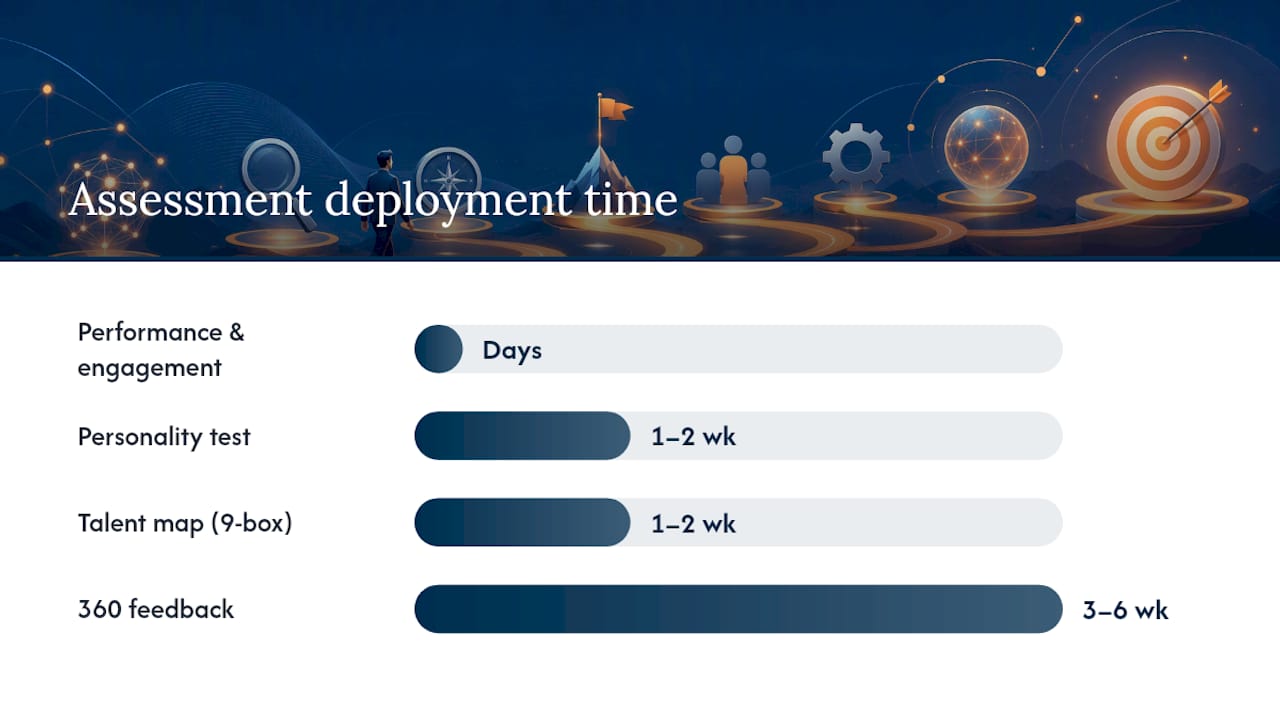
Three assessment methods carry different tradeoffs. A 360 feedback process gives behavioral detail from peers, direct reports, and managers, but takes weeks to administer well. Performance and engagement data are faster to pull and already exist in most HR systems, though they measure outcomes rather than the behaviors driving them. Psychometric or personality-style assessments reveal working styles and communication patterns that predict how a leader will handle conflict or change, information that surveys alone rarely surface.
| Assessment Type | Time to Deploy | Best For |
|---|---|---|
| 360 feedback | 3-6 weeks | Behavioral detail, peer perspective |
| Performance/engagement data | Days | Fast baseline, existing systems |
| Personality-style assessment | 1-2 weeks | Working style, communication gaps |
| Talent map / 9-box grid | 1-2 weeks | Succession and readiness view |
A 9-box grid plots current performance against future potential, giving you a visual map of who is ready now, who needs seasoning, and where you have gaps that hiring alone won't fix. Building one requires manager input, calibration sessions to remove individual bias, and a second look from HR to catch blind spots.
Baselines matter because they become your comparison point at the 90-day and annual review marks. Record scores by cohort, not just individually, so you can track group movement over time. Before assessment week, confirm you have:
- Access to recent engagement survey results
- Manager calendars blocked for calibration sessions
- A defined confidentiality policy for 360 respondents
- Sign-off from legal or HR compliance on assessment tools used
Prioritize: Choosing Cohorts and Defining Competencies
Not every leader gets the same investment at the same time, and pretending otherwise spreads your budget too thin to move anything. Rank potential cohorts, first-time managers, high potentials, senior leaders, against two dimensions: business impact if they improve, and readiness to absorb development right now.
A first-time manager cohort often scores high on impact (they influence retention immediately) and high on readiness (they're hungry for structure). A senior leadership cohort might carry higher strategic impact but lower readiness if they're mid-reorg and distracted. Impact times readiness gives you a defensible sequence instead of a political one.
Competency frameworks should map to role level, not sit as one generic list. First-time managers typically need delegation, feedback delivery, and performance conversations. Senior leaders need strategic influence, cross-functional negotiation, and change sponsorship. Cornerstone's guidance on building leadership development plans recommends defining competencies before designing any learning experience, since the competency list determines everything about program content.
- Rank cohorts by impact × readiness before finalizing scope
- Confirm competency lists differ by role level, not by department alone
- Review cohort composition for representation across race, gender, tenure, and function
- Flag any cohort selection that mirrors existing informal favoritism
Pro Tip: Run your shortlisted cohorts past someone outside HR, ideally a frontline manager, and ask if the list matches who they'd nominate. If it doesn't, you have a visibility gap worth investigating before launch.
A common shortlist for year one: first-time managers (highest volume, fastest win), followed by a smaller high-potential cohort, with senior leader development phased in during year two once the model is proven.
Design: Building the Blended Learning Experience
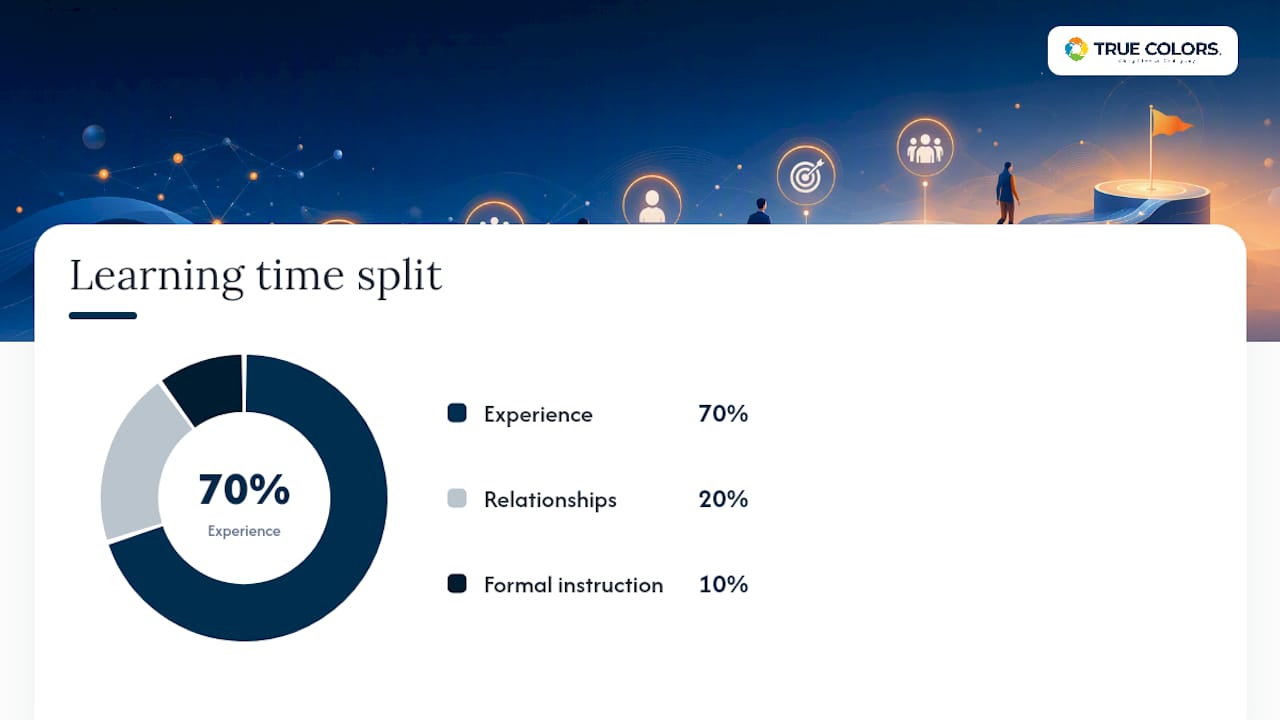
The 70-20-10 model splits development into 70% experience (stretch assignments, real projects), 20% relationships (coaching, mentoring, peer learning), and 10% formal instruction (workshops, courses). Practitioner frameworks, including guidance from Cabinet's leadership plan template, consistently favor this weighting because on-the-job practice sticks better than classroom content alone.
For a first-time manager cohort, a 6-month program might sequence like this:
- Month 1: Baseline assessment results shared individually, kickoff workshop on delegation and feedback fundamentals
- Month 2: Stretch assignment assigned (lead a cross-team project), paired with a peer accountability partner
- Month 3: First coaching session, mid-point check-in on stretch assignment progress
- Month 4: Formal session on difficult conversations, second stretch assignment milestone
- Month 5: Peer learning circle, second coaching session
- Month 6: Final 360 reassessment, capstone presentation to sponsor, individual development plan for year two
Source internal experiences (stretch assignments, job shadowing, cross-functional projects) from your own operations first. They cost less and build organizational knowledge alongside leadership skill. Reserve external experiences, simulations, executive coaching, certification programs, for gaps you cannot fill internally, particularly around strategic or industry-specific competencies.
Weekly time commitment for participants typically runs 2 to 4 hours: one hour of applied work on the stretch assignment, 30 minutes with a peer or coach, and the remainder on reflection or formal content. Programs that ask for more than that in a normal workweek tend to see attendance drop by month three.
- Anchor 70% of program time in real work, not workshops
- Pair every stretch assignment with a named accountability partner
- Keep formal instruction to short, focused sessions rather than day-long seminars
- Build in at least one coaching touchpoint per month
For teams building out a full curriculum structure, a detailed leadership curriculum framework walks through sequencing decisions in more depth.
Measure: KPIs, Cadence, and Building an ROI Story
Leading indicators tell you whether the program is working before business results catch up. Lagging indicators prove it mattered. Track both, because leading indicators alone can mislead you into declaring victory too early, and lagging indicators alone arrive too late to course correct.
Leading indicators include engagement in coaching sessions, completion of stretch assignments, and manager-reported behavior change within 90 days. Lagging indicators include promotion rate within the cohort, voluntary turnover among participants, and movement in the original business KPI, decision speed, customer retention, whatever you defined during the align stage.
- Set baseline scores during the assess stage, before launch
- Define target movement (a specific point increase or percentage shift) for each KPI
- Report leading indicators monthly, lagging indicators quarterly
- Pair every number with a short narrative explaining what drove the change
Cornerstone's research on leadership plan design emphasizes that narrative matters as much as the raw numbers when you're asking sponsors to continue funding.
Build a quarterly review template that answers three questions: what moved, what didn't, and what you'll change next quarter. An annual version rolls those quarters into a single business case, showing the sponsor exactly what their investment produced against the original goal set during alignment.
Pilot and Scale Without Losing Control
Start with one cohort, not the whole organization. A pilot group of 15 to 30 people gives you enough signal to spot design flaws without risking your full budget or reputation on an unproven program.
- Choose a motivated cohort with a supportive manager layer above them, since resistance from managers kills pilots faster than any content problem
- Set a defined pilot length, typically 90 days to 6 months, with clear success criteria agreed upon before launch
- Collect feedback at the midpoint, not just the end, so you can adjust content or pacing while it still matters
- Compare pilot results against your baseline, using the same KPIs you'll use at full scale
- Decide on scale, redesign, or stop based on evidence, not sunk-cost pressure to keep something running
The OPM Leadership Development Toolkit reflects this same instinct toward staged rollout, favoring smaller tested cycles over one large launch. The NCAA's Pathway Program offers a useful outside example: a yearlong cohort model with mentoring and structured milestones, illustrating how a sector-specific program can stay disciplined about pacing rather than rushing to cover everyone at once.
The biggest scaling mistake is expanding cohort size before fixing what the pilot revealed. If coaching capacity was already stretched at 20 participants, doubling to 40 without adding coaches guarantees the same complaints at twice the volume.
Governance, Timeline, and Keeping the Roadmap Alive
A roadmap without owners drifts within two quarters. Assign a RACI: HR or L&D as the responsible party running day-to-day design, the executive sponsor as accountable for outcomes, participating managers as consulted on cohort selection, and the broader leadership team informed through quarterly updates.
Structure the timeline in 90-day cycles nested inside an annual refresh. AIHR's research on leadership plan design points to this 90-day rhythm, weekly practice paired with quarterly review, as the pacing that keeps programs from becoming a once-a-year checkbox exercise.
Budget allocation should split roughly between assessment tools, facilitator or coaching time, and program materials, with a reserve held back for pilot adjustments you can't predict at the planning stage.
- Assign one named owner accountable for reporting results each quarter
- Build manager development goals directly into existing talent review cycles
- Reserve 10 to 15 percent of budget for unplanned pilot fixes
- Revisit competency frameworks annually as strategy shifts
Templates and Tools to Build Your Own Roadmap
A working roadmap needs artifacts, not just a plan on a slide. Build a 90-day cohort template that tracks assessment dates, stretch assignment milestones, coaching touchpoints, and the review meeting where you compare results to baseline.
Assessment tool categories fall into three groups: 360 platforms for behavioral feedback, psychometric or personality-style instruments for working-style insight, and your existing LMS for tracking formal learning completion. Choose based on what data you're missing, not what's easiest to buy.
- Build a mentoring playbook that defines match criteria and meeting cadence
- Maintain a stretch assignment library so managers aren't inventing projects from scratch each cohort
- Keep a running competency map tied to role levels across the organization
- Log every pilot's feedback in one place so lessons carry into the next cohort
Organizations that want a structured program rather than building every piece internally often look at the Connected Leadership Program, which pairs assessment, cohort design, and reinforcement into one system rather than a collection of separate tools.
What Actually Stalls Leadership Programs
Most roadmaps don't fail from bad design. They stall because behavior change never gets reinforced after the formal program ends, and managers quietly revert to old habits within a few months. HBR's research on culture and leadership development makes the case plainly: a program that ignores the surrounding culture is fighting its own organization.
The fix isn't more content. It's a shared language for behavior and consistent reinforcement long after the pilot ends, which is exactly what a practical culture system is built to sustain.
— Theresa
How Truecolorsintl Supports Your Leadership Roadmap
There are providers that offer support for building every stage of this roadmap, assembling assessments, cohort design, and reinforcement. Where a generic training provider hands you a workshop and disappears, our approach centers on a proprietary behavior-based system that carries leaders from personal awareness into aligned action, with ongoing reinforcement rather than a one-time event.

If you're at the assess stage, the Individual Personality Assessment Consultation provides a working-style baseline your roadmap needs; current prices are on the pricing page. If you're designing cohort programs, Personal Awareness & Success Training and related programs aim to build a shared language leaders can use after formal sessions. For organizations ready to run a structured, multi-stage program rather than build one internally, there are programs designed for this handoff, such as the Connected Leadership Program. Reach out to scope which stage of your roadmap needs support first.
Sources
- How to Create a Leadership Development Plan That Drives Results | Cornerstone
- Don't let your company's culture stifle leadership development | HBR
FAQ
What Is a Leadership Development Roadmap?
A leadership development roadmap is a staged plan that aligns leader capability building with specific business goals, moving through alignment, assessment, prioritization, design, measurement, and scaling. It differs from a single training program because it includes governance, timelines, and measurable KPIs rather than a one-time event.
How Long Does It Take to Build a Leadership Development Roadmap?
Most organizations spend about a month on the align and assess stages before launching a pilot cohort. A full pilot typically runs 90 days to 6 months, based on AIHR's recommended cadence, before a scaling decision is made.
What KPIs Should I Track in a Leadership Development Plan?
Track a mix of leading indicators, coaching engagement, stretch assignment completion, and lagging indicators like promotion rate, voluntary turnover, and the specific business metric tied to your original strategic goal. Report leading indicators monthly and lagging indicators quarterly for a clearer trend.
Should I Pilot a Leadership Program Before Rolling It Out Organization-Wide?
Yes. A small pilot cohort of 15 to 30 people lets you test design and coaching capacity before committing your full budget, an approach reflected in the OPM Leadership Development Toolkit and echoed across most practitioner frameworks.
How Does Truecolorsintl Support Leadership Development Roadmaps?
Truecolorsintl offers behavior-based assessments, cohort design, and the Connected Leadership Program to help organizations move from personal awareness into sustained leadership behavior change. Pricing for the Individual Personality Assessment Consultation is $350 one-off; other services are quoted based on scope.