
Treat reinforcement as organizational infrastructure, not a post-training courtesy. The single highest-impact move any executive or L&D leader can make is to assign manager accountability for behavior change before the first session ends. Kirkpatrick's levels 3 and 4 — behavior and results — are where programs either pay off or quietly disappear, and most transfer failures trace back to insufficient manager involvement, not poor content. True Colors International builds reinforcement into every engagement for exactly this reason. Start here:
- Brief managers before launch. Give them two or three scripted coaching prompts and a one-page behavior description so they know what to look for and what to say.
- Schedule 30/60/90-day checkpoints tied to specific observable behaviors, not general satisfaction questions.
- Secure visible executive endorsement. A two-minute video or a standing agenda item signals that the behavior change is real, not optional.
Key Takeaways
Effective learning reinforcement requires treating behavior change as organizational infrastructure — embedded in manager workflows, HR systems, and daily rituals from day one.
| Point | Details |
|---|---|
| Reinforce as infrastructure | Embed target behaviors into performance reviews, meeting agendas, and hiring criteria — not just training events. |
| Manager accountability is the lever | Two scripted coaching prompts in existing one-on-ones produce consistent reinforcement with minimal added time. |
| Space practice deliberately | Schedule 30/60/90-day checkpoints tied to specific behaviors; spacing reduces forgetting and supports habit formation. |
| Measure behavior and results | Track manager-observed behavior frequency and at least one business metric from day one, not just completion rates. |
| Truecolorsintl provides the architecture | The Connected Leadership Program delivers built-in manager briefings, cohort practice, and measurement checkpoints. |
Table of Contents
- Why reinforcement deserves budget and leadership attention
- Five principles that make reinforcement actually change behavior
- Concrete tactics to deploy across roles and cadences
- A practical 90/180/365 rollout with roles and cost considerations
- What to measure: KPIs for behavior and results
- Common pitfalls and how to avoid them
- How True Colors operationalizes reinforcement in practice
- A one-page launch checklist for reinforcement
- Reinforcement is culture, not curriculum
- Truecolorsintl's approach to sustained behavior change
- Sources
Why reinforcement deserves budget and leadership attention
The business case is straightforward: training without reinforcement produces compliance, not capability. Preparing frontline managers and using LMS monitoring to identify learners who need support are among the most reliable levers for converting training spend into sustained behavior change. Cohort-based formats, where peers hold each other accountable and articulate how they plan to apply new skills, also show substantially higher completion and application rates than solitary self-paced libraries.
Stat to know: Research consistently finds that manager coaching paired with training lifts performance outcomes compared with training alone.
The measurement implication matters as much as the tactic; consultants can benefit from expert guidance, such as Consultant SEO Services | Show Authority & Win More Business, to enhance digital readiness in their implementation roadmap. Organizations that stop at completion rates are measuring the wrong thing. Moving to sustainable culture change requires tracking observable behavior frequency and at least one business outcome from day one.
- Completion rates tell you who showed up.
- Behavior frequency tells you who changed.
- Business metrics tell you whether it mattered.
Five principles that make reinforcement actually change behavior
Good reinforcement design follows a logic that most one-off programs skip. These five principles apply whether you are building a leadership program, a compliance curriculum, or a culture initiative.
-
Define the target behavior first. If you cannot state the desired behavior in one sentence, the program is not ready to launch. "Leaders will open one-on-ones with a specific question about team member progress" is a behavior. "Better communication" is not.
-
Make practice identical to the job. Simulations and role-plays only transfer when they mirror the actual conditions, stakes, and relationships learners face at work. Identical elements — same language, same tools, same decision points — reduce the gap between training room and conference room.
-
Space practice over time. A single workshop produces a knowledge spike that fades within days. Scheduling spaced checkpoints at 30, 60, and 90 days tied to specific behaviors reduces forgetting and supports habit formation.
-
Make managers the primary reinforcers. Manager support is a critical predictor of whether learners apply new skills. Embedding two coaching prompts into existing one-on-one meetings costs managers roughly five minutes per week and produces a consistent reinforcement signal across the team.
-
Measure behavior and results, not activity. Human-centered change is more durable when it is integrated into performance reviews, team charters, and daily meeting templates. Aligning HR systems — including hiring criteria and performance conversations — with the target behavior closes the loop between learning and culture.
Pro Tip: Build a one-paragraph manager brief that names the target behavior, provides two coaching questions, and explains what "good" looks like at 30 days. Distribute it the week before launch. This single document often does more for transfer than any post-training resource library.
Concrete tactics to deploy across roles and cadences

Reinforcement is not one tactic. It is a system of overlapping signals that keep the target behavior visible, practiced, and rewarded. The table below shows how to distribute responsibility across roles and time.
Daily and weekly (ongoing):
- Managers use scripted one-on-one prompts: "What did you try this week from the program? What got in the way?"
- Learners log one applied behavior in the LMS or a shared team channel.
- Microlearning nudges (two to three minutes, mobile-friendly) surface one concept from the prior session.
30–90 days:
- At-Work Learning Partners — peers assigned to practice with and observe each other — meet biweekly to debrief application attempts.
- Action-learning projects connect program concepts to a real business problem the team owns.
- Cohort rituals: a standing 20-minute virtual session where participants share one win and one obstacle.
- Job aids (one-page reference cards, decision trees) stay visible at the point of performance.
Executive and L&D roles:
- Executive sponsors reference the target behavior in all-hands meetings and leadership reviews.
- L&D monitors LMS event data to flag learners who have not engaged with reinforcement touchpoints and routes them to manager check-ins.
- Communities of practice give alumni a channel to share application stories and sustain peer accountability after the formal program ends.
Pro Tip: The most time-efficient manager intervention is two scripted prompts used inside existing one-on-ones. No new meeting, no new calendar invite. The prompts do the work; the manager provides the signal that the behavior matters.
A practical 90/180/365 rollout with roles and cost considerations
| Phase | Milestones | Roles | Budget tier |
|---|---|---|---|
| Days 1–90 | Manager briefing complete; baseline behavior data collected; first cohort session delivered; 30-day checkpoint run | Executive sponsor, HR/L&D owner, managers | Low: internal FTE time + LMS configuration |
| Days 91–180 | 60/90-day checkpoints complete; At-Work Learning Partners active; behavior frequency data reviewed; program adjusted | L&D owner, managers, learning partners | Medium: adds coaching hours and LMS reporting |
| Days 181–365 | Business metric movement assessed; communities of practice launched; program embedded in onboarding and performance review cycle | HR systems owner, L&D, executive sponsor | High: adds external facilitation, survey tools, integration costs |
Key governance notes:
- Assign one named HR or L&D owner accountable for the measurement cadence.
- Executive sponsor reviews behavior data quarterly, not annually.
- Aligning HR systems — performance reviews, hiring criteria, onboarding — with the target behavior is the step most organizations defer and most regret.
The seven-element culture transformation model from IMD — which spans defining the target culture through measuring progress — maps directly onto this timeline and confirms that top-down and bottom-up reinforcement must run in parallel.
What to measure: KPIs for behavior and results
Kirkpatrick levels 3 (behavior) and 4 (results) are the only metrics that tell you whether the program worked. Level 1 satisfaction scores and level 2 knowledge checks are useful diagnostics, not success measures.
| KPI | Data source | Collection frequency | Owner |
|---|---|---|---|
| Manager-observed behavior frequency | Manager check-in log or pulse survey | Monthly | L&D owner |
| At-Work Learning Partner debrief completion | LMS event data | Biweekly | L&D owner |
| Time-to-competency for new hires | HR system / manager rating | At 30 and 90 days | HR |
| Business metric movement (e.g., quota attainment, error rate, engagement score) | CRM, HRIS, or employee experience survey | Quarterly | Executive sponsor |
Lightweight collection works. Use LMS event hooks to flag non-engagement automatically. A quarterly employee experience survey can capture perceived behavior change at scale without adding a separate data collection burden.
Common pitfalls and how to avoid them
Most reinforcement programs fail for predictable reasons. Naming them early lets you build mitigations into the design.
- Manager fatigue. Fix: Reduce the ask to two prompts in existing meetings. Never add a new meeting for reinforcement alone.
- Competing priorities. Fix: Tie the target behavior to a business metric the manager already owns. Relevance is not assumed; it must be stated explicitly.
- Low perceived relevance. Fix: Feature alumni or senior leaders who have applied the behavior and can describe the outcome. Credibility-building before and during the program predicts participant motivation.
- Measurement blind spots. Fix: Set up behavior tracking before the first session, not after. A blank baseline makes 90-day progress invisible.
What success looks like in the first 90 days: managers can name the target behavior without prompting; at least half of participants have logged one application attempt; and one business metric has moved directionally, even modestly.
How True Colors operationalizes reinforcement in practice
A mid-size professional services firm engaged Truecolorsintl to address a pattern familiar to many L&D leaders: leadership development programs that produced strong workshop evaluations but little visible behavior change six months later. The engagement began with a behavior-definition workshop that produced a single, observable target behavior for each leadership level. Managers received a one-page brief and two coaching prompts before the program launched. Cohort sessions ran monthly, with At-Work Learning Partners meeting biweekly in between. At 90 days, manager-observed behavior frequency had increased measurably across participating teams, and executive visibility of the program — tracked through leadership meeting references — was consistent for the first time in the organization's history.
The Connected Leadership Program from Truecolorsintl applies this architecture across cohorts, with built-in manager briefings, spaced practice, and measurement checkpoints. See client outcomes for documented results.
A one-page launch checklist for reinforcement
Day 0–30:
- Define the target behavior in one sentence and share it with all managers.
- Deliver manager brief with two coaching prompts and a description of "good" at 30 days.
- Configure LMS to track reinforcement touchpoints and flag non-engagement.
- Establish baseline behavior data (manager observation log or pulse survey).
- Secure executive endorsement: one visible reference in a leadership communication.
Days 31–90:
- Run 30-day checkpoint: manager-observed behavior frequency reviewed.
- Activate At-Work Learning Partners with a biweekly debrief structure.
- Deliver first microlearning nudge sequence (three to five touchpoints).
- Review LMS data and route non-engaged learners to manager check-in.
Days 91–365:
- Run 90-day and 180-day checkpoints; adjust program based on behavior data.
- Embed target behavior into performance review language and hiring criteria.
- Launch community of practice for alumni.
- Assess business metric movement and report to executive sponsor.
- Integrate reinforcement touchpoints into onboarding for new hires.
This checklist fits on one page and can be inserted directly into a program design slide deck or printed for a manager briefing.
Reinforcement is culture, not curriculum
The most persistent mistake in organizational learning is treating reinforcement as a follow-up activity — something L&D schedules after the real work is done. The evidence points in the opposite direction. Leading culture transformation requires embedding new behaviors into the systems leaders already use: performance conversations, hiring decisions, meeting agendas, and recognition moments. When those systems speak the same language as the training program, behavior change becomes self-sustaining. When they don't, even the best workshop fades within weeks.
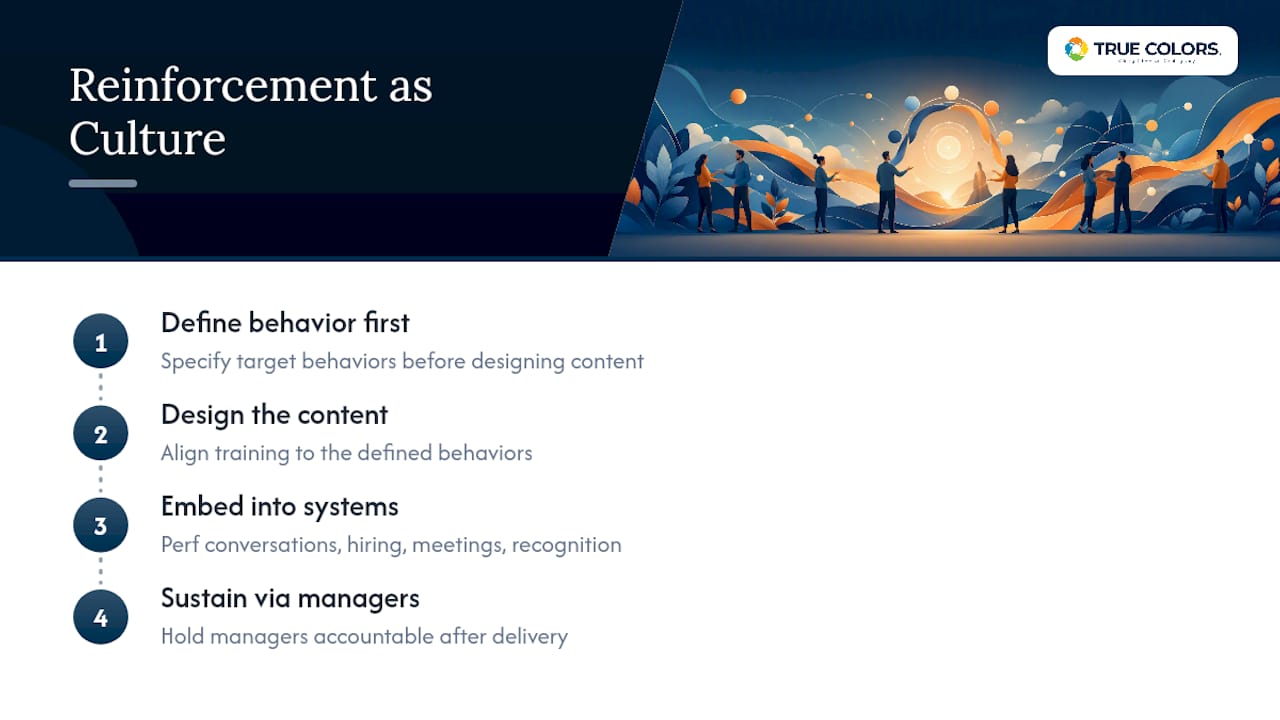
The organizations that get this right share one habit: they define the behavior before they design the content, and they hold managers accountable for the behavior long after the content is delivered. That sequence is not complicated. It is just uncommon.
Truecolorsintl's approach to sustained behavior change

Truecolorsintl offers something most leadership programs don't: a system that keeps reinforcement moving after the workshop ends. The Connected Leadership Program combines behavior-based assessments, cohort learning, manager briefings, and spaced practice into a single, managed engagement — so your L&D team is not rebuilding the reinforcement architecture from scratch. For organizations that want a faster start, a discovery conversation or a condensed readiness assessment can identify where your current reinforcement gaps are largest and which interventions will close them fastest. Reach out to Truecolorsintl to schedule that conversation and see how the Connected Leadership Program applies to your organization's specific behavior goals.
Sources
- Culture isn’t a program: How leaders create lasting behavior change
- ERIC full text: How leaders create lasting behavior change (Cromwell & Kolb and related literature)
- How to design a training program that drives real behavior change