
The nine box grid is a 3×3 talent matrix that maps current performance against future potential to drive succession and development decisions. Organizations use it to run structured talent reviews, prioritize development budgets, and build succession pipelines for critical roles. It works best as a conversation starter, not a verdict. Because potential is inherently harder to measure than performance, every placement needs calibration across managers and real evidence behind it.
TL;DR:
- Many organizations struggle with potential assessment bias, often relying on manager intuition instead of structured, evidence-based evaluation criteria.
- Implementing a formal calibration process with documented evidence and diverse raters significantly reduces variance and bias in placement decisions.
- Each talent grid position requires tailored development actions, such as stretch assignments for high potentials and performance improvement plans for low performers.
- Relying solely on performance KPIs leaves potential ratings vulnerable to bias and misclassification, which can hinder effective succession planning.
- Regularly reviewing placements with clear follow-up actions and behavioral evidence integration enhances actual leadership development instead of just charting results.
Table of Contents
- What Is a Nine Box Grid and How Does It Work?
- How Do You Run a Nine Box Assessment Step by Step?
- What Does Each Box Mean and What Should You Do About It?
- Is the Nine Box Grid Worth Using, and Where Does It Break Down?
- How Do You Build a Nine Box Grid in Excel or a Simple Template?
- How Behavior-Based Evidence Improves Placement Accuracy
- A First-Time Facilitator's Checklist for Running This Well
- Turning Talent Review Data Into Real Behavior Change
- Sources
What Is a Nine Box Grid and How Does It Work?
A nine box grid plots two things: what someone has already delivered, and what they're capable of delivering next. The horizontal axis measures current performance, usually scored low, medium, or high based on results against goals, KPIs, or role expectations. The vertical axis measures potential, the same three levels, but looking forward at capacity for bigger or more complex roles.
Cross those two axes and you get nine cells, each representing a distinct talent profile. SHRM frames the nine box grid as a standard succession planning tool precisely because it forces this two-dimensional view. A high performer with low potential and a high performer with high potential look identical on a performance review, but they need completely different investment strategies. The grid makes that difference visible.
Most organizations label the nine boxes something like this:
- High performance, high potential: Star Performer, sometimes called the successor pool.
- High performance, medium potential: High Impact Performer, strong in role, room to grow.
- High performance, low potential: Trusted Professional, excellent at the current job, likely staying there.
- Medium performance, high potential: Rising Star or Emerging Talent, still building consistency.
- Medium performance, medium potential: Core Player, the backbone of most teams.
- Medium performance, low potential: Solid Contributor, steady but capped.
- Low performance, high potential: Enigma or Rough Diamond, talent that isn't translating into results yet.
- Low performance, medium potential: Inconsistent Player, needs a closer look at fit or engagement.
- Low performance, low potential: Under Performer, the box that triggers the hardest conversations.
The AIHR practitioner framework describes this range running from "Star Performer" at the top right to "Problem Team Member" at the bottom left, with seven distinct profiles in between. The real value isn't the labels themselves. It's what the position implies about investment: top-right cells signal accelerate and retain, bottom-left cells signal intervene or exit, and everything in the middle signals develop with intention rather than assumption.
How Do You Run a Nine Box Assessment Step by Step?
A nine box exercise fails when teams skip straight to scoring. Organizations that get real value from this tool treat it as a process with four distinct phases, not a single meeting where managers eyeball people and place dots on a chart.
- Set criteria before anyone scores anyone. Define what "high performance" and "high potential" mean in concrete, observable terms for your organization. Performance criteria usually tie to existing KPIs, project outcomes, or goal attainment. Potential criteria are trickier and should reference specific behaviors: learning agility, how someone handles ambiguity, willingness to take on stretch work, and influence beyond their formal authority.
- Have managers pre-rate their teams using evidence, not memory. Each manager should walk into calibration with a completed rating and supporting documentation: recent project outcomes, 360 feedback if available, specific examples of behavior under pressure, and any measurable KPI trends. A rating with no evidence attached should not survive the calibration meeting.
- Run a facilitated calibration session with every manager in the room. This is where individual bias gets checked against a group standard. A trained facilitator walks through each name, asks the rating manager to justify the placement with evidence, and opens the floor for other managers who've worked with that person to weigh in. Disagreements are normal and useful. AIHR's guidance on calibration points out that this step reduces variance across managers and often surfaces high-potential employees who were underrated simply because their manager sets a stricter bar than peers.
- Apply tie-breaker rules when consensus doesn't happen. Decide in advance who breaks ties: the department head, HR business partner, or a simple majority vote among calibration attendees. Without a pre-agreed rule, contentious placements stall the whole session.
- Attach a concrete action to every single placement before the meeting ends. A name on the grid with no next step is worse than not running the exercise at all, since it creates the appearance of a decision without any follow-through.
- Schedule a checkpoint, typically 90 to 180 days out, to review progress against the assigned action.
This five-part sequence, defining criteria, assessing, gathering evidence, calibrating, and assigning action, mirrors the process AIHR recommends for building a nine box grid that actually changes outcomes rather than just producing a chart for a slide deck.
Pro Tip: Require every manager to submit at least one specific example, a project, a decision, a moment of visible growth, tied to the potential score before the calibration meeting. Managers who can't produce an example are usually rating on gut feeling, and that's exactly where bias creeps in.
Calibration meetings run long the first time an organization does this. They often require substantial time that decreases as managers get used to the evidence-first format. The friction in year one is the point. It's forcing conversations that normally never happen between departments.
What Does Each Box Mean and What Should You Do About It?
Placement on the grid only matters if it changes what happens next. Each of the nine positions implies a different action, and treating them all the same, throwing every "high potential" employee into a generic leadership program, wastes the exercise.
Top row (high potential):
- High performance, high potential: Move fast. Add these employees to formal succession pools, offer stretch assignments with real stakes, and pair them with an executive mentor. Waiting too long to invest here is how competitors poach your best people.
- Medium performance, high potential: Build a development plan with a defined 12 to 18 month timeline. The performance gap usually closes with the right coaching or a role adjustment that better matches their strengths.
- Low performance, high potential: Diagnose before you act. This is the "Enigma" box, and the mismatch between potential and output often traces back to poor fit, disengagement, or a manager who hasn't given them real opportunity. A structured one-on-one focused on barriers, not blame, usually reveals the issue.
Middle row (medium potential):
- High performance, medium potential: Retain deliberately. These are your trusted operators. Recognition, targeted skill building, and lateral moves keep them engaged without overpromising a leadership track that may not materialize.
- Medium performance, medium potential: Invest in focused upskilling tied to specific skill gaps rather than broad leadership training. This group is your largest population in most organizations, and small improvements here move the whole team's output.
- Low performance, medium potential: Set a short-term performance improvement plan with clear, measurable checkpoints, typically 60 to 90 days, before deciding on further investment.
Bottom row (low potential):
- High performance, low potential: Keep them doing what they do well. Not everyone wants or needs a bigger role, and treating strong individual contributors as a failure to promote misreads the box entirely.
- Medium performance, low potential: Monitor for engagement risk. Steady performers with no growth trajectory can quietly disengage if they feel overlooked.
- Low performance, low potential: This box calls for a direct conversation about role fit, a formal performance improvement plan, or, when neither produces change, a transition out of the organization.
Six concrete actions come up again and again across these boxes: stretch assignments, executive mentoring, targeted upskilling, lateral moves, performance improvement plans, and structured exit conversations. The AIHR research is blunt about what happens without this step: a nine box exercise that produces placements but no development or succession plan tends to demotivate the very employees it was meant to support.
Is the Nine Box Grid Worth Using, and Where Does It Break Down?
The grid earns its place in talent management because it does something most performance reviews can't: it forces a room full of managers to agree on a shared standard, visually, in one sitting. That alone surfaces disagreements that would otherwise stay buried in individual manager opinions. It's fast to build, easy to explain to a leadership team, and gives HR a common language for succession conversations that used to happen informally, if at all.
The weaknesses sit almost entirely on the potential axis. Performance has KPIs and project outcomes behind it. Potential often has nothing but a manager's impression, and that impression is where structured research on talent-evaluation tools flags real risk: unless the evaluation process uses defined evidence and calibration, these tools can surface or even reinforce gender and other biases rather than filter them out. A manager who associates "potential" with confidence, extroversion, or visibility can systematically underrate quieter, high-capability employees.
Pigeonholing is the second common failure. Once someone gets labeled a "Core Player" in one review cycle, that label tends to stick in subsequent cycles even when the person's trajectory has clearly changed. Guidance on nine box grid critique is direct on this point: the tool works as a catalyst for evidence-based conversation, not as a permanent verdict on someone's ceiling.
Three mitigation practices consistently reduce these risks:
- Define behavior indicators for potential before scoring starts, not during the calibration meeting when it's too late to apply consistent standards.
- Use anonymized evidence summaries during calibration so the group discusses the work, not the manager's general impression of the person.
- Require input from more than one rater per employee, ideally someone outside the direct reporting line who has seen the person in a cross-functional setting.
Governance matters just as much as the mechanics. Run the exercise on a fixed cadence, most organizations land on twice a year, and tie every placement to a real development budget line. A nine box review without development support is mainly a chart; with coaching and support, it becomes an effective system.
— Theresa
How Do You Build a Nine Box Grid in Excel or a Simple Template?
You don't need specialized software to run this exercise. A spreadsheet with six columns handles the entire tracking need for most organizations, and downloadable templates from sources like Indeed confirm this is the standard starting point even at larger companies.
- Build the core schema first. Columns should include employee name, current role, performance score (low, medium, high), potential score (low, medium, high), evidence notes, and recommended action. Keep the evidence column mandatory. A row with a score but no supporting note gets flagged for review before calibration.
- Apply color coding to the score columns. Red for low, yellow for medium, green for high makes the pattern across a department visible at a glance, and it's the fastest way to spot a team that's clustering everyone into the middle out of caution.
- Add a summary dashboard tab. A simple count of employees per box, plus a running total of how many sit in the top three succession-ready cells, gives leadership a readiness pipeline view without digging through individual rows.
- Export the summary view to slides for leadership reviews, keeping the detailed spreadsheet as the working document HR and managers use between review cycles.
Run the full assessment twice a year for most organizations, aligned to performance review cycles. Quarterly works for fast-growing teams with high turnover in critical roles, but anything less frequent than annual risks letting stale labels drive real decisions.
How Behavior-Based Evidence Improves Placement Accuracy
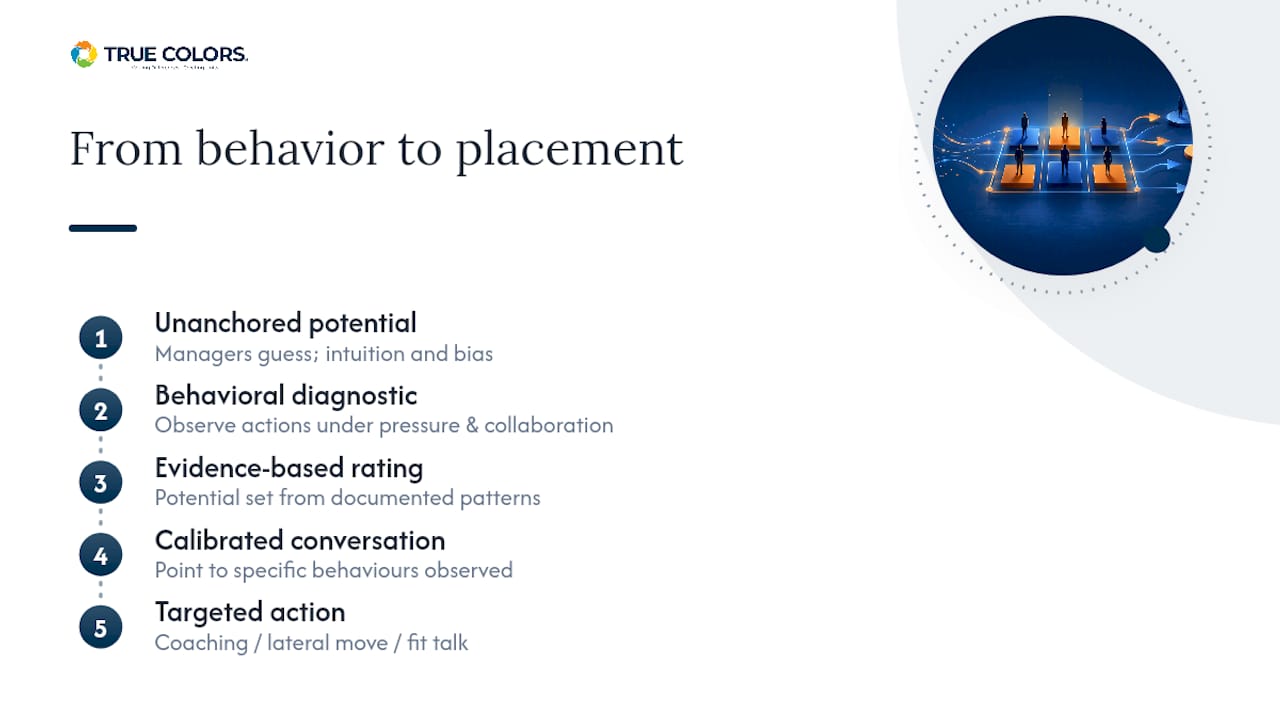
The potential axis is where most nine box exercises quietly fall apart, because "potential" is an inference, not a measurement. Managers fill that gap with intuition, and intuition tracks closely with who reminds them of themselves. This is the exact failure mode the INFORMS-published research on leadership program bias describes: evaluation tools reproduce bias unless the process anchors ratings to structured, observable evidence.
Behavior-based assessment data changes the input, not the framework. Instead of asking a manager to guess at someone's learning agility or stakeholder influence, a structured behavioral diagnostic observes how that person actually operates under pressure, in collaboration, and across communication styles. That shifts the potential rating from opinion to observed pattern.
When a potential score comes from a documented behavioral pattern rather than a manager's gut read, the calibration conversation changes entirely. Instead of debating whether someone "seems" ready for more, the room can point to specific evidence of how that person handles complexity, conflict, and collaboration under real conditions.
Consider an "Enigma" placement, someone with clearly high potential markers but performance that hasn't caught up yet. A behavior diagnostic can often reveal whether the gap is a skill issue, a communication mismatch with their manager, or a role that simply doesn't play to their natural strengths. That distinction determines whether the right action is coaching, a lateral move, or a direct conversation about fit, and guessing wrong wastes months.
This is where nine box output connects to broader culture work. A placement is only as useful as the leadership behavior and team communication that follow it, and organizations that pair calibrated talent reviews with structured leadership development programs see those placements translate into real behavior change rather than a one time labeling exercise.
A First-Time Facilitator's Checklist for Running This Well
Running your first calibrated nine box session goes smoother with three things locked down in advance. First, come to the meeting with every manager's pre-ratings already submitted, along with at least one piece of supporting evidence per employee. Reviewing incomplete ratings live wastes the group's time and invites snap judgments.
Second, prepare facilitation prompts that force evidence over impression. Ask "What specific project or decision showed that?" every time someone offers a rating without a concrete example. That single question does more to correct bias in the room than any policy statement.
Third, build documentation and follow-up into the process from day one. Every placement needs a written action, an owner, and a checkpoint date before anyone leaves the room. Six months later, when someone asks what happened to a "high potential" employee flagged in the last review, you need an answer that isn't "we're not sure." A talent development checklist built for this exact handoff keeps placements from disappearing into a forgotten spreadsheet.
Turning Talent Review Data Into Real Behavior Change
A comprehensive consulting approach helps organizations do what a spreadsheet alone can't: turn a nine box placement into a sustained behavior shift across leadership and teams. A calibrated grid tells you where someone stands. It doesn't tell you how to build the communication habits, leadership consistency, or team alignment that actually move a "Rising Star" into a ready successor.

That's the gap Truecolorsintl closes. Our Connected Leadership Program is built to convert talent-review outcomes into observable leadership behavior change, using the same evidence-based approach this article recommends for calibration itself. We also support the data side of the equation through employee experience surveys that give managers real behavioral evidence to bring into calibration, instead of relying on impression alone. And through corporate consulting engagements, our team can facilitate the calibration session itself, keeping the conversation anchored to evidence and consistent standards across every manager in the room.
Culture is not what gets said in a talent review meeting. It's what gets repeated in how people lead, communicate, and develop each other afterward. If your next nine box cycle is coming up, consider requesting a consultation with a culture and leadership development consultancy to see how a behavior-based system turns those placements into a plan people actually follow through on.
Sources
For readers who want to build their own materials, a few sources stand out as reliable starting points. AIHR's practitioner guide includes a free downloadable template and walks through the five-step build process in detail. SHRM's succession planning resource offers a concise definition and positions the tool within broader succession frameworks. Indeed's nine box talent matrix explainer covers a practical Excel layout. For a deeper look at bias risk in talent-evaluation tools, the INFORMS-published research is worth the read before your first calibration cycle. Organizations exploring how HR software can support a broader talent process at scale may also find a comparison of HR software options useful, and teams focused on structured implementation systems can look to Molded Fortitude Consulting for related frameworks.
- 9 Box Grid: A Practitioner's Guide FREE Template - AIHR
- Succession Planning: What is a 9-box grid? - SHRM
- INFORMS-published study on bias in workplace leadership programs
- Indeed