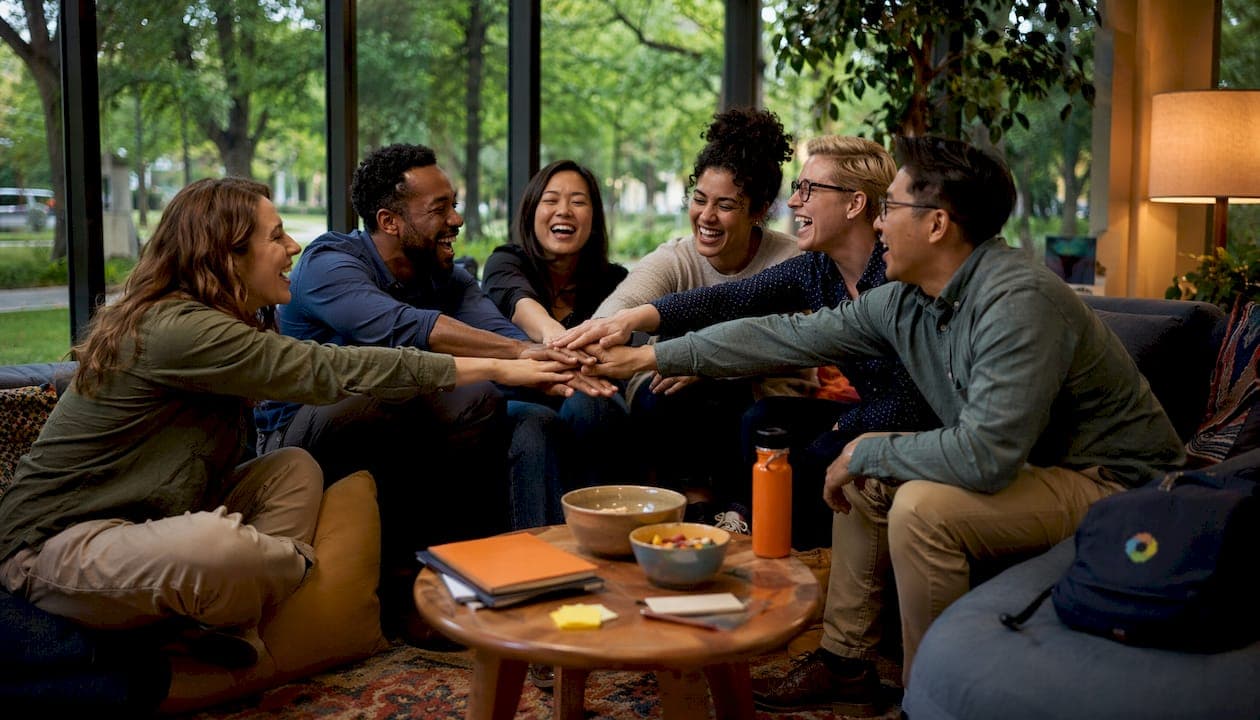
Workplace rituals are one of the most underused tools in organizational development. When they work, they don’t just make people feel good. They build the shared identity, psychological safety, and sense of meaning that drive real engagement and positive behavior at work. Culture is not what is said. It’s what is repeated.
How rituals function in organizational culture
The role of rituals in company culture is to convert abstract values into lived, repeated experience. A ritual is not a routine. Routines are functional, automatic, and task-focused. Rituals carry shared meaning and symbolism, making them psychologically distinct even when they look similar on the surface. A Monday morning standup is a routine. A Monday morning standup where the team shares one win from the previous week, by name and with recognition, is a ritual.
Rituals serve several interconnected functions in organizational life:
-
Create belonging: Shared symbolic acts signal group membership and reinforce identity.
-
Build psychological safety: Predictable, meaningful interactions reduce anxiety and help teams navigate change.
-
Transfer meaning: Rituals attach significance to daily work, making tasks feel purposeful rather than transactional.
-
Drive organizational citizenship: Research links structured group rituals to positive behaviors that extend well beyond the ritual event itself, including helping colleagues, volunteering for extra tasks, and speaking up constructively.
The importance of rituals at work is not a soft concept. It has measurable behavioral consequences, which the research sections below detail.
What workplace rituals are, and what they are not

Scholars distinguish rituals from habits and routines by three defining features: physical actions, psychological import, and communality. All three must be present for an activity to function as a ritual. A team lunch that is purely logistical lacks psychological import. A solo meditation practice lacks communality. When all three elements align, the activity generates connection and meaning that neither habit nor routine can produce.
Workplace rituals span a wide range of forms and frequencies:
-
Daily: Morning check-ins with a personal question, end-of-day gratitude shares, or a team “wins” message in a shared channel.
-
Weekly: Friday retrospectives, peer recognition moments, or a rotating “spotlight” on a team member’s work.
-
Milestone-based: Onboarding ceremonies, project launch rituals, promotion celebrations, or farewell send-offs that honor a person’s contribution.
-
Transitional: Rituals specifically designed to help teams move through change, such as a structured debrief after a difficult quarter.
The distinction between informal and formal rituals also matters. Informal rituals emerge from team behavior organically. Formal rituals are designed and scheduled. Both can be effective, but they carry different risks, which the practical guidance section addresses directly.
How rituals strengthen culture and boost employee engagement
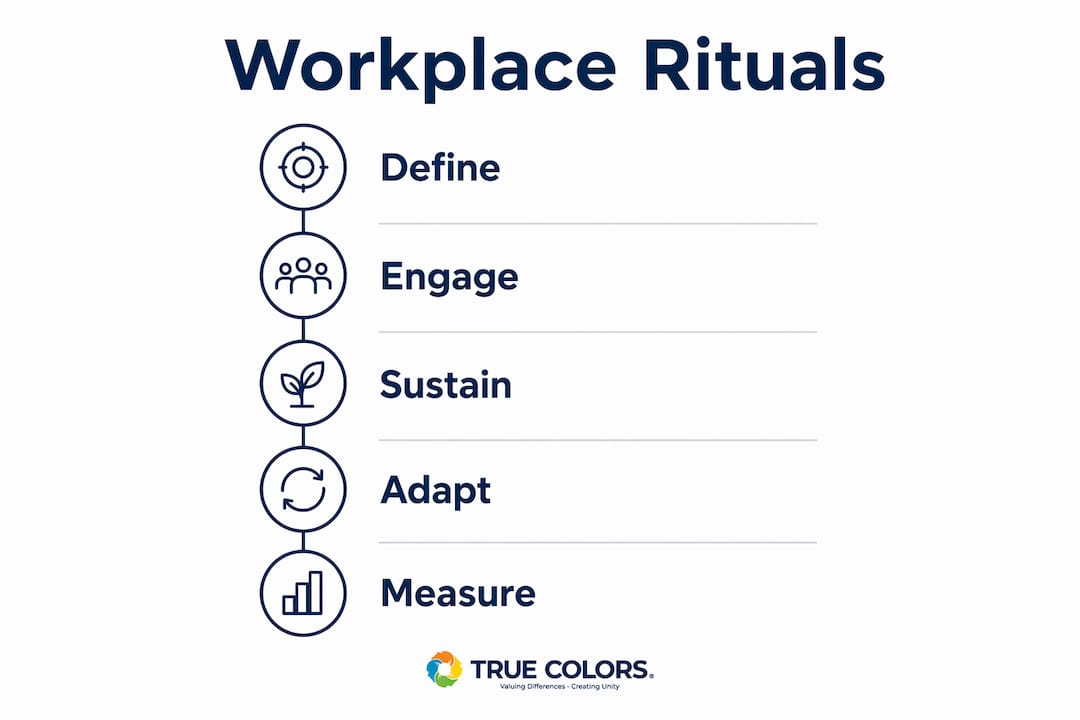
The psychological mechanism behind rituals is meaning transfer. When a team engages in a shared symbolic act, the meaning embedded in that act attaches to the work itself, making ordinary tasks feel more significant. Structured group rituals predict positive organizational citizenship behaviors, meaning employees who participate in meaningful rituals are more likely to go beyond their job descriptions in ways that benefit the whole organization.
Rituals also give leaders a structured, safe way to connect emotionally with their teams. As Harvard Business Review notes:
That balance is harder to achieve than it sounds. Leaders who try to build connection through ad hoc gestures often come across as inconsistent or insincere. A well-designed ritual removes that uncertainty by giving the emotional moment a predictable, shared container. The result is that rituals foster joy, energy, and togetherness in ways that translate directly into team cohesion and motivation.
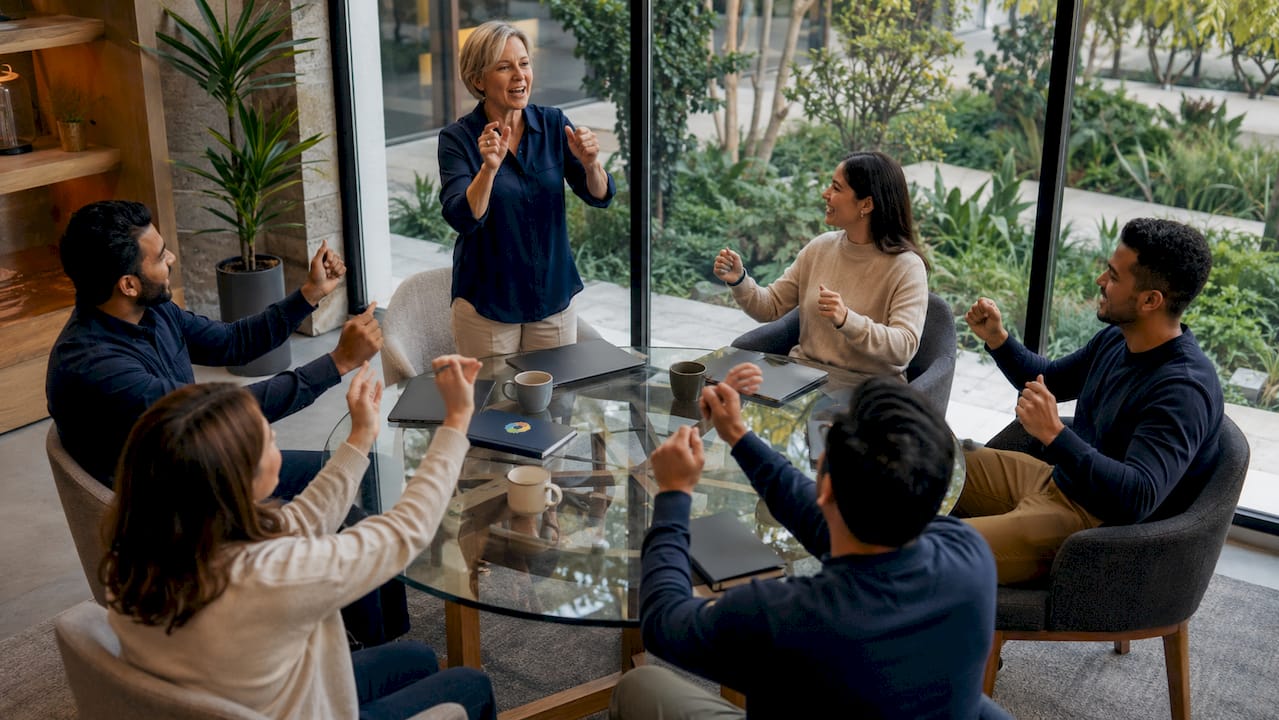
The impact of traditions on culture compounds over time. Teams that share rituals develop a stronger collective identity, which makes them more resilient during periods of organizational stress or change.
Practical guidance for creating and sustaining effective workplace rituals
The most effective workplace rituals emerge organically from team practice rather than top-down mandates. That does not mean leaders should be passive. It means the best approach is to observe what teams already do naturally, identify the moments that carry genuine energy or meaning, and then give those moments structure and consistency.
What to do:
-
Start by auditing existing team behaviors for moments of natural connection or celebration.
-
Name the ritual explicitly so the team recognizes it as meaningful and repeatable.
-
Keep early rituals short and low-stakes to reduce the awkwardness of something new.
-
Align rituals with the team’s actual values, not the values on the poster in the lobby.
-
Assign a “Master of the Ritual” role to one team member who owns consistency and evolution of the practice.
What to avoid:
-
Imposing rituals from the top without team input, which triggers “forced fun” resistance.
-
Designing rituals that are too elaborate to sustain week over week.
-
Letting rituals calcify into empty routines by never refreshing their meaning or format.
-
Treating all teams as identical; a ritual that works for a creative team may feel awkward for an operations group.
Rituals also need to evolve alongside the organization rather than becoming rigid traditions. The goal is a living practice, not a preserved artifact.
Pro Tip: Assign a rotating “Master of the Ritual” role within the team. This person is responsible for facilitating the ritual, keeping it fresh, and flagging when it starts to feel stale. Distributing this responsibility builds ownership and prevents the ritual from becoming the leader’s performance.
For teams going through transitions, structured activities during change are especially effective at maintaining cohesion when uncertainty is high.
What recent research reveals about rituals and meaning at work
A 2025 study published in a peer-reviewed management journal confirmed that the three ritual features, physical actions, psychological import, and communality, are not interchangeable. Remove any one of them and the meaning-transfer effect weakens significantly. This finding has direct implications for how HR leaders design and evaluate rituals.
The same body of research identified that ritual familiarity moderates outcomes. Teams that have practiced a ritual long enough to internalize it show stronger citizenship behaviors than teams encountering it for the first time. This is why sustained practice and leadership roles like the “Master of the Ritual” are not optional extras. They are the mechanism through which rituals embed.
| Ritual Feature | Function | Behavioral Outcome |
|---|---|---|
| Physical actions | Anchors the ritual in embodied, shared experience | Increases presence and group focus |
| Psychological import | Attaches meaning to the activity | Drives motivation and sense of purpose |
| Communality | Creates shared identity and belonging | Predicts organizational citizenship behaviors |
Leadership behavior also shapes ritual efficacy. When leaders participate visibly and consistently, the ritual signals organizational priority. When leaders skip it or treat it as optional, the message is equally clear. The hidden power of workplace rituals lies partly in what leader participation communicates about what the organization values.
How do you measure whether a ritual is working?
Measuring the effectiveness of rituals requires looking at both leading and lagging indicators. Rituals do not produce overnight results, but they do leave measurable traces if you know where to look.
Leading indicators (visible within weeks):
-
Participation rates and voluntary attendance
-
Team member energy and affect during and after the ritual
-
Qualitative feedback on whether the ritual feels meaningful or performative
-
Whether team members reference the ritual in other conversations
Lagging indicators (visible over months):
-
Changes in employee engagement survey scores, particularly items related to belonging and psychological safety
-
Organizational citizenship behaviors such as peer support, discretionary effort, and constructive voice
-
Retention patterns within teams that have sustained rituals versus those that have not
-
Culture audit results that track whether stated values align with observed behaviors
Truecolorsintl’s employee experience survey tools give HR leaders a structured way to track the belonging, safety, and engagement dimensions that rituals most directly influence. Pairing ritual design with measurement closes the loop between intention and impact.
Case studies: what sustained rituals look like in practice
Zappos and the culture of celebration. Zappos built an entire operating model around rituals of recognition and celebration. New employee onboarding included structured rituals designed to transmit the company’s values through experience rather than documentation. The result was a culture where employees could articulate and demonstrate the values, not just recite them.
The U.S. military and transition rituals. Military units rely heavily on formal rituals to manage the psychological weight of transitions, from deployment ceremonies to unit stand-downs. Research on military cohesion consistently links these rituals to unit identity and resilience under stress. The structure is not incidental. It is the point.
High-growth tech teams and the weekly retrospective. Many engineering teams at high-growth companies have formalized the retrospective as a ritual rather than a meeting. The distinction is deliberate: the retrospective follows a consistent format, includes a moment of acknowledgment before problem-solving, and closes with a shared commitment. Teams that treat it as a ritual report stronger psychological safety than those that treat it as a status update.
What these cases share is consistency, leadership participation, and alignment between the ritual’s symbolic content and the organization’s actual priorities. Rituals that act as dynamic anchors for organizational identity evolve with the company rather than becoming relics. For teams working on transforming workplace culture, rituals are often the most durable lever available.
Truecolorsintl helps organizations design the habits and shared practices that make culture observable and repeatable. If you want to move from values on a wall to behaviors in the room, explore our culture programs or learn more about the Connected Leadership Program built to help leaders model and sustain the practices that matter.

Key Takeaways
Workplace rituals are the most direct mechanism organizations have for converting stated values into repeated, observable behavior that builds culture from the inside out.
| Point | Details |
|---|---|
| Rituals require three features | Physical actions, psychological import, and communality must all be present for meaning transfer to occur. |
| Organic emergence beats mandates | The most effective rituals grow from existing team behaviors rather than top-down design. |
| Leadership participation is the signal | When leaders skip rituals, teams read it as a signal about organizational priorities. |
| Sustained practice drives citizenship | Teams that internalize rituals over time show stronger organizational citizenship behaviors than those new to them. |
| Measurement closes the loop | Track participation, engagement survey scores, and citizenship behaviors to assess whether rituals are working. |