
The strategy choice cascade is a five-part framework that converts ambition into a coherent chain of trade-offs, built around Winning Aspiration, Where-to-Play, How-to-Win, Capabilities Required, and Management Systems. It integrates strategy and execution into one document instead of two separate exercises, and its power sits in the middle pair: Where-to-Play and How-to-Win decide everything else that follows.
TL;DR:
- The success of a strategy cascade relies heavily on aligning capabilities and management systems with the critical choices of where-to-play and how-to-win.
- Clear exclusion lists and tangible KPIs for each cascade box are essential to prevent the strategy from becoming a meaningless wish list.
- Regular testing through conditions for changing decisions and frequent review cycles helps keep strategy adjustments practical and responsive.
- Organizational culture and daily leadership behaviors are key to implementing and sustaining the choices made in the cascade framework.
- Using True Colors' behavior-based systems can translate strategy choices into daily routines that reinforce long-term strategic alignment.
Table of Contents
- What Are the Five Choices in a Strategy Cascade?
- Why Where-to-Play and How-to-Win Are the Heart of the Cascade
- How Do You Run a Strategy Cascade Workshop?
- What Kills a Strategy Cascade After the Workshop?
- How Do You Test and Review Cascade Choices Over Time?
- How True Colors Turns Cascade Choices Into Daily Behavior
- When Should You Use the Cascade Instead of a Diagnosis First?
- Why Culture Determines Whether a Cascade Sticks
- How True Colors Helps You Operationalize Cascade Choices
- Sources
What Are the Five Choices in a Strategy Cascade?
The strategy choice cascade came from A.G. Lafley and Roger Martin's work at Procter & Gamble, later formalized in their book Playing to Win. Their central argument: strategy is not a mission statement or a five-year plan. It is a set of five interlocking choices, each one testing and constraining the others.
Here's what each box means in operational terms:
- Winning aspiration: The specific definition of success, stated in terms concrete enough to reject some options and accept others, not a slogan.
- Where-to-play: The precise battlefield, meaning which customers, geographies, categories, and channels you will actually compete in.
- How-to-win: The specific way you will beat competitors in that chosen arena, whether through cost, differentiation, or a defensible niche advantage.
- Capabilities required: The reinforcing set of activities and competencies you must build or acquire to win the way you've chosen.
- Management systems: The structures, metrics, and processes that support the capabilities and reinforce the choices over time.
Each box constrains the one below it and gets tested by the one above it, which is what Roger Martin's framing of the cascade captures. If your management systems can't be built to support the capabilities you named, you haven't finished the strategy. You've written a wish list with a strategy-shaped cover page.
Why Where-to-Play and How-to-Win Are the Heart of the Cascade
Winning aspiration sets the ceiling. Capabilities and management systems are the plumbing. The two choices that actually decide who wins in the market are where-to-play and how-to-win, and Harvard Business Review's own data visualization of the cascade places them at the framework's center for exactly this reason: everything above exists to justify them, and everything below exists to enable them.
How-to-win comes in a handful of recognizable archetypes, and each one drags a different capability list behind it:
- Cost leadership demands supply chain discipline, scale, and operational rigor as core capabilities.
- Differentiation demands brand investment, R&D, or design talent that competitors can't easily copy.
- Niche domination demands deep specialization and often a willingness to walk away from the broader market entirely.
Naming a how-to-win without naming what you'll refuse to chase isn't a real choice. It's ambition wearing a strategy costume.
Pro Tip: Before your team leaves the room, write down three things you will explicitly stop doing or stop pursuing. If the list is empty, your how-to-win isn't finished.
How Do You Run a Strategy Cascade Workshop?
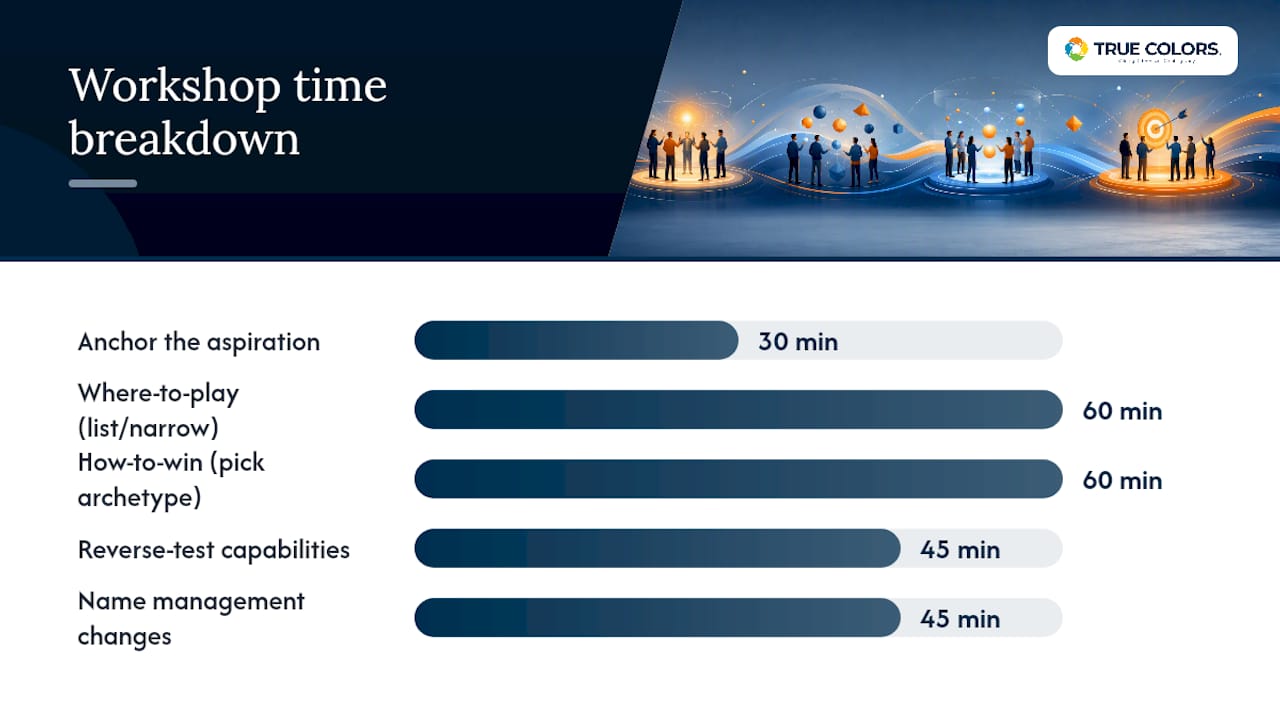
A cascade session works as a half-day sprint for a single business unit or a full day when you're aligning an entire leadership team across multiple units. Assign a facilitator who isn't the senior-most voice in the room. That person keeps the group honest about exclusions, which the highest-paid person tends to resist.
Run the session in this sequence:
- Anchor the aspiration (30 minutes). Ask: "What does winning look like, specifically, in three years?" Reject anything that could describe five different companies.
- Draft where-to-play (60 minutes). List customer segments, geographies, and channels. Force the group to cross out at least half.
- Draft how-to-win (60 minutes). Pick one archetype. Ask: "What would have to be true about competitors for this to fail?"
- Reverse-test capabilities (45 minutes). List what you'd need to build. If a capability isn't realistically buildable within a reasonable timeframe, go back and narrow where-to-play or revise how-to-win.
- Name management system changes (45 minutes). What metric, incentive, or review cadence needs to change to reinforce this?
Worked example: A regional logistics unit sets its aspiration as "the fastest reliable delivery partner for mid-market e-commerce in three adjacent states." Where-to-play narrows to mid-market retailers under $50 million in revenue. How-to-win is speed and reliability, not price. That single choice forces three concrete changes: a new dispatch software capability, a driver retention program (capability), and a shift from cost-per-mile to on-time-percentage as the primary dashboard metric (management system).
| Deliverable | Owner | Due in first 90 days |
|---|---|---|
| One-page cascade document | Business unit leader | Week 2 |
| Top 3 capability priorities | Operations lead | Day 45 |
| Top 3 management system changes | HR/Finance lead | Day 90 |
Small teams and large enterprises both benefit from keeping the workshop output down to a single page. According to the Playing to Win framework's practical application, the discipline of forcing a cascade onto one page is what makes it usable instead of shelved.
What Kills a Strategy Cascade After the Workshop?
Most cascades die in the gap between choice and system, not in the choosing. HBR's own analysis notes that strategic choices need to be made simultaneously rather than sequentially, and teams that treat management systems as an afterthought routinely watch incentives and dashboards quietly override the strategy they just agreed on.
The other repeat offender is refusal to exclude. A complete guide to the strategy choice cascade makes the point directly: a strategy that doesn't name what it won't do is a wish list. Teams also tend to overinvest energy in the aspiration (inspiring but untestable) or the systems (detailed but disconnected from any actual competitive choice), leaving the middle pair thin.
Three changes create pull-through by Monday morning:
- Swap one dashboard metric to reflect the chosen how-to-win.
- Add one hiring criterion tied to a required capability.
- Add one weekly check-in question that references the where-to-play choice directly.
Pro Tip: Pick the metric change first. Teams believe what gets measured faster than they believe what gets announced.
How Do You Test and Review Cascade Choices Over Time?
Treat every box as a bet, not a fact. For each choice, write the condition under which you'd change your mind, a pre-mortem trigger you check for on a schedule rather than waiting to notice failure. The cascade is iterative by design: revise one box and you must re-test the others, since a narrower where-to-play might make a capability suddenly affordable that wasn't before, as discussed in this Strategic product consulting guide for founders.
Assign one KPI per box so the review has teeth:
| Cascade box | Sample KPI | Review use |
|---|---|---|
| Winning aspiration | Market share vs. target segment | Confirms the aspiration is still realistic |
| Where-to-play | Revenue concentration by segment | Flags drift outside chosen arena |
| How-to-win | Win rate against named competitors | Tests if the advantage still holds |
| Capabilities | Time-to-build vs. plan | Signals capability gaps early |
| Management systems | % of incentive plans aligned to strategy | Catches quiet misalignment |
Run a monthly operational check with functional leads to track the KPIs, and a quarterly strategic review with the full leadership team to revisit the conditions for change. A quarterly cadence usually gives enough time for a capability investment to show real movement without letting a bad bet run unchecked for a year.
How True Colors Turns Cascade Choices Into Daily Behavior
Capability and management system choices only become real when they show up in what people do every day. Leadership rituals, onboarding anchors, and hiring screens are how a strategic choice becomes a habit instead of a memo. A short weekly ritual tied to your chosen how-to-win, or an onboarding conversation that names the capability you're building, does more to reinforce a management system than a new policy document ever will. Culture is not what is said. It's what is repeated.

When Should You Use the Cascade Instead of a Diagnosis First?
Use a diagnosis-first approach, in the style of Richard Rumelt's kernel, when you don't yet know your core problem. Use the cascade once you're ready to design forward choices, not diagnose backward ones. The cascade struggles with very early-stage ventures that lack a stable competitive arena to even define. If your team just finished this article and still hasn't run a workshop, that's the next step, not another framework search.
Why Culture Determines Whether a Cascade Sticks
The conventional wisdom treats the cascade as a strategy tool, full stop. That undersells what actually breaks it. In practice, cascades fail less often because the choices were wrong and more often because the organization's behavior never changed to match them. A team can produce a beautiful one-page cascade in an afternoon and still watch it evaporate within a quarter, because nobody touched the hiring process, the meeting rhythm, or the review that determines who gets promoted.
What gets underestimated is how much the management systems box depends on consistency, not cleverness. A mediocre metric applied every single week beats a brilliant one that gets mentioned once and forgotten. Leaders who treat leadership team alignment as a one-time workshop outcome rather than an ongoing behavioral discipline tend to relearn this the hard way, usually around the same time next year's strategy refresh rolls around.
The gap between what the cascade promises and what most organizations get isn't a framework problem. It's a follow-through problem, and follow-through is a culture question before it's a strategy question.
— Theresa
How True Colors Helps You Operationalize Cascade Choices
Choosing your capabilities and management systems on paper is the easy half. Turning them into how your leaders actually behave, week over week, is where most cascades either take hold or quietly fade. Truecolorsintl is the practical route to that second half, a behavior-based system that closes the gap the strategy documents never do.

Two services map directly onto the cascade's back end. The Connected Leadership Program helps leadership teams translate How-to-Win and Capabilities Required choices into observable daily routines, from meeting rituals to decision habits, instead of leaving them stranded in a strategy deck. The Employee Experience Survey then diagnoses where your current management systems and culture already support those choices, and where they quietly work against them.
A typical engagement runs a facilitated workshop, followed by a 90-day pilot on the capability and system priorities you named, followed by measurement against the KPIs you set. If your team is ready to move from a one-page cascade to changed behavior on the floor, start with a consulting and training conversation to scope the workshop that fits your organization.
Sources
- Roger L. Martin — Strategy thought pillars
- HBR — The Strategy Choice Cascade (data visual)
- Playing to Win Strategy Framework: The Five-Choice Cascade