
Purpose-driven leadership means anchoring every significant decision, communication, and team routine to a clearly articulated organizational "why." Leaders who practice it don't just set goals — they connect those goals to a reason for existing that resonates with employees at every level. Research from MIT Sloan Management Review shows that leaders who regularly discuss purpose, maintain equitable relationships, and grant autonomy significantly boost employee commitment across organizations. The practical implication is direct: when purpose is embedded into daily work rather than printed on a wall, alignment, engagement, and strategic coherence follow.
Table of Contents
- What is purpose-driven leadership, and how does it differ from related styles?
- Core characteristics that define purpose-driven leaders
- Why purpose-driven leadership produces measurable results
- How to become a purpose-driven leader: a step-by-step plan
- How do you embed purpose across HR, governance, and daily operations?
- Real-world examples of purpose-driven leadership in practice
- How do you measure whether purpose-driven leadership is working?
- Common pitfalls that undermine purpose-driven leadership
- Your 30-60-90 day action checklist for leading with purpose
- Key Takeaways
- The case for treating purpose as an operational discipline
- How Truecolorsintl helps leaders move from purpose to practice
- Further reading and key sources
What is purpose-driven leadership, and how does it differ from related styles?
Purpose-driven leadership is an integrative approach that shapes a leader's actions, values, and culture by tying individual purpose to organizational purpose. A systematic review of 58 research papers describes it as a framework that links engagement, cohesion, and motivation through a shared organizational "north star" — a guiding reason for existing that informs decisions from the boardroom to the front line.

That distinction matters when you compare purpose-driven leadership with styles that are often mentioned in the same breath:
| Leadership Style | Primary Focus | How Influence Is Built | Typical Outcomes |
|---|---|---|---|
| Purpose-driven | Shared organizational "why" | Connecting daily work to mission | Alignment, engagement, resilience |
| Servant | Follower needs and growth | Removing obstacles for others | Trust, loyalty, psychological safety |
| Transformational | Inspiring change and vision | Charisma and motivational communication | Innovation, elevated performance |
| Values-based | Ethical principles and integrity | Modeling consistent moral behavior | Credibility, ethical culture |
Purpose-driven leadership draws from all three adjacent styles, but its defining feature is the bidirectional connection between personal and organizational purpose. According to Springer Nature, successful practice requires leaders to discover their own purpose, help others discover theirs, and then reliably connect both to the organization's mission. That bidirectional quality is what separates it from a top-down vision statement. Authenticity is not optional here — leaders whose stated purpose conflicts with their observable behavior erode trust faster than leaders who never articulated a purpose at all.
Core characteristics that define purpose-driven leaders
The behaviors below are what purpose-driven leadership looks like in practice, not in theory:
- Clarity of purpose. The leader can articulate the organizational "why" in plain language, without jargon, in under two minutes.
- Authenticity. Personal values and leadership behavior are visibly consistent. A leader who champions work-life balance but sends emails at midnight signals the opposite of purpose.
- Strategic coherence. Decisions — including budget trade-offs and hiring choices — are traceable back to the stated purpose. When a product team is asked to drop a profitable feature because it conflicts with the company's mission, that is strategic coherence in action.
- Empathy and active listening. Purpose-driven leaders understand what motivates each team member and adjust how they connect individual roles to the broader mission accordingly.
- Communication skill. They translate abstract purpose into concrete, role-level meaning. A hospital administrator who tells nurses "your work reduces readmission rates by keeping patients informed" is doing this well.
- Ability to connect daily tasks to mission. Every team meeting, performance review, and project kickoff includes a brief, genuine reference to why the work matters.
- Granting autonomy. Employees are trusted to make decisions within the boundaries of the purpose. Micromanagement and purpose-driven leadership are fundamentally incompatible.
- Modeling trade-off decisions. When purpose and profit conflict, the leader makes the purpose-aligned call visibly and explains the reasoning. This builds credibility that no all-hands speech can replicate.
- Distributed purpose. Rather than broadcasting purpose from the top, these leaders create conditions for others to discover their own connection to the mission.
- Consistency over time. Purpose is not a quarterly theme. Leaders who sustain purpose-aligned behavior through difficult periods — layoffs, market downturns, leadership transitions — demonstrate that the commitment is real.
For the trait of connecting daily tasks to mission: a manufacturing plant manager who opens every shift briefing with a one-sentence reminder of the product's end-user impact is practicing this consistently, not performatively.
Pro Tip: Start with your own "leadership why" before asking your team to connect to organizational purpose. Write a two-sentence statement that explains why you lead the way you do, then test whether your last five decisions are traceable to it. If they aren't, that gap is where your development work begins.
Why purpose-driven leadership produces measurable results
Organizations that embed purpose into their logic, identity, and strategy see stronger long-term performance — not as a soft benefit, but as a strategic imperative with measurable social and business outcomes.
Study spotlight: A study analyzing 57,000 employees across 469 companies found that team leaders who regularly conduct purpose dialogues, maintain equitable relationships, and grant autonomy produce significantly higher employee commitment — making the team leader the critical intermediary between high-level purpose and daily work.
The practical translation of that finding is worth spelling out. Higher commitment means more discretionary effort: employees who feel their work connects to something meaningful go beyond the minimum without being asked. It also means better cross-functional cooperation, because teams aligned to a shared purpose have a built-in reason to collaborate rather than protect territory. Retention of high performers improves because purpose-oriented workplaces give talented people a reason to stay that compensation alone cannot replicate. And practitioner research consistently links purpose-driven leadership to increased innovation, since employees who understand the "why" are better positioned to generate ideas that actually fit the mission.
Resilience is the benefit that gets underestimated most. In volatile or uncertain conditions, a clearly embedded purpose gives teams a decision-making anchor when the usual playbook doesn't apply. That stability is not accidental — it is the direct result of leaders who built purpose into governance and daily routines before the crisis arrived.
How to become a purpose-driven leader: a step-by-step plan
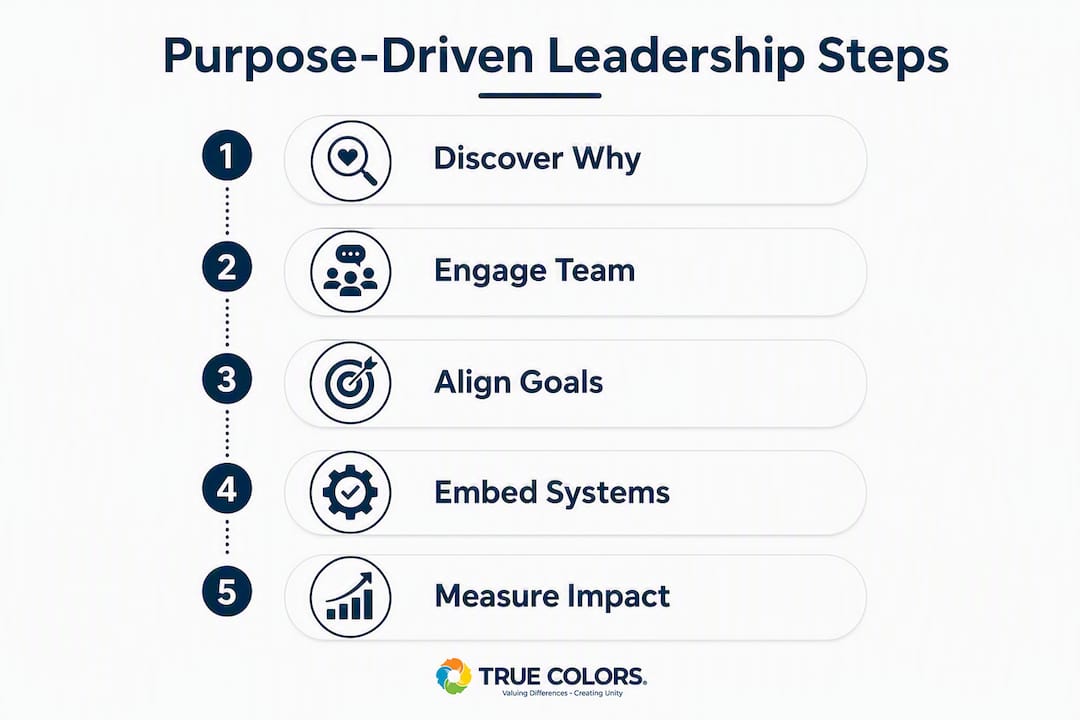
The path from intention to practice follows a clear sequence. Each step builds on the last.
-
Discover your leadership "why." Reflect on the moments in your career when you felt most effective and most aligned. What were you doing? Who benefited? Write a two-sentence personal purpose statement. Ask yourself: What would be lost if I stopped leading this team? What do I want my leadership to make possible for others?
-
Map organizational purpose. Review your organization's stated mission, values, and strategic priorities. Identify where they converge into a single, defensible reason for existing. If that reason is not clear, that is the first problem to solve — with your leadership team, not alone. Ask your team: When does our work feel most meaningful? What would our customers lose if we disappeared?
-
Run purpose dialogues with your team. Hold structured conversations — not all-hands speeches — where team members articulate what the organization's purpose means to them personally. These dialogues are the mechanism that MIT Sloan's research identifies as the missing link between purpose and performance. Keep them small, regular, and two-directional.
-
Translate purpose into role-level micropurposes. Work with each direct report to write a one-sentence statement of how their specific role advances the organizational mission. A finance analyst's micropurpose is not "I manage the budget" — it is "I protect the resources that let our product team take smart risks."
-
Align metrics and incentives. Review your team's KPIs and performance criteria. Any metric that rewards behavior inconsistent with the stated purpose is a credibility problem waiting to surface. Adjust at least one metric in the next review cycle to reflect a purpose-aligned behavior. A leadership development curriculum that bakes purpose alignment into its competency framework makes this step far easier to sustain.
-
Iterate and communicate. Purpose is not a launch event. Schedule a quarterly review of whether team behaviors, decisions, and outcomes are still tracking to the stated purpose. Communicate what you are learning — including where the gaps are — openly and specifically.
Pro Tip: Avoid top-down imposition by treating the first purpose dialogue as a listening session, not a presentation. Your job in that conversation is to ask questions and take notes, not to sell the mission statement. The purpose that lands is the one the team helps articulate.
How do you embed purpose across HR, governance, and daily operations?
Announcing purpose is easy. Embedding it is the work. The role of HR in culture change is central here, because the systems HR controls — recruiting, onboarding, performance management, and learning — are where purpose either gets reinforced or quietly contradicted.

Recruiting and onboarding are the highest-leverage entry points. Job descriptions that name the organizational purpose and ask candidates to describe their own connection to it filter for alignment before the first interview. Onboarding programs that spend time on "why we exist" before "how we work" set a different expectation from day one. A new hire who can articulate the company's purpose after two weeks is far more likely to make purpose-aligned decisions independently six months later.
Performance management is where most purpose initiatives break down. If the annual review rewards revenue generation but never asks whether the work was done in a way consistent with the organization's values, the purpose statement becomes decoration. Adding one purpose-aligned behavioral criterion to every performance review — even a simple one like "demonstrates awareness of how their work connects to our mission" — changes what managers and employees discuss.
Governance and decision rules are the least glamorous and most important lever. Leaders who embed purpose into investment criteria ("Does this initiative advance our core mission?") and resource allocation decisions create a paper trail that makes purpose visible and accountable. When a leadership team passes on a profitable opportunity because it conflicts with the stated purpose, and documents that reasoning, it sends a signal that no internal communications campaign can replicate.
Operational levers worth activating:
- Rewrite at least three job descriptions to include a purpose-connection statement
- Add a purpose-alignment question to the standard interview guide
- Include a "purpose check" agenda item in monthly leadership team meetings
- Tie at least one performance criterion per role to a purpose-aligned behavior
- Review capital allocation decisions against purpose criteria before approval
Real-world examples of purpose-driven leadership in practice
The product decision. A mid-size healthcare technology company was offered a lucrative contract to build a data analytics tool for a client whose practices conflicted with the company's stated mission of improving patient outcomes. The CEO declined the contract in a leadership team meeting, explained the purpose-alignment rationale in writing, and shared that reasoning with the broader organization. Within three months, two senior engineers who had been considering leaving cited that decision as the reason they stayed. The lesson: visible trade-off decisions are the most credible purpose signal a leader can send.
The HR decision. A regional logistics firm redesigned its onboarding program to open with a two-hour session on the company's founding story and its purpose of "keeping communities connected." New hires were asked to write a one-paragraph statement describing how their specific role contributed to that mission before their first day on the floor. Manager feedback in the following quarter noted that new employees asked better questions and required less re-direction on priorities. Purpose clarity at entry reduced the time managers spent re-explaining "why we do it this way."
The crisis response. During a period of significant operational disruption, a manufacturing leader held weekly 20-minute team check-ins focused not on metrics but on the question: "What does our purpose require of us right now?" Rather than defaulting to cost-cutting decisions that would have undermined long-term capability, the team identified two investments — in safety training and supplier relationships — that were directly traceable to the company's stated commitment to its workforce and community. The decisions were harder in the short term and more defensible in the long term.
The generalizable lesson across all three: purpose-driven leadership shows up most clearly in the decisions that cost something. When purpose is only invoked in easy situations, it is not yet embedded.
How do you measure whether purpose-driven leadership is working?
Measurement starts with leading indicators, not lagging ones. By the time turnover data reflects a purpose problem, the damage is already done.
Recommended KPIs:
- Employee engagement scores, tracked quarterly and segmented by team
- Purpose alignment index (a dedicated pulse survey measure)
- Retention rate of high performers over 12-month rolling periods
- Cross-functional collaboration frequency (project participation across departments)
- Internal promotion rate as a proxy for development investment
Sample pulse survey questions (5-point agreement scale):
- "I understand how my daily work connects to our organization's mission."
- "My manager regularly discusses why our team's work matters."
- "I feel trusted to make decisions that align with our values."
- "Our organization's stated purpose is reflected in how decisions are actually made here."
The Employee Experience Survey from Truecolorsintl is built to surface exactly these kinds of purpose and alignment signals at the team level, making it easier to identify where purpose is landing and where it is not.
Measurement principles:
- Focus on leading indicators (dialogue frequency, role clarity, autonomy perception) before lagging ones (turnover, absenteeism)
- Triangulate: pair quantitative scores with qualitative team conversations to understand the "why" behind the numbers
- Avoid vanity metrics — an all-hands attendance rate tells you nothing about purpose connection
- Measure at the team level, not just the organizational level, since purpose translates through team leaders
Common pitfalls that undermine purpose-driven leadership
The most common failure mode is not cynicism — it is the gap between what leaders say and what the organization's systems reward. When a company publishes a purpose statement and then runs performance reviews that never reference it, employees learn quickly which signal to trust.
Signal over substance is the most pervasive risk. California Management Review research distinguishes between impact substance (operational change) and impact signal (communication), and warns that overemphasizing signal without substance invites accusations of purpose-washing. The corrective is straightforward: before publishing any purpose-related communication, identify one operational change that supports it.
Red flags to watch for:
- Leaders who can articulate the purpose statement but cannot name a recent decision it influenced
- Purpose initiatives with aggressive 90-day "transformation" timelines and no plan for sustained reinforcement
- HR practices (hiring criteria, promotion decisions, compensation structures) that are inconsistent with stated values
- Purpose conversations that flow only downward, with no mechanism for employees to push back or contribute
Corrective steps:
- Tie one leadership decision per quarter explicitly to a purpose metric and communicate the connection
- Pilot micropurpose work in a single unit before scaling organization-wide
- Audit one HR process per quarter for purpose alignment
- Build a feedback loop — a short pulse question asking employees whether recent decisions reflected the stated purpose — and share the results with the leadership team
Poor leader follow-through is the second most common failure. Purpose requires consistency over time, not a launch event. Leaders who champion purpose during a strategic planning cycle and then revert to purely financial decision-making in the next quarter teach their teams that purpose is seasonal. The fix is behavioral, not communicative: leadership communication style that consistently references purpose in routine conversations — not just town halls — is what sustains the signal.
Your 30-60-90 day action checklist for leading with purpose
Days 1–30: Establish the foundation
- Write your personal leadership "why" statement (2 sentences). Expected outcome: clarity on your own purpose before asking others for theirs.
- Review the organization's mission, values, and strategic priorities for coherence. Expected outcome: identify where they align and where they conflict.
- Hold one-on-one purpose conversations with each direct report. Expected outcome: understand how each person currently connects their role to the mission.
- Identify one existing metric that contradicts the stated purpose. Expected outcome: a concrete change target for the next 60 days.
Days 31–60: Build alignment
- Facilitate a team purpose dialogue (small group, two-directional). Expected outcome: a shared, team-generated articulation of the mission's meaning.
- Co-create role-level micropurpose statements with each direct report. Expected outcome: each person can articulate their contribution to the mission in one sentence.
- Adjust one performance criterion to reflect a purpose-aligned behavior. Expected outcome: the review process begins reinforcing what the purpose requires.
- Rewrite one job description to include a purpose-connection statement. Expected outcome: recruiting begins filtering for alignment.
Days 61–90: Measure and reinforce
- Run a short pulse survey (4–5 questions) measuring purpose connection and autonomy perception. Expected outcome: a baseline for tracking progress.
- Review one governance or investment decision against purpose criteria. Expected outcome: a documented example of purpose-aligned decision-making.
- Share what you are learning — including the gaps — with your team. Expected outcome: credibility through transparency, not just messaging.
- Schedule a quarterly purpose review as a standing agenda item. Expected outcome: purpose becomes a recurring operational discipline, not a one-time initiative.
Quick wins that build early credibility: making one visible, purpose-aligned trade-off decision and explaining it publicly; running the first purpose dialogue before the 30-day mark; and naming one metric you are retiring because it no longer reflects the mission.
Key Takeaways
Purpose-driven leadership works when leaders embed organizational purpose into daily decisions, team routines, and HR systems — not just into communications.
| Point | Details |
|---|---|
| Core definition | Purpose-driven leadership anchors decisions and daily work to a clearly articulated organizational "why." |
| Research-backed benefits | Leaders who conduct regular purpose dialogues significantly boost employee commitment, engagement, and retention. |
| Critical behaviors | Granting autonomy, modeling trade-off decisions, and running bidirectional purpose dialogues are the highest-leverage leader behaviors. |
| Measurement priority | Track leading indicators — purpose alignment pulse scores, role clarity, and autonomy perception — before lagging ones like turnover. |
| Truecolorsintl's approach | Truecolorsintl's Connected Leadership Program and Employee Experience Survey translate these principles into a structured, measurable culture change process. |
The case for treating purpose as an operational discipline
Most organizations treat purpose as a communications problem. They invest in a well-crafted mission statement, a brand refresh, and an all-hands presentation — and then wonder why nothing changes. The research is clear on why: purpose that lives only in language has no mechanism for influencing behavior.
What the evidence actually supports is treating purpose as an operational discipline, the same way organizations treat financial controls or quality management. That means building it into hiring criteria, performance reviews, investment decisions, and team routines — not as an add-on, but as the governing logic. The leaders who do this well are not necessarily the most charismatic communicators. They are the ones who make the same purpose-aligned call consistently, explain their reasoning, and create systems that make it easier for others to do the same.
There is also a subtler point worth naming: the leaders who struggle most with purpose-driven leadership are often those who conflate purpose with positivity. Purpose is not about making work feel good all the time. It is about giving people a reason to do hard things well. A team that understands why their work matters will navigate difficulty more effectively than a team that has been told their work is meaningful but has never seen that claim tested.
The 30-60-90 day plan in this guide is not a transformation timeline. It is a foundation-building sequence. Real culture change — the kind where purpose shapes behavior without constant reinforcement from the top — takes longer and requires the kind of sustained, consistent leadership that no single initiative can produce. Start with the behaviors. The culture follows.
How Truecolorsintl helps leaders move from purpose to practice

Knowing what purpose-driven leadership requires and building the organizational systems to sustain it are two different challenges. Truecolorsintl's Connected Leadership Program gives leaders a structured path from personal awareness to aligned team behavior — covering purpose dialogue facilitation, communication style, and the behavioral habits that make culture change stick. The Employee Experience Survey provides the pulse measurement infrastructure to track whether purpose is landing at the team level, not just in leadership conversations. And for organizations ready to move at scale, Truecolorsintl's consulting programs embed purpose into the HR and governance systems where it has the most lasting impact.
If you are ready to move from intention to implementation, the Connected Leadership Program is the right starting point. Reach out to Truecolorsintl to learn how the program fits your organization's current stage.
Further reading and key sources
Research and frameworks
- MIT Sloan Management Review: "The Missing Link Between Purpose and Performance" — The 57,000-employee study that identifies purpose dialogue, equitable relationships, and autonomy as the three behaviors that connect purpose to commitment. Essential reading for any leader designing a purpose initiative.
- MDPI: "Exploring Purpose-Driven Leadership: Theoretical Foundations, Mechanisms, and Impacts" — A systematic review of 58 research papers that maps the academic foundations of purpose-driven leadership and its links to engagement, cohesion, and motivation.
- California Management Review: "Purpose-Driven Transformation" — A strategic roadmap covering purpose logic, identity, and strategy, with a clear warning about the risks of overemphasizing signal over substance.
- Springer Nature: "Purpose-Driven Leadership" — The concentric, distributed framework that explains why purpose cannot be imposed top-down and what bidirectional purpose practice looks like in organizations.
- Center for Creative Leadership: "Purpose in Leadership" — A practitioner-oriented overview of why and how leaders develop and sustain purpose-driven practice.
Practical implementation
- Truecolorsintl Connected Leadership Program — A structured leadership development program that translates purpose and behavior awareness into team-level culture change.
- Truecolorsintl Employee Experience Survey — A pulse measurement tool designed to surface purpose alignment and engagement signals at the team level.
- Truecolorsintl: "The Role of HR in Culture Change" — Practical guidance on how HR can operationalize purpose across recruiting, onboarding, and performance management.