
Manager training is the single most important factor shaping employee engagement, team performance, and organizational success. Manager quality explains 70% of the variance in team engagement, according to a Gallup meta-analysis of 2.5 million work units. That number reframes the entire conversation about where HR investment should go. Employees do not experience your culture through mission statements. They experience it through their manager, every single day. Understanding why manager training matters most is not an academic exercise. It is a direct line to retention, profitability, and the kind of culture that actually holds together under pressure.
Why manager training matters most for team outcomes
The gap between what organizations expect from managers and what they actually prepare them to do is significant. 60% of first-time managers receive no formal training before stepping into the role. That is not a minor oversight. It is a structural failure with predictable consequences: the same research shows a 60% failure rate for new managers within 24 months.
Most organizations promote their best individual contributors into management. The logic feels sound. High performance in a technical role signals competence. But only about 10% of people possess natural high talent for management. Selecting on technical skill rather than relational ability sets most new managers up to struggle, and their teams pay the price.

One of the most damaging patterns that emerges from undertrained managers is avoidant management. Avoidant management describes the behavior of managers who delay feedback, sidestep difficult conversations, and avoid accountability because they were never trained to handle conflict. The result is eroded trust, disengaged employees, and a culture where problems quietly compound.
Pro Tip: When evaluating candidates for management roles, assess intrinsic motivation to develop others and relational skill, not just past performance metrics. The two profiles rarely overlap.
- Managers promoted without training often default to managing the way they were managed, repeating patterns that may not fit their team's needs.
- Avoidant management is a hidden driver of turnover. Employees leave managers, not companies.
- Companies spend billions on leadership development but frequently exclude first-time and middle managers, the very people closest to daily employee experience.
- Without structured development, new managers rely on instinct in high-stakes moments, and instinct is inconsistent.
What are the measurable benefits of training managers?
The business case for manager development programs is not theoretical. Organizations with strong training programs report 24% higher profit margins and 37% lower employee turnover compared to those without. Those are not marginal gains. They represent the difference between a culture that retains talent and one that constantly rebuilds it.
"Highly engaged managers, developed through consistent training and coaching, reduce turnover by 59%, reduce quality defects by 41%, and increase profitability by 21%. The manager is not just a people function. The manager is a business function."
The performance data reinforces this point. Organizations with formal manager development programs show a 41% improvement in team performance metrics compared to competitors without such programs. That gap compounds over time. Teams with well-trained managers produce better work, make fewer errors, and stay longer.
| Outcome | Impact of strong manager training |
|---|---|
| Employee turnover | 37% lower in organizations with formal programs |
| Team performance metrics | 41% improvement over competitors without programs |
| Profit margins | 24% higher in companies with strong training |
| Quality defects | 41% reduction linked to engaged, trained managers |
| Profitability | 21% increase tied to high manager engagement |
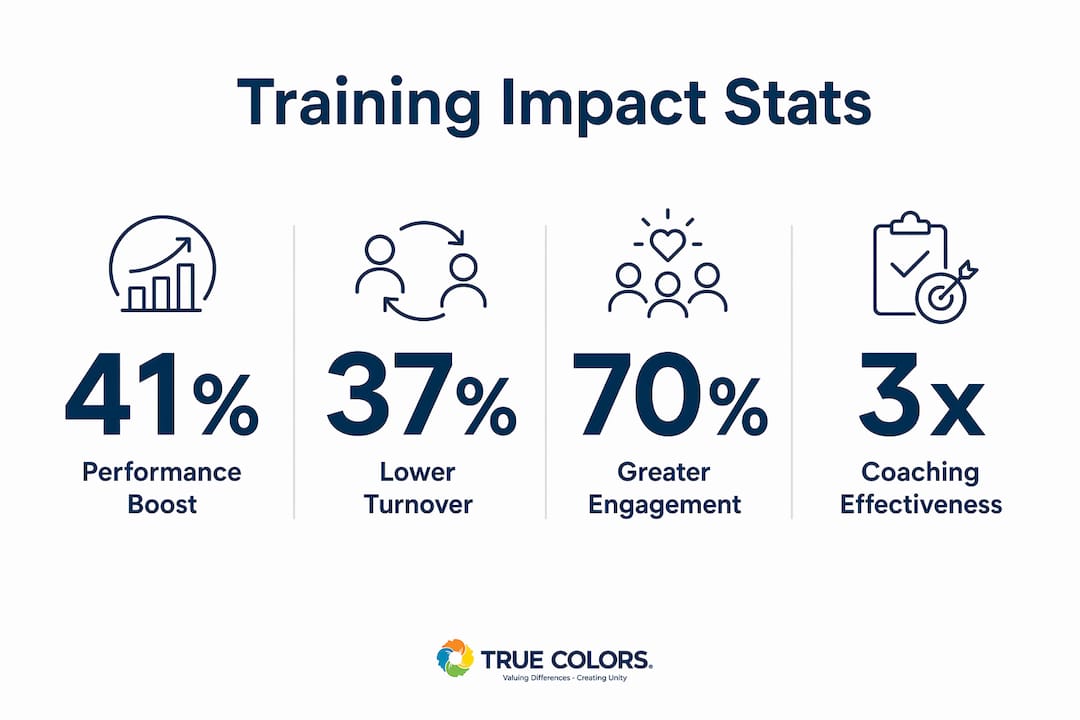
The impact of manager training on retention alone justifies the investment. Replacing an employee costs organizations significantly in recruiting, onboarding, and lost productivity. When trained managers create environments where people want to stay, that cost disappears from the budget.
What does effective manager training actually include?
Effective manager development programs are built around four core skill domains. Each domain addresses a distinct dimension of the management role.
- Managing self. Managers must understand their own behavioral tendencies, communication style, and emotional triggers before they can lead others well. Self-awareness is the foundation of consistent leadership behavior.
- Managing results. This covers goal setting, performance conversations, accountability structures, and the ability to connect individual work to organizational priorities.
- Managing people. This domain includes giving feedback, coaching for growth, navigating conflict, and building psychological safety within teams. It is where most undertrained managers struggle most.
- Managing change. Organizations shift constantly. Managers need the skills to communicate change clearly, address resistance, and maintain team stability during uncertainty.
Structured curriculum alone does not produce lasting behavior change. Training programs that incorporate coaching are 3.2 times more likely to secure sustained executive buy-in and real behavioral change. The reason is straightforward: workshops teach concepts, but coaching creates application. Managers need a space to practice new behaviors, receive feedback, and adjust in real time.
Pro Tip: Design manager training as a spaced learning experience over several months, not a single event. Behavior change requires repetition, reflection, and reinforcement, not a one-day workshop.
Measurement is the final piece most programs skip. Change should be measured at three levels: behavioral change in the manager, team-level outcomes like engagement and retention, and business-level impact like profitability and quality. Without measurement at all three levels, organizations cannot prove ROI or justify continued investment. The role of manager as coach is central to this model. Managers who coach their teams consistently produce stronger results than those who only direct and evaluate.
How do you embed manager training into organizational culture?
Manager development programs fail when organizations treat them as optional HR support rather than operational infrastructure. The distinction matters. Optional programs get deprioritized when budgets tighten. Infrastructure does not.
Embedding manager training into culture requires deliberate structural choices:
- Separate the management track from the technical track. Not every high performer should become a manager. Create a parallel path for individual contributors who want to grow without taking on people leadership. This protects both the employee and the team.
- Market training programs internally. Organizations that market training programs internally achieve significantly higher manager engagement and business impact. Treat your development programs the way you treat your products. Communicate the value, share success stories, and make participation visible.
- Link training outcomes to metrics that matter. Connect manager development directly to retention rates, engagement scores, and team performance data. When leaders see the correlation, training moves from a cost center to a growth driver.
- Make HR a strategic partner, not an administrator. The role of HR in leadership development is to design, champion, and measure manager training programs. HR professionals who position themselves as culture architects, not compliance managers, drive far greater organizational impact.
Leadership commitment is the variable that determines whether manager development takes root. When senior leaders visibly participate in and endorse training programs, adoption rates rise and the cultural signal is clear: developing managers is how we operate here, not something we do when there is extra budget.
Truecolorsintl works with organizations to make this shift concrete. The approach connects behavioral self-awareness to observable leadership actions, creating the kind of consistency that builds trust across teams and levels. Culture is not what is said. It is what is repeated.
Key Takeaways
Manager training is the highest-leverage investment an organization can make, directly driving engagement, retention, profitability, and the consistency of leadership behavior that defines culture.
| Point | Details |
|---|---|
| Manager quality drives engagement | Manager quality explains 70% of team engagement variance, making training the top performance lever. |
| Unpreparedness is widespread | 60% of new managers receive no formal training, leading to a 60% failure rate within 24 months. |
| Training produces measurable gains | Organizations with strong programs report 24% higher profit margins and 37% lower turnover. |
| Coaching multiplies training impact | Programs that integrate coaching are 3.2 times more likely to produce sustained behavioral change. |
| Embed training as infrastructure | Linking manager development to retention and engagement metrics moves it from optional to operational. |
What I have learned about manager training after years in this work
The most common mistake I see organizations make is treating manager training as a one-time event tied to a promotion. Someone gets the title, attends a two-day workshop, and is then expected to lead a team through performance reviews, conflict, and change. That sequence does not work. It has never worked.
What actually changes behavior is sustained, structured support over time. Managers need to practice difficult conversations before they are in one. They need feedback on how they show up, not just on what they deliver. And they need to understand their own behavioral patterns well enough to recognize when those patterns are helping or hurting the people around them.
I have also seen organizations select managers for all the wrong reasons, and then wonder why engagement scores drop. Gallup's research is clear: natural management talent is rare. Most organizations are not selecting for it. They are selecting for tenure and technical output, which are real contributions but poor predictors of leadership effectiveness.
The organizations that get this right treat manager development as a continuous practice, not a credential. They build feedback loops, invest in coaching, and measure what actually changes at the team level. Truecolorsintl's approach to leadership development curriculum reflects exactly this philosophy: behavior change requires a system, not a seminar.
If you are a business leader or HR professional reading this, the question is not whether manager training matters. The research settled that. The question is whether your organization is treating it with the seriousness it deserves.
— Theresa
How Truecolorsintl supports manager development
Truecolorsintl helps organizations build the kind of leadership culture where trained, self-aware managers drive real performance. The programs connect behavioral insight to observable leadership actions, giving managers practical tools they can apply immediately with their teams.

The Connected Leadership Program is designed for organizations that want more than awareness. It builds the habits, communication skills, and coaching behaviors that make leadership consistent across levels. Truecolorsintl also offers consulting and training solutions tailored to where your organization is right now, whether you are building a manager development program from scratch or reinforcing one that has lost momentum. The goal is always the same: culture that holds because the people leading it know how to lead.
FAQ
Why does manager training matter more than other leadership programs?
Managers are the primary point of contact between organizational strategy and daily employee experience. Because manager quality explains 70% of team engagement variance, training at this level produces broader and faster impact than programs focused only on senior leadership.
What happens when managers receive no formal training?
60% of untrained new managers fail within 24 months. Undertrained managers typically default to avoidant behaviors, delaying feedback and accountability conversations, which erodes team trust and drives turnover.
How long should a manager training program run?
Effective programs run over several months rather than a single event. Spaced learning combined with one-on-one coaching produces sustained behavioral change, while one-day workshops produce awareness without application.
What metrics should organizations use to measure manager training ROI?
Measure change at three levels: behavioral shifts in the manager, team outcomes like engagement and retention rates, and business results like profitability and quality defect rates. All three levels together prove the full return on investment.
How does manager training affect employee retention?
Organizations with strong manager development programs report 37% lower employee turnover. Trained managers create environments where employees feel supported, which is the single strongest predictor of whether someone stays or leaves.