
Culture programs are a direct driver of financial performance, not a soft investment in morale. Organizations with high-performing cultures delivered a 47% share price advantage over peers within two years, according to Culture Amp research. The challenge for organizational leaders and HR professionals is not proving that culture matters. The challenge is knowing how to connect culture programs to business results in a way that finance leaders recognize and boards can act on. This article gives you a framework to do exactly that, using behavior measurement, financial linkage, and reporting structures that hold up in the boardroom.
How to connect culture programs to business results
The industry term for this practice is culture ROI measurement. It refers to the process of mapping observable cultural behaviors to financial outcomes through a defined chain of evidence. Most culture programs fail to demonstrate impact not because the impact is absent, but because the measurement stops too early. Leaders track engagement scores and call it done. That is not enough.
Culture ROI is a composite of contributions to outcomes that CFOs already track: alignment, productivity, and workforce capability. The business case is financial and visible in revenue growth and operational efficiency. Platforms like Culture Amp, Happily.ai, and Gallup each offer data showing that culture programs, when structured correctly, produce measurable shifts in turnover, productivity, and profitability.

Starting with the right metrics matters. Voluntary attrition and replacement costs are the most reliable entry points for connecting culture to finance. Structured culture activation programs reduce voluntary turnover by 40%, saving $480,000 annually per 100 employees from replacement costs alone. That number is concrete enough for any CFO conversation.
What tools and foundations do you need first?
Effective culture measurement requires four connected layers: behavior, experience, performance, and financial outcome. Each layer feeds the next. A manager who holds weekly one-on-ones improves the employee experience, which raises productivity and reduces replacement costs. That chain is the measurement framework.
The tools that support this work fall into three categories:
-
Engagement and experience platforms: Culture Amp, Gallup Q12, and Happily.ai capture behavioral and experience data at regular intervals.
-
Financial analytics tools: Standard HR information systems such as Workday and SAP SuccessFactors track turnover rates, productivity metrics, and labor costs.
-
Culture activation systems: Truecolorsintl and similar behavior-based programs identify which specific behaviors are driving or undermining performance.
The comparison below shows how common tools differ in what they measure and what they output.
| Tool | Primary measure | Output for leaders |
|---|---|---|
| Culture Amp | Engagement and sentiment | Trend reports, attrition risk scores |
| Gallup Q12 | Employee engagement | Business unit performance benchmarks |
| Happily.ai | Real-time pulse data | Leading indicator alerts |
| Workday Analytics | HR and financial data | Turnover cost calculations |
| Truecolorsintl | Behavioral patterns and alignment | Culture activation and team performance maps |
Start small. Pick two or three metrics tied directly to voluntary attrition and productivity. Build the measurement habit before expanding to broader culture indexes. Leaders who try to measure everything at once typically end up reporting nothing useful.
How do you translate culture behaviors into financial results?
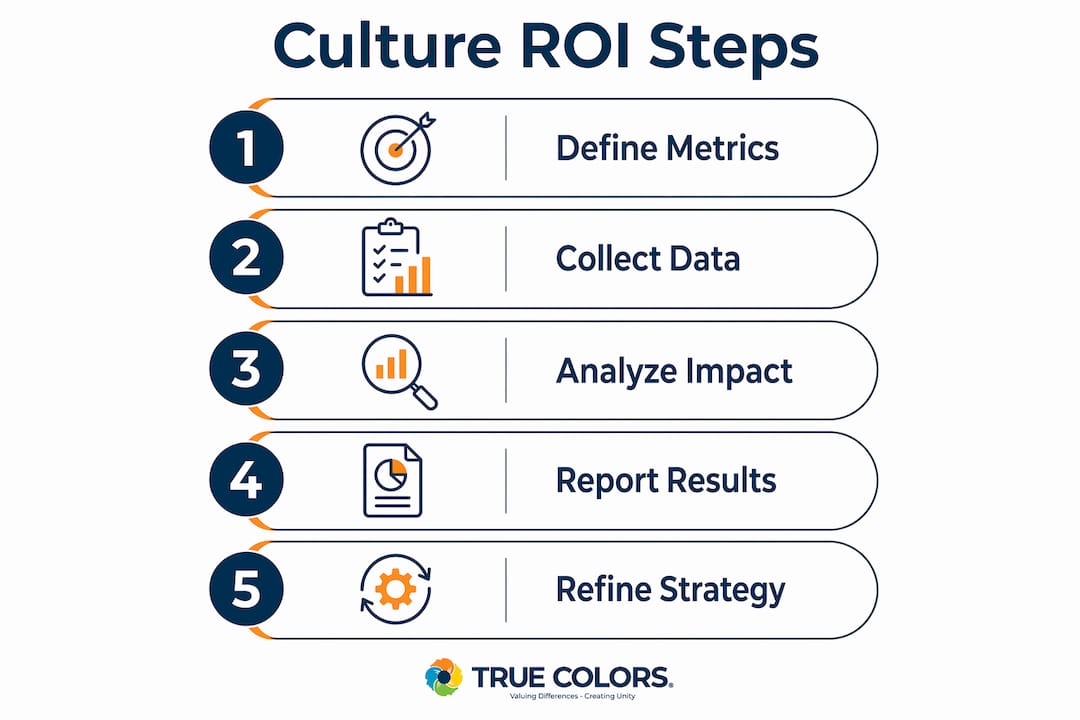
This is where most culture programs either succeed or stall. The process requires discipline and a defined sequence. Measuring cultural effectiveness means tracking behavior changes first, then linking those changes to performance shifts, and finally expressing those shifts in financial terms.
Follow these steps:
-
Identify two or three target behaviors linked to a known business problem. Recognition frequency and psychological safety are strong starting points because they serve as 30–90-day early warnings on attrition spikes and productivity drops.
-
Set a measurement cadence. Capture leading indicators monthly. Do not wait for quarterly engagement surveys. By the time quarterly data arrives, the problem has already cost money.
-
Map behavior changes to performance shifts. If recognition frequency increases by a measurable amount over 60 days, track whether absenteeism or voluntary exits change in the same period.
-
Convert performance shifts into financial language. Highly engaged business units achieve 23% higher profitability and 18% higher sales productivity. Use those benchmarks to build your own before-and-after financial snapshot.
-
Build an executive report that shows the chain: behavior changed, performance improved, cost decreased, or revenue increased.
The table below summarizes key leading indicators and their financial connections.
| Leading indicator | What it predicts | Financial link |
|---|---|---|
| Recognition frequency | Attrition risk | Replacement cost reduction |
| Psychological safety scores | Team productivity | Revenue per employee |
| Manager one-on-one consistency | Employee experience | Absenteeism and turnover costs |
| eNPS trajectory | Engagement trend | Customer satisfaction and retention |
Pro Tip: Build your first executive report around a single behavior change and one financial outcome. A tight story with real numbers beats a broad culture narrative every time.
What are the most common pitfalls in proving culture ROI?
Most culture ROI efforts fail for predictable reasons. Recognizing them early saves months of wasted effort.
-
Measuring too broadly. Tracking 20 culture metrics produces noise, not insight. Boards prefer 3–5 metrics connected to business outcomes over dozens of culture measures.
-
Relying only on engagement surveys. Engagement scores without financial linkage do not move CFOs. They are necessary but not sufficient.
-
Inconsistent leadership behavior. Berkeley research shows that consistent manager behaviors drive culture reinforcement more effectively than complex policies. Culture is not what is said. It is what is repeated.
-
Treating culture as a one-time program. Culture change requires ongoing leadership commitment and alignment of hiring, performance management, and rewards with culture goals, according to SHRM.
-
Reporting in culture language to finance audiences. Executives and boards respond to turnover savings, productivity gains, and strategic execution. They do not respond to engagement percentages in isolation.
Pro Tip: When a culture initiative produces a small, measurable win, report it immediately. Small wins build credibility with finance leaders and create permission to expand the program.
The fix for most of these pitfalls is the same: narrow the focus, maintain measurement consistency, and translate every finding into financial terms before presenting it upward. Leadership behaviors and practices that reinforce culture consistently are more powerful than any single training event.
How do you communicate culture impact to finance and executive leadership?
Finance leaders respond to the language of business outcomes. Culture ROI becomes credible when it is expressed as a composite of contributions to outcomes CFOs already track: alignment, productivity, and workforce capability. Recognition data functions as a continuous behavioral proxy linking culture to strategic execution.
The most effective communication approaches for executive audiences include:
-
Before-and-after financial snapshots. Show turnover rate at program launch versus six months later. Attach a dollar value to the difference.
-
Voluntary turnover rate as the anchor metric. It is the most credible and easiest to calculate. Boards understand it immediately.
-
eNPS trajectory as a forward-looking signal. A rising eNPS trend tells the board that culture health is improving before financial results confirm it.
-
Alignment to strategic priorities. Connect culture metrics to the specific business goals on the board’s agenda for the year.
The comparison below shows two communication approaches and their effectiveness with finance audiences.
| Communication method | What it includes | Finance response |
|---|---|---|
| Engagement score report | Survey results, satisfaction trends | Low. Seen as HR reporting. |
| Financial narrative with behavior chain | Turnover savings, productivity gains, behavior data | High. Treated as business reporting. |
Embed culture metrics into monthly or quarterly board reporting as a standard item, not a special presentation. When culture data appears alongside revenue and operational metrics, it earns the same level of attention. Leadership training that reinforces this reporting discipline helps leaders sustain the habit over time.
Key takeaways
Culture programs produce measurable financial results when leaders connect specific behavior changes to turnover savings, productivity gains, and profitability through a defined four-layer measurement chain.
| Point | Details |
|---|---|
| Start with attrition metrics | Voluntary turnover and replacement costs are the most credible entry points for culture ROI. |
| Use a four-layer chain | Link behavior to experience, then to performance, then to financial outcome for executive credibility. |
| Track leading indicators monthly | Recognition frequency and psychological safety predict financial risk 30–90 days before lagging data confirms it. |
| Report in financial language | Present 3–5 metrics tied to business outcomes, not broad engagement scores, to earn CFO buy-in. |
| Consistency beats complexity | Sustained manager behavior reinforcement drives culture change more effectively than policy overhauls. |
Culture programs are an investment, not a line item
I have spent years watching culture programs get cut from budgets because leaders could not answer one question: what did this produce? The programs were often good. The measurement was almost always missing.
The uncomfortable truth is that most HR professionals present culture work in the wrong language. They lead with engagement scores and satisfaction trends. Finance leaders hear “soft data” and move on. The moment you translate the same information into turnover savings and productivity gains, the conversation changes completely.
What I have found works is starting with one behavior, one metric, and one financial outcome. Not a culture transformation. Not a values overhaul. One behavior that is observable, measurable, and connected to a cost the business already tracks. Build the evidence there first. Then expand.
Leadership consistency is the variable most organizations underestimate. A well-designed culture program delivered inconsistently by managers produces inconsistent results. The research from Berkeley confirms what practitioners already know: the execution of culture lies in the daily repetition of managerial behavior, not in the sophistication of program design.
The organizations that get this right treat culture measurement as a leadership discipline, not an HR reporting task. They embed it into how they run the business. That shift in ownership is what separates programs that produce lasting results from those that fade after the launch quarter.
— Robert Cook
Truecolorsintl programs that connect culture to performance
Truecolorsintl helps organizations move from culture intention to culture evidence. The programs are built around observable behavior change, not abstract values statements.

The Connected Leadership Program gives leaders the tools to model consistent behaviors that reinforce culture and drive measurable team performance. The employee experience survey captures leading indicators of financial risk before they show up in turnover data. For organizations ready to build a culture that translates into business results, Truecolorsintl’s corporate solutions provide the structure, measurement, and reinforcement to make it last.
FAQ
What does it mean to connect culture programs to business results?
Connecting culture programs to business results means mapping observable behavior changes to financial outcomes such as turnover savings, productivity gains, and profitability. The process uses a four-layer chain: behavior, experience, performance, and financial outcome.
How long does it take to see measurable culture ROI?
Leading indicators like recognition frequency and psychological safety scores show movement within 30–90 days. Financial outcomes such as turnover reduction typically become visible within six months of a structured program.
What metrics should HR present to a CFO about culture?
Boards and CFOs respond best to 3–5 metrics tied directly to business outcomes, including voluntary turnover rate, eNPS trajectory, and productivity per employee. Engagement scores alone do not build CFO credibility.
Why do most culture programs fail to show ROI?
Most programs fail because measurement stops at engagement surveys and doesn't connect to financial data. Inconsistent leadership behavior and overly broad measurement frameworks also prevent clear results from emerging.
How does leadership behavior affect the effectiveness of culture programs?
Consistent manager behaviors reinforce shared culture more effectively than complex policies or one-time training events. Berkeley research confirms that culture management succeeds through coherent, repeated leadership actions rather than program sophistication.