
No single cultural change model wins in every situation, and any consultant who claims otherwise is selling you something. The right choice depends on what you are trying to fix. Use Schein's model when you need to diagnose deep, unspoken assumptions driving dysfunction. Use Hofstede's framework for cross-cultural or multinational alignment work. Reach for the Competing Values Framework (CVF) when leadership teams disagree about direction and need a shared language. Choose the Denison Model when the board wants culture tied to performance metrics. Use the Barrett Model for values-based transformation and employee meaning-making. And look at research-based prototypes like the Organizational Culture Transformation Model (OCTM) when you want an integrated, element-by-element implementation blueprint.
Here is where to go from here:
- Read the model summaries below to understand what each one actually measures.
- Run the selection checklist to match your organization's goal to the right framework.
- Follow the implementation playbook to move from diagnosis to sustained behavior change.
Key Takeaways
Sustainable cultural change depends on selecting a model matched to your specific goal, then aligning systems, incentives, and leadership behavior around it, not on messaging alone.
| Point | Details |
|---|---|
| No universal model exists | Match Schein, Hofstede, CVF, Denison, Barrett, or OCTM to your specific diagnostic or transformation goal. |
| Systems beat slogans | Incentives, hiring, and processes must change alongside values statements or old behavior persists. |
| Measure at multiple levels | Track individual, team, and organizational indicators, not just one layer of the culture. |
| Implementation takes time | Pilots run three to six months; enterprise programs typically need twelve to thirty-six months. |
| Truecolorsintl operationalizes models | Its behavior-based assessments, leadership training, and ongoing coaching turn diagnosis into sustained action. |
Table of Contents
- What Is a Cultural Change Model?
- How Do the Leading Cultural Change Models Compare?
- How Do You Choose the Right Cultural Change Model?
- What Are the Steps to Implement Cultural Change?
- How Does True Colors Turn a Model Into Behavior Change?
- What Leaders Get Wrong About Choosing a Model
- Ready to Put a Cultural Change Model Into Practice?
- Frequently Asked Questions
- Sources
What Is a Cultural Change Model?
A cultural change model is a structured framework for diagnosing how an organization currently behaves, designing interventions that shift that behavior, and measuring whether the shift sticks. It is not a poster in the break room or a values statement in the employee handbook. A working model does four jobs: it diagnoses the current state, aligns leadership around a target state, guides intervention design, and provides a way to measure progress over time.
These models operate at different levels, and that distinction matters more than most leaders realize:
- Micro level: individual beliefs, habits, and daily behaviors.
- Meso level: team norms, communication patterns, and management practices.
- Macro level: organizational systems, incentive structures, and formal policy.
Stanford research on intentional culture change frames employees as "culturally shaped shapers." People absorb the culture around them, then actively reproduce or resist it. A model that only addresses one level of that loop, say, individual mindset without touching team incentives, tends to stall. Culture change that ignores the macro layer rarely outlasts the initiative that launched it, which is part of why defining strategic culture change up front matters before you pick a framework.
How Do the Leading Cultural Change Models Compare?
Each of the models below approaches culture from a different angle. None captures everything, and that is precisely why comparing them side by side, rather than picking the most famous name, produces better decisions.
-
Schein's Three-Level Model. Schein treats culture as layers: visible artifacts, espoused values, and underlying basic assumptions. The deepest layer is the hardest to see and the hardest to shift, because it requires people to unlearn assumptions before new behavior feels natural. Toolshero's summary of Schein's model describes this as an "onion" structure. Best use: diagnosing why surface-level initiatives (new mission statements, rebranded values) fail to change actual behavior. Limitation: it is diagnostic, not prescriptive. It tells you what is wrong, not exactly how to fix it.
-
Hofstede's Cultural Dimensions. Built originally to compare national cultures, Hofstede's dimensions (power distance, individualism versus collectivism, uncertainty avoidance, and others) get borrowed by organizations managing multinational teams or post-merger integration. Best use: cross-border alignment and understanding why the same policy lands differently in different regions. Limitation: it was not designed for single-company culture work and can oversimplify organizational nuance.
-
Competing Values Framework (CVF). CVF maps culture across two axes: flexibility versus stability, and internal versus external focus, producing four culture types (clan, adhocracy, market, hierarchy). Best use: getting a leadership team to agree on where the organization sits today and where it wants to go, using a shared visual language. Limitation: the four-quadrant model can feel reductive for complex, blended cultures.
-
Denison Model. Denison links four traits, involvement, consistency, adaptability, and mission, to measurable business performance. Best use: when leadership wants culture work justified with performance data rather than sentiment. Limitation: it requires disciplined survey infrastructure to generate meaningful benchmarks.
-
Barrett Model. Built on a values hierarchy, the Barrett Model compares personal values, current culture values, and desired culture values to reveal gaps. Best use: values-based transformation where meaning and purpose drive engagement. Limitation: values mapping alone doesn't change behavior if systems still reward the old way of working, a gap Harvard Business Research warns against.
-
Organizational Culture Transformation Model (OCTM). This research-based prototype names ten integrated elements: ownership, involvement, change management, recognition, leadership, common vision, people and team development, communication, continuous improvement, and survey. The OCTM framework works less like a diagnostic lens and more like a build checklist for organizations that already know their target culture and need an execution structure. For a fuller breakdown of these frameworks, see Truecolorsintl's guide to organizational culture models.
How Do You Choose the Right Cultural Change Model?
Match the model to the problem, not the problem to the model. That sounds obvious, and it is the single most common mistake leadership teams make. They pick the framework a consultant pitched, then discover it doesn't answer the question the board actually asked.
Run through these criteria before committing:
- What is the primary goal? Diagnosis, leadership alignment, values work, or cross-cultural integration each point toward a different model.
- What level are you targeting? Individual behavior, team dynamics, or organization-wide systems.
- How much evidence does leadership expect? Some models (Denison) lean heavily on quantitative benchmarking; others (Schein) rely on qualitative interviews and observation.
- How fast do you need results? Values mapping can happen in weeks; systems-level change measured against performance data takes quarters.
- Is your leadership team ready to be examined too? Every credible model requires leaders to change their own behavior first.
| Model | Level of Analysis | Best For | Complexity/Data Needs | Evidence Base | Typical Output |
|---|---|---|---|---|---|
| Schein | Individual/organization | Deep diagnosis, unlearning old assumptions | High, needs interviews and observation | Strong academic pedigree | Layered assumption map |
| Hofstede | Organization/national | Cross-cultural, multinational alignment | Moderate, survey-based | Extensive cross-national research | Dimension scores |
| CVF | Team/organization | Leadership alignment on direction | Low to moderate, workshop-based | Well-established academic framework | Quadrant culture map |
| Denison | Organization | Tying culture to performance metrics | High, requires survey infrastructure | Strong, performance-linked research | Trait scorecard |
| Barrett | Individual/organization | Values-based transformation | Moderate, values survey | Practitioner-developed, widely used | Values gap report |
| OCTM | Organization | Integrated, element-by-element execution | High, needs full program buildout | Emerging research-based prototype | Ten-element action plan |
The most common red flag: choosing a values-mapping model when your incentive systems still reward the old behavior. If sales commissions reward individual heroics but your Barrett assessment says you want collaboration, the assessment will lose every time. For guidance on where HR should own that systems alignment, see Truecolorsintl's guide to HR's role in culture change.
What Are the Steps to Implement Cultural Change?
Culture change follows a sequence, and skipping steps is why so many initiatives produce a new set of posters and no new behavior.
- Diagnose. Use interviews, surveys, and observed behavior, not just leadership assumptions, to map the current state honestly.
- Design interventions. Translate diagnostic findings into specific changes: hiring criteria, onboarding rituals, meeting structures, incentive formulas.
- Align leadership. McKinsey's research on culture transformation identifies role-modeling and identifying informal influencers as two of the highest-leverage moves leaders can make early.
- Pilot and cascade. Test interventions in one division or team before rolling out organization-wide.
- Measure. Track survey results, behavioral indicators, and retention data on a set cadence, quarterly works for most organizations. Truecolorsintl's guide to measuring culture effectiveness outlines what to track and how often.
- Reinforce. Repeat the desired behaviors publicly, reward them structurally, and revisit progress on a fixed schedule.
A pilot program typically runs several months. An enterprise-wide rollout usually needs multiple quarters to show durable results. HBR's research on systems-first change is blunt about the biggest obstacle: communication campaigns without systems changes rarely stick, because incentives keep pulling people back to old habits.
Pro Tip: Track leading indicators, meeting behaviors, decision escalation patterns, peer recognition frequency, not just lagging ones like turnover, or you won't know something is working until it's too late to course-correct.
How Does True Colors Turn a Model Into Behavior Change?
Most cultural change models tell you what's wrong. Fewer tell you exactly what to do about it on a Monday morning. That gap, between diagnosis and daily behavior, is where transformation efforts typically die.
Truecolorsintl works from that gap forward. Rather than stopping at a values map or a quadrant score, the system converts diagnostic findings into leadership development programs, team training built around observable behaviors, and structured reinforcement that continues after the workshop ends.
- Personality-style assessments identify behavioral patterns helping or hurting team performance.
- Leadership development translates diagnostic insight into specific, repeatable actions.
- Employee experience surveys track whether behavior change is actually taking hold.
- Ongoing coaching prevents the common failure mode: a strong kickoff followed by silence.
Culture is not what is said. It's what is repeated. A framework only earns its keep when it changes what people do on an ordinary Tuesday, not just what they say in a workshop.
That emphasis on consistent, measurable behavioral levers echoes what Berkeley's research on organizational culture has found: culture is measurable, and it responds to hiring, socialization, and incentive design more reliably than to messaging alone.
What Leaders Get Wrong About Choosing a Model
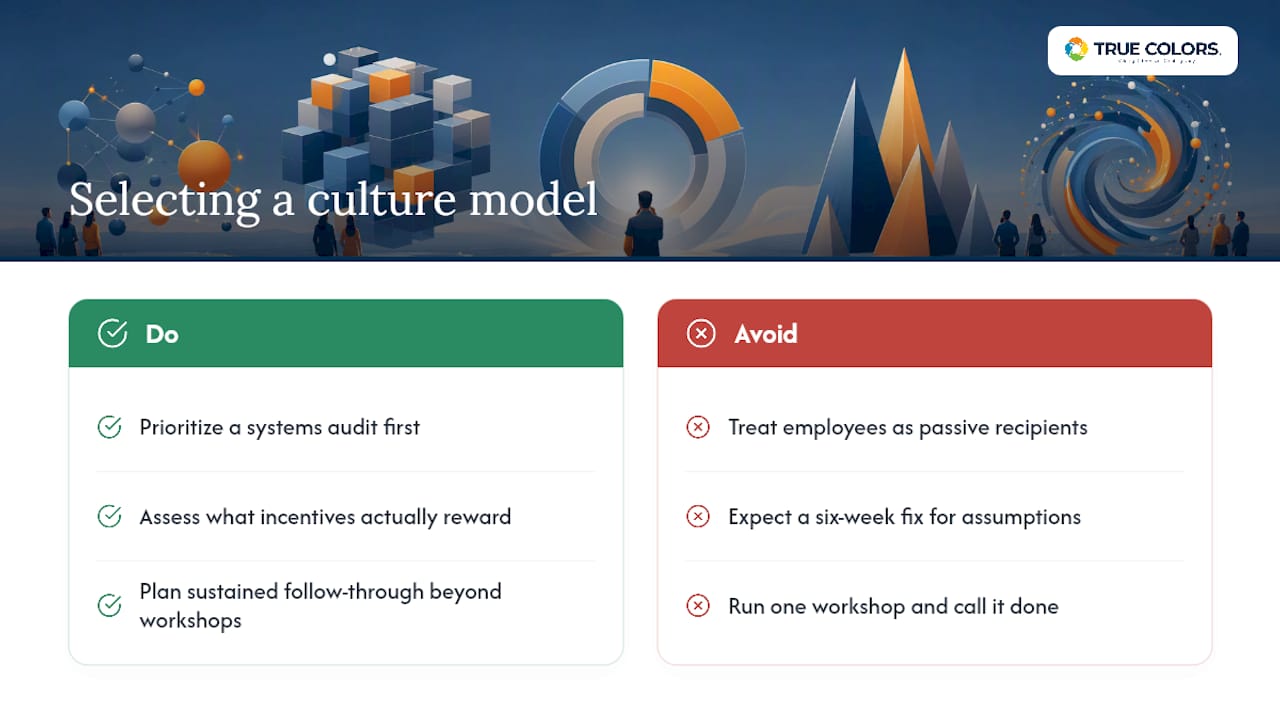
The conventional advice treats model selection like picking a diet plan: find the one with the best reviews and commit fully. That advice ignores the actual research. The Stanford framework is explicit that people are "culturally shaped shapers," meaning any model that treats employees as passive recipients of a new culture is working against how culture actually forms.
What gets underestimated most is timing. Leaders want a six-week engagement to produce Denison-style performance lift, but deep-assumption change, the kind Schein's model diagnoses, resists shortcuts. My honest read: most failed culture initiatives didn't fail because leadership picked the wrong model. They failed because leadership picked a model, ran one workshop, and called it done. The framework was never the weak link. The follow-through was.
If you take one thing from this comparison, prioritize the systems audit before the values workshop. Find out what your incentive structures actually reward before you ask employees to believe in a different set of values. That order, systems first, sentiment second, is the difference between a framework that sticks and one that becomes a slide deck nobody opens again.
Ready to Put a Cultural Change Model Into Practice?
Comparing frameworks gets you a diagnosis. Turning that diagnosis into daily leadership behavior, sustained team habits, and measurable performance shifts is a different job, and it's the one Truecolorsintl was built to do.
Instead of leaving you with a values map and a to-do list, Truecolorsintl's Corporate Consulting and Coaching Solutions combine behavior-based assessments, leadership development, and ongoing reinforcement so the model you choose actually changes what people do at work. If your priority is measuring where culture stands today, the Employee Experience Survey gives you the baseline data most models require before any intervention design begins. And if leadership alignment is the real bottleneck, the Connected Leadership Program turns diagnostic findings into specific leader behaviors, with coaching that continues past the initial rollout.
Start by requesting a consultation to identify which model fits your organization's current gap, then build the reinforcement system that keeps it from fading after quarter one.
Frequently Asked Questions
What is the most widely used cultural change model? No single model dominates. Schein's model is the most cited academically for diagnosing deep assumptions, while the Competing Values Framework sees the widest practitioner use for leadership alignment workshops.
How long does organizational culture change typically take? A focused pilot can show early signals in three to six months. Enterprise-wide, durable change, the kind that survives leadership turnover, generally takes twelve to thirty-six months.
Can you combine multiple cultural change models? Yes, and many organizations do. A common combination pairs Schein's diagnostic depth with CVF's leadership alignment tool, then uses Denison or a survey-based system to measure results over time.
Why do most culture change initiatives fail? The most common cause is relying on communication and values statements while leaving hiring, incentives, and processes unchanged, a gap HBR's research identifies as the core reason messaging-only efforts stall.
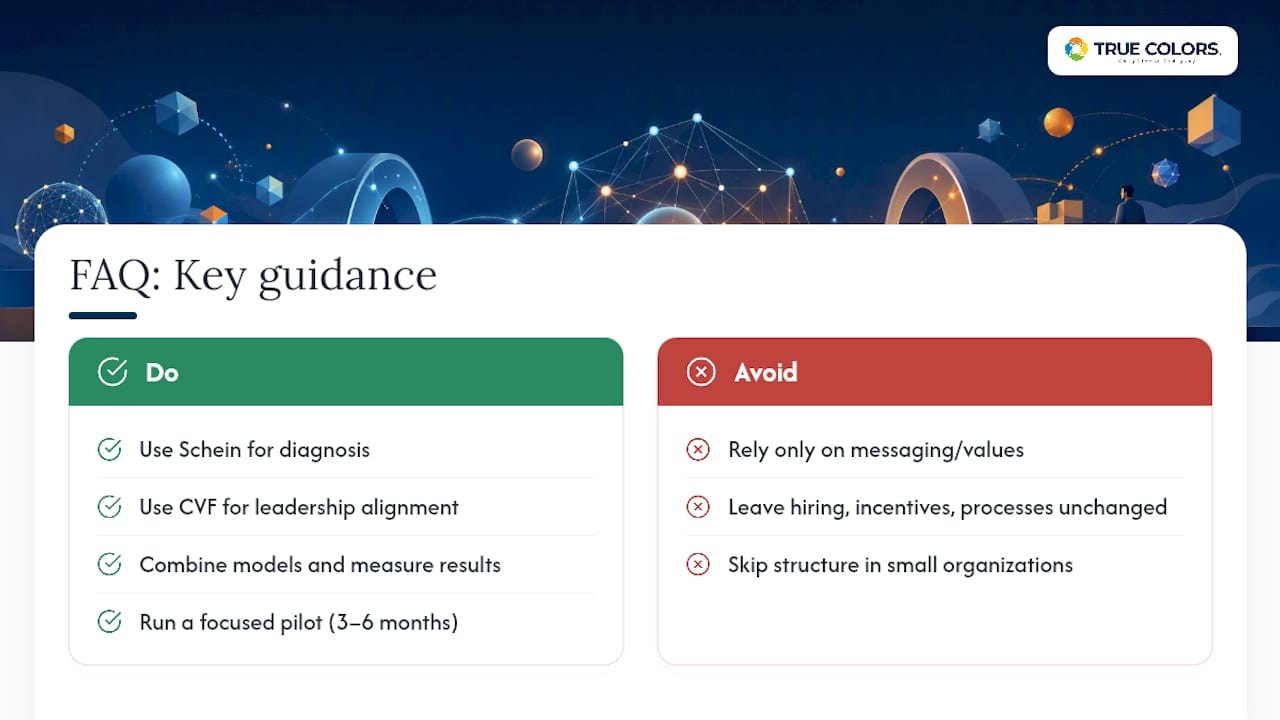
Do small organizations need a formal cultural change model? Smaller organizations can use lighter versions of these frameworks, but skipping structure entirely tends to produce inconsistent leadership behavior and initiatives that quietly fade within a year.
Sources
- To change company culture, focus on systems—not communication
- We built this culture (so we can change it): Seven principles for intentional culture change
- Making organizational culture great: Moving beyond popular beliefs