
The most effective approach to assessing organizational culture is a blended diagnostic that combines a validated survey instrument with targeted qualitative methods and structured leadership facilitation. No single tool gives you the full picture. A survey measures patterns at scale; focus groups explain the "why" behind those patterns; and leadership workshops turn findings into a prioritized plan that actually gets executed.
- Why this approach works: It balances breadth, validity, and context. You get defensible baselines from a validated instrument like the OCAI (Organizational Culture Assessment Instrument), behavioral specificity from structured interviews, and organizational commitment from leadership co-ownership of the results.
- When a DIY approach fits: Small to mid-size teams with internal measurement experience, a clear behavior inventory, and a culture of psychological safety around feedback. A well-designed pulse survey and two or three structured focus groups (each with 6–8 metrics tracked) can generate solid signal.
- When to bring in a consultant: Large or complex organizations, those in active transformation, or any situation where leadership credibility around the process is in question. Comprehensive cultural assessments combine quantitative surveys with qualitative methods to validate findings and capture voices that surveys alone miss.
Table of Contents
- What are culture assessment tools, and how do they differ from engagement surveys?
- What methods and frameworks do effective culture assessments use?
- How do you choose the right culture assessment tool or approach?
- How should you plan and roll out a culture assessment?
- Which metrics and questions should your culture assessment include?
- What are the most common culture assessment pitfalls?
- How Truecolorsintl's blended diagnostic works in practice
- Key Takeaways
- What actually works in the field
- Truecolorsintl's practical system for culture change
- Useful sources and further reading
What are culture assessment tools, and how do they differ from engagement surveys?
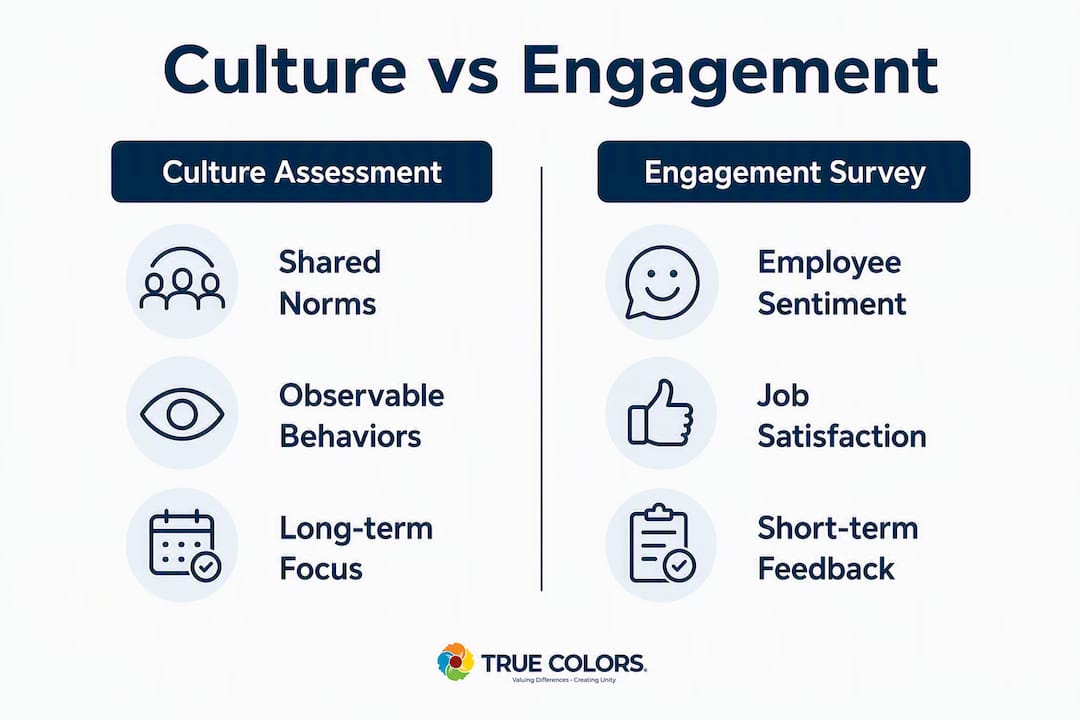
Culture assessment tools are instruments and methods that measure the shared beliefs, norms, and observable behaviors that define how work actually gets done in an organization. They answer questions like: What behaviors does this organization reward, even informally? How do decisions actually get made? What does it feel like to raise a concern here?
That is a fundamentally different question from what an engagement survey asks. Engagement surveys measure sentiment: how motivated, committed, or likely to stay an employee feels. Both matter, but conflating them produces muddled data and competing intervention priorities.
| Dimension | Culture assessment | Engagement survey |
|---|---|---|
| Primary purpose | Measure shared norms, behaviors, and decision-making patterns | Measure employee sentiment, motivation, and retention risk |
| Typical questions | "How often does your manager give specific behavioral feedback?" | "How satisfied are you with your manager?" |
| Best use case | Diagnosing cultural drivers of performance or dysfunction | Tracking morale, identifying flight risk, benchmarking satisfaction |
| Cadence | Annual or biannual; tied to strategic cycles | Quarterly pulse or annual census |
| Expected outputs | Behavioral gap analysis, culture typology, prioritized interventions | Engagement score, driver analysis, attrition risk flags |
Microsoft Viva Glint's guidance explicitly cautions against combining culture and engagement surveys in a single instrument because the two constructs have different drivers and the combined length undermines response quality on both.
Pro Tip: Combine culture and engagement measures only when you have a specific hypothesis linking a cultural behavior to an engagement outcome — for example, testing whether feedback frequency predicts retention. Run them as linked but separate instruments, then cross-reference the data in analysis rather than merging the question sets.
What methods and frameworks do effective culture assessments use?
The practical toolbox for workplace culture evaluation is broader than most HR teams initially assume. Each method has a distinct role, and the strongest diagnostics use at least two.

Validated survey instruments
Structured, psychometrically tested questionnaires like the OCAI (built on the Competing Values Framework) and the Denison Organizational Culture Survey give you a defensible baseline that holds up to scrutiny over time. The OCAI maps organizations across four culture types: Clan, Adhocracy, Market, and Hierarchy. The Denison model assesses involvement, consistency, adaptability, and mission. Both frameworks are diagnostic tools, best used when you need a starting point for comparison or a before/after measure of change. A validated instrument provides structured, reliable baselines that map neatly to intervention guidance.
Standardized and custom survey instruments
Beyond validated frameworks, many organizations use custom Likert-scale surveys built around their own stated values or leadership competencies. These are more flexible but require careful design to avoid leading questions and social desirability bias. They work best when paired with a validated anchor instrument.
Pulse surveys
Short, frequent check-ins (5–15 questions) deployed every 4–8 weeks. Pulse surveys are most useful for tracking directional change between full assessments, not for establishing a baseline. Regular opportunities to express opinion also increase employees' sense of belonging, which makes pulse cadences a useful engagement lever alongside their diagnostic function.
Focus groups
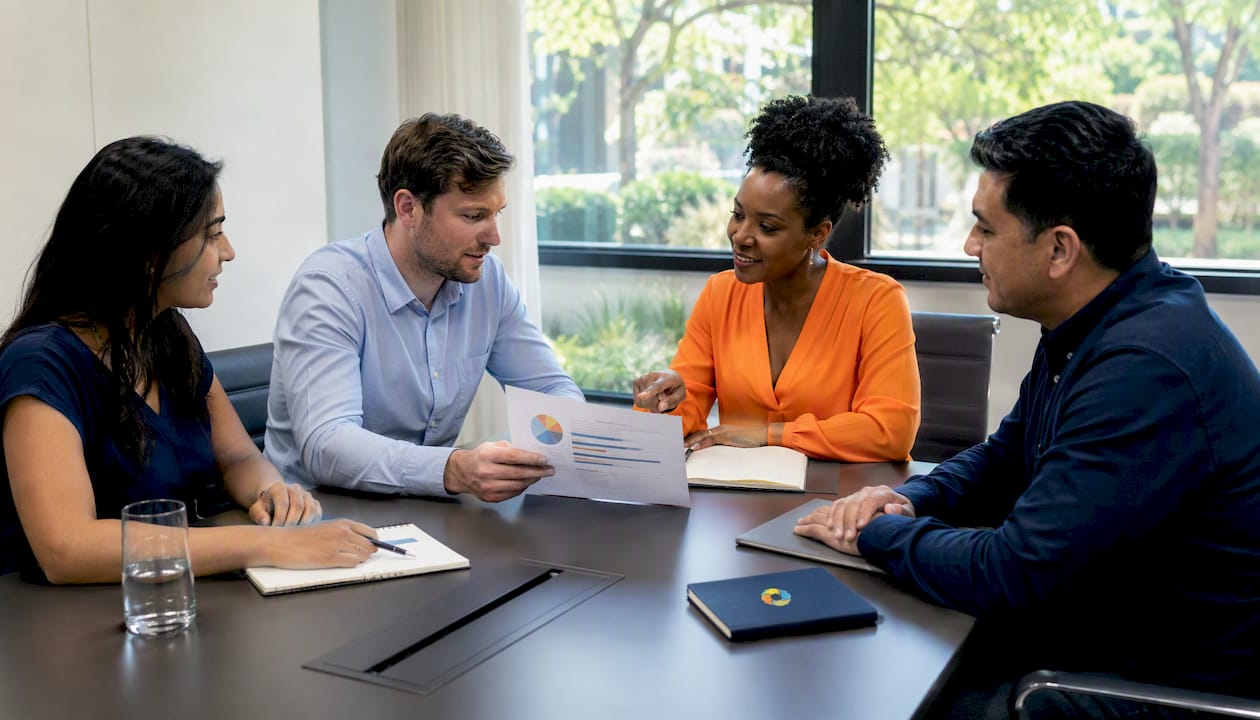
Structured group conversations across role levels and functions. A well-facilitated focus group (6–10 participants, 60–90 minutes) surfaces the informal rules and invisible cultural forces that no survey can reach. Best used after a survey to explain patterns in the data.
One-on-one interviews
Short, structured interviews of 20–30 minutes across organizational levels provide the context needed to translate scores into action. Particularly valuable for senior leaders and high-influence informal leaders whose candor in a group setting may be limited.
Culture walks and ethnographic observation
Direct observation of physical spaces, meeting behaviors, communication norms, and decision-making rituals. Useful for organizations where stated values and lived behaviors are suspected to diverge significantly. Requires a trained observer and clear protocols to avoid subjective bias.
HR and operational data analysis
Turnover rates, internal mobility patterns, promotion velocity, performance review distributions, and absenteeism data all carry cultural signal. Mapping these against survey findings reveals whether the culture employees describe matches the culture the organization's systems actually reinforce.
Behavior-inventory approaches, which ask leaders to define the specific observable actions that reflect their stated values before any survey is deployed, are increasingly common in enterprise diagnostics. Truecolorsintl uses this approach as the first step in its blended diagnostic process, ensuring that survey items are grounded in the organization's own language rather than generic constructs.
How do you choose the right culture assessment tool or approach?
Choosing a workplace culture evaluation method is a procurement and design decision, not just a methodology preference. The dimensions below are the ones that actually differentiate tools and providers.
Selection checklist
- Use case fit: Is the goal a baseline diagnostic, ongoing monitoring, a pre-merger culture comparison, or post-change tracking? Different use cases favor different instruments.
- Methodology and validation: Is the survey instrument psychometrically validated? Does the provider publish reliability and validity data? Can they explain their factor structure?
- Depth of reporting and analytics: Does the platform produce segmented reports by department, tenure, level, and demographic? Can you drill into item-level data?
- Facilitation and action-planning support: Does the provider offer facilitated leadership workshops to interpret results and build a prioritized action plan? Assessments without facilitation rarely lead to prioritized organizational change.
- Anonymity protections: What is the minimum group size for reporting? How is individual data protected? Is the anonymity guarantee contractual?
- Benchmarking availability: Can you compare your scores against industry peers or organizations of similar size? Validated benchmarks save interpretation time and improve the credibility of findings with senior leaders.
- Integrations and data export: Can results feed into your HRIS, BI tools, or performance management platform? Can you export raw (anonymized) data?
- Implementation timeline: How long from contract to first results? What internal resources does the rollout require?
- Pricing model: Per-seat, per-survey, project-based, or retainer? What is included versus billed separately?
Questions to ask vendors during discovery
- Can you share a sample survey instrument and codebook?
- What is your methodology for ensuring anonymity, and what is the minimum group size for reporting?
- Do you offer facilitated workshops as part of the engagement, or is that a separate cost?
- What benchmarks do you provide, and how current is the benchmark database?
- What is the typical implementation timeline for an organization of our size?
- What can we customize, and what is fixed in your instrument?
- Who owns the raw data, and in what format can we export it?
Red flags
Watch for providers who cannot produce a sample instrument, offer no facilitation or implementation plan, give vague answers about anonymity, or cannot explain the psychometric basis of their tool. An inability to export raw data is a significant concern for any organization that wants to track change over time in its own systems.
Tool category comparison
| Selection dimension | Entry-level tools | Mid-market platforms | Enterprise blended diagnostics |
|---|---|---|---|
| Best for | Small teams, quick pulse checks | Mid-size orgs, ongoing monitoring | Large or complex orgs, transformation |
| Methodology / validation | Often unvalidated; custom questions | Partially validated; some benchmarks | Validated instruments + qualitative methods |
| Reporting depth | Basic aggregate scores | Segmented dashboards | Full segmentation + qualitative synthesis |
| Facilitation support | None or self-serve guides | Optional add-on | Included; structured leadership workshops |
| Anonymity protections | Basic; small-group risk | Configurable thresholds | Contractual guarantees; strict minimums |
| Benchmarking | None or limited | Industry benchmarks | Cross-industry + custom peer groups |
| Integration / export | CSV export only | API or HRIS connectors | Full data ownership; BI integration |
| Implementation time | Days to 2 weeks | 2–6 weeks | 6–12 weeks for full diagnostic |
| Pricing model | Per-seat or flat fee | Per-seat or tiered | Project-based or enterprise contract |
For leaders wondering whether their organization's culture issues run deeper than a survey can surface, the guide on identifying hidden culture problems covers the diagnostic red flags worth checking before selecting a tool.
How should you plan and roll out a culture assessment?
A well-designed rollout is what separates a culture assessment that produces a prioritized action plan from one that produces a PDF no one reads. The phases below apply to a company-wide assessment; a pilot with one business unit compresses the timeline by roughly half.
- Define and prepare (weeks 1–3): Align leadership on the purpose and scope of the assessment. Build the behavior inventory: what specific, observable actions reflect your stated values? Confirm the survey instrument, anonymity protocols, and segmentation plan. Draft the communication plan.
- Communicate (week 4): Send a leadership message explaining the purpose, what will be done with results, and how anonymity is protected. Employees need to trust anonymity and expect action before they will give honest responses. This step is where most organizations underinvest.
- Measure (weeks 5–6): Deploy the survey. Keep the window to 10–14 days. Send one reminder at the midpoint. For qualitative methods, schedule focus groups and interviews to run concurrently or immediately after the survey closes.
- Analyze and validate (weeks 7–9): Synthesize quantitative results with qualitative findings. Identify where the two methods converge and where they diverge — divergence is often the most diagnostic signal. Prepare a leadership-ready summary.
- Plan and act (weeks 10–12): Facilitate a leadership workshop to interpret findings, prioritize two or three behavioral interventions, and assign ownership. Publish a summary of findings and commitments to the broader organization.
- Track (ongoing): Deploy pulse surveys every 6–8 weeks on the specific behaviors targeted by interventions. Run a full assessment at 12–18 months to measure directional change.
Response-rate tactics
Response rates below 60% produce unreliable segmentation data. The most effective levers are a credible leadership communication (not an HR email), a clear anonymity guarantee, a survey window of no more than two weeks, and a visible commitment to share results and act on them. Incentives help at the margin but do not substitute for trust.
Major cost drivers
Custom question design, third-party facilitation, sample size and segmentation depth, reporting complexity, benchmarking database access, and any HRIS or BI integration work are the primary cost variables. Organizations that skip facilitation to reduce cost typically spend more later trying to interpret and act on findings without a structured process.
For a more detailed look at how culture is measured in organizations, including framework selection and metric design, that guide covers the diagnostic process from baseline to tracking.
Which metrics and questions should your culture assessment include?
Culture is not what is said. It is what is repeated. The metrics and questions that matter most are the ones tied to observable, repeated behaviors rather than to stated intentions or general sentiment.
Recommended metric set (6–8 high-impact indicators)
Experts recommend limiting dashboards to 6–8 metrics to maintain leadership focus and consistent tracking. A practical set for most organizations:
- Feedback frequency (manager-to-employee behavioral feedback, measured by survey and cross-referenced with performance review records)
- Psychological safety score (team-level, measured by validated Likert items)
- Decision-making clarity (how clearly people understand who decides what)
- Cross-functional collaboration quality (survey-based, validated against project delivery data)
- Recognition consistency (frequency and specificity of recognition, measured by survey)
- Leadership behavior alignment (degree to which leaders model stated values, measured by 360 or survey)
- Inclusion and voice (whether people feel their perspective is heard and acted on)
- Accountability norms (whether commitments are followed through, measured behaviorally)
Behavior indicator to HR data source mapping
| Behavior indicator | Survey measure | HR / operational data source |
|---|---|---|
| Feedback frequency | "My manager gives me specific behavioral feedback regularly" | Performance review completion rates; 1:1 cadence records |
| Psychological safety | "I can raise concerns without fear of negative consequences" | Speak-up channel usage; exit interview themes |
| Decision-making clarity | "I understand who is responsible for key decisions in my area" | Escalation rates; project post-mortem data |
| Recognition consistency | "Recognition I receive is specific and tied to my behavior" | Recognition platform data; peer nomination rates |
| Leadership alignment | "Leaders in my organization consistently model our stated values" | 360 feedback scores; leadership assessment data |
Sample Likert-scale items (behavior-specific)
Measuring culture at the group level improves actionability and aligns results with organizational outcomes. Each item below is written to measure observable behavior, not vague sentiment.
- My manager gives me specific, behavior-focused feedback at least twice a month.
- When someone raises a concern in my team, it is taken seriously and followed up on.
- Decisions in my team are made by the people with the most relevant information, not just the most seniority.
- My team regularly reviews what is and is not working in how we collaborate.
- Leaders in my organization behave consistently with our stated values, even under pressure.
- When a mistake is made on my team, the focus is on learning rather than blame.
- I understand how my work connects to the organization's priorities.
- Recognition on my team is specific and tied to observable contributions.
- Cross-functional requests from my team are responded to within agreed timeframes.
- My manager follows through on commitments made in our conversations.
Sample open-ended prompts for focus groups and interviews
For cultural interview questions and structured qualitative follow-up, open prompts should push past surface-level responses. These work well in 20–30 minute structured interviews or focus groups of 6–10 participants.
- Describe a recent situation where you saw our values in action. What specifically happened?
- What behaviors does this organization actually reward, even if they are not the ones we say we value?
- Where do decisions get stuck, and why?
- What would a new employee notice about how we work together that we might not notice ourselves?
- What is one thing leaders could do differently that would have the biggest impact on how this team functions?
- When you have raised a concern in the past, what happened? What did that experience tell you about this organization?
Triangulate open-ended responses with survey scores by mapping themes to the specific Likert items they correspond to. Where qualitative themes contradict high survey scores, treat the qualitative signal as the more accurate one — people often rate sentiment higher than behavior in anonymous surveys when they are uncertain about true anonymity.
What are the most common culture assessment pitfalls?
Most culture assessments do not fail because of bad questions. They fail because of process design, trust deficits, and the absence of leadership ownership after results are in.
- Treating assessment as an HR-only initiative. When the assessment is positioned as an HR project rather than a leadership initiative, senior leaders disengage from the results. BDO's guidance is direct on this: culture change requires leadership engagement from the start, and assessments should be framed as strategic tools for organizational effectiveness. Mitigation: have the CEO or a senior leader sponsor the assessment publicly and present the results.
- Changing questions between cycles. Modifying survey items between annual assessments makes it impossible to detect genuine cultural shifts versus noise. Mitigation: lock your core metric set for at least two full cycles before revising.
- Overloading dashboards. A 40-metric culture dashboard is not a diagnostic tool. It is a distraction. Mitigation: limit your tracking dashboard to 6–8 high-impact metrics and resist the pressure to add more.
- Ignoring qualitative follow-up. Survey scores tell you what is happening; focus groups tell you why. Skipping qualitative methods leaves you with patterns you cannot explain and interventions you cannot prioritize. Mitigation: schedule focus groups before the survey window closes so they run concurrently.
- Weak anonymity practices. Employees who doubt anonymity give socially desirable responses, not honest ones. A common misstep is reporting results for groups of fewer than five people, which allows individuals to be identified by inference. Mitigation: set a minimum group size of 7–10 for any reported segment and communicate that threshold explicitly before the survey launches.
- No leadership ownership of action. The most common reason culture assessments stall is that findings are shared but no one is accountable for acting on them. Mitigation: the facilitated leadership workshop that follows results should produce a written action plan with named owners and a 90-day milestone.
A blended diagnostic prevents most of these pitfalls structurally. When qualitative methods are built into the process, when leadership facilitation is a deliverable rather than an afterthought, and when the metric set is defined before the survey launches, the conditions for follow-through are established from the start.
For a deeper look at diagnosing and rebuilding a broken culture, that resource covers the specific indicators that signal a culture has drifted beyond what a survey alone can address.
How Truecolorsintl's blended diagnostic works in practice
Truecolorsintl's approach to organizational culture assessment is built on a practical system rooted in observable human behavior. The process is designed for organizations that need more than a score — they need a clear path from diagnosis to aligned action.
The diagnostic process
- Behavior inventory: Leadership defines the specific, observable behaviors that reflect the organization's stated values. This step grounds the entire assessment in the organization's own language and prevents the instrument from measuring generic constructs that do not connect to real work.
- Validated survey instrument: A behavior-specific survey is deployed organization-wide, with anonymity protections and segmentation built in. Items are written at the group level to improve actionability.
- Targeted qualitative validation: Structured focus groups and one-on-one interviews across role levels pressure-test survey findings and surface root causes that quantitative data cannot reach.
- Leadership facilitation workshop: A structured session where senior leaders interpret findings together, identify the two or three behavioral priorities with the highest leverage, and assign ownership of interventions.
- Prioritized action plan: A written plan with named owners, 90-day milestones, and a defined pulse cadence for tracking progress.
- Tracking dashboard: A focused dashboard tracking 6–8 behavioral indicators, updated through pulse surveys every 6–8 weeks, lets leaders see directional change without waiting for the next full assessment.
Deliverables
- Survey instrument and item codebook
- Focus-group synthesis report
- Leadership facilitation session(s) with prioritized findings
- Written action plan with named owners and milestones
- Dashboard template with defined metric set
- Follow-up pulse cadence and schedule
This approach is particularly well-suited to complex organizations because it builds leadership ownership into the process architecture rather than hoping for it after the fact. Workplace culture consulting consistently surfaces the same pattern: the gap between a culture assessment that drives change and one that collects dust is almost always a leadership ownership gap, not a data quality gap.
For organizations interested in what follow-up interventions look like after a diagnostic, examples of culture-focused training programs illustrate how behavioral priorities from an assessment translate into structured development programs.
Key Takeaways
A blended diagnostic that combines a validated survey, targeted qualitative methods, and structured leadership facilitation is the most reliable path from culture assessment to organizational change.
| Point | Details |
|---|---|
| Blended methods are the standard | Pair a validated survey with focus groups and leadership workshops; neither method alone produces a complete picture. |
| Limit your metric set | Track 6–8 high-impact behavioral indicators consistently across cycles to detect genuine shifts rather than noise. |
| Leadership ownership is the deciding factor | Assessments framed as HR projects stall; those sponsored and co-owned by senior leaders drive follow-through. |
| Anonymity drives response quality | Set a minimum group size of 7–10 for any reported segment and communicate that threshold before the survey launches. |
| Truecolorsintl's blended diagnostic | Truecolorsintl combines behavior inventory, validated survey, qualitative validation, and facilitated action planning for enterprise organizations. |
What actually works in the field
The gap between a culture assessment that changes behavior and one that produces a well-formatted report is almost always a leadership ownership problem, not a methodology problem. Organizations spend considerable time selecting the right instrument, debating validated frameworks versus custom surveys, and designing elegant dashboards. Then the results land in a leadership meeting, generate a few hours of discussion, and quietly disappear into a shared drive.
What actually moves the needle is deceptively simple: leaders who can name the two or three specific behaviors they are personally committing to change, and who are held accountable for those commitments in the next 90 days. The survey is the starting point, not the destination. The qualitative follow-up is where you find out why the patterns exist. The facilitated workshop is where leadership ownership either gets built or does not.
Two practical steps you can take immediately, regardless of where you are in the process:
- Run a 10-question pilot pulse on one team. Use behavior-specific Likert items (not sentiment questions), set a minimum group size of 7 for reporting, and debrief the results with the team's leader within two weeks. The pilot will tell you more about your organization's readiness for a full assessment than any vendor conversation.
- Convene a leadership alignment session before you select any tool. Ask senior leaders to define, in writing, the three to five observable behaviors that would tell them the culture is working. That conversation surfaces disagreements, clarifies priorities, and creates the behavior inventory that makes any subsequent assessment far more useful.
Culture is not what is said. It is what is repeated. The assessment is how you find out what is actually being repeated.
Truecolorsintl's practical system for culture change
Most organizations that reach out to Truecolorsintl have already tried a survey. They have the data. What they do not have is a clear path from that data to aligned leadership behavior and sustained change. That is exactly the gap Truecolorsintl's corporate consulting and culture programs are built to close.
Truecolorsintl's blended diagnostic moves organizations from awareness to aligned action through a structured process: behavior inventory, validated survey, qualitative validation, leadership facilitation, and a prioritized action plan with a built-in tracking cadence. The system is designed for medium to large organizations where culture complexity requires more than a platform subscription. If you are ready to move from assessment to change, the practical next step is a scoping conversation. You can also request a sample survey instrument or a live walkthrough of the diagnostic process through the employee experience survey page. Reach out to schedule a pilot or a scoping call and see what a behavior-grounded diagnostic looks like in practice.
Useful sources and further reading
The sources below are organized by what you need next in your assessment process.
| Source | Best for |
|---|---|
| Microsoft Viva Glint Culture Survey template | Understanding how to design behavior-specific survey items and why culture and engagement instruments should stay separate |
| AIHR: What Is a Cultural Assessment? | Comprehensive overview of assessment methods, blended approaches, and implementation guidance |
| BDO: Cultural Assessments | Leadership engagement strategy, framing the assessment as a strategic initiative, and facilitation guidance |
| Soteria HR: How to Measure Company Culture | Metric selection, dashboard design, anonymity practices, and response-rate tactics |
| AI-based culture fit assessment guide | How AI augments culture and fit assessments, particularly useful for talent acquisition contexts |
| Truecolorsintl: How to Measure Organizational Culture Effectiveness | Dashboard design, leading vs. lagging indicators, and tracking progress over time |
| Truecolorsintl: How Culture Is Measured in Organizations | Framework selection, formal diagnostic processes, and metric design for HR leaders |
Truecolorsintl's sample survey instruments, behavior inventory templates, and action planning guides are available on request. Contact the team through the corporate consulting page to request templates or discuss a scoping engagement.