
A decision-making workshop gives teams a structured, repeatable process for reaching better decisions faster, and for turning those decisions into named actions instead of stalled ideas. It works best for decision owners, cross-functional teams, and leadership cohorts wrestling with ambiguous or high-stakes calls. Depending on the stakes, sessions run from a 90 to 120 minute decision lab up through half-day, full-day, or multi-session programs.
TL;DR:
- Decision-making workshops clarify who owns the decision, what criteria matter, and establish next steps within 30 to 90 days, reducing ambiguity.
- They produce measurable outcomes such as documented decision criteria, named owners with explicit authority, and concrete follow-up actions tied to deadlines.
- The most effective format varies by stakes: quick 90-minute labs for tactical decisions, or longer sessions with prework for complex, high-stakes, or political choices.
- Key exercises like voting, affinity mapping, and considering the opposite help surface group sentiment efficiently and reduce bias in decision fixing.
- Facilitators should assign roles, choose decision models deliberately, and track immediate and quarterly outcomes to embed decision discipline into team culture.
Table of Contents
- What a Decision-Making Workshop Actually Achieves
- Sample Agendas and Facilitator-Ready Exercises
- Designing the Workshop Around Your Team and Stakes
- Facilitation Best Practices Backed by Real Evidence
- Measuring Success and Keeping Decisions From Dying
- When to Facilitate Yourself and When to Bring in a Partner
- How True Colors International Designs Workshops That Stick
- Sources
- FAQ
What a Decision-Making Workshop Actually Achieves
Sponsors often ask for proof before they book a room or a facilitator. Fair question. A well-run decision-making workshop produces outcomes you can point to in a follow-up meeting, not just a good afternoon of conversation.
The clearest win is clarity of decision rights. Teams leave knowing who owns the call, what criteria matter, and what happens in the next 30 days. That single shift, naming an owner and criteria before people start debating, is why Atlassian's seven-step decision process treats framing and evidence-gathering as separate steps from choosing. Skip that separation and groups default to whoever talks first.
Workshops earn their budget on outcomes like these:
- Agreed decision criteria, written down and ranked, before anyone proposes a solution
- A named decision owner with explicit authority to act, not just "the team decides"
- Immediate 30/60/90-day next steps tied to a real calendar, not a vague intention
- A documented fallback method (vote, leader call) if consensus stalls
- Reduced rework because the group tested alternatives before committing
Not every decision needs this treatment. Routine, low-stakes calls are better left to the person closest to the work. Workshops earn their keep on high-ambiguity, cross-functional, or strategic decisions where multiple stakeholders hold partial information and getting it wrong is expensive. Behaviorally, the change shows up as faster follow-through and fewer reopened decisions, which is the real return on investment sponsors should track.
Sample Agendas and Facilitator-Ready Exercises
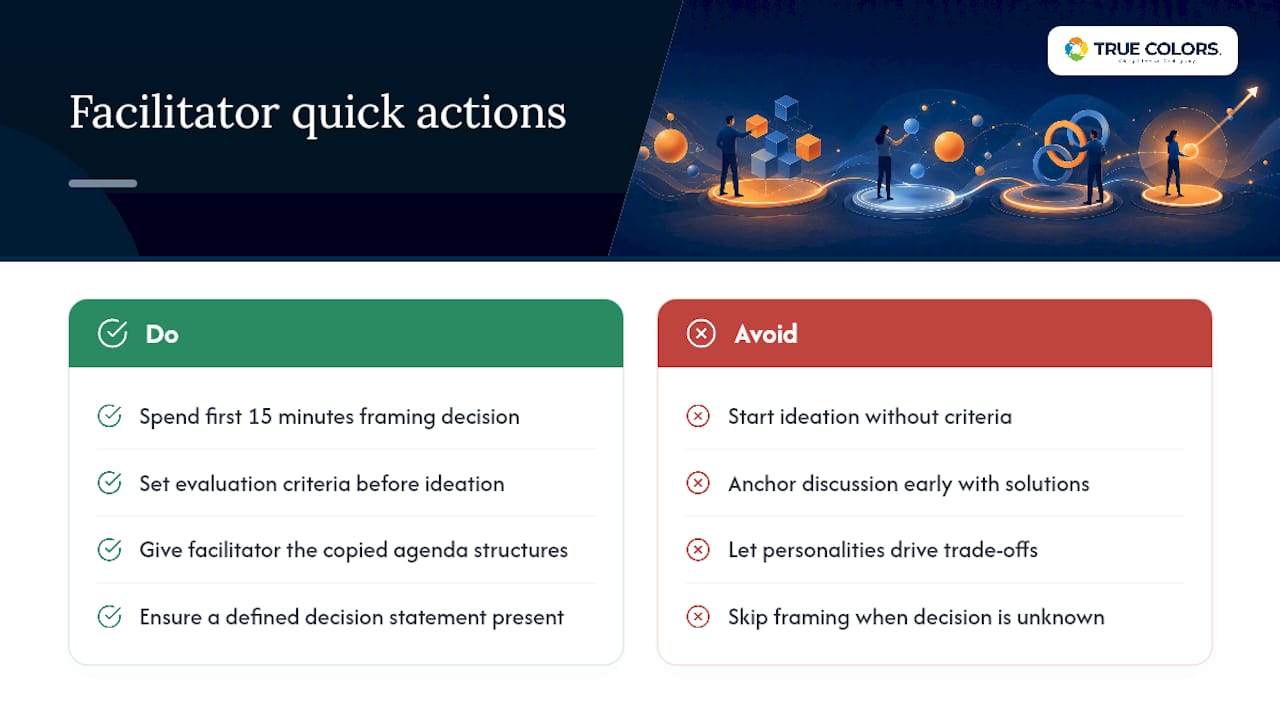
Copy these structures directly, or hand them to whoever is facilitating. Each one assumes a defined decision statement walks in the door with the group. If the group doesn't know what it's deciding yet, spend the first 15 minutes framing that before anything else, since setting evaluation criteria before ideation prevents early anchoring and keeps discussion focused on trade-offs rather than personalities.
The 90 to 120 minute decision lab
- Open and frame (10 min): State the decision, the deadline, and who owns the final call.
- Warm-up (10 min): A low-stakes practice decision to normalize disagreement and speed.
- Divergent ideation (20 min): Generate options, including at least two that aren't the status quo.
- Consider the opposite (15 min): Each option's strongest critic argues against it.
- Narrowing (20 min): Dot voting or affinity mapping to cluster and cut weak options.
- Decision (20 min): Apply a weighted decision matrix or the agreed fallback method.
- Close (10 min): Assign owners, dates, and how progress gets reported.
Short, time-boxed labs like this work well for tactical choices; strategic decisions with real organizational weight generally need a multi-session format with prework baked in.
Half-day and full-day formats
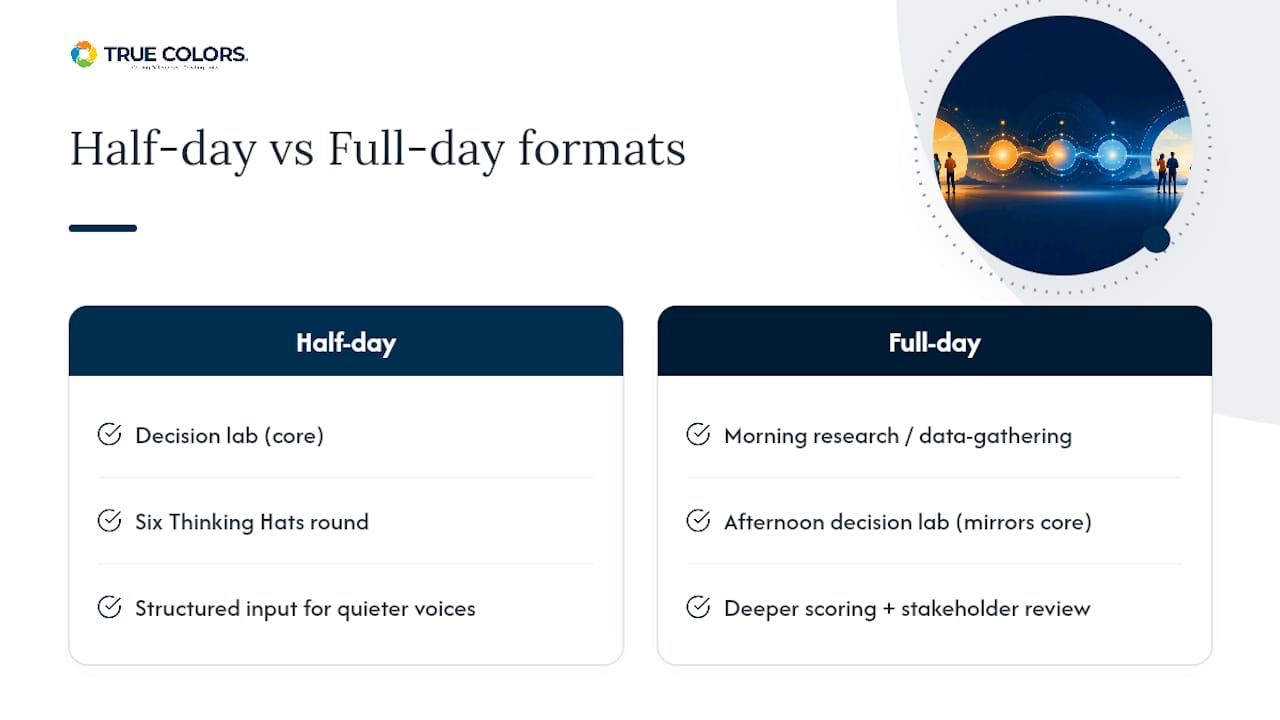
A half-day agenda stretches the lab above and adds a second option-generation round using Six Thinking Hats, giving quieter voices a structured way to weigh in without competing for airtime. A full-day format adds a research or data-gathering block in the morning, feeding an afternoon that mirrors the decision lab but with deeper scoring and a stakeholder review checkpoint before the group commits.
Pro Tip: Schedule the toughest, most political decision right after lunch, not first thing. Groups are more candid once they've built momentum on a lower-stakes warm-up decision.
Exercise templates worth stealing
- Dot voting: Sticky notes and dot stickers (or a digital whiteboard poll). Each participant votes on top options; fastest way to surface group sentiment without a long debate.
- Affinity mapping: Cluster raw ideas into themes before scoring; prevents duplicate options from splitting votes.
- Effort/impact grid: Plot options on a two-axis chart to separate quick wins from long-shot bets.
- Weighted decision matrix: List criteria, assign weights, score each option, and let the math surface the leader rather than the loudest voice.
- Six Thinking Hats: Rotate the group through six lenses (facts, feelings, risks, benefits, creativity, process) to force complete coverage.
- Consider the opposite: Assign someone to argue against the favored option before the vote locks in.
- Nominal group technique: Silent individual brainstorming, then round-robin sharing, to reduce anchoring on the first idea spoken aloud.
For remote or hybrid groups, replace flip charts with a shared digital whiteboard, run votes through a live polling tool, and use breakout rooms for small-group scoring before regrouping. A facilitation partner like AmmarAI's productivity workflows can also speed up the note-taking and synthesis work between exercises, freeing the facilitator to focus on the room instead of the whiteboard.
Designing the Workshop Around Your Team and Stakes
Match the format to the decision, not the calendar. A low-stakes, familiar decision fits the 90-minute lab. A decision that's unfamiliar, high-stakes, or politically loaded deserves a half-day or multi-session structure with prework, because groups facing genuine novelty need time to gather evidence before they're ready to choose well.
Roles matter as much as timing. Every workshop needs:
- A driver or decider who owns the final call and can't be overruled by group fatigue
- Contributors who bring context, data, or stakes in the outcome
- A subject matter expert brought in for specific technical or market input
- An observer or note taker capturing the reasoning, not just the result
Group size runs best between six and twelve people. Fewer than six and you lose diversity of view; more than twelve and dot voting turns into a popularity contest.
On decision models, pick deliberately rather than defaulting to consensus:
- Leader decides with input works when speed matters more than buy-in.
- DACI (Driver, Approver, Contributors, Informed) suits cross-functional decisions where accountability needs to be explicit.
- Consensus with a fallback vote protects morale while still preventing an endless stall.
- Majority vote works for lower-stakes calls where speed beats nuance.
For virtual sessions, set a camera-on norm for anything beyond a quick poll, share the working document in advance, and build in asynchronous prework so people arrive with context rather than cold.
Facilitation Best Practices Backed by Real Evidence
The single highest-leverage move a facilitator can make is forcing the group to argue against its own favorite option before it locks in. Research reviewed by SIOP and SHRM found that "consider the opposite" cuts decision-making bias significantly, while simply warning a group about bias can backfire and entrench the original view further.
Pair that with an outside-view check, asking how similar decisions played out elsewhere, to surface failure modes the room hasn't considered. IMD's research on decision-making under pressure backs the same instinct: structured rules and probabilistic framing beat gut calls when the stakes are real, a point covered in its ten principles for better decisions.
A few facilitation dos and don'ts worth posting on the wall:
- Do frame criteria before anyone proposes a solution.
- Do require at least two non-status-quo alternatives before narrowing.
- Don't let the first or most senior voice anchor the room.
- Don't skip the fallback decision method; pre-agreeing it prevents post-workshop reversals.
True Colors International builds this evidence into a full behavior-to-action system rather than a one-off session. Facilitators work from templates that carry criteria, ownership, and measurement forward, so the workshop's output becomes an organizational habit instead of a memory. Recommended pre-work for participants: read the decision brief, bring one alternative already in mind, and flag any conflict of interest before the room opens.
Pro Tip: Give every participant an index card and ask them to write their initial recommendation before discussion starts. Collect the cards. It's the cheapest anchoring check you'll ever run, and it shows you exactly how much the group's thinking shifted by the end.
Measuring Success and Keeping Decisions From Dying
A decision-making workshop that ends without measurement is just an expensive meeting. Track two layers: what happens immediately after the session, and what happens over the following quarter.
Immediate measures worth capturing on the spot:
- Was a decision owner actually named, by name, not by role?
- Are there specific 30/60/90-day actions with dates attached?
- Did the group document its reasoning, not just its conclusion?
Outcome measures worth reviewing 60 to 90 days out:
- Percentage of committed actions actually completed
- Movement on the KPI the decision was meant to influence
- How often the decision got reversed or reopened
| Metric | When to check | Target signal |
|---|---|---|
| Decision owner named | End of session | Yes, by name |
| Actions with dates | End of session | Committed actions completed |
| Actions completed | 30 to 90 days out | Rising completion rate |
| Decision reversals | 90 days out | Fewer than prior cycle |
Build a recurring cadence, a standup check-in at 30 days, a fuller progress review at 90, with one accountability owner responsible for chasing status. Keep every workshop's output in a shared decision register rather than a one-time deck. Over time, that register becomes organizational memory: a record of what was decided, why, and what actually happened next, which is exactly the kind of reinforcement infrastructure that keeps good habits from quietly disappearing.
When to Facilitate Yourself and When to Bring in a Partner
Run it yourself when the decision is contained, the group trusts each other, and someone internal can hold neutral ground. Bring in an outside facilitator when you see recurring deadlock, low psychological safety, or a decision complex enough that internal politics will bend the outcome. An external facilitator has no stake in who wins the argument, which is often the entire point. If you're weighing that choice, our team effectiveness templates and case studies are a reasonable place to start comparing your situation against.
— Theresa
How True Colors International Designs Workshops That Stick
A practical alternative to a one-off training day is to build the criteria, ownership, and measurement templates into the culture system itself, so decisions stay made. Our Connected Leadership Program exists for organizations that want a partner to design the agenda, facilitate the room, and set up the 30/60/90-day tracking that turns a workshop into a habit.

Engaging a consulting partner means a custom agenda built around your actual decision stakes, a facilitator trained in behavior-based techniques, and reinforcement tools like decision registers and progress reviews that outlast the session itself. This is culture change made operational, moving a team from personal awareness of how they decide to aligned, repeatable action. If your leadership team keeps circling the same decisions without closing them, visit the Connected Leadership Program page and start a conversation about what a facilitated session could look like for your team.
Sources
- Ten principles for making better decisions - IMD
- Decision-Making Process: Steps, Tips, and Strategies - Atlassian
- Evidence-Based Strategies to Improve Workplace Decisions: Small Steps, Big Effects
FAQ
What Are the 5 C's of Decision-Making?
Common versions include Clarify, Consider, Choose, Commit, and Check, a rough sequence for framing the decision, weighing options, picking a path, acting on it, and reviewing the result.
What Are the 3 C's of Decision-Making?
A shorter version used in some training programs is Choices, Consequences, and Consideration, emphasizing that every option carries trade-offs worth naming before committing.
What Are the 4 R's of Decision-Making?
Definitions vary by program, but a common framing covers Recognize (the decision exists), Research (gather evidence), Resolve (choose), and Review (check outcomes against expectations).
What Is the 10 10 10 Rule for Decision-Making?
The 10 10 10 rule asks how you'll feel about a choice in 10 minutes, 10 months, and 10 years, a quick way to separate short-term emotion from longer-term consequences during a workshop's narrowing phase.
How Long Should a Decision-Making Workshop Be?
A tactical decision fits a 90 to 120 minute decision lab, while unfamiliar or high-stakes strategic decisions typically need a half-day, full-day, or multi-session format with prework built in.