
Follow-up is the difference between a workshop that raises awareness and one that actually changes behavior. Without structured reinforcement, transfer rates remain low — research consistently shows that most learning fades within days when nothing follows the initial session. FAO guidance on capacity development recommends planning follow-up during the design phase, not as an afterthought. True Colors International builds reinforcement into every engagement for exactly this reason.
The business case is direct:
- Skill transfer increases measurably when participants receive coaching, peer support, or structured check-ins after a workshop.
- Repeat training costs drop when follow-up embeds the learning the first time.
- Employee engagement holds longer when leaders model and reinforce new behaviors consistently.
Assign a follow-up owner and activate initial follow-up steps within 72 hours of your next workshop. That sequence — owner assignment and communication within the 0–72 hour window — determines whether the investment pays off.
Key Takeaways
Follow-up is a design requirement, not an optional add-on: organizations that plan reinforcement before the workshop runs consistently see higher skill transfer and more durable behavior change than those that treat follow-up as an afterthought.
| Point | Details |
|---|---|
| Plan follow-up during design | Assign a follow-up owner and schedule checkpoints before the workshop runs, not after. |
| Act within 72 hours | Send a recap and commitment prompt within 72 hours to counter the forgetting curve and anchor retention. |
| Use a 30/60/90 cadence | Structure checkpoints at 30, 60, and 90 days with named owners and measurable milestones at each stage. |
| Measure behaviors, not just satisfaction | Track manager-observed behavior frequency and business outcomes alongside participation metrics. |
| True Colors International | Provides manager coaching, follow-up toolkits, and employee experience surveys to sustain culture change after workshops. |
Table of Contents
- Why culture workshops need follow-up to produce real results
- When should you plan follow-up, and who owns each phase?
- What follow-up methods actually work?
- How do you measure whether follow-up is working?
- What gets in the way, and how do you fix it?
- Your 30/60/90 follow-up playbook
- The part most organizations skip
- True Colors International supports culture work beyond the workshop
- Sources
Why culture workshops need follow-up to produce real results
A workshop can shift thinking in a room. It rarely shifts behavior in an organization. The gap between those two outcomes is where most culture initiatives stall, and the research on this is clear: one-off sessions raise awareness but leave entrenched systems, habits, and incentives untouched.
Transfer rates without structured follow-up are commonly low. Peer meetings, supervisory consultations, action plans, and technical support have each been shown to increase transfer and produce measurable operational benefits — yet most organizations skip them entirely.
The mechanism is cognitive as much as organizational. Without reinforcement, the forgetting curve erodes workshop content within 48–72 hours. Workshop Weaver's analysis of the spacing effect shows that contact within that window significantly boosts retention. Spaced activation over weeks compounds the effect further.
The business benefits of follow-up map directly to outcomes HR leaders are already measured on: higher skill transfer, lower cost-per-behavior-change, improved retention, and faster time-to-adoption. Planning follow-up during the design phase, before the workshop runs, is what makes those outcomes achievable rather than accidental. Culture programs that connect to lasting business results share this design discipline as a common thread.
When should you plan follow-up, and who owns each phase?
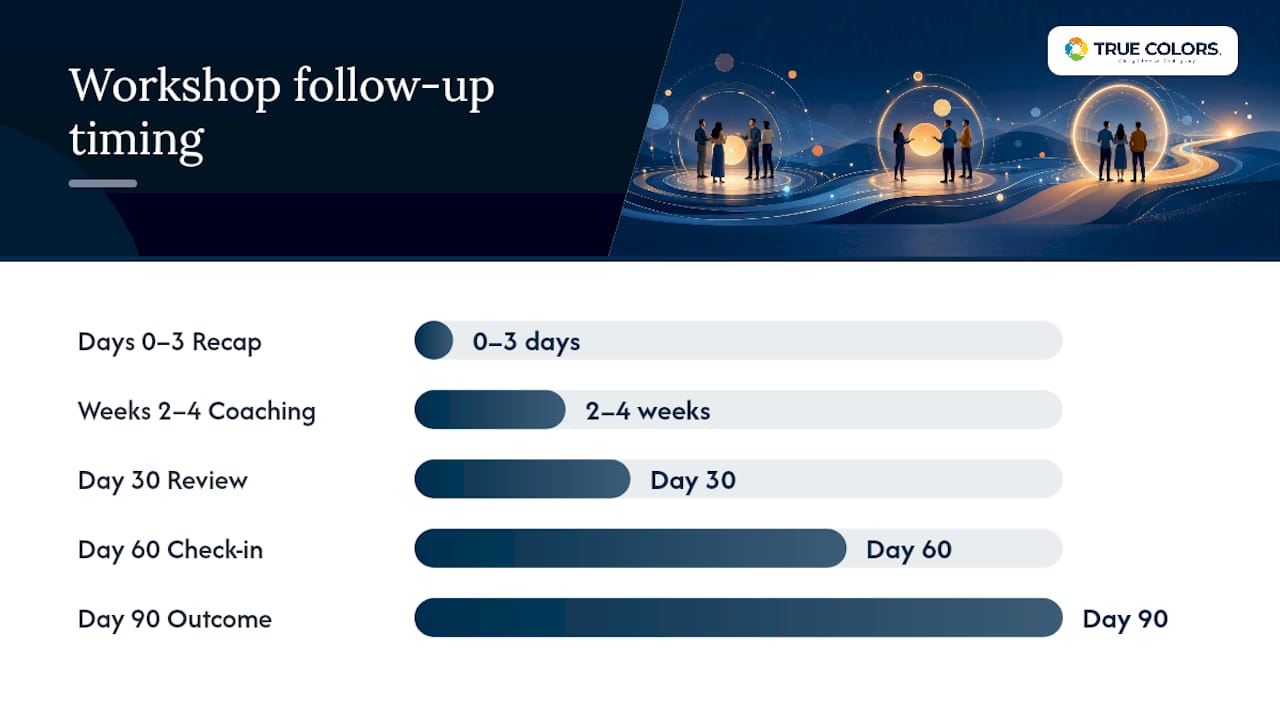
Plan follow-up during workshop design. Activate the first steps within 72 hours of delivery.
Timeline at a glance:
- Days 0–3: Facilitator sends recap and commitment prompts; sponsor sends a visible acknowledgment to the team.
- Weeks 2–4: Managers conduct first coaching conversations; HR distributes short pulse surveys.
- Day 30: HR reviews participation data; managers report observed behavior changes.
- Day 60: Peer community or cohort check-in; refresher resource distributed.
- Day 90: Outcome review against baseline KPIs; follow-up design updated based on findings.
Role responsibilities:
- Workshop facilitator: Documents key commitments and distributes a post-session summary within 24 hours.
- Direct managers: Lead coaching conversations, observe behavior, and name what they see — both progress and gaps.
- HR/L&D: Owns measurement logistics, survey timing, and checkpoint scheduling.
- Senior sponsor: Models the learning publicly, references workshop themes in team communications, and creates visible permission for reflection.
The 60-day checkpoint is where most programs reveal whether manager behavior has actually shifted. The 90-day review is where you decide whether to scale, adjust, or repeat.
What follow-up methods actually work?
Match the method to the objective. Awareness gaps call for refresher tools; skill adoption requires coaching; systemic change demands manager accountability and process redesign.
-
Manager coaching conversations — highest impact, moderate cost. Managers observe specific behaviors, name them, and connect them to workshop commitments. Building a manager coaching program requires clear conversation guides and a defined cadence, but even monthly check-ins produce measurable lift.
-
Peer communities of practice — low cost, high sustainability. Small cohorts meet bi-weekly to share what they tried, what worked, and where they got stuck. The social accountability effect is significant.
-
Mentoring programs — best for leadership behavior change. Pairing participants with a more experienced colleague who models the target behaviors accelerates adoption, particularly for communication and conflict norms.
-
Refresher sessions — short (30–45 minutes), spaced 4–6 weeks apart. Effective for reinforcing frameworks introduced in the original workshop. Culture-focused training programs that work typically include at least two spaced touchpoints.
-
Toolkits and digital resources — lowest cost, lowest accountability. Useful as reference material but insufficient alone. Pair with a prompt or check-in to drive actual use.
-
Accountability check-ins — brief async prompts (a Slack message, a one-question survey) that keep the learning visible between formal touchpoints.
Pro Tip: Bundle a peer community meeting with a manager checkpoint in the same week. Participants arrive at the manager conversation having already processed their experience with peers, which makes the coaching discussion more specific and productive.
How do you measure whether follow-up is working?
Measure behaviors and business outcomes, not just satisfaction scores. A post-workshop survey asking "Was this valuable?" tells you almost nothing about whether behavior changed.
| Measurement level | KPI examples | Collection method |
|---|---|---|
| Behavior indicators | Frequency of target behaviors observed by managers; peer-reported communication shifts | Manager observation log; 2-week pulse survey |
| Participation metrics | Checkpoint attendance rate; resource download or completion rate | LMS or calendar tracking |
| Business outcomes | Retention rate change; quality or error rate; cycle time on key processes | HR data; operational dashboards |
Data collection sequence:
- Week 2: Short pulse survey (3–5 questions) on confidence and initial application attempts.
- Week 8: Behavior-focused survey plus manager observation summary.
- Day 90: Outcome mapping against pre-workshop baseline.
The feedback loop works like this: HR collects data, shares findings with facilitators and sponsors, and the team adjusts follow-up design for the next cohort. Tracking analytics through this cycle helps consultants and HR leaders identify which interventions are driving change and which are just generating activity. Follow-up contact also surfaces the obstacles participants face, which directly improves future workshop design. Measuring organizational culture effectiveness requires this kind of iterative loop, not a one-time assessment.
What gets in the way, and how do you fix it?
Most follow-up fails because the organization still rewards old behaviors. Name that clearly, then address the structural causes.
- Manager overload: Embed coaching conversations into existing one-on-ones rather than scheduling separate meetings. A five-minute structured check-in beats a 30-minute session that never happens.
- No accountability: Assign a named owner for each checkpoint. Shared ownership is no ownership.
- Competing priorities: Reduce scope to a pilot team of 8–12 people. Prove the model before scaling.
- Insufficient resources: Low-cost follow-up activities — peer meetings, action plans, brief supervisory consultations — consistently produce measurable improvements and often pay for themselves.
- Misaligned performance systems: If performance reviews don't reference the behaviors introduced in the workshop, managers and employees receive a clear signal that those behaviors don't matter. Align at least one review criterion before the workshop runs.
Manager script for initiating a coaching conversation: "I want to check in on one thing from the workshop. What's one behavior you committed to trying? Where have you had a chance to practice it, and what got in the way?"
Script for securing time for an accountability check-in: "I'd like to add five minutes to our standing meeting for the next six weeks to track progress on our culture commitments. It's the same agenda — just a structured close."
Leaders who model learning publicly and create space for reflection are the single most reliable predictor of whether workshop learning integrates into daily work. That's a leadership behavior, not a program feature.
Your 30/60/90 follow-up playbook
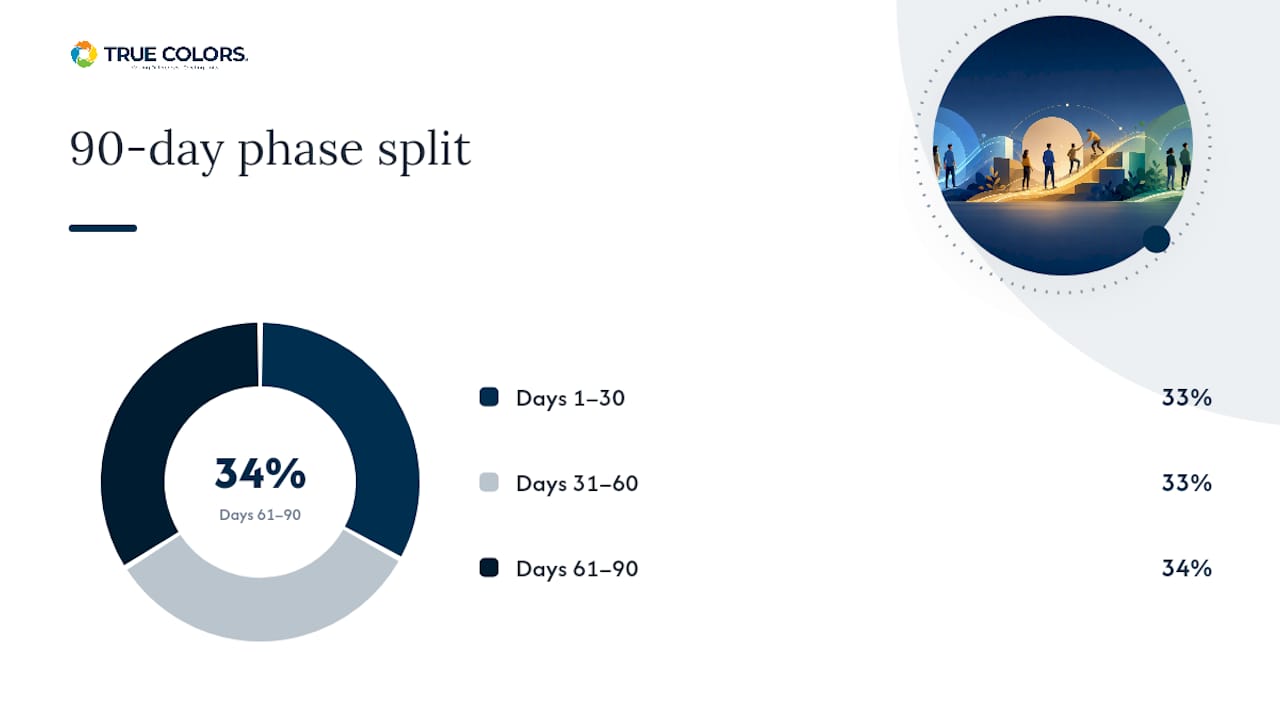
This playbook covers three phases, each with a named owner and a measurable milestone. Copy it, assign owners, and run it as a pilot before scaling.
| Phase | Owner | Key actions | Success indicator |
|---|---|---|---|
| Days 1–30 | Facilitator + HR | Send recap (Day 1); distribute commitment prompt (Day 3); conduct pulse survey (Week 2); schedule manager check-ins | survey response; all managers complete first check-in |
| Days 31–60 | Managers + HR | Run peer community session; distribute refresher resource; collect manager observation logs | Behavior change noted in observation logs |
| Days 61–90 | HR + Senior sponsor | Conduct outcome review; map results to baseline KPIs; update follow-up design; share findings with leadership | At least one business outcome metric shows directional improvement |
Sample communications:
- Day 1 (facilitator to participants): "Thank you for your engagement today. Attached is a one-page summary of the key commitments from the session. Review it before your next team meeting and identify one behavior to try this week."
- Day 3 (HR to managers): "Your team completed the workshop. Your role now is to notice and name the behaviors they're practicing. Here's a two-question check-in guide for your next one-on-one."
- Week 4 (manager to team): "We're four weeks out from the workshop. I want to spend five minutes this week on what's working and what's getting in the way. Come ready to share one example."
Follow-up checklist:
- Follow-up owner assigned before workshop delivery
- Recap and commitment prompt sent within 72 hours
- Pulse survey deployed at Week 2
- Manager coaching conversations completed by Day 30
- Peer community or cohort session held by Day 60
- Outcome review completed at Day 90
- Follow-up design updated for next cohort
Effective follow-up sequencing follows the same logic here as in any structured communication program: timing, ownership, and a clear next action at each stage.
The part most organizations skip
Culture is not what is said. It's what is repeated. That's the lens True Colors International brings to every engagement, and it's why follow-up isn't a nice addition to a workshop program. It's the mechanism that determines whether the workshop mattered at all.
The most common failure mode isn't a bad workshop. It's a good workshop with no system behind it. Organizations invest in the event and skip the infrastructure. Then, six months later, they wonder why nothing changed and consider running the workshop again.
What actually works is treating follow-up as a design requirement from day one. Plan the 30/60/90 cadence before the facilitator walks in the room. Assign owners before the session ends. Send the first post-session summary within 24 hours, and ensure a commitment prompt or checkpoint is activated during the first 72 hours. The cost of doing this well is a fraction of the cost of repeating a workshop that didn't stick.
True Colors International supports culture work beyond the workshop
True Colors International works with organizational leaders and HR teams to build the reinforcement systems that make workshop learning last. The work doesn't end when the session does.

For teams ready to move from a single workshop to a sustained culture program, True Colors offers manager coaching programs, employee experience surveys, follow-up toolkits, and implementation support designed around your organization's specific behavioral goals. The Connected Leadership Program packages these elements into a structured engagement that includes checkpoints, measurement, and ongoing reinforcement.
Request a consultation at Truecolorsintl to discuss a pilot rollout and what your first 90 days could look like.
Sources
- Improving Training Impact Through Effective Follow-Up: Techniques and Their Application
- You're Not Fixing the Culture. You're Running a Workshop. | Workshop Weaver Blog