
Culture training loses impact when organizations treat it as a single event rather than a continuous process built on behavioral reinforcement, structural alignment, and ongoing support. The forgetting curve alone explains part of the problem: people forget 70% of new training information within 24 hours and 90% within a week. That statistic means a full-day workshop on cultural competency can be functionally erased before Monday morning. Understanding why culture training loses impact requires looking beyond content delivery to the systems, habits, and leadership behaviors that either reinforce or undermine what was learned.
Why culture training loses impact: the research case against knowledge-only design
Traditional culture training is built on a flawed assumption: that knowing more about cultural differences automatically produces better behavior. Research does not support that assumption.
A study examining nurses with high levels of cognitive cultural knowledge found a counterintuitive result. Knowledge about cultural norms did not automatically lead to better care or higher job satisfaction. In some cases, higher knowledge scores correlated with worse performance outcomes. The explanation is cognitive overload. When leaders and HR professionals load employees with cultural facts without building the reflective skills to apply them, the information creates confusion rather than clarity.

Cross-cultural management education research reinforces this finding. Post-program assessments at 18–24 months show that sustained gains appear only when regional language instruction and ongoing organizational support accompany the training. Programs that deliver content and then disappear produce short-term awareness at best.
The pattern across these studies points to the same root cause:
-
Training focused on knowledge acquisition without behavioral practice fails to transfer to real work situations.
-
Delayed evaluations consistently show skill decay when reinforcement is absent after the initial program.
-
Cognitive entrenchment, where employees apply new cultural frameworks too rigidly, can reduce adaptability.
-
Organizational backing, not training content alone, predicts whether cultural competency gains hold over time.
Culture training effectiveness is not a content problem. It is a design and system problem.
What makes one-time training events fail to change behavior?
The forgetting curve is the most documented reason culture training fails to stick. Without deliberate reinforcement, most new training is forgotten rapidly, requiring a design that integrates repetition and manager involvement. A single workshop cannot compete with the weight of daily habits, existing team norms, and unaddressed organizational pressures.
Timing compounds the problem. Most organizations deliver culture training during onboarding or at an annual all-hands event. Employees then return to their roles without any structured opportunity to practice what they learned. The gap between training delivery and on-the-job application is where skills go to disappear.
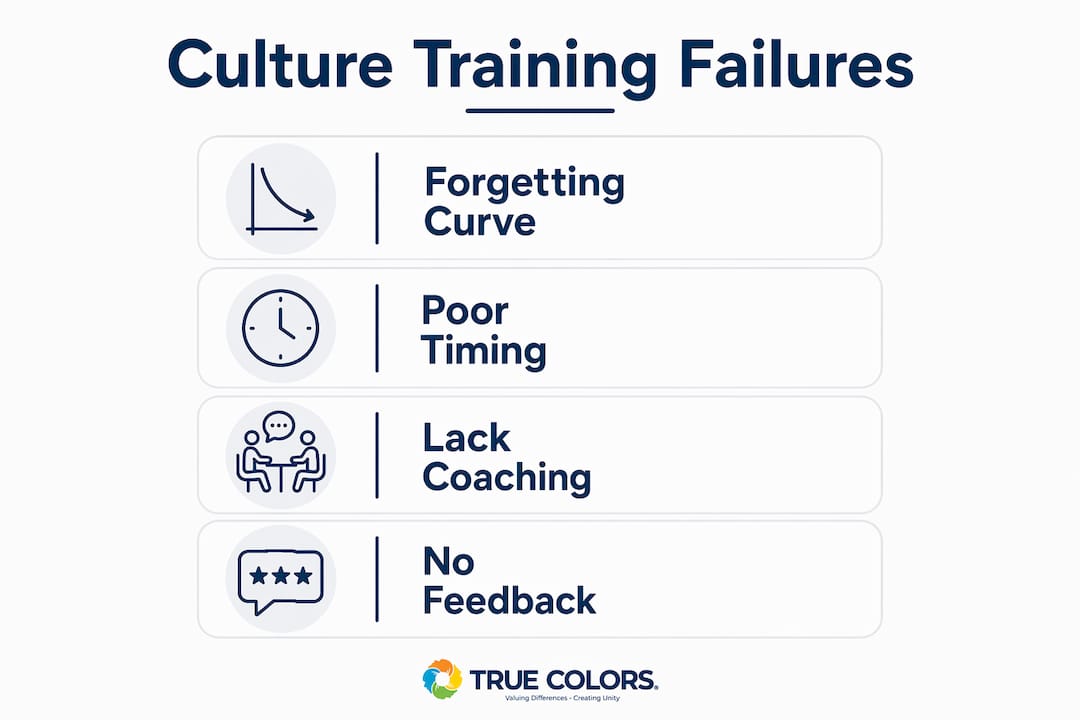
Manager reinforcement is the most critical missing piece. Training as an event fails without managers coaching and providing real-time feedback on learning application. When a manager never references the training, never models the behaviors it promoted, and never creates space for reflection, employees correctly conclude that the training was not serious. Culture is not what is said. It is what is repeated.
Pro Tip: Build a 90-day reinforcement calendar for every culture training program. Assign managers three specific coaching conversations tied to training behaviors. Without a calendar, reinforcement does not happen.
The absence of feedback loops is equally damaging. Employees need to know whether their behavior is changing in the right direction. Without structured check-ins, peer reflection, or manager observation, there is no mechanism to correct drift or build confidence in new skills. The result is a decline in training results that leaders often misattribute to employee disengagement rather than design failure.
The visible versus embedded gap in culture change initiatives
Culture change initiatives fail largely due to focusing on visible messaging rather than embedded structural changes. This is the most expensive mistake organizations make, and it is also the most common.
Visible culture changes are easy to produce and easy to measure superficially. Embedded changes require altering the systems that govern daily decisions, and those systems are harder to touch. The distinction matters because employees are experts at reading which one their organization values.
Here is how the gap typically plays out in practice:
-
Visible changes get launched. New values posters go up. A culture workshop runs. Leadership sends an all-staff email about the importance of inclusion or psychological safety.
-
Embedded systems stay unchanged. Promotion criteria still reward individual performance over collaboration. Reward systems still favor short-term results over the behaviors the training promoted. Decision-making authority stays concentrated at the top.
-
Employees notice the contradiction. When the visible message conflicts with the embedded reality, employees trust the reality. Credibility erodes quickly.
-
Initiative fatigue sets in. Too many simultaneous culture demands create cognitive and emotional overload. Employees stop engaging with new programs because past programs produced no real change.
Pro Tip: Before launching any culture training program, audit your reward and recognition systems. If the behaviors the training promotes are not rewarded in performance reviews, the training will not produce lasting change.
The visible-embedded gap is also why contradictory leadership behavior is so damaging. When senior leaders publicly champion a culture initiative but privately make decisions that contradict it, the training loses all credibility. Leaders are the most powerful culture signal in any organization.
How metacognitive cultural intelligence changes training outcomes
Metacognitive cultural intelligence is defined as the ability to reflect on and adapt one’s own thought processes when navigating cultural differences. It is distinct from simply knowing cultural facts, and research shows it is a stronger predictor of effective performance than cognitive knowledge alone.
The nursing study referenced earlier makes this concrete. Nurses who scored higher on reflective, adaptive abilities outperformed those who scored higher on cultural knowledge scores. Reflection and adaptation produced better care. Facts alone did not. This finding applies directly to organizational settings where leaders and teams must navigate diverse colleagues, clients, and stakeholders in real time.
Metacognitive skills are trainable, but they require a different instructional approach. Standard culture training delivers information. Metacognitive training builds the habit of asking: “How am I thinking about this situation, and is that thinking serving me well?” That question is what separates cultural competency challenges that get resolved from those that calcify into team dysfunction.
Organizations can cultivate metacognitive skills by building structured reflection into training design. Scenario-based practice, peer debrief sessions, and manager-led coaching conversations all create the conditions where reflection becomes a habit rather than a one-time exercise. The goal is not cultural knowledge retention. The goal is adaptive thinking that employees can apply to situations they have never encountered before.
Practical strategies to improve sustained culture training impact
Improving training impact requires treating culture as an ongoing system, not a program with a start and end date. The research is clear that training must be structured as an ongoing process embedded in daily operations for lasting skills transfer to occur.
Localization is one underused lever. Latin American participants in Spanish-language tracks report higher cultural intelligence gains than those in English-only tracks. Language accessibility directly improves engagement and metacognitive reflection. Organizations with multilingual workforces that deliver training only in English are leaving measurable gains on the table.
Measurement is another gap. Combining quantitative and qualitative metrics for long-term behavior change verification is the standard for demonstrating training value to decision-makers. Most organizations measure training satisfaction immediately after a session. That data tells you almost nothing about behavior change. Longitudinal tracking, manager observation scores, and team performance indicators are the metrics that matter.
| Common pitfall | Strategic improvement |
|---|---|
| One-time workshop with no follow-up | Structured 90-day reinforcement with manager coaching |
| Knowledge-only curriculum | Scenario-based practice with metacognitive reflection |
| Visible culture messaging without system change | Audit and align reward systems before launching training |
| English-only delivery for multilingual teams | Localized tracks in participants’ native languages |
| Satisfaction surveys as the only metric | Longitudinal behavioral tracking and manager observation |
| Multiple simultaneous culture initiatives | Sequenced, focused programs with clear organizational priority |
Leaders who want to measure culture effectiveness over time need to build measurement into the program design from day one, not as an afterthought. When measurement is retrofitted, the data is rarely actionable.
Key takeaways
Culture training loses impact when it is designed as a knowledge event rather than a behavior system with reinforcement, structural alignment, and ongoing leadership support.
| Point | Details |
|---|---|
| Forgetting curve undermines one-time events | Without reinforcement, 90% of training content is forgotten within a week. |
| Knowledge alone is insufficient | Higher cultural knowledge scores can backfire without reflective, adaptive skills. |
| Visible change without embedded change fails | Reward systems and decision-making must align with the behaviors training promotes. |
| Manager reinforcement is non-negotiable | Managers who do not coach training behaviors signal that the training does not matter. |
| Metacognitive skills outperform cultural facts | Training that builds adaptive thinking produces stronger performance than content delivery alone. |
What I have learned about why culture training stops working
I have watched organizations invest significantly in culture programs and walk away confused when nothing changed six months later. The pattern is almost always the same. The training was well-designed, the facilitators were skilled, and the content was relevant. What was missing was everything that came after.
The disconnect between training design and real-world workplace application is no mystery. It is a predictable consequence of treating culture as a message to be delivered rather than a system to be built. When I look at organizations that shift their culture, they share one characteristic: their leaders changed their own behavior first and kept changing it consistently. The training was a catalyst, not the cause.
What I find most useful about the Truecolorsintl approach is that it does not stop at awareness. It gives leaders and teams a shared language for behavior and builds the reinforcement structures that keep that language alive in daily decisions. That is the difference between a workshop that fades and a culture that holds. If you want to understand why leaders fail culture initiatives, start by looking at what happens the week after the training ends.
— Theresa Stairs
How Truecolorsintl supports lasting culture change

Truecolorsintl works with organizational leaders and HR professionals who are done with culture programs that produce short-term awareness and long-term disappointment. The Truecolorsintl system connects personal behavior awareness to team alignment, leadership development, and the structural reinforcement that keeps culture change moving. Programs include leadership development and corporate consulting designed to address the visible-embedded gap directly. Whether your organization needs to rebuild trust, align leadership behavior, or create a measurement framework for culture impact, Truecolorsintl provides the tools and ongoing support to make it real. Visit Truecolorsintl to learn how the system works in practice.
FAQ
Why does culture training lose impact so quickly?
Culture training loses impact because most programs are designed as single events without reinforcement. Without manager coaching and structured follow-up, people forget 90% of training content within a week.
Is more cultural knowledge always better for performance?
No. Research shows that higher cognitive cultural knowledge can reduce performance when it is not paired with reflective, adaptive skills. Metacognitive cultural intelligence is a stronger predictor of effective performance than factual knowledge alone.
What role do managers play in the effectiveness of culture training?
Managers are the primary reinforcement mechanism for any culture training program. When managers do not coach the behaviors promoted in training, employees interpret that as a signal that the training does not reflect real organizational priorities.
How should organizations measure the impact of culture training?
Organizations should combine quantitative metrics, such as team performance indicators, with qualitative data, such as manager observation scores, tracked over 12–24 months. Immediate satisfaction surveys do not measure behavior change.
What is the visible versus embedded gap in culture change?
The visible-embedded gap describes the disconnect between surface-level cultural signals, like slogans and workshops, and the underlying systems that drive daily behavior, such as reward structures and decision-making authority. Culture change fails when visible signals are updated but embedded systems stay the same.