
After your engagement survey closes, run a focused 90-day action plan with two or three priorities, one named owner per action, and an observable metric for each. Skip the 40-item spreadsheet. Skip the department-wide committee. Assign clear ownership, set a short timeline, and review progress in public at 30, 60, and 90 days.
TL;DR:
- Most engagement plans fail due to too many priorities, lack of clear ownership, and poor follow-up, which are addressed by limiting focus to two or three actions.
- Turning survey results into an effective plan requires filtering themes by importance, impact, and team capability, then prioritizing actions with measurable milestones.
- Implementing a two-meeting process, with pre-readings, voting, and specific owner assignment, ensures accountability and structured follow-through.
- Progress is best measured through specific actions and short pulse surveys at 90 days, avoiding reliance on long-term metrics like attrition or annual engagement scores.
- True Colors offers tools and training to solidify the process through diagnostic surveys, leadership development, and team facilitation, ensuring the plan becomes sustained behavior.
Table of Contents
- What Is Engagement Action Planning and Why Does a 90-Day Cycle Work?
- How Do You Turn Survey Results Into a 90-Day Action Plan?
- How Do You Run an Engagement Action-Planning Meeting?
- A Copyable 90-Day Action Plan Template
- How True Colors Turns Survey Data Into Team-Owned Action
- How Do You Measure Whether the Action Plan Actually Worked?
- How Do Engagement Action Plans Connect to Bigger Organizational Goals?
- Why Team-Owned Plans Beat Polished Ones
- How True Colors Helps You Build the Plan That Actually Runs
- Sources
- FAQ
What Is Engagement Action Planning and Why Does a 90-Day Cycle Work?
Engagement action planning is the process of converting survey findings into a small set of prioritized commitments, each with a named owner, a defined timeline, and a metric the team can actually observe. It is not a report. It is not a slide deck that summarizes what employees said. It is a working document that assigns responsibility and tracks whether anything changed.
The 90-day cycle exists for a practical reason: survey data has a shelf life. Employees remember what they said and start watching for a response within weeks, not quarters. A strong action plan limits priorities to two or three, assigns one named owner per action, and uses metrics that can move within that window, which keeps the plan honest and the team accountable.
Most engagement plans fail before they start, and the causes repeat across organizations: too many priorities diluting focus, actions with no individual owner, and plans that live in a leadership deck instead of a tracker anyone checks. A disciplined seven-step approach prevents all three by forcing small scope, single ownership, and a visible follow-up cadence. Ninety days is long enough to build a habit and short enough that nobody forgets they committed to it.
How Do You Turn Survey Results Into a 90-Day Action Plan?
Converting a dashboard full of scores into a plan people actually execute takes five distinct steps. Skip any one of them and the plan drifts back into a document nobody opens after week two.
- Reduce survey output to candidate themes. Apply three filters to every low-scoring item: is it both low and important to employees, is it corroborated across multiple teams or comment threads, and can this specific team actually fix it? A theme that fails any filter gets parked, not ignored, but it does not make the shortlist.
- Prioritize using impact versus effort. Score remaining candidates on a simple quadrant: high impact and low effort goes first, high impact and high effort goes second if capacity allows. Choose two or three priorities total. Anything beyond that number splits attention and guarantees none of them get finished.
- Write each priority as a 90-day row. Every priority needs a specific action, one named person (never a department or "the leadership team"), and three milestones at days 30, 60, and 90. Pair it with a metric your team can observe inside the quarter, not one that only shows up in next year's annual survey.
- Communicate the plan in "you said, we are doing" format. State the survey finding, the action you are taking, and just as important, what you are explicitly not doing this cycle. Employees trust plans more when leaders name the tradeoffs out loud rather than implying every concern will be solved at once.
- Review at 30, 60, and 90 days, then close the cycle publicly. A short checklist at each checkpoint (what shipped, what stalled, what the pulse metric shows) keeps owners accountable and gives the next planning cycle real data to build on.
A short closing report at day 90 describing what shipped, what the metrics show, and what carries into the next cycle is one of the strongest practical predictors of better response rates the next time you survey. Teams that see a visible close, rather than silence, answer more honestly the next round.
Pro Tip: Write the "what we are not doing" line before you write the action itself. It forces the same discipline that keeps the whole plan to two or three priorities instead of ten.
Communication matters as much as the plan's content. Forbes Human Resources Council members point to transparency and frequent updates on the reasoning behind decisions as one of the strategies working best right now, particularly when changes touch pay, workload, or career paths. Employees forgive an imperfect plan. They rarely forgive silence about why a priority got cut.
Choosing metrics is where most plans quietly fail. A quarterly plan needs a quarterly metric: 1:1 coverage rate, number of public recognitions logged per week, percentage of teams with an updated decision log. Attrition and annual engagement scores will not move meaningfully in 90 days, so measuring the plan against them guarantees a discouraging review at day 90 regardless of how much real progress happened. If retention is the underlying goal, track a forward-looking pulse item like intent to stay rather than waiting on turnover data that lags by months. Guidance on designing surveys for actionable output applies just as much to the pulse checks you run mid-cycle as it does to the original engagement survey.
How Do You Run an Engagement Action-Planning Meeting?
Converting survey data into owned actions works best as a two-meeting sequence, scheduled at least a week apart so people have time to reflect before committing to anything. UCSF's process checklist lays out this exact structure, and it holds up well for both in-person and remote teams.
Before either meeting:
- Distribute survey results to the team at least two days in advance so people arrive having already read them, not skimming during the meeting.
- Set expectations up front: this is a working session that ends in commitments, not a venting session with no follow-through.
- Assign someone (usually the manager, sometimes HR) to facilitate rather than dominate the conversation.
Meeting 1: reflect and vote.
- Open with a short, neutral read of the results, no editorializing yet.
- Give everyone five minutes of individual, silent write-up: what stood out, what would you fix first.
- Run breakout discussion in small groups of three or four to surface shared themes.
- Vote as a full team on the top two or three issues worth acting on this cycle.
Meeting 2: build the plan.
- Take the voted themes and convert each into a specific action with one named owner.
- Set the observable metric and the 30/60/90 milestones for each row.
- Enter the finished plan into a shared tracker (a survey platform, an HR system, or a simple shared document) so it is visible past the meeting itself.
For remote sessions, replace in-room breakouts with a shared digital board and keep voting anonymous to avoid social pressure skewing results. Structured facilitation like this shifts accountability from HR to the managers and teams who control day-to-day operations, which is exactly where engagement follow-through actually lives. A team effectiveness workshop guide with pre-built templates can shortcut the setup work for either meeting.
A Copyable 90-Day Action Plan Template
Pick metrics that can genuinely move inside a quarter. Pulse survey items, activity counts, and coverage rates work. Annual attrition and year-over-year engagement index scores do not. The two example rows below are modeled on patterns practitioners see succeed repeatedly: a manager habit and a recognition rhythm.
Copy this structure into a spreadsheet or your HR tracker and fill the blank rows with your own top two or three priorities. Keep every row to one owner, one action, and one metric. The moment a row has two owners, accountability disappears.
How True Colors Turns Survey Data Into Team-Owned Action
True Colors approaches engagement action planning as a full cycle, not a single deliverable. The Employee Experience Survey generates the diagnostic data that feeds directly into the prioritization step, giving teams a clear read on where scores are both low and important before any meeting happens.
From there, the work becomes behavioral rather than administrative. Support maps to the process in a few concrete ways:
- Survey design and reporting that surfaces themes teams can actually act on, not just aggregate scores.
- The Connected Leadership Program builds the manager habits (consistent 1:1s, visible follow-through, transparent communication) that make owned actions stick past the first 30 days.
- Team-facilitated workshops that walk groups through the two-meeting model, from individual reflection to voted priorities to a finished plan.
- Ongoing reinforcement so the 90-day habit survives past the first cycle instead of fading once the initial excitement wears off.
The system is built on the premise that culture change happens through personal awareness translated into aligned, repeated action.
How Do You Measure Whether the Action Plan Actually Worked?
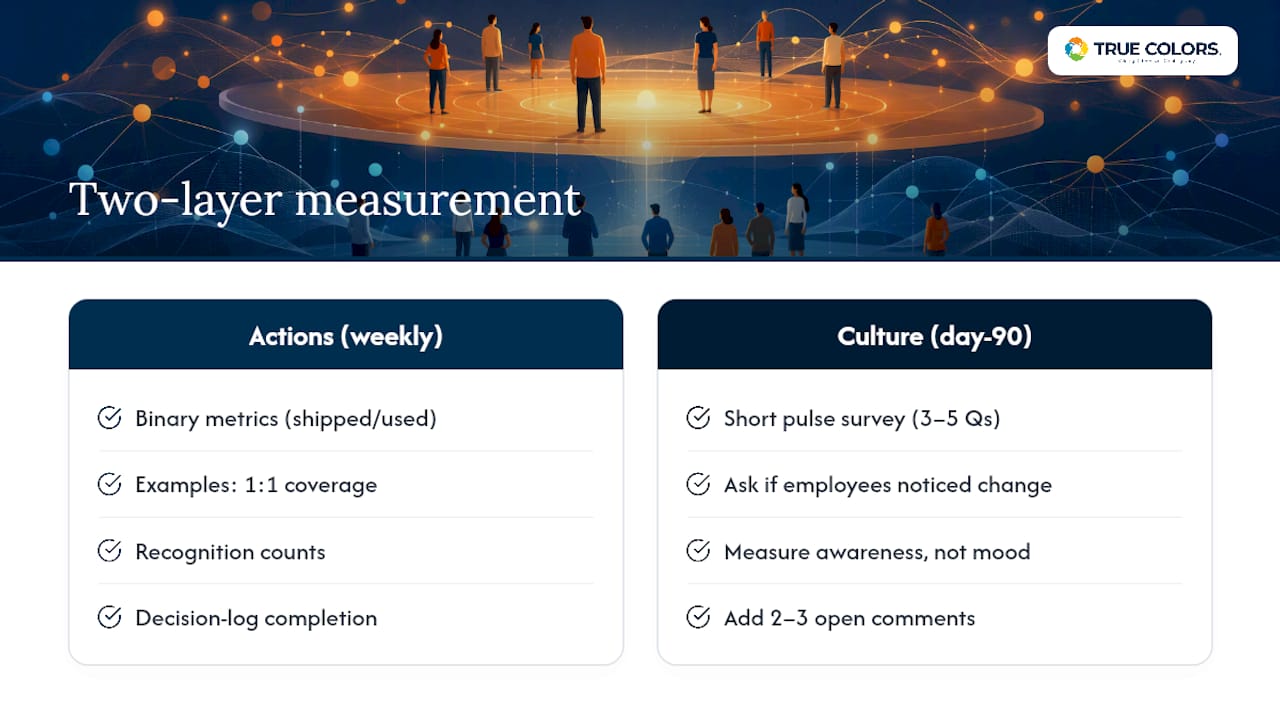
The 30/60/90 metrics tell you whether individual actions shipped. They do not tell you whether engagement itself improved, and conflating the two is a common mistake. Track both layers separately.
At the action level, keep measuring the specific metric you set: 1:1 coverage rate, recognition counts, decision-log completion. These are binary and easy to check weekly. At the culture level, run a short pulse survey (three to five questions) at day 90 rather than waiting for the next annual cycle. Ask whether employees noticed the specific change, not just whether they feel generally better, since general sentiment moves slowly and specific awareness moves fast.
Employee surveys remain one of the most reliable ways to measure engagement, but only when paired with visible follow-through. A survey with no action attached teaches employees that responding honestly changes nothing, which quietly depresses response rates and honesty in every future cycle.
Watch for a specific trap: teams sometimes declare victory because an action "shipped" (the 1:1 template rolled out, the shoutout ritual launched) without checking whether it changed how employees actually feel. Shipping and impact are different measurements. A rolled-out template that nobody uses by week six is not progress, even though it appears complete on a tracker. Build a light qualitative check into the day-90 review, a few open-ended comments alongside the pulse score, to catch that gap before it becomes next year's same complaint.
How Do Engagement Action Plans Connect to Bigger Organizational Goals?
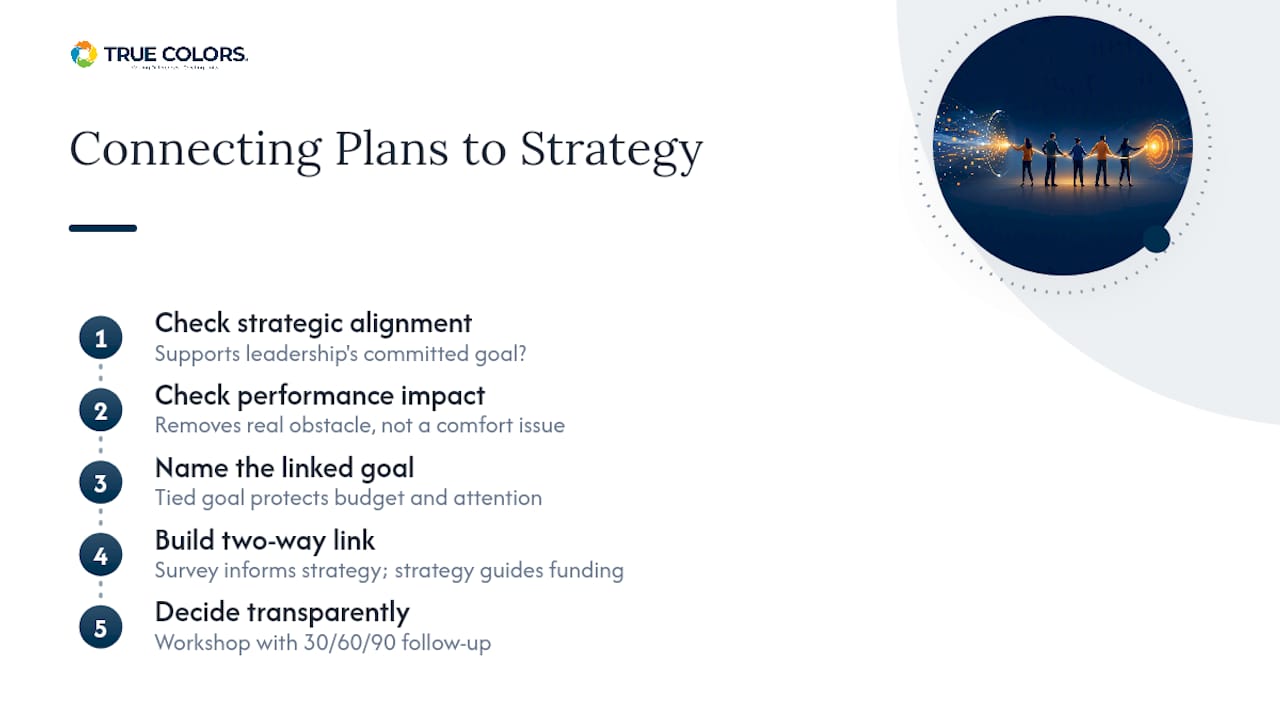
An engagement action plan that ignores the organization's actual strategy produces busywork dressed up as culture work. Before locking in priorities, check each candidate against two questions: does this action support a goal leadership has already committed to, and does fixing it remove a real obstacle to performance, not just a comfort issue.
A recognition gap, for instance, connects naturally to retention goals in a tight labor market. A 1:1 consistency problem connects to onboarding speed, internal mobility, and manager effectiveness goals most organizations already track. Draw that line explicitly when you communicate the plan. Employees engage more when they see their feedback shaping something the company visibly cares about, not a side project running parallel to real priorities.
This alignment also protects the plan's budget and attention when competing priorities show up mid-quarter, which they will. A plan tied to a named strategic goal survives a reprioritization meeting. A plan that exists only because "the survey said so" gets cut first when leadership needs to free up capacity elsewhere.
Build the connection in both directions. Let survey themes inform strategic planning (recurring complaints about unclear priorities are a signal worth escalating past the team level), and let strategic priorities inform which survey themes get funded first. A decision-making workshop format with built-in 30/60/90 follow-up can help leadership teams make that prioritization call transparently instead of behind closed doors, which matters as much for trust as the decision itself.
Why Team-Owned Plans Beat Polished Ones
The best engagement action plans I have seen are not the most polished ones. They are the ones a manager can explain from memory, without opening the deck, because they wrote it with their own team instead of receiving it from HR.
That distinction shapes every recommendation in this piece. Naming a single owner works because ambiguity is where accountability quietly dies. Capping priorities at two or three works because focus is a finite resource, not a talking point. Closing the loop publicly at day 90, even when results are mixed, works because employees judge leadership by whether they follow through, not by whether every metric moved.
Culture is not what gets said in a survey debrief. It's what gets repeated, quarter after quarter, until it becomes how the team actually operates.
— Theresa
How True Colors Helps You Build the Plan That Actually Runs
If your survey results are sitting in a dashboard with no owner attached, that gap is exactly where most engagement work stalls, not in the data itself, but in the handoff from insight to action. True Colors closes that gap with a system built around personal awareness translated into repeatable team behavior.

The Employee Experience Survey gives you the diagnostic layer, clean data on where priorities genuinely sit. From there, Team Building Training and related programs walk your team through the two-meeting model that turns voted themes into owned actions with real deadlines. For managers who need to build the follow-through habits that keep a 90-day plan alive past week three, the Connected Leadership Program focuses specifically on the consistency and communication behaviors this article recommends. If your organization is weighing a broader culture initiative alongside your next survey cycle, Corporate Consulting Solutions can scope a program suited to your structure. Reach out to start mapping your next 90-day cycle before your current survey data goes cold.
Sources
For a ready-to-use meeting structure, the Team Engagement Action Planning Process Checklist covers the two-meeting sequence in full. For the priority-and-owner discipline behind the 90-day model, see the seven-step action plan toolkit. For internal examples mapped to this exact process, review True Colors' guide to 90-day survey action planning.
- 12 employee engagement strategies that are working now
- Team Engagement Action Planning Process Checklist
- Employee Engagement Action Plan: From Results to Fixes
- Employee Engagement Action Plan: 7-Step Toolkit (2026)
FAQ
What Are the Core Elements of a Strong Engagement Action Plan?
A strong plan limits itself to two or three priorities, assigns one named owner per action rather than a department, and pairs each action with an observable metric and a 90-day timeline. It also gets communicated back to employees in "you said, we are doing" language, including what the team is explicitly not addressing this cycle.
What Are the Steps in an Engagement Action Plan?
The core sequence runs five steps: reduce survey results to a few corroborated and fixable themes, prioritize by impact versus effort, write each priority as a 90-day row with an owner and metric, communicate the plan transparently, and review progress at 30, 60, and 90 days. This mirrors the UCSF process checklist, which structures the work across two facilitated meetings.
What Does a Good Engagement Action Plan Example Look Like?
A good example ties one specific, low-scoring theme to one concrete action, such as a biweekly manager 1:1 owned by the team lead, tracked with 1:1 coverage rate as the metric. The plan section above includes two filled example rows, manager 1:1 consistency and recognition visibility, built on patterns that show up repeatedly in practitioner toolkits.
How Often Should We Run a New Engagement Action Planning Cycle?
Most organizations run a full cycle every 90 days, aligned to the review checkpoints in the plan itself, with a lighter pulse check at each 30-day interval. Running cycles much longer than a quarter risks losing the freshness of the original survey data and the momentum from the first round of actions.
Can True Colors Help Us Run This Process End to End?
Yes. True Colors supports the full cycle from the Employee Experience Survey through facilitated team workshops and leadership training that reinforce the follow-through habits a 90-day plan depends on. Pricing for most programs is available on request through the Corporate Consulting Solutions page.