
High-potential programs identify employees who can grow into future strategic roles, then accelerate their readiness through structured development rather than chance. The first move is not picking names. It's defining the future roles and business capabilities the program needs to fill, setting transparent criteria for potential, and requiring multiple evidence sources instead of relying on manager nomination alone. Research on selection design backs this sequence because calibrated, multi-source selection consistently outperforms single-rater judgment.
TL;DR:
- Selecting high-potential employees should be based on clear future role definitions and multi-source evidence, not manager nominations alone.
- Structured, proven formats like cohort programs, multi-year rotations, or short intensives should match the organization's size and urgency for maximum effectiveness.
- Key program components include transparent criteria, comprehensive assessments, targeted development actions, and manager accountability linked to succession plans.
- Using an optimization approach rather than ranking alone improves cohort diversity and talent identification by 10 to 19 percent.
- Communicating criteria openly and maintaining a semi-private designation balance helps prevent resentment and build trust across the organization.
Table of Contents
- What High Potential Programs Actually Do
- HiPo vs High Performer: Why This Distinction Breaks Most Programs
- Program Formats That Actually Work, and Their Trade-Offs
- The Building Blocks Every HiPo Program Needs
- Selection as an Optimization Problem, Not a Ranking Exercise
- Rolling Out a Program: Design, Pilot, Scale
- Proving the Program Works: KPIs and Governance
- A Practical Example: Applying a Behavior-First Lens to HiPo Design
- Practitioner Viewpoint: Transparency Is a Trade-Off, Not a Default
- How True Colors Turns HiPo Strategy Into Practice
- Sources
- FAQ
What High Potential Programs Actually Do
A high-potential program is targeted, structured development aimed at getting specific people ready for bigger roles faster than their current trajectory would allow. It is not a reward, and it is not a performance bonus dressed up as career planning. The strategic outcome is readiness: having someone capable of stepping into a director or VP seat before the seat opens up, not scrambling to hire externally once it does.
Done well, these programs produce three measurable effects. They shorten the time it takes to fill critical roles. They improve retention among your most mobile employees, the ones most likely to leave if they don't see a path. And they strengthen succession pipelines by giving talent reviews real candidates to discuss instead of guesses.
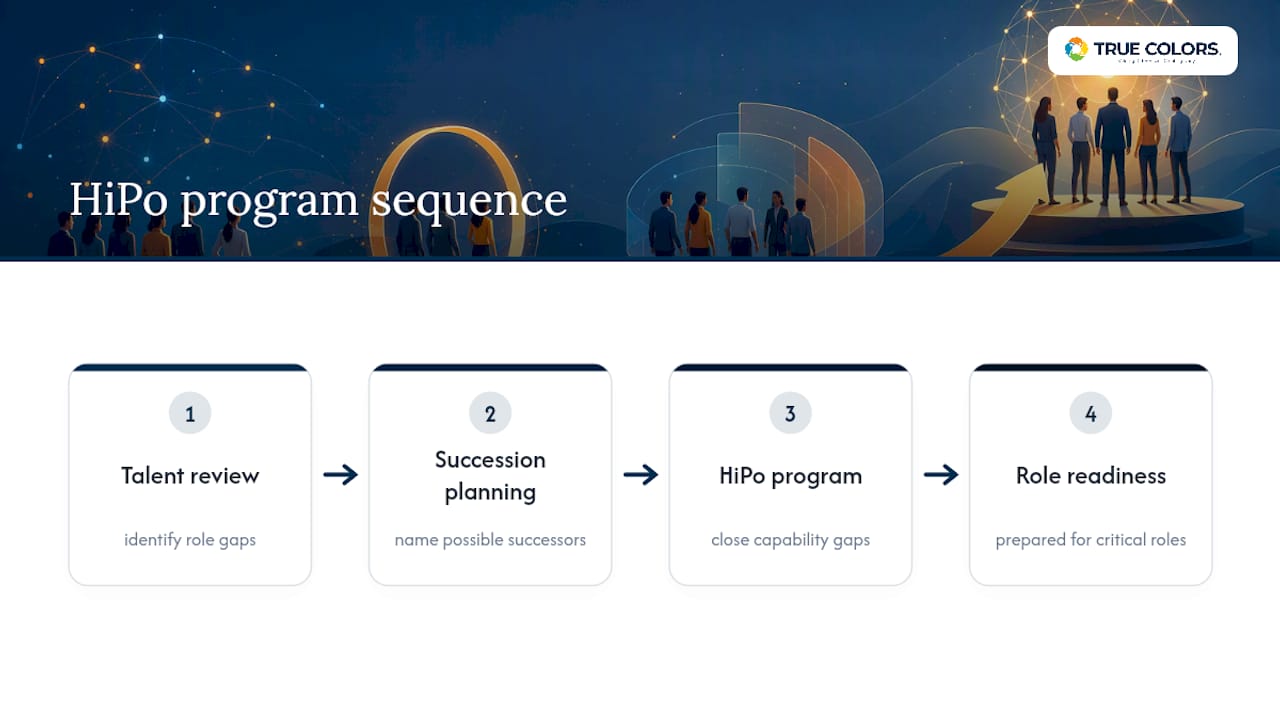
This is where HiPo programs sit inside the bigger talent management picture. A talent review identifies where the organization has gaps. Succession planning decides who might fill them. The HiPo program is the mechanism that closes the distance between where someone is today and where the role demands they be. Without it, succession planning is a list of names with no development behind them. Northwell Health's program design guidance frames this sequencing clearly: define the roles first, then build the development path backward from there.
HiPo vs High Performer: Why This Distinction Breaks Most Programs
Performance measures what someone has already done. Potential measures what they could do in a different, bigger, or more ambiguous role. These are not the same skill set, and treating them as interchangeable is the single most common design flaw in talent programs.
A star performer in a current role can plateau hard in a stretch role that demands ambiguity tolerance, influence without authority, or rapid learning agility. Conversely, someone with average current output might show every marker of future capability. The three signals that matter most are ability (can they learn fast under pressure), aspiration (do they actually want the bigger role and its trade-offs), and agility (do they adapt when the playbook doesn't apply).
The consequence of conflating the two: organizations promote based on tenure and output, then watch promising employees fail in expanded scope because nobody assessed for agility. A workable rubric item looks less like "exceeds targets" and more like "sought out ambiguous problems and changed approach when the first one failed."
Program Formats That Actually Work, and Their Trade-Offs
HiPo programs come in three practical shapes, and picking the wrong one for your organization's size and urgency wastes both budget and goodwill.
Cohort-based programs (6 to 12 months) group 15 to 30 people through a shared curriculum: assessment, stretch projects, coaching, and periodic executive touchpoints. They fit mid-size organizations that need visible momentum without a multi-year budget commitment. Resource needs are moderate: a program owner, external or internal coaching capacity, and executive sponsors willing to show up for panels or mentoring sessions.
Multi-year pipelines with rotations build sustained readiness by moving participants through two or three functional or geographic assignments over 24 to 36 months. These suit large organizations with genuine bench-strength needs and enough scale to create real rotational slots. The payoff compounds: alumni networks from these pipelines often become informal mentoring channels for the next cohort, which lowers the cost of running it again.
Short intensives, week-long residencies or executive courses, work as a supplement, not a substitute. Harvard Business School's High Potentials Leadership Program is a useful illustration: a six-day immersive format built for leaders who need concentrated exposure to strategic frameworks and peer benchmarking, not a full-year commitment. Use intensives when you need to signal investment quickly or when budget doesn't support a longer cohort structure.
Whichever format you choose, the component checklist stays consistent:
- A stretch assignment tied to a real business problem, not a simulation
- Coaching or mentoring with a named, accountable person
- Executive exposure through sponsorship, shadowing, or steering-committee access
- A documented development plan reviewed at set intervals
The Building Blocks Every HiPo Program Needs
Programs fail not because the idea is wrong but because a component is missing. Four building blocks separate programs that produce readiness from programs that produce resentment.
Transparent criteria. Define what "potential" means for your organization and which future roles the program targets. Vague criteria like "leadership potential" invite bias and erode trust the moment someone asks why they weren't selected.
A real assessment suite. Manager opinion alone is not evidence. Layer in 360-degree feedback, skills-gap analysis against the target role, and where the role warrants it, situational assessments or work samples. Northwell Health's program structure lists 360 feedback and coaching among its core components, alongside senior-leader involvement in review.
Development actions with teeth. Stretch assignments, rotations, coaching, cohort peer learning, and formal instruction each build a different capability. Common leadership-development components across organizations include executive coaching, cross-functional strategic projects, mentoring, and simulations, and the strongest programs use several in combination rather than defaulting to a single workshop series.
Manager accountability, tied to succession. Managers need a defined role in the process, not just a nomination checkbox. That means participating in calibration, sponsoring stretch work, and reporting on development progress at review intervals.
- Written criteria published to managers, not just HR
- 360 feedback plus at least one additional evidence source
- A named coach or mentor per participant
- A documented individual development plan reviewed at least annually
- A clear link from the HiPo designation to succession slates
Pro Tip: Publish your potential criteria the same way you publish promotion criteria. If employees can't see the bar, they'll assume it's political, and that assumption alone drives more attrition than the actual selection decision does.
One benchmark study found many organizations skip formal criteria altogether. The 2024 High Performer & High Potential Development Report found that a large share of organizations lack a consistent development philosophy for HiPo talent, and written development plans are inconsistently applied even where formal programs exist. A 360 feedback framework built to change behavior rather than just generate scores closes part of that gap.
Selection as an Optimization Problem, Not a Ranking Exercise
Most organizations select HiPo cohorts by ranking candidates and cutting at a number. That approach treats selection like a single-variable contest, when it is actually a two-variable optimization: you're balancing talent strength against cohort diversity, and doing either one at the expense of the other produces a worse outcome on both counts.
Harvard Business School research on cohort selection found that structured selection tools using an explicit optimization approach, rather than simple ranking, could improve cohorts by 10 to 19% on either diversity or talent measures simultaneously. That is not a marginal gain. It means the ranking-and-cutoff method most organizations default to is likely leaving real talent and real diversity on the table at the same time.
A repeatable workflow looks like this:
- Collect multiple evidence sources for every candidate: manager input, peer feedback, 360 assessment results, and work samples. Where feasible, add organizational network analysis to surface informal influence that manager nominations miss.
- Score candidates against the published rubric independently, before any group discussion happens.
- Convene a calibration panel across functions, not just within one manager's chain, so a single rater's bias doesn't decide an outcome alone.
- Train raters on the rubric before calibration, not during it. Untrained raters anchor on personality and recency, not on the criteria you wrote down.
- Document the decision rule for every selected and non-selected candidate, and record the designation's shelf-life upfront.
Watch for two red flags that signal a broken process: nomination-only selection with no independent evidence, and calibration panels where one senior voice consistently overrides the rubric. Both point to a program that will drift toward favoritism within two cycles, regardless of how good the original criteria were.
Internal tools that support evidence-based hiring and selection frameworks can extend the same rigor from external hiring into internal cohort selection, since the underlying bias risks are identical.
Rolling Out a Program: Design, Pilot, Scale
A HiPo program should never launch organization-wide on the first try. The rollout sequence that actually works has three phases.
- Design. Name the target roles and capabilities the program builds toward. Set outcome metrics before you set curriculum. Secure an executive sponsor who will show up, not just approve a budget line. Build a KPI plan alongside the design, not after launch.
- Pilot. Run a single cohort of 15 to 25 people for one cycle. Build a feedback loop at the midpoint and end, capturing both participant and manager input. Treat the pilot as a test of the selection process itself, not just the curriculum.
- Scale. Embed the program into standing talent review cadences so it isn't a side project that dies when its champion changes jobs. Formalize manager accountabilities in writing, and budget recurring funds for coaching and stretch assignments rather than treating them as one-time costs.
Communication is the piece most rollout plans skip, and it's the piece that determines whether the program builds trust or resentment. Tell selected employees what the designation means, what it doesn't guarantee, and how long it lasts. Tell non-selected employees what development access remains open to them and how the criteria might apply to a future cycle. A leadership cohort program built around manager buy-in tends to survive leadership turnover better than one built solely on individual sponsorship, because the accountability lives in the process, not one person's memory.
Proving the Program Works: KPIs and Governance
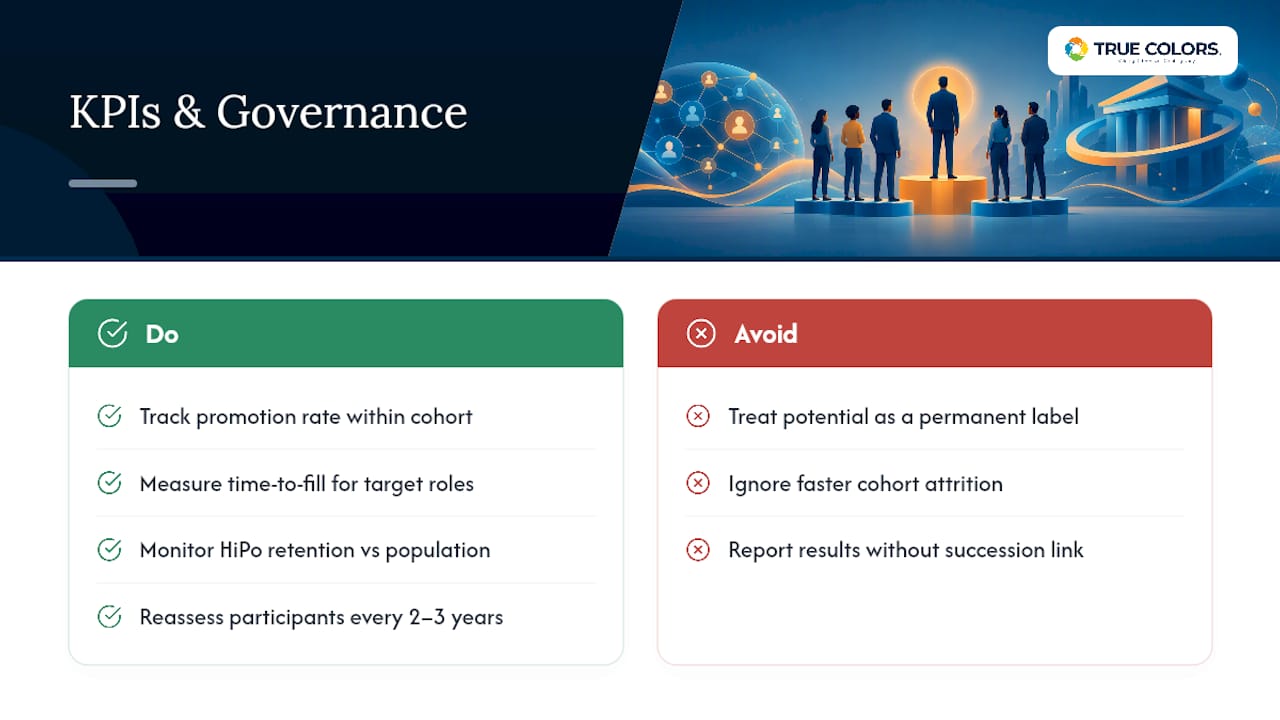
Five metrics tell you whether a HiPo program is producing readiness or just producing a feel-good label. Track promotion rate within the cohort, time-to-fill for critical roles the program targets, retention of HiPo participants specifically (a cohort that leaves faster than the general population is a warning sign, not a coincidence), readiness ratings from calibration panels over time, and manager plus participant satisfaction with the development experience itself.
Reassessment matters as much as initial selection. Survey-based benchmarks on program design suggest a shelf-life of two to three years is common practice, with periodic reassessment rather than a permanent designation. Treating potential as a fixed label rather than a status that can change both directions keeps the program honest and keeps employees who plateau from occupying a slot someone else has earned.
When reporting to executive sponsors, tie results directly to succession decisions: how many HiPo participants filled critical roles, and how much faster than the historical baseline. That link is what keeps the program funded past its first budget cycle.
A Practical Example: Applying a Behavior-First Lens to HiPo Design
Assessment data tells you what someone can do. It rarely tells you why a manager conversation about development keeps stalling. A behavior-first diagnosis, the kind True Colors builds its consulting approach around, adds that missing layer: it clarifies how a high-potential employee actually communicates, handles conflict, and responds to stretch pressure, which turns a generic development plan into one a manager can actually coach against.
Several True Colors offerings map directly onto HiPo program components:
- Assessment consultations that surface behavioral style alongside skills-gap data, sharpening the evidence base beyond manager nomination
- Communication and conflict-navigation training that gives cohort members a shared language for stretch-assignment friction
- Ongoing reinforcement programs that keep development active between formal review cycles, rather than letting a plan go stale after the kickoff session
Culture is not what a program announces. It's what gets repeated in every manager conversation after the launch slide deck is forgotten.
Practitioner Viewpoint: Transparency Is a Trade-Off, Not a Default
Confidential HiPo labels avoid the ego problems of a public list but risk quiet resentment when non-selected employees sense they've been passed over with no explanation. Fully public labels build clarity but can create entitlement among the selected and disengagement among everyone else. The workable middle ground: keep the designation semi-private, but publish the criteria openly and guarantee development access to non-selected employees.
Every manager should be able to answer three questions before a talent review: What does this designation change for the employee? What happens if performance or aspiration shifts? What development stays available to those not selected?
— Theresa
How True Colors Turns HiPo Strategy Into Practice
True Colors offers a practical approach to running a HiPo program that adds behavioral insights beyond assessment data alone. Where most talent tools stop at scores and rubrics, True Colors adds the behavior-first layer that turns a potential rating into a real manager conversation, backed by a consistent shared language across the whole cohort, not just a report nobody reopens after the kickoff.

That starts with an Individual Personality Assessment Consultation, priced at $350 for a one-off engagement, which gives HR a behavioral baseline for candidates before calibration panels convene. From there, True Colors programs covering communication training, team building, and conflict navigation give cohorts the reinforcement layer most programs lose within two quarters of launch. If you're not sure where your culture stands before you build a HiPo cohort on top of it, start with the Company Culture Check and request a scoping call from there.
Sources
- High Potential Development Program - Center for Learning and Innovation | Northwell Health
- High Potentials Leadership Program | Harvard Business School (example of an intensive format)
- Harvard Business School research on selection optimization and cohort composition
FAQ
What does "HiPo" mean in HR?
HiPo stands for "high potential," referring to an employee identified as capable of taking on significantly larger or more complex roles in the future. It's distinct from "high performer," which describes current output rather than future capability.
What is the 70/20/10 model?
The 70/20/10 model holds that development happens roughly 70% through on-the-job experience like stretch assignments, 20% through coaching and relationships, and 10% through formal instruction. It's commonly used to design the mix of activities inside HiPo programs, weighting experiential work over classroom training.
What are the 5 R's of leadership?
Definitions of the "5 R's of leadership" vary by source and aren't standardized across the field, so treat any specific list with caution. Rather than rely on an unverified acronym, focus HiPo development on documented capabilities: readiness, resilience, relationship-building, results orientation, and reflection are common themes across leadership frameworks, though no single authoritative version exists.
Can you give examples of leadership development programs?
Formats range from six-month to one-year internal cohorts combining coaching and stretch projects, to multi-year rotational pipelines for larger organizations, to short intensives like Harvard Business School's six-day High Potentials Leadership Program. Truecolorsintl offers a complementary approach through leadership cohort programs built around behavior-first development and manager accountability.
How much does a personality assessment for HiPo selection cost?
Truecolorsintl's Individual Personality Assessment Consultation is priced at $350 as a one-off engagement. Pricing for group or customized assessments is available on request through the same page.