
A leadership cohort program is a small, time-bound group of leaders who move through the same curriculum together, applying new skills to real work between sessions. The core value isn't the content delivered. It's the peer accountability that turns instruction into repeated behavior change. This guide covers the formats, design steps, and measurement approaches that separate cohorts that reshape leadership behavior from ones that just fill a training calendar.
TL;DR:
- Cohort program length should match the complexity of targeted behavior change, ranging from 6 weeks for tactical skills to over a year for strategic leadership.
- Eligibility, size, and role alignment are critical, with smaller groups fostering vulnerability and honest feedback, especially among similar seniority levels.
- The strongest results occur when programs combine structured peer feedback, applied projects, and manager reinforcement, rather than relying solely on content delivery.
- Measuring success requires pre and post assessments, behavior logs, and long-term follow-ups, focusing on behavior retention and organizational impact.
- Failures often stem from poor psychological safety or lack of reinforcement, which can be fixed through clear metrics, norms, and manager involvement.
Table of Contents
- What Makes a Leadership Cohort Program Different From a Workshop?
- What Are the Most Common Cohort Formats and Sizes?
- Who Should Join a Leadership Cohort, and When?
- Why Does Cohort Learning Actually Change Leadership Behavior?
- How Do You Design and Run a Cohort Program That Sticks?
- How Do You Measure Whether a Cohort Program Worked?
- What Goes Wrong With Cohort Programs, and How Do You Fix It?
- What's the Real Return on a Leadership Cohort Program?
- Build a Cohort Program That Changes Behavior, Not Just Opinions
- Sources
What Makes a Leadership Cohort Program Different From a Workshop?
A cohort is a defined group of leaders, usually between eight and twenty-five people, who progress through a shared curriculum on a fixed schedule rather than attending isolated sessions. Unlike a one-day workshop or a self-paced course, a cohort has continuity. The same people show up week after week, which means trust builds and feedback gets sharper over time.
The model typically includes:
- Scheduled group sessions spaced over weeks or months, not compressed into a single event
- Applied projects tied to each participant's actual role, not hypothetical case studies
- Structured peer feedback, where participants critique and coach each other under facilitation
- A trained facilitator who manages group dynamics, not just content delivery
- Explicit alignment with each participant's manager, so new behaviors get reinforced at work
CompassPoint's cohort model frames this as whole-person development built on peer learning, coaching, and long-term relationship building rather than a stack of slides. That framing matters because one-off training rarely survives contact with a busy calendar. A cohort's recurring structure is what makes new behavior stick past the first week.
What Are the Most Common Cohort Formats and Sizes?
Program length should match the depth of behavior change you're targeting, not an arbitrary internal deadline. Cohort program research from Teachfloor documents three common tiers:
- Tactical cohorts (6 to 12 weeks): narrow skill focus, such as delegation or feedback conversations, often for first-time managers
- Mid-level cohorts (3 to 6 months): broader capability building for managers of managers, blending live sessions with applied projects
- Executive cohorts (6 to 12+ months): identity-level leadership work, succession preparation, and strategic decision-making under ambiguity
Session cadence usually runs every one to three weeks, with short "micro-practice" assignments in between, like trying a specific conversation technique with a direct report and reporting results at the next session.
Cohort size matters more than most program owners assume. A full group of fifteen to twenty-five works for shared content and cross-functional exposure, but real vulnerability tends to surface in smaller circles of four to six. Many well-designed programs break the full cohort into standing small groups for the entirety of the program, so participants build a consistent peer relationship rather than a rotating cast of strangers. Eligibility should be intentional, too: mixing wildly different seniority levels in one small circle often suppresses honest disclosure rather than encouraging it.
Who Should Join a Leadership Cohort, and When?
Cohort programs deliver the strongest return for people navigating a leadership transition, not people simply looking for general skill polish. The clearest candidates fall into a few groups:
- New or first-time managers who need practice handling conflict and delegation before habits calcify.
- High-potential mid-level leaders being groomed for the next tier, where succession planning depends on visible readiness.
- Cross-functional change agents driving a specific initiative, such as a merger integration or a culture reset, who need a shared vocabulary with peers outside their department.
- New hires stepping into leadership roles, where a cohort accelerates both skill-building and internal network formation.
Organizations use this format for succession pipelines, capability accelerators tied to a strategic priority, and leadership cohorts built around a specific demographic or business challenge. Ownership varies. Internal L&D teams run cohorts when they have facilitation talent and time; many organizations bring in outside providers when they need objectivity or specialized facilitation skill. Either way, manager sponsorship is non-negotiable. A cohort without an engaged manager on the other end produces insight that never gets applied.
Why Does Cohort Learning Actually Change Leadership Behavior?
The 70-20-10 model suggests that the majority of leadership development comes from on-the-job experience and social interactions, with a smaller portion from formal instruction. A well-designed cohort inverts the ratio by building structured practice and peer feedback directly into the curriculum, which is exactly why the Forbes Coaches Council's analysis of cohort learning treats the social 20% as the real engine of durable change.
Real-time dialogue and peer feedback activate reward circuits in the brain that reinforce new leadership behaviors faster than solitary study ever can.
The outcomes data backs this up, even at modest scale. A four-month cohort pilot documented in Frontiers in Education recorded an 82% positive shift in leadership self-confidence among matched participant responses, alongside higher program retention, when the cohort paired applied design-thinking projects with structured peer coaching.
That is a single pilot, not a universal guarantee, and effect sizes will vary with cohort quality and facilitator skill. But the direction is consistent with what industry adoption data on live cohort-based development reports across organizations scaling the format with coaching and assessment layered in.
How Do You Design and Run a Cohort Program That Sticks?
Building a cohort that changes behavior, rather than just filling seats, follows a fairly predictable sequence.
- Map the capability gap first. Define the specific behaviors you want different in six months, not a vague "better leadership" goal. Behavioral indicators, like "gives direct feedback within 48 hours of an incident," give you something measurable later.
- Recruit deliberately. Set eligibility criteria tied to role or readiness, cap the group size, and secure a written manager commitment before the first session. A manager who won't commit thirty minutes a month to reinforcement is a signal the participant isn't ready.
- Build the session architecture around practice, not lecture. Blend short facilitated input with peer case work, live skill rehearsal, and an applied project tied to the participant's actual team.
- Build in reinforcement between sessions. Micro-practice assignments, brief manager check-ins, and a peer accountability partner keep the work alive between the monthly or biweekly meetings.
- Decide logistics early. Facilitator training matters as much as content design. Choose a virtual, hybrid, or in-person format based on how much the group needs unstructured relationship time, and lock the schedule before recruiting so attendance doesn't erode.
Pro Tip: Treat every session as an experiment zone rather than a lecture hall. Ask each participant to try one specific leadership move before the next meeting and report what happened, even if it failed. That single habit does more for retention than any amount of additional content.
A practical curriculum-building framework can help translate these steps into an actual session-by-session plan rather than a loose intention.
How Do You Measure Whether a Cohort Program Worked?
Measurement has to happen at more than one point, or you'll only ever capture how people felt on the last day, not what changed at work. A reasonable toolbox includes pre and post self-assessments, 360-degree feedback from peers and direct reports, manager ratings of specific behaviors, and simple behavior-frequency logs participants fill out themselves.
- Capture a baseline before the program starts, not after
- Re-measure immediately at graduation to gauge confidence and knowledge shifts
- Follow up again at three months to see whether behaviors survived contact with daily work
- Do a final check at six to twelve months, when it's fair to ask about retention, promotion readiness, or team engagement scores
The Frontiers in Education pilot's 82% self-confidence shift is a useful reference point, but the metric that actually matters to your organization depends on why you built the program. If the goal was succession readiness, track promotion rate and time-to-fill for leadership vacancies. If the goal was retention, track voluntary turnover among cohort graduates versus a comparable peer group. A structured employee experience survey can capture the downstream culture signal that behavior change is supposed to produce.
What Goes Wrong With Cohort Programs, and How Do You Fix It?
The most common failure is treating the cohort as a content delivery vehicle, packing sessions with slides and frameworks instead of practice time. A close second is weak psychological safety, where participants perform for each other instead of disclosing real struggles, which guts the peer-feedback mechanism the whole model depends on.
Other recurring problems and fixes worth building in from day one:
- No manager reinforcement: fix it with a written manager commitment and scheduled check-ins baked into the program calendar, not left informal
- Vague success metrics: fix it by defining behavioral indicators before recruiting, not after the program ends
- Weak forum norms: fix it with a co-created charter the cohort itself writes in session one, covering confidentiality and how feedback gets delivered
- Practice-free sessions: fix it by treating each meeting as an experiment, where participants report back on something they actually tried
True Colors' analysis of why leadership development programs fail points to the same root cause across most breakdowns: programs describe desired behavior without building the reinforcement structure that makes it repeatable. Guidance on building a peer learning culture covers how to establish the safety and norms a cohort depends on before it even starts.
What's the Real Return on a Leadership Cohort Program?
Most organizations evaluate cohort programs on satisfaction scores, which measure whether people enjoyed the sessions and tells you almost nothing about whether they lead differently.
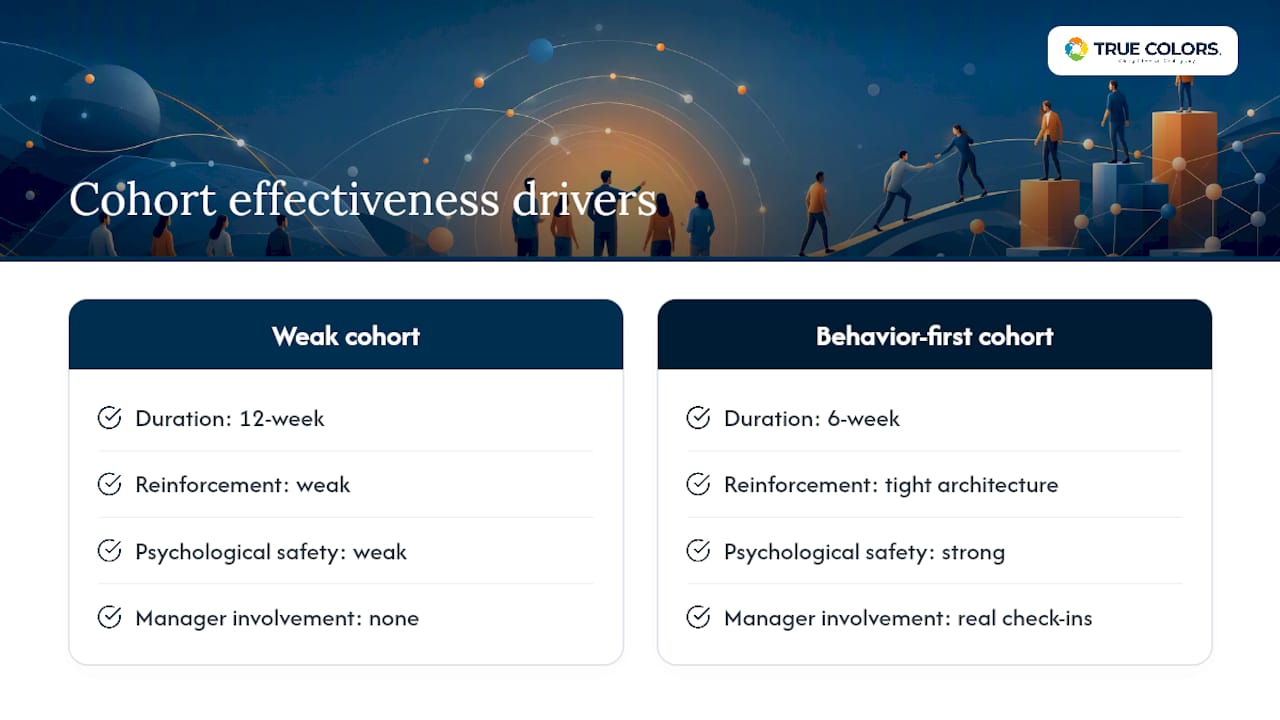
Where conventional advice falls short is in treating "cohort" as a delivery mechanism rather than a behavior system. A twelve-week cohort with weak psychological safety and no manager involvement will underperform a six-week program with a tight forum charter and real manager check-ins. Duration is a distant second factor behind reinforcement design.
If you're building or buying a cohort program in 2026, prioritize the reinforcement architecture before you finalize curriculum content. Ask who is accountable for behavior change after the last session ends, not just who facilitates the sessions themselves. That single question separates programs that shift culture from programs that generate a good feedback survey and nothing else.
— Theresa
Build a Cohort Program That Changes Behavior, Not Just Opinions
Some organizations seek alternatives to generic training vendors in order to achieve actual shifts in leadership behavior, rather than just discussion. Where most cohort providers hand you a content calendar, some providers build reinforcement systems using behavior-based assessments and manager alignment tools so new leadership habits survive past the final session.

The Connected Leadership Program applies exactly the design principles covered here: cohort structure, applied practice, and manager-aligned reinforcement built around a proven behavior framework rather than generic leadership theory. This program targets HR and L&D leaders who have seen training initiatives produce strong feedback scores but little behavior change, and who want programs to yield lasting results.
If you're planning a cohort initiative, consider discussing programs that focus on reinforcement architecture tailored to your organization's specific capability gaps.
Sources
- Cohort learning: how social interaction shapes leadership development — Forbes Coaches Council
- Applying design thinking to a cohort leadership and project management pilot — Frontiers in Education
- The new model of live, cohort-based leadership development — industry report
- Cohort Leadership Programs — CompassPoint