Industrial culture is the shared behaviors, norms, leadership habits and team routines that determine whether a plant runs safely, builds quality product, and hits its performance targets. It is what people do, not what a poster on the break room wall says they should do. If you lead HR or operations at a manufacturing or industrial organization, the first move is not a survey rollout or a values refresh. Run a short, multimethod diagnostic this month, then pair it with a focused, action-first pilot built around one "moment of truth," a shift handover, a safety stop, a quality escape. Assemble a two-week pilot team now, or schedule frontline focus groups for next week. That single step tells you more about your real culture than any all-hands meeting ever will.
Key Takeaways
Industrial culture change succeeds when leaders diagnose behavior with a multimethod approach, then pilot a focused intervention at a real moment of truth before scaling it.
| Point | Details |
|---|---|
| Define culture by behavior | Industrial culture is what leaders and teams do repeatedly, not what a values statement says. |
| Run a five-step diagnostic | Combine short surveys with focus groups, then aggregate by role, shift and site before prioritizing gaps. |
| Middle managers decide adoption | Equip supervisors with coaching tools since they sit between executive intent and frontline reality. |
| Reach a third of the workforce | Learning interventions need to reach at least one-third of employees to produce lasting behavior change, per McKinsey. |
| Leadership commitment is the top barrier | Research across 50 North American manufacturers found culture and leadership commitment rank as the leading obstacles to sustaining lean gains. |
| Start with a pilot, not a rollout | Truecolorsintl designs diagnostic pilots and leadership coaching programs that embed into existing shift routines rather than running as a parallel initiative. |
Table of Contents
- What Industrial Culture Means and Why It Drives Performance
- What's the Fastest Way to Diagnose Culture This Quarter?
- Which Interventions Actually Change Behavior on the Floor?
- How Should You Measure and Sustain Culture Gains?
- How Do You Deploy Culture Programs Across Shifts and Sites?
- Historical Development and Origins of Industrial Culture
- How Industrial Culture Shapes Engagement and Morale
- How Does Industrial Culture Differ Across Industries and Regions?
- How Are Technology and Automation Changing Industrial Culture?
- What Do Successful Culture Transformations Look Like?
- What Gets in the Way of Changing Industrial Culture?
- Why True Colors Bets on Behavior Before Mindset
- Ready to Turn Diagnosis Into Action?
- Sources
What Industrial Culture Means and Why It Drives Performance
This is not the industrial culture of art history or post-industrial theory. In an operational context, industrial culture means the observable behaviors, leadership practices and team habits that show up on a shop floor: how a supervisor responds to a near-miss, whether operators flag defects or hide them, how middle managers coach versus command.
Culture intersects directly with safety, quality and lean performance. When leadership behavior is inconsistent, safety compliance drifts, quality escapes rise, and lean tools get followed on paper but ignored in practice. Cummins CHRO Marvin Boakye has argued that culture must be treated as a strategic differentiator, translated into how leaders spend their time and what they model daily, not delegated to a values statement. Integrated survey research backs this up: instruments that combine lean, safety, quality and culture measures surface misalignments that single-domain surveys miss entirely.
What's the Fastest Way to Diagnose Culture This Quarter?
A five-step diagnostic gives HR and L&D a repeatable way to find where behavior breaks down and where a pilot will pay off fastest.
- Map moments of truth. Identify the two or three moments where culture shows up most visibly: shift handoffs, safety stops, quality holds, and name the teams involved.
- Run a short multimethod assessment. Pair a brief survey with targeted focus groups rather than relying on one instrument. Research on culture measurement instruments is clear that no single tool reliably captures organizational culture; typological, dimensional and qualitative methods together produce a more trustworthy read.
- Aggregate and analyze subcultures. Break results out by role, shift, and site. A plant's culture is rarely uniform, and middle-management perception often diverges sharply from frontline experience.
- Prioritize behavioral gaps tied to KPIs. Rank findings against safety incidents, quality escapes and OEE, not against abstract engagement scores.
- Design a small, action-first pilot. Pick one team, one moment of truth, and a 90-day window with two or three measures you can actually track.
Useful diagnostic inputs to gather along the way:
- Recent near-miss and quality-escape logs by team
- Shift-level attendance and turnover trends
- Supervisor coaching frequency, even a rough estimate
Truecolorsintl's culture assessment tools approach follows this same logic: link behavior data to the operational outcomes leaders already track, rather than building a parallel engagement metric nobody trusts.
Which Interventions Actually Change Behavior on the Floor?
Diagnostics tell you where the gap is. Interventions close it, and the ones that work in industrial settings share a common trait: they happen where the work happens, not in a classroom.
- Make leadership visible in the field. Executives who walk the floor and ask about the moment of truth you identified, rather than reviewing dashboards from an office, signal what actually matters.
- Equip middle managers with coaching tools. A simple observation checklist beats a leadership seminar; middle managers are often the linchpin between executive intent and frontline reality, and equipping them with coaching skills accelerates adoption.
- Build action-first learning modules. Short, hands-on training tied directly to a moment of truth works better than generic culture workshops. Truecolorsintl's culture-focused training programs are built around this same shift-friendly format.
- Reinforce with operational routines. Daily huddles, visual management boards, and a clear stop-the-line norm turn a one-time training into a habit.
The NUMMI plant transformation remains the clearest industrial proof point: leaders changed what workers did before asking them to change how they thought, embedding new routines first and letting mindset shift follow.
Pro Tip: Start your pilot with the team that has the most visible moment of truth, not the most willing team. A visible early win spreads faster than a quiet one.
Scale by running pilots, reinforcing what works for 60 to 90 days, then expanding the coaching network team by team rather than rolling out plant-wide on day one.
How Should You Measure and Sustain Culture Gains?
Culture work fails most often not at launch but six months later, when the reinforcement stops. A durable measurement design has three layers: behavior KPIs (observed safety compliance, huddle attendance), leading operational metrics (near-miss rates, first-pass quality), and short engagement pulses.
Keep surveys short and aggregate results to the group level rather than chasing individual scores; plan subgroup analysis by shift and role from the start, since a plant-wide average hides where the real gap sits. Learning interventions need to reach at least a third of the workforce to produce a durable shift, a useful benchmark when you are deciding how wide to run a pilot before scaling it.
- Coaching check-ins on a two-week cadence for the pilot team
- A simple leader scorecard tracking observed behaviors, not just outcomes
- A feedback loop back into daily operations governance, not a separate HR meeting
Run a fuller diagnostic every six to twelve months, and use continuous short pulses in between. Truecolorsintl's guide to measuring culture effectiveness walks through sample-size and cadence questions in more depth.
How Do You Deploy Culture Programs Across Shifts and Sites?
Standard office-centric change management routinely fails in industrial settings because it assumes everyone sits at a desk and checks email. Embed reinforcement into shift handovers and existing daily routines instead of layering on a separate digital module nobody has time for.
- Train frontline coaches and change agents who work the same shifts as the people they support.
- Use short visual job aids at the point of work, not a slide deck stored on a shared drive.
- Decentralize cadence to local leaders so second and third shift get the same attention as first shift.
- Build two-way feedback channels that fit the floor: a clipboard sheet, a floorboard input, a thirty-second huddle report.
Historical Development and Origins of Industrial Culture
Industrial culture as a management concern traces back to the productivity and quality movements of the mid-20th century, when manufacturers first started treating worker behavior as a lever separate from equipment and process design. W. Edwards Deming's quality work in postwar Japan planted an early seed: culture and process were never separable, and management behavior shaped outcomes as much as machinery did.
The Toyota Production System formalized this thinking, building continuous improvement and respect for people into daily routines rather than annual initiatives. When Toyota partnered with General Motors to run the NUMMI plant in Fremont, California, the transformation of a previously troubled workforce into one of the most productive plants in the GM system became a foundational case study for culture change through changed behavior rather than changed messaging.
Lean and Six Sigma methodologies, including DMAIC (Define, Measure, Analyze, Improve, Control), spread through the 1980s and 1990s and brought a data discipline to operations. What took longer to catch on was extending that same discipline to behavior itself. Recent work applying culturally adaptive DMAIC frameworks to workplace culture treats behavioral KPIs with the same rigor as defect rates, a natural extension of a model industrial leaders already trust. That history matters for a practical reason: the tools your organization already uses for process improvement are the same tools that work for culture, if you point them at behavior instead of only at throughput.
How Industrial Culture Shapes Engagement and Morale
Weak industrial culture shows up first in morale, long before it shows up in a quality report. Workers who see leaders behave inconsistently, tolerating shortcuts one week and cracking down the next, disengage faster than workers facing tough but predictable standards.
Engagement in industrial settings tracks closely with whether frontline employees feel heard when they flag a problem. A supervisor who dismisses a safety concern once teaches an entire shift not to raise the next one. That silence is often mistaken for compliance, when it is actually the earliest signal of a culture problem.
Middle management sits at the center of this dynamic. Employees experience culture through their direct supervisor far more than through executive messaging, which is why coaching-equipped middle managers move engagement faster than any top-down campaign. Morale also responds to visible follow-through: when a team raises an issue in a huddle and sees a leader act on it within days, trust compounds. When the same issue gets raised three times with no visible response, disengagement sets in and tends to spread to adjacent teams.
The practical implication for HR and L&D leaders is straightforward: engagement scores rise and fall on leadership consistency and responsiveness, not on the sophistication of your recognition program. A behavior-based diagnostic that tracks how quickly frontline concerns get addressed tells you more about morale than a standalone satisfaction survey.
How Does Industrial Culture Differ Across Industries and Regions?
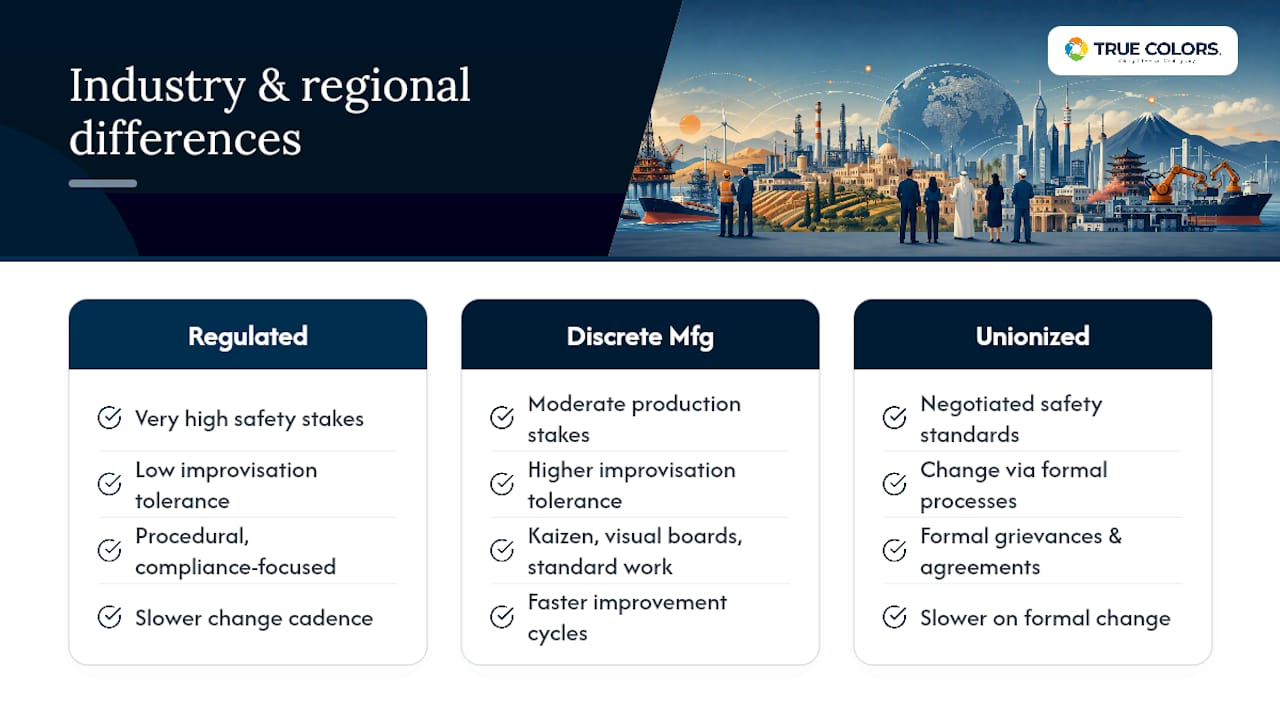
Industrial culture is not one thing. A discrete manufacturing plant running short production runs behaves differently from a continuous-process chemical facility where a single misstep can shut down a line for days. The stakes of a safety lapse, the tolerance for improvisation, and the pace of decision-making all vary with the underlying process.
Heavily regulated sectors, aerospace, pharmaceuticals, food processing, tend to build documentation and compliance deep into daily routines, which shapes a more procedural culture where deviation carries real consequence. Discrete manufacturing and automotive supply chains, by contrast, often build a culture more oriented around continuous improvement cadence, daily kaizen events, visual boards, standardized work reviews, because the Toyota Production System shaped so much of that sector's operating rhythm.
Regional differences matter too, though less than most leaders assume. Unionized workforces in parts of North America and Europe often carry a stronger expectation of formal grievance processes and negotiated safety standards, which shapes how leadership communicates change. Non-union sites and many operations in fast-growing manufacturing regions tend to move faster on pilots but can lack the same institutional memory around past change efforts, good and bad.
None of these differences change the core mechanics of culture change. Whatever the industry or region, culture still shows up in moments of truth, still gets shaped most by middle-management behavior, and still requires a multimethod diagnostic before you design an intervention. The variable is which moments of truth matter most and how much regulatory or union structure surrounds them, not whether the behavior-first approach applies.
How Are Technology and Automation Changing Industrial Culture?
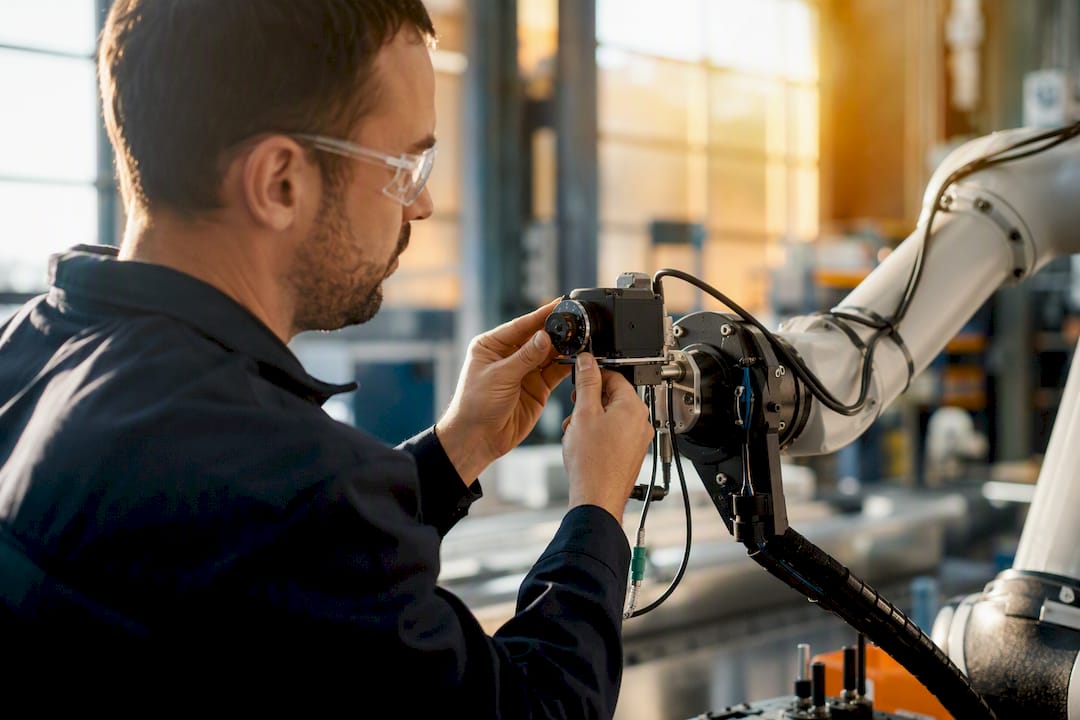
Automation is reshaping industrial culture in ways that go beyond headcount. As robotics and sensor data take over repetitive tasks, the remaining human roles skew toward monitoring, exception-handling and judgment calls, which demands a different kind of trust between operators and supervisors than the old command-and-control model.
Digital tools also change how quickly problems surface. Real-time dashboards can flag a quality drift or a near-miss pattern within minutes instead of a weekly report, which raises the bar on how fast leadership needs to respond. That speed cuts both ways: a plant with strong culture uses the data to coach faster, while a plant with weak culture just gets more data confirming problems nobody addresses.
There is a real risk in over-relying on digital delivery for the culture work itself. Standard change management approaches often fail in industrial settings because they assume everyone engages through a screen, and many frontline workers spend their shift away from a desk entirely. Automation should reduce the manual burden on supervisors so they have more time to coach, not replace the coaching with an app notification.
The organizations getting this right treat technology as an amplifier for existing routines, not a substitute for them. A visual board digitized into a tablet still needs a supervisor standing at it during the huddle. A predictive maintenance alert still needs a technician trained to trust it and act on it consistently. Automation raises the ceiling on what a strong culture can achieve; it does very little for a weak one.
What Do Successful Culture Transformations Look Like?
The NUMMI transformation is the case every industrial leader should study first. A workforce with a documented history of absenteeism and adversarial labor relations became, under joint Toyota and GM management, one of the most productive and highest-quality plants in the GM system. The shift did not start with a values campaign. It started with changing daily practices: standardized work, visible leadership on the floor, and a genuine stop-the-line authority given to line workers. Mindset change followed the behavior change, not the other way around.
Cummins offers a more recent example of the same principle applied at the executive level. CHRO Marvin Boakye has described treating culture as a strategic differentiator rather than a separate HR initiative, pushing leaders to spend measurable time on team development and to model the behaviors the company says it values. That framing matters because it puts culture on the same footing as revenue or safety in an executive's calendar, not as a side project.
A third pattern shows up in applied research on DMAIC-adapted models, where organizations embedded behavioral KPIs directly into existing process-improvement frameworks. Rather than running a culture program alongside lean initiatives, they built behavior measurement into the same control charts and review cadences operators already used. The common thread across all three examples: transformation stuck when it was embedded into existing operational rhythms rather than run as a parallel program competing for attention.
What Gets in the Way of Changing Industrial Culture?
Culture change efforts stall for predictable reasons, and most of them are avoidable if you plan for them upfront.
Leadership commitment is the biggest one. Survey-based research across 50 North American manufacturing organizations found that culture change and leadership commitment consistently rank as the top barriers to sustaining lean transformation, ahead of budget, technology or training gaps. Culture initiatives that lose executive attention after the launch event rarely survive the first operational crisis.
Middle-management squeeze is a close second. Supervisors caught between an executive vision they did not design and a frontline reality they live daily often default to the path of least resistance, enforcing old norms because that is what gets measured. Without coaching tools and explicit permission to prioritize the new behavior, middle managers become the bottleneck rather than the accelerator.
A few other patterns show up repeatedly:
- Treating a survey launch as the finish line instead of the starting point of a diagnostic.
- Running training as a one-time event disconnected from daily routines and moments of truth.
- Measuring engagement in isolation from safety, quality and lean metrics, so leaders cannot see the connection.
- Rolling out plant-wide before proving the approach works in one pilot team.
The pattern behind nearly every failed effort is the same: leaders tried to change how people talk about culture before changing what people actually do.
Why True Colors Bets on Behavior Before Mindset
Most culture programs start with awareness and hope behavior follows. That order rarely works in an industrial setting, where a shift supervisor needs a concrete practice to run tomorrow morning, not a new belief to hold. True Colors builds programs around the reverse sequence: define the behavior, practice it in the moment of truth, then let the mindset catch up. It is a harder discipline to hold to, and it is also the one the NUMMI and Cummins evidence consistently supports.
Ready to Turn Diagnosis Into Action?
Most culture consultants stop at the assessment and hand you a report full of scores with no path to changed behavior on the floor. Truecolorsintl is built for the step after that report: turning a diagnostic into leadership habits, middle-manager coaching, and reinforcement that survives past the ninety-day mark.
Our approach combines behavior-based assessments, leadership development, and employee experience surveys into one connected system rather than three disconnected vendors. The Connected Leadership Program is where most industrial clients start, because it gives middle managers the coaching tools this article covers in the interventions section, and it plugs directly into the diagnostic and pilot design outlined above. If you're weighing a talent strategy partner alongside culture work, Careerscape's workforce advisory services is a resource worth a look too.
The next step is small on purpose: request a short diagnostic pilot with our team and pick one moment of truth to start with. Visit Truecolorsintl to schedule a leadership alignment session and see how a two-week pilot fits into your existing operational calendar.
Sources
- How to make culture a strategic imperative: Cummins CHRO Marvin Boakye
- Review of organizational culture measurement instruments
- Challenges in Lean transformation in manufacturing: culture as a barrier
- How to change a culture: Lessons from NUMMI