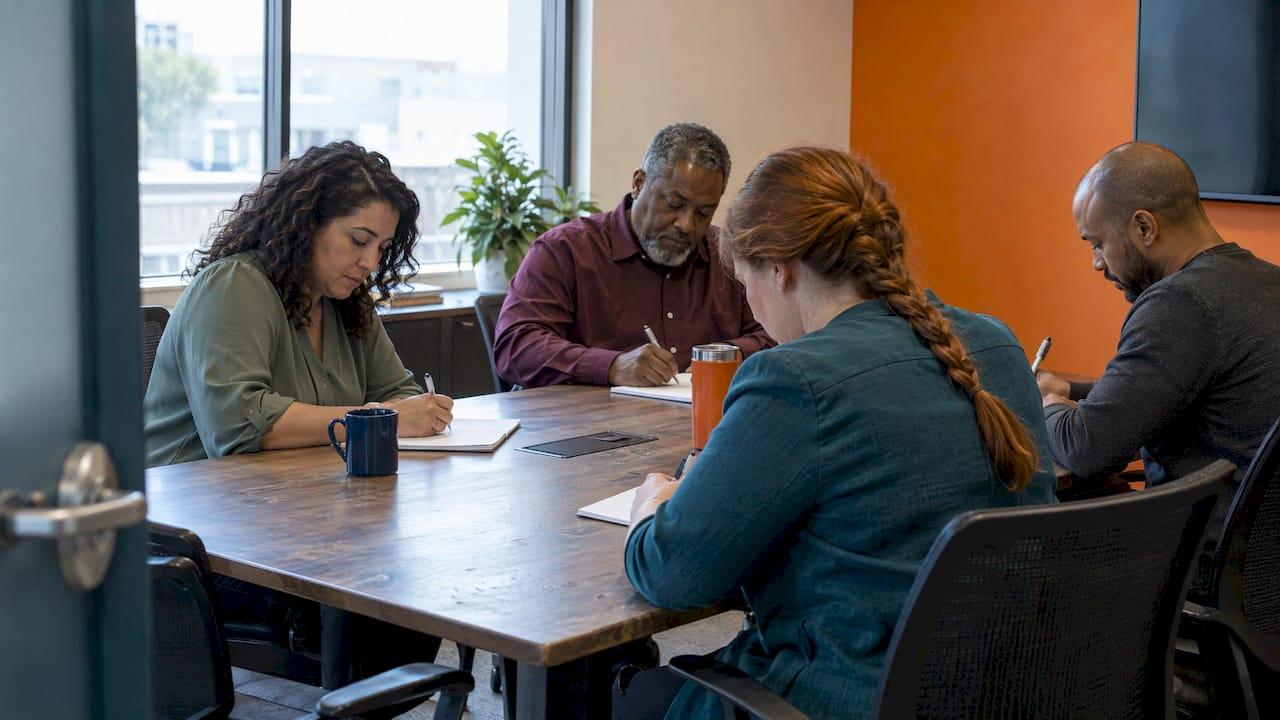
A team conflict workshop works when it is treated as the start of a behavior change, not a single event. The session surfaces what is straining the team, gives people a shared language to discuss it, and ends with observable commitments that leaders reinforce afterward. Without that last part, most of the value fades by the next quarter. This guide covers how to decide whether your team is ready, how to structure the session, how to facilitate it, and how to make the outcomes stick.
TL;DR
- Check readiness first. Active, heated conflict should be managed before a group workshop, and the session should be framed as normal, not shameful.
- Plan a focused format: 1 to 1.5 hours for a guidelines conversation, or a 4 to 5 hour working session for urgent cross-team issues.
- Separate task disagreements from interpersonal friction. Unresolved task conflict can turn personal.
- Turn discussion into 5 to 10 written, observable actions, and review them every 3 to 6 months.
- Reinforcement is what changes culture. Plan the follow-up before the workshop, not after it.
Table of Contents
- What a team conflict workshop is, and when it helps
- Decide whether the team is ready
- Choose the format and length
- Prepare the room, the agenda and the facilitator
- Run the session: a workable agenda
- Facilitate without taking sides
- Turn discussion into agreements people can observe
- Reinforce so the change lasts
- How to tell whether it worked
- Our perspective
- How True Colors supports team conflict work
- FAQ
- Sources
What a team conflict workshop is, and when it helps
A team conflict workshop is a facilitated session in which a team examines how it disagrees, what is driving friction, and what it will do differently. The goal is not to remove conflict. The Agency for Healthcare Research and Quality's TeamSTEPPS curriculum states that conflict is inevitable in any group because people bring different needs, perspectives and priorities. The aim is to handle it before it interferes with the work.
The same source separates two kinds of conflict, and the distinction is useful when you scope a workshop:
- Informational (task) conflict: disagreement about data, priorities, methods or decisions.
- Interpersonal conflict: friction about style, tone, trust or respect.
TeamSTEPPS notes that task disagreements left unresolved can evolve into interpersonal ones and weaken teamwork. That is the pattern many HR directors recognize: a missed handoff becomes a story about who cannot be relied on.
Organizational development literature describes team-level interventions as suited to a team dealing with internal issues that affect its work, or to two teams that must collaborate and are not. Effective ones are grounded in behavioral science, have defined goals and structure, and are led by facilitators with real organizational development skill.
Signs a workshop is the right tool
- Meetings repeat the same disagreements without resolution.
- Decisions are made outside the room, then reopened inside it.
- Two functions blame each other for delays or quality problems.
- A newly formed or recently reorganized team has no agreed way of handling disagreement.
- Engagement or employee experience survey results point to communication or trust as a weak spot.
That last signal matters for executives who want evidence before they commit. Our Employee Experience Survey gives leaders insight into what is helping or hurting performance, which helps define the workshop's focus before anyone enters a room.
Decide whether the team is ready
The most common mistake is putting a team in a room while the conflict is still raw. UC Davis's ombuds office guidance on developing group conflict guidelines advises determining group readiness first. Newly formed groups, or groups with little active conflict, are best positioned for a group conversation. Where conflict is active, it should be managed first, for example through individual conversations with the people involved.
A practical readiness check for HR and L&D leaders:
- Interview or survey in advance. Ask each member privately what is working, what is not, and what they want from the session.
- Look for power imbalances. If a manager's presence will silence the team, plan for that in the design.
- Check for acute situations. Allegations of harassment, discrimination or misconduct belong in a formal HR process, not a team workshop.
- Confirm leadership commitment. If the leader will not participate and act on the outcome, the session will not hold.
Normalize conflict before the day arrives. UC Davis points out that conflict is often stigmatized as negative and shameful, so the invitation itself should explain that the session is about working better together, not about assigning fault.
Choose the format and length
There is no single correct length. Two formats from the research mark the range.
| Format | Length | Best for |
|---|---|---|
| Group conflict guidelines conversation | 1 to 1.5 hours, per UC Davis | Newly formed teams or teams with little active conflict that want agreed norms |
| Confrontation meeting | 4 to 5 hours, per the University of Minnesota OD text | Urgent issues across areas and levels that need problem-solving and prioritized action |
| Skills-based training series | Several sessions over weeks | Building shared habits in communication, feedback and conflict navigation |
The confrontation meeting, first developed by Richard Beckhard in 1967, follows a clear flow. A leader sets the tone. Small, diverse groups identify obstacles and opportunities. Groups reconvene to present conclusions. New groups prioritize actions. Leadership then defines priorities, reports back and sets a process for monitoring the action plan. Well run, it improves alignment, decision-making, engagement and cross-team collaboration.
For most organizations, the practical answer is a hybrid: a focused working session to surface and prioritize issues, followed by skills training that builds the behaviors the team just said it needs. Our Conflict Navigation Training is one of the team programs we offer for that second layer, and our team building programs cover shared working habits.
Prepare the room, the agenda and the facilitator
Preparation decides more of the outcome than any exercise. The guide for leaders on facilitating dialogue from NYAC recommends the following before the session:
- Plan who participates and think through power dynamics.
- Choose a neutral, welcoming setting with everyone facing one another, in round tables or a circle.
- Allow a reasonable timeframe and provide refreshments.
- Send invitations to everyone at the same time with enough lead time.
- Share the agenda in advance, build a clear trust-building process, and have a plan for the worst case.
- Prepare an evaluation and next-steps process, and bring a co-facilitator or support team.
For remote teams, the same logic applies: smaller breakout groups, a visible agenda, and a co-facilitator managing the chat and the quieter voices.
Who should facilitate
A leader who is part of the conflict is rarely the best person to run the room. Organizational development guidance calls for facilitators with real OD knowledge and skills. In practice that means someone neutral who can hold the structure, name patterns without blame, and keep the group moving toward action. For leaders who want this support, our corporate consulting solutions and our conflict management consulting are built for that need.
The facilitator should also tell the group up front what role they are playing. UC Davis advises preparing for the facilitation role and communicating it at the outset, so that nobody wonders whose side the facilitator is on.
Run the session: a workable agenda
Below is a structure for a half-day working session. Shorten it for a 90-minute version by trimming the exercises, never by cutting the opening or the close.
- Frame the purpose and ground rules (15 minutes). The leader names why the session is happening and what will happen with the results. Keep it future-focused and free of blame.
- Build a shared language (30 to 45 minutes). Teams often argue about style as if it were substance. A behavior-based assessment helps people see that a colleague who pushes for speed and one who wants detail are working from different instincts, not bad intent. This is where our personality-style approach fits: it gives the team a common vocabulary for how each person communicates and handles pressure, so the next steps rest on understanding rather than assumption. See our personality workshop activities for ways to apply it.
- Surface the issues (45 to 60 minutes). Use small mixed groups. Ask each to name obstacles and what is working. Separate task issues from interpersonal ones.
- Name root causes (30 minutes). The TREC guide on mediating interpersonal conflict directs facilitators to collectively name root causes such as communication patterns, faulty assumptions or structural ambiguity about decision-making. Most recurring conflicts trace to one of these, not to a bad colleague.
- Prioritize and commit (45 minutes). Move from complaints to commitments, covered in the next sections.
- Close with evaluation and next steps (15 minutes). NYAC advises always making time for this, even if discussion must be cut short. Ask what was helpful, whether anyone learned something they had not considered, and what the group will do with the work, including action steps and the next meeting time.
Exercise design
UC Berkeley's Team Building Toolkit offers a sound seven-step sequence for any activity: select it with a clear objective, prepare, explain it, check for understanding, run it, debrief with prepared questions while tolerating silence, and reinforce the learning back on the job. The last two steps are the ones teams skip. Silence after a debrief question is often where the honest answer arrives.

Facilitate without taking sides
The facilitator's job is to make the room safe enough for candor and fair enough that nobody feels outnumbered. Research from UC Berkeley describes the FACET approach, which helps leaders facilitate conflict without taking sides by framing purpose and ground rules, listening reflectively, and clarifying shared meaning before exploring solutions. The author links this to psychological safety and the signaling of fairness, which are essential for building or restoring trust.
From the TREC guide, several facilitator habits are worth adopting:
- Look for the need behind the demand. Behind most positions is a need to feel respected, supported, understood or heard.
- Open with a solution-focused, future-oriented frame and steer clear of blame.
- Name small successes to build momentum.
- Hold one-to-one check-ins during and after the session.
- Set dates and benchmarks, and hold all parties accountable to what they agree.
TeamSTEPPS adds two practical tools for the individual conversations that follow: formative feedback and the DESC script, a structured way to describe a situation, express concern, suggest alternatives and agree on consequences. It also notes that staff stress and burnout make interpersonal conflict more frequent and harder to address constructively, which is a reason to schedule workshops before a team is at its limit.
Handling unequal participation
In most teams, a few voices dominate. Use written individual input before discussion, round-robin responses, and small groups that mix levels and functions. When a senior leader speaks first, others tend to align. Ask leaders to speak last, and say so in advance.
For related guidance, see our pieces on tips for handling difficult discussions at work and how different work styles create workplace conflict.
Turn discussion into agreements people can observe
This is the step where most workshops fail. Teams leave with good feelings and values such as "treat each other with respect," which nobody can verify.
UC Davis recommends a different path. Brainstorm suggestions, then use a consensus-based process to prioritize them into a shortlist of 5 to 10 items. Refine each into an observable action. "We respect each other" becomes something a colleague could see or hear, such as "we raise disagreement in the meeting, not afterward in side conversations." Share the written guidelines, invite proposed edits for a follow-up meeting, and review them every 3 to 6 months and whenever new members join.
A useful test for each agreement: could a new hire watch the team for a week and tell whether it is being followed? If not, rewrite it.
For decision-heavy teams, our decision making workshop agendas with 30/60/90 follow-up show how to build the follow-up into the plan, and our 30/60/90 plan for executive team conflict does the same at the leadership level.
Reinforce so the change lasts
The workshop is day one. What changes the culture is what the team repeats afterward. A short reinforcement plan might include:
- A 15-minute check-in on the agreements at the next regular team meeting.
- A leader who models the agreed behavior first, and says so when they miss.
- A 30-day pulse check with two or three questions on how conflict is being handled.
- A review of the guidelines at 90 days, then every 3 to 6 months, as UC Davis advises.
- Displaying team outputs and inviting participants to share the activity's impact, as the Berkeley toolkit suggests.
For sustaining progress with managers and leaders beyond the team, structured leadership workshops for managers can extend the same habits into daily management practice.
How to tell whether it worked
Do not rely on how people felt when they left. Track what changes in behavior and outcomes.
The evidence that conflict work can pay off is real, though it comes from specific settings. A one-year study of third-party consultation in a hospital operating room found statistically significant improvement on all six Group Behavior Inventory subscales, a 95% decline in physician abuse of scheduling privileges, and nursing turnover falling from 30% the previous year to zero. A 2008 study in Conflict Resolution Quarterly found that skills from a conflict resolution workshop persisted 12 months later, with participants reporting reduced tension, greater mutual understanding and stronger relationships.
Those are healthcare examples, so use them as a guide to what to measure rather than a promise of the same results. Reasonable indicators for a corporate team include:
- Rework, missed handoffs or escalations between the teams involved.
- Voluntary turnover and absence in the team.
- Engagement and employee experience survey items on trust and communication.
- Psychological safety items, such as whether it is safe to take a risk on the team.
- Whether the written agreements are being used in meetings.
Set the baseline before the workshop, so there is something to compare at 30, 60 and 90 days. Our team effectiveness workshop guide includes templates and measurement ideas.
Our perspective
Culture is not what is said. It is what is repeated. That is why we treat a conflict workshop as one moment inside a longer system, not as the system itself.
In our experience as a culture and behavior consultancy, teams rarely struggle because people lack good intentions. They struggle because they do not share a language for how they differ. When people can see that a colleague's directness, caution, enthusiasm or need for structure is a style and not a verdict on them, the conversation changes from who is wrong to what the team needs.
That is the path our practical system is designed to follow: from personal awareness, to aligned action, to stronger leadership, better communication and a culture that is reinforced over time. Awareness without action stays a conversation, and action without reinforcement fades. Leaders who plan for all three get a team that handles the next disagreement better than the last one.
Theresa
How True Colors supports team conflict work
If you are an HR director, L&D leader or executive planning this for your organization, we can help you move from the workshop to a sustained program. Our Conflict Navigation Training, Communication Training and Team Building Training are offered through our team programs, and our customized group work applies our personality-style assessment to your own teams. For a broader engagement that includes leadership development and ongoing reinforcement, start with our corporate consulting solutions.

Tell us the team, the pattern you are seeing and the outcome you want, and we will help you shape the right format.
FAQ
How long should a team conflict workshop be?
It depends on the goal. A conversation to agree on group conflict guidelines can fit in 1 to 1.5 hours, according to UC Davis. A confrontation-meeting style session for urgent cross-team issues runs 4 to 5 hours. Plan reinforcement beyond either one.
Should we run a workshop while the conflict is still active?
Usually not as the first step. Active conflict is better managed through individual conversations first, and the group session works best once people can discuss issues without it becoming personal. Serious misconduct allegations belong with HR and legal counsel, not in a team workshop.
Who should facilitate: an internal leader or an outside professional?
Choose someone who is not a party to the conflict and who has organizational development skill. A neutral facilitator can hold the structure and name patterns without appearing to take sides. Many organizations bring in an external consultant when the team's manager is part of the dynamic.
How do we keep the agreements from fading?
Write 5 to 10 agreements as observable actions, share them in writing, and review them at the next meeting. Then revisit them every 3 to 6 months and when new members join. Leaders who model the agreements first make the biggest difference.
Sources
- Concept: Conflict in Teams, AHRQ TeamSTEPPS
- Team Level OD Interventions, University of Minnesota
- Group Conflict Guidelines, UC Davis Ombuds Office
- Guide for Leaders: Facilitating Dialogue, NYAC
- Mediating Interpersonal Conflict, TREC
- Team Building Toolkit, UC Berkeley HR
- FACET approach, UC Berkeley dissertation
- Conflict Management in Surgery: The Impact of Third Party Consultation
- What Sticks, Conflict Resolution Quarterly