
Company culture directly shapes customer experience because employees enact culture in every interaction. When the values, habits, and expectations inside an organization align with what customers need, frontline behavior becomes consistent, empathetic, and effective. When they don't, customers feel it — even if they can't name it.
The mechanism is straightforward: culture sets the norms employees follow, those norms drive behavior, and behavior is what customers actually experience. Three elements make this chain work or break it:
- Employee behavior alignment — whether daily actions match stated values
- Cultural intelligence (CQ) — the capacity to read and adapt to customers from different cultural backgrounds
- Leadership reinforcement — whether leaders model and reward the behaviors they expect
Research on intercultural service encounters confirms that frontline employees' CQ materially influences customer loyalty and service evaluations across markets. Organizations that treat CQ as an operational capability — not a soft skill — see measurable improvements in retention and satisfaction scores.
Pro Tip: Before your next leadership meeting, ask: "What behavior did we recognize or reward this week that a customer would notice?" If the room goes quiet, your culture-to-CX gap is already visible.
Table of Contents
- How culture affects customer experience: the causal chain
- What moves when culture and CX are aligned
- How culture shapes the people who serve your customers
- Leadership behaviors and rituals that keep culture-to-CX alignment alive
- What culture-to-CX alignment looks like in practice
- A step-by-step plan to align your culture with customer expectations
- How long does it take to see measurable results?
- Common pitfalls that undermine culture-to-CX programs
- How behavior-based systems make culture change stick
- Key Takeaways
- Why culture is the leverage point most leaders underestimate
- Truecolorsintl helps you turn culture into measurable CX outcomes
- Useful sources and further reading
How culture affects customer experience: the causal chain
Culture does not reach customers through mission statements. It reaches them through the employee who answers the phone, processes the return, or handles the complaint. That employee's behavior is shaped by what their organization rewards, tolerates, and repeats — which is culture in its most operational form.

The mechanism chain runs like this:
Organizational culture → employee mindset → frontline behavior → customer perception → business outcomes
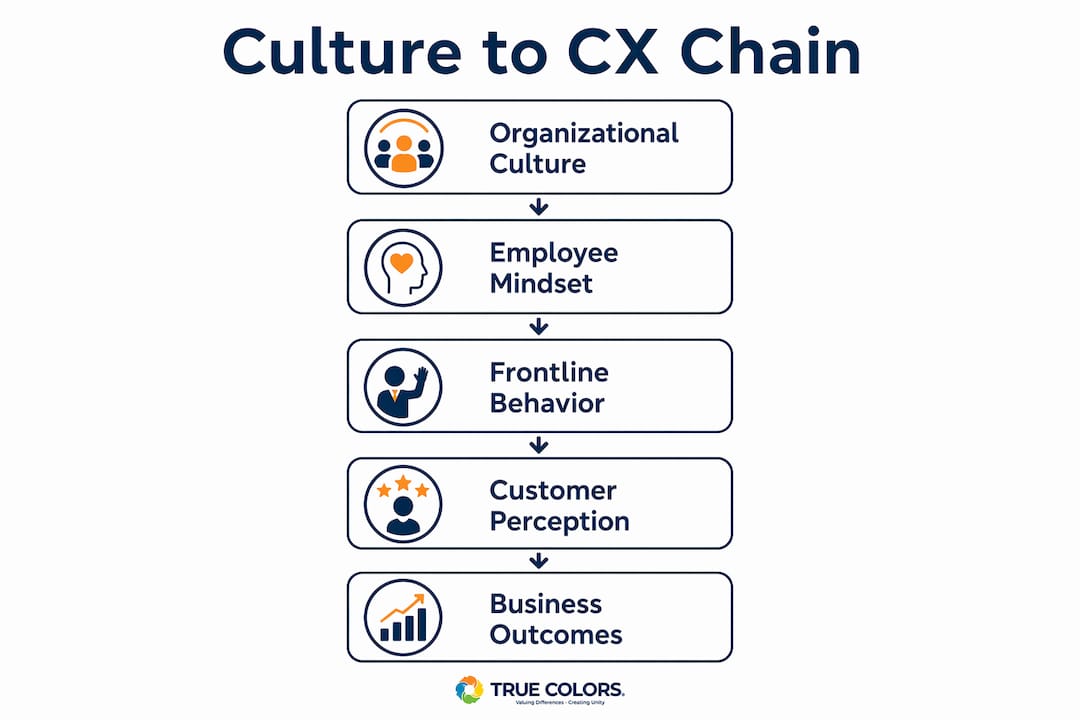
Each link is a leverage point. A culture that rewards speed over empathy produces fast but impersonal service. A culture that rewards resolution over compliance produces employees who solve problems rather than recite policies. The customer doesn't see the internal culture; they experience its output.
Cultural dimensions add another layer. Research using Hofstede's framework shows that customers from low power-distance cultures place higher expectations on responsiveness and reliability, while those from individualistic orientations expect stronger empathy and personal assurance. When a service organization's internal culture doesn't account for these differences, the mismatch creates friction that customers attribute to poor service — not cultural misalignment.
| Cultural Dimension | Customer Expectation Tendency | CX Risk When Ignored |
|---|---|---|
| Low power distance | High responsiveness, peer-level tone | Customers feel dismissed by formal, hierarchical scripts |
| High collectivism | Relationship-first, norm-driven decisions | Customers feel rushed through transactional processes |
| High individualism | Personal empathy, tailored assurance | Customers feel like a ticket number, not a person |
| High context | Implicit signals, relationship cues | Customers feel misread when staff rely on explicit scripts only |
Consumer journey research shows that in collectivist contexts, purchase decisions are more relationship- and norm-driven than individually rational — meaning the pre-purchase and post-purchase phases carry more weight than most Western-trained CX teams expect.
Culture is not what is said. It's what is repeated — in every service interaction, every escalation decision, and every moment a frontline employee chooses between the easy answer and the right one.
The most damaging mismatches are invisible. A response surface analysis of airline reviews found that provider and passenger culture together influence service evaluations in non-linear ways — meaning the gap between provider and customer cultural assumptions compounds, rather than simply adds, to dissatisfaction.
Pro Tip: Map your customer journey against your internal culture norms. Where your process prioritizes efficiency and your customer expects relationship, you have a structural CX risk — not a training problem.
What moves when culture and CX are aligned
Alignment between organizational culture and customer expectations doesn't produce vague "better vibes." It produces measurable shifts in specific KPIs that leaders can track, report, and use to justify investment.
| KPI | What It Reveals About Culture | Directional Expectation |
|---|---|---|
| Net Promoter Score (NPS) | Whether customers trust the organization enough to advocate | Rises when employees consistently exceed expectations |
| Customer Satisfaction (CSAT) | Whether individual interactions met expectations | Improves when frontline behavior matches customer cultural norms |
| Customer Retention Rate | Whether customers see enough value to return | Increases when cultural alignment reduces friction and builds trust |
| Customer Lifetime Value (LTV) | Whether customers deepen their relationship over time | Grows when trust and consistency compound across interactions |
| First Contact Resolution (FCR) | Whether employees have the judgment to resolve issues | Improves when culture empowers rather than constrains employees |
| Churn Rate | Whether customers are quietly leaving | Decreases when cultural misalignment is diagnosed and corrected |
The link between employee engagement and customer outcomes is well-documented. Harvard Business Review reports that engaged employees create better customer experiences — a finding that holds across industries and organization sizes. Engagement is itself a cultural output: it reflects whether employees feel aligned with the organization's values and equipped to act on them.
Studies on cultural intelligence find that when frontline employees have high physical CQ — the ability to adapt behavior in real time — the link between perceived service quality and customer loyalty strengthens measurably. This is not a marginal effect. It's the difference between a customer who returns and one who defects silently.
Pro Tip: During a culture-to-CX pilot, track FCR and CSAT weekly for the first 90 days. These are your fastest-moving leading indicators. NPS and retention will follow, but they lag by months — don't wait for them to validate early progress.
How culture shapes the people who serve your customers
Hiring, onboarding, and training are the three moments when culture either gets embedded or gets diluted. Most organizations treat them as separate HR functions. The ones with strong culture-to-CX alignment treat them as a single, continuous system.

Hiring for culture add, not culture fit
"Culture fit" hiring tends to replicate the existing team's assumptions — including its blind spots about customer diversity. Research on intercultural service encounters supports hiring for "culture add": bringing in perspectives that mirror customer diversity rather than reinforce internal homogeneity. This approach increases collective empathy and reduces the risk of defaulting to a single cultural script when serving varied customers.
Practical interview questions that surface CQ:
- "Tell me about a time you served a customer whose expectations were different from what you anticipated. What did you notice, and what did you do?"
- "Describe a situation where your usual approach didn't work. How did you read the signals and adjust?"
- "When a customer goes quiet or seems disengaged, what do you do next?"
Onboarding that embeds CQ from day one
Experimental research shows that metacognitive CQ — the ability to pause, reflect on cultural assumptions, and adapt — can be developed through structured training. Onboarding is the highest-leverage moment to build this capability, before default scripts calcify into habits.
Effective onboarding design includes:
- Customer persona profiles that include cultural orientation, not just demographics
- Role-play scenarios drawn from real cultural mismatch situations the team has encountered
- A "cultural signals" guide that helps new hires recognize high-context versus low-context cues
- Pairing new hires with mentors who model situational adaptation, not just product knowledge
Incentives and recognition that reinforce the right behavior
What gets measured gets repeated. If your recognition system rewards speed and volume but ignores empathy and resolution quality, your culture will produce fast, impersonal service — regardless of what your values statement says.
Balanced scorecard elements that reinforce customer-centric behavior:
- CSAT scores tied to individual and team recognition (not just compensation)
- FCR rates as a quality indicator alongside handle time
- Customer story sharing in team meetings — naming specific behaviors that made a difference
- Peer recognition for cultural adaptation moments ("I saw you shift your approach when the customer seemed hesitant — that's exactly what we're building here")
Pro Tip: Audit your current incentive structure before designing training. If speed is rewarded and empathy is not measured, training alone won't change behavior. Fix the incentive first.
Leadership behaviors and rituals that keep culture-to-CX alignment alive
Culture doesn't drift because employees forget the values. It drifts because leaders stop modeling them. The most durable culture-to-CX programs are built on visible, repeated leadership behavior — not annual culture surveys or values posters.
What leaders actually need to do
- Model the behavior publicly. When a leader handles a customer escalation with curiosity rather than defensiveness, the team notices. When they don't, the team notices that too.
- Include CX in executive scorecards. Culture KPIs — NPS, CSAT, FCR, employee engagement — belong in the same dashboard as revenue and margin. Separating them signals that culture is an HR concern, not a business one.
- Escalate with questions, not blame. When a CX failure surfaces, the leader's first response sets the cultural norm. "What did the customer need that we didn't provide?" is a different culture than "Who made this mistake?"
- Protect the rituals. Daily huddles, customer story sharing, and post-journey reviews only work if they happen consistently. Leaders who cancel them under pressure signal that culture is optional.
Governance mechanisms that sustain alignment
A CX steering committee with cross-functional representation — including HR, operations, and frontline managers — creates accountability that no single department can provide alone. Simple leadership rituals like customer-story sharing and leader-led huddles are among the most effective sustainment mechanisms practitioners have documented, precisely because they require no technology and create daily reinforcement.
The organizations that sustain culture-to-CX alignment over years are not the ones with the best training programs. They are the ones where leaders make the same behavioral choices on a difficult Tuesday that they make during a culture launch event.
Red flags that signal governance is symbolic, not functional:
- CX metrics appear in board decks but not in manager performance reviews
- Culture initiatives are owned exclusively by HR with no operational co-owner
- Customer feedback is reviewed quarterly rather than weekly
- Leaders talk about customer centricity but escalate based on cost, not customer impact
Pro Tip: Add one customer story to every leadership team meeting agenda. Not a metric — a story. Stories build the emotional context that makes metrics meaningful and keeps leaders connected to what customers actually experience.
What culture-to-CX alignment looks like in practice
1. A service team that rebuilt trust through CQ training
A mid-size financial services firm noticed that CSAT scores were consistently lower among customers from collectivist cultural backgrounds, despite high FCR rates. The diagnosis: frontline employees were resolving issues efficiently but transactionally — skipping the relationship-building cues that these customers expected before they felt comfortable proceeding.
The team introduced CQ training focused on metacognitive adaptation: pausing to read relational signals before moving to resolution. Within two quarters, CSAT among the affected segment improved, and repeat contact rates dropped. The lesson was not that efficiency was wrong — it was that efficiency without cultural awareness produces satisfaction for some customers and alienation for others.
Key lessons:
- Segment CSAT by customer cultural profile, not just by product or channel
- Train for signal-reading before resolution, not just resolution speed
- Measure repeat contact rates as a proxy for unresolved cultural friction
2. A retail brand that lost customers it thought were satisfied
A national retailer with strong NPS scores discovered through exit interviews that a segment of customers from high-context, hierarchical backgrounds had been quietly defecting for over a year. These customers had never complained — consistent with research showing that customers from hierarchical cultures often don't complain but simply stop returning.
The cultural mismatch: the retailer's service culture emphasized directness and efficiency, which these customers experienced as dismissive. Silence had been misread as satisfaction.
Key lessons:
- Silence is not satisfaction — especially from customers in high power-distance or high-context cultures
- Exit interview design must include cultural orientation questions, not just product or price questions
- Churn analysis should be segmented by customer demographic and cultural background
3. A healthcare organization that aligned culture and improved patient experience
A regional healthcare network identified that patient satisfaction scores varied significantly by clinic location — not by clinical quality, but by the cultural composition of the patient population and the cultural alignment of the care team. Clinics where staff cultural backgrounds overlapped with patient populations consistently outperformed those where they didn't.
The organization responded by redesigning onboarding to include cultural orientation training and by adjusting hiring criteria to prioritize culture-add candidates in underperforming locations. Patient satisfaction scores in those locations improved over the following year.
Key lessons:
- Cultural alignment between staff and patient/customer populations is a measurable performance variable
- Hiring criteria should reflect the cultural diversity of the customer base, not just technical qualifications
- Onboarding is the fastest lever for improving cultural alignment in existing teams
| Vignette | Starting Gap | Intervention | Outcome Direction |
|---|---|---|---|
| Financial services | Low CSAT in collectivist segments | Metacognitive CQ training | CSAT improved; repeat contacts declined |
| National retailer | Silent defection from high-context customers | Exit interview redesign; cultural segmentation | Churn cause identified and addressed |
| Healthcare network | CSAT variance by location | Culture-add hiring; cultural onboarding | Patient satisfaction improved in target locations |
A step-by-step plan to align your culture with customer expectations
The sequence matters. Organizations that skip assessment and jump to training typically produce short-term behavior change that fades within 90 days because the underlying cultural gaps remain unaddressed.
Phase 1: Assess
- Audit current CX metrics by customer segment, including cultural and demographic overlays where available
- Conduct frontline interviews to surface the informal rules employees actually follow (not the stated values)
- Map your customer journey against your internal cultural norms — identify where your process prioritizes efficiency and your customer expects relationship
- Review drop-off and churn data for patterns that correlate with cultural mismatch rather than product or price
Phase 2: Define behaviors
- Translate cultural values into observable, specific behaviors — not "be empathetic" but "ask one clarifying question before offering a solution"
- Identify the three to five behaviors that have the highest impact on your target customer segments
- Build a behavioral rubric that managers can use to coach and recognize
Phase 3: Pilot
- Select one team or location with a clear cultural mismatch and measurable baseline metrics
- Run a 60–90 day pilot with weekly CSAT and FCR tracking
- Include qualitative signals: frontline feedback, customer interviews, and observation
Phase 4: Measure and scale
- Compare pilot results against baseline and control group
- Document what worked, what didn't, and why — with behavioral specificity
- Scale the behaviors and training design that moved the metrics, not the entire program
Vendor briefing checklist for RFPs:
- Does the vendor assess existing cultural gaps before designing interventions?
- Can they map culture elements to specific CX behaviors and metrics?
- Do they provide a measurement plan with leading and lagging indicators?
- Can they show case studies with before/after CX metrics?
- What is their sustainment model after the initial training?
Pro Tip: Prioritize quick wins in Phase 3 by targeting the cultural mismatch with the highest churn correlation. A visible early result builds internal credibility for the broader program.
Quick wins vs. structural changes:
- Quick wins (30–60 days): Behavioral rubrics, recognition rituals, CQ signal guides for frontline staff
- Medium-term (3–6 months): Onboarding redesign, hiring criteria revision, manager coaching cadence
- Structural (6–18 months): Governance redesign, executive scorecard integration, culture KPI infrastructure
How long does it take to see measurable results?
Culture change is not an event. It's a pattern that accumulates over time, and the metrics that reflect it move at different speeds.
| Initiative Type | Expected Signal | Timeline | Measurement Method |
|---|---|---|---|
| CQ training (frontline) | CSAT, FCR improvement | 1–3 months | Weekly CSAT surveys; FCR tracking |
| Behavioral rubric + recognition | Employee engagement lift | 1–3 months | Pulse surveys; manager observation |
| Onboarding redesign | New hire competency speed | 3–6 months | 90-day performance reviews |
| Hiring criteria revision | Team cultural diversity | 3–9 months | Demographic and CQ assessment data |
| Manager coaching cadence | NPS movement | 3–9 months | Quarterly NPS; customer interviews |
| Governance redesign | Retention and LTV | 9 months | Cohort retention analysis; LTV tracking |
Combining quantitative drop-off metrics with frontline qualitative signals is the most reliable diagnostic approach — neither method alone captures the full picture. Quantitative data tells you where the gap is; qualitative signals tell you why.
A critical measurement caution: customers from hierarchical cultures often don't complain — they simply stop returning. This means standard satisfaction surveys will undercount cultural dissatisfaction. Supplement CSAT with behavioral signals: repeat contact rates, channel switching, and exit interview data segmented by cultural background.
Measurement checklist for pilots:
- Baseline CSAT and FCR established before the pilot begins
- Weekly tracking cadence for leading indicators
- Qualitative check-ins with frontline staff at 30 and 60 days
- Customer interviews with at least two cultural segments represented
- Control group or comparable location for comparison
Common pitfalls that undermine culture-to-CX programs
Most culture-to-CX initiatives don't fail because the diagnosis was wrong. They fail because the implementation defaults to the path of least resistance — slogans instead of behaviors, training events instead of sustained reinforcement.
The most common pitfalls:
- Slogans instead of behaviors. "We put customers first" is not a behavior. "Ask one clarifying question before offering a solution" is. Vague values produce inconsistent actions.
- Cultural cloning in hiring. Hiring for "culture fit" replicates the team's existing blind spots. It reduces the range of perspectives available to serve a diverse customer base.
- Treating CQ as optional. When employees lack tools to recognize cultural differences, they default to familiar scripts — causing repeated, avoidable CX failures that look like individual errors but are systemic.
- Misreading silence as satisfaction. Customers who don't complain are not necessarily satisfied. In many cultural contexts, silence is the precursor to defection.
- Training without incentive alignment. If the recognition system rewards speed and the training teaches empathy, speed wins every time.
- One-time events instead of sustained reinforcement. A two-day workshop produces awareness. Sustained behavioral change requires repeated reinforcement through rituals, coaching, and measurement.
Culture training loses impact the moment it stops being reinforced by the behaviors leaders model and the outcomes organizations measure.
Red-flag checklist for pilot reviews:
- Are managers coaching to the behavioral rubric, or reverting to their own style?
- Are recognition rituals happening weekly, or only during the launch phase?
- Is CX data being reviewed at the team level, or only at the executive level?
- Are frontline employees being asked for qualitative feedback, or only surveyed?
Pro Tip: Review why culture training loses impact before designing your program. The failure modes are predictable — and preventable when you know what to look for.
How behavior-based systems make culture change stick
The gap between a culture initiative and a culture change is operationalization. Most programs produce awareness. The ones that produce measurable CX outcomes translate awareness into repeated, observable behavior — and then measure it.
A behavior-based program follows a specific anatomy:
- Assessment: Identify existing cultural gaps using behavioral data, CX metrics, and frontline input — not just survey scores
- Leader coaching: Equip leaders to model and reinforce target behaviors before asking frontline employees to adopt them
- Team workshops: Build CQ and situational adaptation skills through scenario-based practice, not lecture
- Behavioral nudges: Embed reminders, rubrics, and recognition rituals into daily workflows so behavior change doesn't depend on memory
- Measurement cadence: Track leading indicators weekly and lagging indicators quarterly, with a formal review at 90 days
Organizations that follow this structure can expect engagement lift within the first quarter, CSAT and NPS movement within two to three quarters, and retention improvements within the first year — provided the governance structures are in place to sustain the reinforcement.
Culture-focused training programs that combine behavioral specificity with measurement cadence consistently outperform those that rely on values articulation alone. The difference is not the quality of the content — it's whether the behavior is reinforced after the training ends.
What to demand from a vendor:
- A behavioral assessment before any training design begins
- A measurement plan with named leading and lagging indicators
- A sustainment model that extends beyond the initial engagement
- Case studies with before/after CX metrics, not just participant satisfaction scores
- A clear implementation timeline with defined milestones and success criteria
Pro Tip: Ask any vendor: "What behavior will be different on day 91 that wasn't on day 1, and how will you measure it?" The answer tells you whether they are selling training or culture change.
Key Takeaways
Culture directly shapes customer experience through employee behavior — and organizations that operationalize this link through CQ training, behavioral reinforcement, and governance structures see measurable improvements in CSAT, NPS, and retention.
| Point | Details |
|---|---|
| Culture reaches customers through behavior | Employee actions, not values statements, are what customers experience in every interaction. |
| CQ is an operational capability | Frontline employees with high cultural intelligence produce stronger loyalty and satisfaction outcomes across diverse customer segments. |
| Silence is not satisfaction | Customers from hierarchical cultures often defect without complaining — segment churn data by cultural background to surface hidden gaps. |
| Measurement must be mixed-method | Combine quantitative KPIs with qualitative signals; leading indicators move in 1–3 months, retention shifts take 9 months. |
| Truecolorsintl operationalizes the change | True Colors International translates culture into observable behaviors through assessments, coaching, workshops, and a sustained measurement cadence. |
Pro Tip: Start your pilot within the next 30–60 days: pick one team, establish a CSAT and FCR baseline, and run a 90-day behavioral intervention. Use the measurement checklist and vendor briefing template in the how-to section to structure the engagement.
Why culture is the leverage point most leaders underestimate
There's a pattern worth naming directly. Most CX improvement efforts start with the customer — journey mapping, persona research, channel optimization. These are useful. But they consistently underperform when the internal culture hasn't been addressed, because the people delivering the experience are still operating from a different set of norms.
The more durable insight is this: culture is upstream of everything else in CX. You can redesign the journey, but if the employee at the critical moment defaults to a familiar script instead of reading the customer's actual signals, the journey map is irrelevant. The research on cultural dimensions and consumer behavior makes clear that customers from different cultural orientations don't just prefer different things — they process service interactions through fundamentally different frameworks of expectation, power, and relationship.
What I find most underestimated is the role of metacognitive CQ — the capacity to pause and question your own assumptions in real time. It's not a personality trait. It's a learnable skill, and it's the one that separates employees who de-escalate difficult interactions from those who inadvertently make them worse. Organizations that invest in building this capability at scale are not just improving CX scores. They are building a more resilient, adaptive workforce.
The leaders who get the most from culture-to-CX work are the ones who stop treating it as a training initiative and start treating it as an operating system. That shift in framing changes everything — from how they hire, to how they govern, to what they measure.
Truecolorsintl helps you turn culture into measurable CX outcomes
Most culture programs produce insight without traction. Truecolorsintl is built for the gap between awareness and change. Through a behavior-based system grounded in human psychology, True Colors International helps organizations identify the specific cultural gaps that are limiting CX performance, then build the leadership behaviors, team habits, and measurement infrastructure to close them.
A typical engagement begins with a behavioral assessment that surfaces what is actually driving frontline behavior — not what the values statement says, but what employees are rewarded and recognized for doing. From there, True Colors designs leader coaching, team workshops, and onboarding tools calibrated to your customer base and your CX goals. The sustainment model keeps progress moving after the initial program ends, through reinforcement rituals, pulse surveys, and a measurement cadence tied to your KPIs.
If you're ready to move from culture aspiration to culture performance, explore True Colors' corporate consulting programs or visit truecolorsintl.com to connect with a consultant and discuss what a pilot engagement would look like for your organization.
Useful sources and further reading
The research underpinning this guide spans cultural psychology, service quality, and organizational behavior. These sources are the most useful for leaders building a culture-to-CX program:
-
Culture and Consumer Behavior: Horizontal and Vertical Cultural Factors (PMC) — The most rigorous academic treatment of how cultural orientation shapes consumer expectations and service provider judgments. Best for leaders who want to understand the theoretical foundation before designing interventions.
-
Culture and the Consumer Journey (Journal of Retailing) — Directly applicable to journey mapping: shows how collectivist versus individualist orientations change pre-purchase, purchase, and post-purchase behavior. Use this when redesigning customer journeys for diverse markets.
-
Building Customer Loyalty in Intercultural Service Encounters (Journal of International Marketing) — The strongest empirical case for treating CQ as an operational capability. Useful for vendor briefings and for making the business case for CQ training investment.
-
Service Excellence and Metacognitive CQ (Journal of Service Theory and Practice) — Experimental evidence that metacognitive CQ can be trained and that it improves service adaptation. Best for training design and onboarding program development.
-
The Joint Effect of Consumer and Provider Culture on Service Evaluations (White Rose) — Response surface analysis showing that provider-customer cultural mismatches compound dissatisfaction non-linearly. Use for the business case for auditing provider-side cultural assumptions.
-
Cultural Intelligence at Work: What It Is and How It Drives Customer Outcomes (CXM World) — Practitioner-focused analysis of CQ as an operational filter. Most useful for frontline training design and for explaining CQ to non-technical stakeholders.
-
Hofstede's Cultural Dimensions and Service Expectations (Journal of International Marketing) — Foundational study linking power distance and individualism to service quality expectations. Use when segmenting your customer base by cultural orientation for the first time.
-
Engaged Employees Create Better Customer Experiences (Harvard Business Review) — Practitioner-accessible summary of the engagement-to-CX link. Useful for executive briefings and for making the internal case for culture investment.
-
True Colors International: Leadership Development and Culture Building Programs — The primary resource for organizations seeking a behavior-based, measurement-driven approach to culture-to-CX alignment. Includes program descriptions, case studies, and engagement options.