
Top-down culture strategy is the organizational approach where senior leaders define the vision, values, and priorities that cascade downward through every level of the company. This centralized method drives alignment, accountability, and consistent execution across large or complex organizations. It is the dominant model in industries like manufacturing, healthcare, and retail, where uniform standards and rapid decisions are non-negotiable. Understanding what is top-down culture strategy, and how to apply it without stifling your people, is one of the most consequential leadership decisions you will make.
What is top-down culture strategy and why it matters
Top-down culture strategy centralizes direction and decision-making at the leadership level, then cascades values and priorities downward for execution. Senior executives set the “what” and the “why.” Everyone below them is responsible for the “how.” This structure creates a single, authoritative line of command that reduces ambiguity and keeps the entire organization pointed in the same direction.
The approach is not simply a management style. It is a governance choice that shapes how information flows, how decisions get made, and which behaviors get rewarded. Culture is not what is said. It is what is repeated. When leaders consistently model and reinforce specific behaviors, those behaviors become the culture. Top-down strategy makes that reinforcement deliberate and systematic.

Organizations in regulated industries rely on this model because compliance requires consistency. A hospital network cannot afford 50 different interpretations of a patient safety protocol. A retail chain cannot allow individual stores to define their own customer service standards. In these contexts, top-down culture strategy is not optional. It is the operating system.
What are the main benefits of a top-down culture strategy?
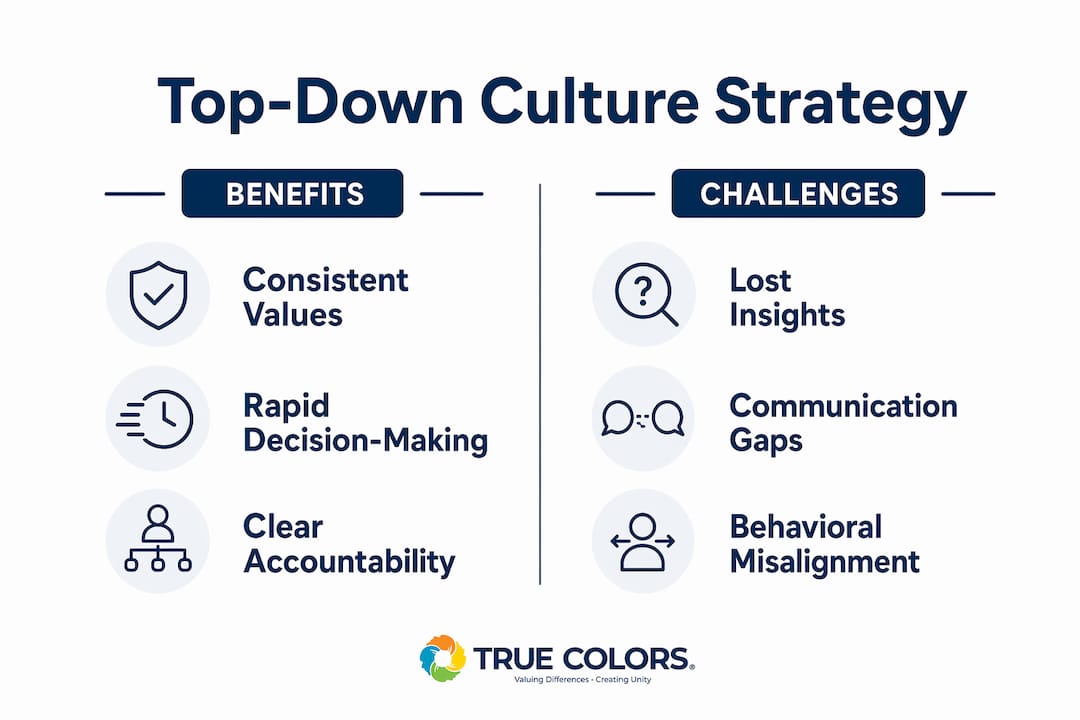
The clearest benefit of a top-down approach is speed. Rapid execution becomes possible by removing the need for multi-stakeholder consensus at every decision point. When one authoritative voice sets direction, teams can act immediately rather than waiting for alignment meetings to resolve competing priorities.
Beyond speed, the approach delivers three additional advantages that leaders consistently undervalue:
-
Clarity of accountability. Every role knows what it owns. When direction comes from the top, there is no ambiguity about who is responsible for which outcomes.
-
Uniform standards. Large organizations with multiple locations or departments maintain consistent quality when standards are set centrally and enforced consistently.
-
Risk mitigation. In crisis situations or regulated environments, top-down control excels because it limits the number of decision points where errors can occur.
-
Faster onboarding. New employees learn the culture quickly when expectations are explicit, documented, and modeled from the top.
Pro Tip: Pair your top-down directives with a one-page culture brief that translates executive priorities into observable daily behaviors. This gives managers a concrete tool to reinforce culture without interpretation drift.
The consistency benefit compounds over time. When every manager in every location reinforces the same standards, the organization builds a reputation that becomes a competitive asset. Customers, partners, and recruits all respond to organizations that behave predictably and professionally at scale.
What challenges and risks can arise from a top-down culture strategy?
The most common failure in top-down culture strategy is the “say-do” gap. Leaders undermine credibility when they declare cultural values but reward behaviors that contradict them. If a company announces a commitment to collaboration but promotes only individual contributors, the declared culture becomes noise. Employees stop listening to what leadership says and start watching what leadership does.
Three additional risks deserve direct attention:
-
Employee disengagement. When frontline employees have no voice in decisions that affect their daily work, motivation erodes. Limited frontline involvement stifles both innovation and operational insight.
-
Communication gaps. Directives that travel through multiple management layers often arrive distorted. The original intent gets filtered, softened, or misinterpreted at each level.
-
Resistance to change. People resist what they did not help create. A purely top-down rollout of a new initiative frequently encounters passive resistance from teams who feel excluded from the process.
Pro Tip: Build a quarterly “listening session” into your leadership calendar. Bring frontline employees into a structured conversation about what is working and what is not. This is not a suggestion box. It is a formal feedback mechanism that feeds directly into leadership decisions.
Leaders risk losing vital ground-level insights when they rely solely on downward communication. The information that travels up through a rigid hierarchy is often filtered to tell leaders what they want to hear. Without deliberate feedback loops, strategy becomes disconnected from operational reality.
How does top-down culture strategy compare with bottom-up approaches?
Top-down and bottom-up approaches are governance tools, not opposing philosophies. The right choice depends on context: scale, risk tolerance, regulatory environment, and the pace of change the organization faces.
| Dimension | Top-down culture strategy | Bottom-up culture approach |
|---|---|---|
| Decision-making | Centralized at senior leadership | Distributed across teams and individuals |
| Communication flow | Downward from executives to frontline | Upward from frontline to leadership |
| Accountability | Clear, role-specific, leadership-defined | Shared, team-driven, emergent |
| Innovation | Constrained by central approval | Encouraged through frontline experimentation |
| Best fit | Regulated industries, crisis response, scale | Agile teams, creative functions, startups |
Bottom-up culture strategy generates stronger employee ownership and surfaces ideas that leadership would never encounter from the top. The tradeoff is slower consensus and inconsistent standards across teams. Highly regulated firms favor top-down for control, while agile teams prefer bottom-up for the speed of iteration it enables.
The most effective organizations do not choose one or the other. Sophisticated organizations adopt hybrid models where leadership sets strategic direction top-down, while tactical decisions are decentralized to preserve execution agility. Leadership controls the “what” and the “why.” Frontline teams own the “how.” This structure preserves alignment without creating the rigidity that kills engagement. Understanding how culture shapes strategy is the foundation for making this hybrid model work in practice.
What best practices help leaders implement top-down culture strategy effectively?
Effective implementation requires more than issuing directives. It requires building the systems that make those directives stick. A growth strategy framework can help leaders think through the structural conditions that support top-down culture before rollout begins.
-
Define observable behaviors, not just values. “Integrity” is not a behavior. “We tell customers about problems before they ask” is a behavior. Translate every cultural value into specific, observable actions that managers can recognize and reinforce.
-
Align rewards with declared culture. Audit your recognition programs, promotion criteria, and performance reviews. If the behaviors you reward contradict the culture you declare, the reward system wins every time.
-
Build explicit communication channels. Clear communication channels and feedback loops are not optional in top-down structures. They are the mechanism that keeps strategy connected to reality. Establish regular all-hands updates, manager briefings, and documented escalation paths.
-
Focus leadership on the “what,” not the “how.” Micromanagement is the most common way top-down leadership destroys engagement. Set clear outcomes and standards. Then give teams the authority to determine how they meet them.
-
Measure culture, not just performance. Use structured tools to assess whether your declared culture matches the lived experience of employees. Truecolorsintl’s employee experience survey gives leaders a data-driven view of where alignment exists and where it breaks down.
Pro Tip: Review your last five promotion decisions. Ask: did these people model the culture we declared, or did they simply hit their numbers? If the answer is the latter, your reward system is actively undermining your culture strategy.
The leaders who succeed with top-down culture strategy treat communication as infrastructure, not an event. They build communication systems that carry culture consistently, not just during annual kickoffs or crisis moments.
What real-world examples illustrate top-down culture strategy in action?
Top-down culture strategy shows up most clearly in sectors where consistency is a safety or compliance requirement.
-
Healthcare networks use a top-down strategy to enforce patient safety protocols uniformly across hospitals, clinics, and outpatient facilities. A single deviation from a hand-hygiene standard can cause patient harm. Central enforcement is not bureaucracy. It is protection.
-
Retail chains cascade customer service standards from corporate leadership to every store location. When a customer walks into any location of a national brand, the experience should feel identical. That consistency is the product of deliberate top-down culture reinforcement.
-
Manufacturing operations rely on a top-down safety culture to reduce workplace incidents. When leadership visibly prioritizes safety, conducts regular audits, and holds managers accountable for compliance, incident rates fall. Behavior change starts at the top and cascades down.
The lesson across all three sectors is the same. Top-down culture works when leadership behavior matches the declared standard. When executives skip the safety walk or ignore a customer complaint, the culture message collapses. The culture transformation process always begins with what leaders do, not what they say.
Key Takeaways
Top-down culture strategy succeeds when leaders align their daily behavior, reward systems, and communication channels with the values they declare.
| Point | Details |
|---|---|
| Centralized direction drives alignment | Senior leaders set values and priorities that cascade downward for consistent execution across the organization. |
| Speed and accountability are core benefits | Removing multi-stakeholder consensus delays enables faster decisions and clearer role ownership. |
| The “say-do” gap is the primary risk | Culture erodes when leaders reward behaviors that contradict their declared values. |
| Feedback loops are non-negotiable | Top-down structures must include formal mechanisms for frontline input to prevent strategic drift. |
| Hybrid models outperform pure top-down | Leadership sets direction centrally while frontline teams retain authority over tactical execution. |
What I’ve learned about top-down culture after years in the field
The leaders I respect most do not debate top-down versus bottom-up. They recognize that the question is not which model to choose. It is how to use centralized direction without creating a culture where people stop telling you the truth.
The most dangerous moment in any top-down organization is when the feedback stops. Not because employees have nothing to say, but because they have learned that saying it does not change anything. That silence looks like compliance. It's disengagement in disguise.
What I have found works is treating top-down strategy as the skeleton and bottom-up input as the nervous system. The skeleton gives the organization its shape and strength. The nervous system tells you when something is wrong before it becomes a crisis. You need both. Leaders who build only the skeleton end up with an organization that cannot feel its own pain.
The practical implication is simple: build feedback mechanisms before you need them. Do not wait for a culture crisis to start listening. The organizations that get this right are the ones where frontline employees believe their input influences decisions. That belief is fragile. It takes consistent reinforcement to maintain, and one ignored concern to destroy.
— Theresa Stairs
How Truecolorsintl helps leaders build a culture that holds
Truecolorsintl works with organizational leaders who need culture to be more than a slide deck. The Connected Leadership Program gives leaders a practical system for translating top-down vision into consistent, observable behavior across every level of the organization.

Whether you are implementing a top-down culture strategy for the first time or trying to close the gap between what your culture says and what it does, Truecolorsintl provides the tools, training, and reinforcement to make it real. From leadership development to team alignment and culture-building programs, the work starts with behavior and builds from there. Leaders who are ready to move from declaration to execution will find a practical partner in Truecolorsintl.
FAQ
What is a top-down culture strategy in simple terms?
Top-down culture strategy is the approach where senior leaders define organizational values and priorities, then cascade them downward through management layers for consistent execution across the entire company.
What are the main benefits of a top-down strategy?
The primary benefits are rapid decision-making, clear accountability, and uniform standards across large or complex organizations, particularly in regulated industries like healthcare and manufacturing.
What is the biggest risk of a top-down management style?
The biggest risk is the “say-do” gap, where leaders declare cultural values but reward behaviors that contradict them, eroding trust and disengaging employees over time.
How does top-down culture differ from bottom-up culture?
Top-down culture centralizes decision-making and communication at the leadership level, while bottom-up culture distributes authority to frontline teams, encouraging experimentation and employee-driven innovation.
Can top-down and bottom-up culture strategies work together?
Yes. The most effective organizations use a hybrid model where leadership sets strategic direction top-down and frontline teams retain authority over tactical execution, balancing alignment with agility.