
Culture transformation fails primarily because leadership behavior contradicts stated values, and organizations treat culture as a program to launch rather than a system to redesign. Three causes account for most failures: leaders who model the old culture while announcing a new one; misdiagnosis of where authority and influence actually sit; and governance structures that reward the behaviors the transformation is trying to eliminate. The immediate action you can take in the next 72 hours: ask three people who report to you what they observe you doing differently since the transformation began. If they struggle to answer, that gap is your starting point. Practitioners at True Colors International consistently find that this single reality check surfaces more useful diagnostic data than months of engagement surveys.
- Leadership modeling gap: Executives announce values but make decisions that contradict them, signaling to the organization that the transformation is theater.
- Misdiagnosis of power and process: Leaders apply frameworks without first mapping informal authority networks, historical decision patterns, and the people whose resistance will determine whether change sticks.
- Measurement and governance gaps: Organizations track activity (workshop attendance, pulse survey scores) rather than observable behavior change, so problems stay invisible until momentum collapses.
Key Takeaways
Culture transformation fails when leadership behavior, governance structures, and measurement systems remain misaligned with stated values — fixing all three simultaneously is what separates lasting change from repeated launches.
| Point | Details |
|---|---|
| Leadership behavior is the culture | Leaders who model old behaviors while announcing new values signal that the transformation is optional. |
| Governance redesign precedes culture change | Changing processes, decision rights, and incentives produces cultural shifts; speeches and workshops alone do not. |
| Middle managers need capability, not just messaging | Enablement — skills, authority, and coaching — determines whether executive intent reaches frontline behavior. |
| Measure observable behavior, not activity | Track behavioral KPIs and decision patterns, not workshop attendance or pulse survey scores. |
| Truecolorsintl connects awareness to aligned action | Behavior-based assessments, leadership coaching, and reinforcement systems give organizations a measurable path from diagnosis to sustained culture change. |
Table of Contents
- Why culture transformation fails: the ranked failure modes
- How misdiagnosis and politics derail transformation
- What leaders should stop doing right now
- What actually works: a checklist for lasting culture change
- Realistic timelines and costs for culture transformation
- A rescue playbook for a failing transformation
- The pattern no one wants to admit
- True Colors International's approach to culture that sticks
- Sources
Why culture transformation fails: the ranked failure modes
Understanding the specific failure modes helps leaders stop treating symptoms and start addressing causes. These are the most common, ordered by how often they appear as the primary reason a transformation stalls or reverses.
-
Leadership modeling gap. Senior leaders announce a new culture and then continue making decisions the old way. Promotions still go to people who hit numbers regardless of how they treat their teams. Budget decisions still favor short-term output over long-term capability. Employees read behavior, not slide decks. HBR research on leader behavior confirms that culture embeds through what leaders do consistently, not what they say publicly. Watch for: town halls where leaders describe values they visibly violate in the following week's decisions.
-
Treating culture as a program. A values refresh, a new set of posters, a two-day offsite — these are launches, not transformations. Culture follows changes to how work is organized and governed, not the reverse. Harvard Business School's Working Knowledge makes this point directly: culture is a lagging indicator that shifts when processes, decision rights, and strategic priorities shift first. Watch for: pilot programs that run in isolation while the rest of the organization operates unchanged.
-
Weak middle-manager enablement. Middle managers are the transmission layer between executive intent and frontline behavior. When they receive a new culture message without the skills, authority, or time to model it, they default to what they know. The transformation stalls at the manager layer, invisible to senior leadership until engagement scores drop. Watch for: managers who can recite the new values but cannot describe a single decision they made differently because of them.
-
Governance and incentive mismatch. Performance management systems, promotion criteria, and bonus structures that reward old behaviors will always outcompete a culture narrative. If collaboration is a stated value but individual heroics still drive advancement, the incentive system wins. Watch for: high performers who openly violate cultural norms and face no consequence.
-
Misaligned organization design and processes. Reporting lines, meeting structures, and approval chains that were built for the old culture actively resist the new one. A company that wants faster, more autonomous decision-making but still routes every significant choice through a five-layer approval process is designing for failure. Watch for: employees who express commitment to the new culture but say the system won't let them act on it.
-
Short-term metrics focus. Boards and executive teams that measure quarterly results create pressure that consistently overrides culture investment. When performance dips, culture programs are the first budget cut. Forbes reporting on hidden failure causes identifies short-term thinking as one of the most underreported reasons well-funded programs fail to change behavior. Watch for: culture investment that disappears the moment a revenue target is missed.
-
Poor diagnosis of power and networks. Formal org charts rarely show where influence actually sits. Initiatives that bypass informal power holders — respected technical experts, long-tenured managers, union representatives — generate resistance that looks like apathy but is actually organized opposition. Watch for: change champions who are enthusiastic but have no credibility with the skeptics.
-
Insufficient measurement. Organizations that cannot describe what behavioral change looks like in observable terms cannot tell whether it is happening. Pulse survey scores and training completion rates measure activity, not culture. Watch for: culture strategy execution failures where leaders report the program is on track while frontline behavior is unchanged.
How misdiagnosis and politics derail transformation
Most culture initiatives fail not because the people running them lack commitment, but because they misread the terrain before selecting their approach. Reworked's practitioner analysis identifies four terrains that explain why culture efforts stall: misdiagnosis of authority networks, weak power alignment, shallow engagement, and absent measurement. Leaders who skip terrain mapping tend to apply a method that works in theory but collides with the organization's actual power structure.
Two cases illustrate this pattern clearly.
Avinor (Norwegian Civil Aviation). A longitudinal case study found that a mismatch between the organization's culture type and the chosen implementation method contributed to the premature collapse of a deliberate change initiative. The program began with participatory processes that built genuine buy-in, then abruptly shifted to top-down enforcement when timelines tightened. That reversal broke trust and effectively ended the initiative. The lesson is not that top-down methods are wrong — it is that switching methods mid-stream without renegotiating expectations destroys the psychological contract that makes change possible.
ANZ Bank (Agile Rollout). Reporting on ANZ's agile transformation shows how adopting a popular method without aligning supporting processes and including critical operating teams can produce internal mismatch and performance drag. Technology and product teams adopted agile practices while core processing functions continued operating under traditional structures. The result was a cultural split that undermined the intended gains.
Misdiagnosis is not a failure of intelligence. It is a failure of process. Leaders who skip terrain mapping before selecting a change method are making a high-stakes decision with incomplete information — and the organization pays the cost.
Diagnostic questions to test for power, politics, and method mismatch:
- Who makes decisions that are not reflected in the formal org chart, and have they been consulted?
- Which informal networks carry the most credibility with frontline employees?
- Has the organization successfully completed a change of similar scope before, and what method was used?
- Are the people most resistant to this change also the people with the most organizational knowledge?
- Do the stated values of this transformation align with how the organization has historically rewarded people?
- Is the implementation method participatory, top-down, or hybrid — and does that match the organization's culture type?
- What happens when a change initiative conflicts with a short-term performance target?
- Who has the authority to stop this initiative, and what would motivate them to do so?
When answers reveal concentrated informal power, a history of top-down reversals, or incentive systems that contradict the transformation's goals, the priority is governance redesign before any further rollout. Adapting the implementation style alone — adding more town halls, more communication — will not resolve a structural mismatch. You can learn more about identifying hidden culture problems before they derail a program.
What leaders should stop doing right now
Some of the most common culture tactics actively damage the transformation they are meant to support. Stopping them is often more valuable than adding new initiatives.
-
One-off workshops. A two-day training event creates awareness but rarely changes behavior. Without reinforcement, practice, and accountability structures, culture training loses impact within weeks. The signal it sends: culture is an event, not a commitment. Stop action: pause the next scheduled workshop until a reinforcement plan is in place.
-
Values rebranding without process change. Renaming values, redesigning the intranet, and launching a new acronym are visible activities that consume significant resources and change nothing about how decisions get made. Employees recognize the gap immediately, and cynicism compounds with each subsequent launch. Stop action: freeze any new values communication until at least one governance change is in place that reflects those values.
-
Incentive misalignment. Announcing collaboration as a core value while maintaining individual-only bonus structures sends a direct message about what the organization actually rewards. The incentive system is the culture. Stop action: audit the top five performance metrics used in the last promotion cycle and test whether they reinforce or contradict the stated culture.
-
Superficial engagement campaigns. Pulse surveys, culture ambassadors, and engagement scores that are not connected to observable behavioral change create the appearance of progress without the substance. When scores improve but behavior does not, leaders lose the ability to detect real problems. Stop action: replace one engagement metric with a behavioral observation measure before the next reporting cycle.
-
Changing language without changing decisions. Adopting new vocabulary ("psychological safety," "growth mindset," "radical transparency") without changing how meetings are run, how dissent is handled, or how performance reviews are conducted is a form of theater. Employees learn quickly that the new language is decorative. Stop action: identify one recurring decision-making process and redesign it to reflect the stated values before using the new language in any further communication.
What actually works: a checklist for lasting culture change
The organizations that sustain culture change share a common pattern: they redesign work and governance first, then reinforce new behaviors through consistent leader modeling and measurement. The following checklist is prioritized by impact.
| Priority | Element | Sample Behavioral KPI |
|---|---|---|
| 1 | Senior leader modeling and cadence | Frequency of leader-led retrospectives per quarter; decisions publicly tied to stated values |
| 2 | Redesign of work and decision rights | Percentage of decisions made at the lowest appropriate level; reduction in approval layers |
| 3 | Middle-manager enablement | Manager practice adoption rate; frequency of structured team check-ins |
| 4 | Governance and accountability | Promotion criteria that include behavioral evidence; consequence tracking for norm violations |
| 5 | Measurement strategy | Behavioral observation data collected quarterly; gap between stated and observed values |
| 6 | Reinforcement mechanisms | Onboarding integration of cultural norms; peer recognition tied to behavioral criteria |
Pro Tip: Test new practices with existing power holders first, not just with volunteers. Early adopters who already have organizational credibility create visible proof points that skeptics cannot easily dismiss. A respected senior manager who changes one visible behavior carries more persuasive weight than ten enthusiastic but low-influence champions.
One organization redesigned its weekly leadership meeting to require each attendee to name one decision made in the prior week that reflected the stated culture. Within two quarters, leaders reported that the practice changed how they made decisions throughout the week, not just how they reported them. The meeting structure created a behavioral accountability loop that no communication campaign had achieved.
Sustainable culture change also requires leading the transformation top-down with visible executive commitment, while simultaneously building the middle-manager capability that makes change durable at the team level. Neither layer alone is sufficient.
Realistic timelines and costs for culture transformation
Leaders who expect culture change in 90 days are setting their organizations up for disappointment and their programs up for cancellation. The following phases reflect what research and practitioner experience consistently show.
| Phase | Typical Duration | Key Milestones |
|---|---|---|
| Diagnose and baseline | 1–3 months | Terrain map complete; behavioral baseline established; governance gaps identified |
| Pilot and redesign | 3–6 months | At least one process redesigned; manager enablement underway; first behavioral KPI data collected |
| Scale and embed | 6 months | Promotion criteria updated; reinforcement systems active; manager practice adoption above threshold |
| Sustain | 18 months | Culture norms visible in hiring, onboarding, and performance management; leadership transitions do not reverse gains |
Budgeting guidance follows a similar logic. Culture transformation is not a line item in the training budget — it requires dedicated change capability, which typically means a combination of internal program ownership and external expertise for diagnosis, design, and coaching. Organizations that treat culture work as a project with a defined end date consistently see regression when the project closes. The investment needs a runway long enough to reach the sustain phase, where the culture begins to self-reinforce through hiring, onboarding, and promotion decisions.
Intermediate signals worth tracking before the sustain phase: behavioral KPI trends at the team level, manager practice adoption rates, evidence of changed decision patterns in cross-functional meetings, and whether new hires describe the culture they experience as consistent with what they were told during recruitment.
A rescue playbook for a failing transformation
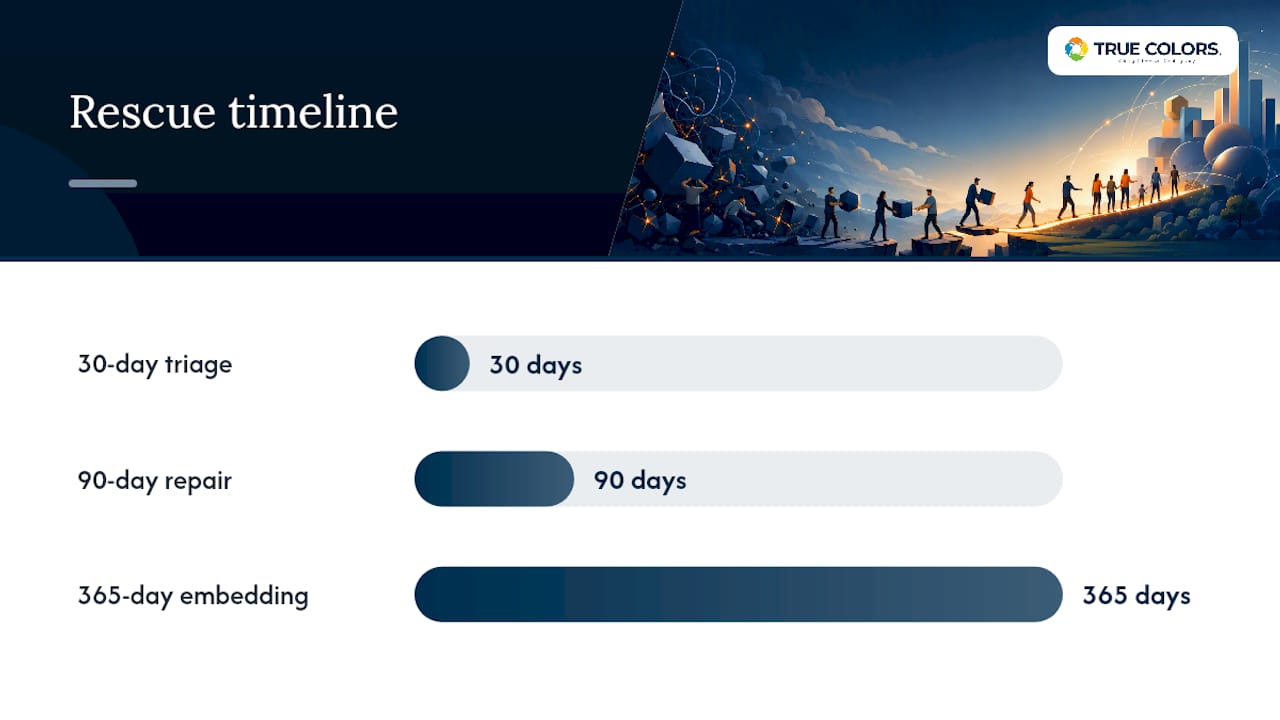
If your transformation is already showing signs of stall or reversal, the following timeline gives you a structured path back.
30-day triage
- Run the leadership reality check: ask direct reports what they observe leaders doing differently. Document the gap.
- Identify and pause any communication campaigns that are not backed by visible process changes.
- Map informal power holders who have not been engaged and schedule direct conversations.
- Establish one behavioral metric you will report publicly within 30 days.
- Brief middle managers on what is changing, why the current approach is being adjusted, and what support they will receive.
90-day repair
- Redesign at least one governance process (a meeting structure, an approval chain, a promotion criterion) to reflect stated values.
- Establish a behavioral measurement baseline using observation data, not survey scores alone.
- Identify two or three incentive quick-wins: small changes to recognition or reward that visibly align with the stated culture.
- Communicate with candid transparency about what has not worked and what is changing — employees who have watched previous launches fail need evidence of a different approach, not a new narrative.
365-day embedding
- Complete role and process redesign so that the organizational structure supports the culture rather than resisting it.
- Align promotion and performance criteria with behavioral evidence.
- Build reinforcement into onboarding, hiring, and leadership development so that culture norms transfer to new people without requiring a separate program.
Planning template leaders can adapt:
"We identified [specific gap] as the primary reason our transformation stalled. In the next 30 days, we will [specific governance or process change], assign ownership to [named role], and begin reporting [specific behavioral metric] in our monthly leadership review. By 90 days, we expect to see [observable indicator]. By 12 months, [specific structural change] will be complete and reflected in our promotion and performance criteria."
This template forces specificity on ownership, metrics, and timelines — the three elements most often missing from rescue plans that fail a second time.
The pattern no one wants to admit
Culture programs lose momentum for a reason that is uncomfortable to name directly: the people with the most authority to change the culture are often the people who benefit most from keeping it the same.
This is not cynicism. It is a structural observation. Senior leaders who rose through an organization by mastering its existing culture have deep, often unconscious, behavioral habits tied to that culture. Asking them to model something different is not just a communication challenge — it is a personal change challenge. And personal change is hard, especially when the old behaviors still produce results in the short term.
The organizations that break this pattern share one characteristic: they treat leadership behavior as a measurable, accountable output, not a soft aspiration. They define what "modeling the culture" looks like in observable terms, they track it, and they connect it to consequences. True Colors International's approach starts here — moving from personal awareness of behavioral styles to aligned action, where leaders can see the gap between their intentions and their impact and have a structured path to close it. The behavior-based assessment work is not a personality exercise. It is a diagnostic tool that makes the invisible visible, so leaders can act on what they find rather than defend against what they feel.

The other pattern worth naming: middle managers are consistently under-resourced in culture transformations. They receive the message, attend the training, and are then expected to translate executive intent into team behavior without additional time, authority, or coaching. When the transformation stalls at the manager layer, the instinct is to add more communication. The actual need is more capability and more structural support — clearer decision rights, reduced administrative load, and regular coaching on the specific behaviors the culture requires.
True Colors International's approach to culture that sticks
Culture transformation stalls when organizations rely on awareness alone and never build the systems that make new behavior the path of least resistance. True Colors International's corporate consulting and coaching solutions are designed specifically for this gap — connecting behavior-based assessments to leadership development, middle-manager enablement, and ongoing reinforcement that keeps progress visible and measurable.

The work begins with diagnosis: an employee experience survey that baselines where culture actually stands, not where leadership assumes it does. From there, Truecolorsintl builds the manager capability and leadership coaching that turn awareness into observable behavior change — with KPIs tied to real decisions, not attendance records. The Connected Leadership Program gives leaders the specific skills to model the culture they are asking their teams to adopt. If your transformation needs a structured path from diagnosis to sustained change, contact Truecolorsintl to start with a behavioral assessment of where your organization stands today.
Sources
- Your Culture Effort Didn't Stall for Lack of Effort (Reworked)
- To Change Your Company's Culture, Don't Start by Trying to Change the Culture | Working Knowledge
- Doomed to Fail: A Case Study of Change Implementation Collapse In the Norwegian Civil Aviation Industry
- 5 Hidden Reasons Culture Change Fails At Work And What To Do About It (Forbes)