
An effective approach for organizations is a short, role-based cohort workshop, half a day for managers or two days for a mixed leader and manager group, built around live practice rather than lecture. Pair it with a follow-up reinforcement plan and you get real behavior change, not just a training credit. This works whether you're leading a single department through a system rollout or supporting an organization-wide restructuring, and the format decisions below explain how to build it.
TL;DR:
- Virtual workshops with breakout rooms are practical for dispersed leadership teams, but they require monitoring tools for effective role-play practice.
- Most change management frameworks serve distinct purposes; ADKAR focuses on individuals, Kotter on organizational steps, and Bridges on emotional transitions, so choose based on the change type.
- Designing behaviors-focused objectives, such as diagnosing specific ADKAR stages or conducting action-oriented exercises, yields better long-term adoption than generic knowledge transfer.
- Follow-up reinforcement, such as coaching checklists or communication cadences, is critical within the first three months to sustain change and prevent skill fade.
- Tailoring content and post-workshop activities by role—sponsors, managers, change agents, frontline—maximizes learning transfer and overall change success.
Table of Contents
- Choosing the Right Format for Your Change Management Workshop
- ADKAR vs. Kotter vs. Bridges: Which Framework Fits Your Workshop?
- How to Design a Change Management Workshop That Sticks
- Who Should Attend and What Each Role Needs to Learn
- How Do You Measure Whether a Workshop Actually Worked?
- Assessment insights, personality-style data, employee experience findings, feed directly into which exercises and coaching scenarios a given group actually needs, rather than running the same agenda for every organization regardless of where their adoption gaps sit.
- What Practitioners Get Wrong About Change Workshops
- Bring True Colors Into Your Next Change Initiative
- Sources
- FAQ
Choosing the Right Format for Your Change Management Workshop
Onsite, virtual, and blended delivery each solve a different problem, and picking the wrong one is the most common reason a workshop feels productive in the room but evaporates by Friday.
Onsite sessions work best when the group needs to practice hard conversations face to face, coaching a resistant direct report, delivering bad news about a role change, walking through a tense stakeholder meeting. Body language and real-time pushback are part of the lesson. Plan on 90 minutes to a full day for a single onsite session, and cap the room at 20 to 25 participants if you want everyone to get real practice time.
Virtual synchronous workshops trade some of that intimacy for reach. A distributed leadership team spread across four time zones isn't flying in for a half-day session, so a two-hour video session with breakout rooms for role-play becomes the practical choice. Breakout groups of three or four keep virtual practice from turning into a passive webinar.
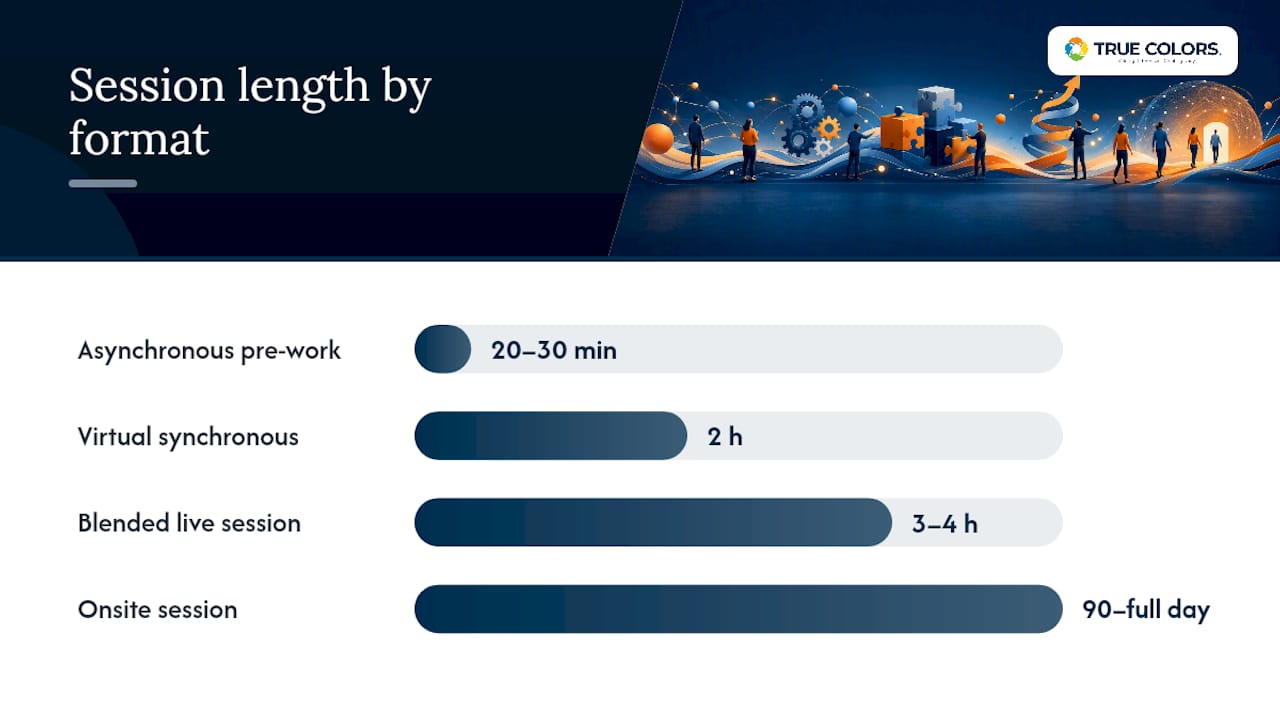
Asynchronous modules cover the knowledge transfer that doesn't need a facilitator in the room, framework overviews, case study reading, short video explainers, freeing live time for the exercises that actually build skill. This is where a lot of programs get the sequencing backward: they spend synchronous time explaining ADKAR instead of practicing it.
Blended cohorts combine all three and tend to produce the strongest transfer results, according to workshop design patterns used in university and corporate change management training courses. A typical structure:
- Pre-work: a 20 to 30 minute asynchronous module covering the framework and vocabulary
- Live session: 3 to 4 hours of onsite or virtual practice, simulation, and coaching
- Follow-up: a shorter virtual check-in 30 to 45 days later to troubleshoot real application
Facilitation and tech considerations matter more for simulations than for lecture content. A virtual role-play needs breakout rooms that can be monitored and rejoined smoothly; an onsite simulation needs enough physical space for small groups to talk without overhearing each other. Providers that run flexible catalogs, onsite, virtual classroom, and self-paced tracks, structure their offerings around exactly this tradeoff, according to Business Training Works.
ADKAR vs. Kotter vs. Bridges: Which Framework Fits Your Workshop?
ADKAR, Kotter's 8-step model, and the Bridges Transition Model answer three different questions, and most workshop design mistakes come from treating them as interchangeable.
ADKAR focuses on the individual: does this person have Awareness, Desire, Knowledge, Ability, and Reinforcement to make the change stick? It's diagnostic and granular, which makes it strong for manager-level coaching workshops where the goal is spotting exactly where an employee is stuck.
Kotter's model operates at the organizational level, building urgency, forming a coalition, communicating vision, and locking in wins. It's the right lens for leader and sponsor sessions focused on governance, communication cadence, and coalition-building rather than individual behavior.
Bridges' Transition Model addresses the psychological experience of change, endings, the messy neutral zone, and new beginnings. It's the model to reach for when the change involves identity loss, a merger, a reorg, a role elimination, where the emotional processing matters as much as the mechanics.
A short decision checklist works better than trying to memorize all three frameworks cold:
- What's changing? A system or process (favor ADKAR), the whole organization's direction (favor Kotter), or people's roles and identity (favor Bridges)
- Who needs to change? Individual contributors and managers (ADKAR), senior leadership and coalitions (Kotter), affected teams processing loss (Bridges)
- What's the time horizon? Weeks (ADKAR sprint), a multi-year transformation (Kotter), an ambiguous or unknown target state (Bridges, often paired with exploratory approaches)
- What's the primary blocker? Individual skill or motivation (ADKAR), lack of executive alignment (Kotter), emotional resistance to loss (Bridges)
Comparison frameworks built around this kind of diagnosis, mapping transformation type, primary challenge, and time horizon to a recommended model, consistently put diagnosis before framework selection rather than the reverse, according to SI Labs' change model comparison.
In practice, most mature programs combine frameworks rather than picking one. A common integration pattern runs Kotter at the program level for sponsorship, coalition, and vision, deploys ADKAR campaigns inside individual workstreams like system literacy or role redesign, and layers Bridges over specific cohorts undergoing identity change, according to Compel Framework's guide to choosing among the three. The strategic communications cadence for the overall initiative stays separate from workstream-level updates, which keeps people from drowning in messaging that doesn't apply to them.
Pro Tip: Pick one primary framework as your workshop's spine before you build the agenda. Trying to teach ADKAR, Kotter, and Bridges with equal weight in a single session is the fastest way to leave participants remembering none of them.
The most common pitfall is framework fatigue, presenting all three as equally weighted options and letting participants pick whichever sounds best. Treat the supporting frameworks as tools assigned to specific jobs, not competing recipes people vote on.
How to Design a Change Management Workshop That Sticks
Every objective in your agenda should trace back to a specific behavior, not a concept. "Understand ADKAR" is not a learning objective. "Diagnose which ADKAR stage is blocking adoption on your team and choose one intervention" is.
Sample half-day agenda for managers
- Opening and framing (20 minutes): the business case for the change and what's at stake for this group specifically
- Framework walkthrough (30 minutes): a compressed ADKAR overview, delivered as pre-work if you're running blended
- ADKAR assessment exercise (45 minutes): managers assess a real direct report or team against the five stages using a simple worksheet
- Manager coaching practice (60 minutes): paired role-play where one manager coaches a "resistant employee" played by a peer, then swaps
- Debrief and force-field analysis (30 minutes): identifying driving and restraining forces for their specific change
- Action planning (30 minutes): each manager commits to one specific conversation they'll have in the next two weeks
- Close and reinforcement setup (15 minutes): scheduling the follow-up check-in
Sample two-day agenda for a leader and manager cohort
Day one focuses on Kotter-level work: sponsorship, coalition-building, and communication planning, closing with a simulation exercise where leadership teams work through a mock announcement and stakeholder Q&A under time pressure. Day two shifts to ADKAR-level manager practice: coaching role-plays, resistance-handling drills, and small-group case studies pulled from the organization's actual change initiative. This mirrors the structure used in university-run programs, where online simulations let participants practice leading change and get feedback before facing the real thing, according to Boston University's Change Management Essentials Workshop.
Exercise templates worth building into almost any workshop:
- Role-play: manager coaches a scripted "resistant employee" persona, then debriefs what worked
- ADKAR self-assessment: participants map their own team against the five stages before designing an intervention
- Force-field analysis: listing forces pushing the change forward versus forces holding it back
- Simulation or business game: a compressed, high-pressure scenario (a system failure, a stakeholder revolt) that forces quick decisions
Pro Tip: End every exercise with a structured debrief, what happened, what surprised you, what would you do differently, rather than moving straight to the next activity. The debrief is often where the actual learning happens, not the exercise itself.
Facilitation and transfer depend on what happens after the workshop ends. Build homework into the close: one specific conversation, one document to draft, and one team meeting to run differently within two weeks. Without a concrete assignment tied to a date, the energy from the room dissipates within days. This kind of design thinking, tying objectives to real behaviors and building practice into the structure itself, is covered in more depth in Truecolorsintl's guide to designing behavior-based training programs.
Who Should Attend and What Each Role Needs to Learn
The strongest cohorts mix a sponsor, several managers, a handful of designated change agents, and a small group of frontline representatives, because each role sees a different part of the change and needs different tools to support it.
Training content should shift by role rather than treating everyone as a generic "participant." Leaders and sponsors need coalition-building and communication skills; managers need coaching and reinforcement practices they can use in one-on-ones, according to Prosci's guide to change management training.
- Sponsors and senior leaders: focus on vision articulation, coalition-building, and modeling visible commitment; suited to Kotter-based simulation exercises and stakeholder Q&A drills
- Managers: focus on coaching, resistance-handling, and reinforcement conversations; suited to ADKAR-based role-play and one-on-one coaching practice
- Designated change agents: focus on peer influence and surfacing frontline concerns early; suited to listening-session practice and feedback-routing exercises
- Frontline representatives: focus on translating the change into daily workflow and voicing practical obstacles; suited to workflow-mapping exercises and Q&A panels
Pre-work should match the role too. Managers benefit from reviewing their team's current adoption barriers before the session; sponsors benefit from a short briefing on likely resistance points. Follow-up should be equally differentiated: managers need a coaching checklist for their next few one-on-ones, while sponsors need a communication cadence to maintain visibility. Manager-level reinforcement in particular tends to determine whether adoption sticks, which Truecolorsintl's research on manager training treats as the single highest-leverage role in the entire rollout.
How Do You Measure Whether a Workshop Actually Worked?
Attendance and satisfaction scores tell you almost nothing about whether behavior changed. Mapping measurement to ADKAR stages instead gives a practical scorecard for exactly where adoption is breaking down, and leading indicators tied to those stages predict long-term adoption far better than completion metrics alone, according to Udemy Business' comparison of change management models.
A workable cadence looks like this:
- Baseline (before the workshop): survey current awareness and sentiment toward the change
- Immediate post-workshop: assess Knowledge and confidence in Ability through a short quiz or self-rating
- 1 to 3 months out: manager observation checklists and adoption metrics tied to the actual system or process
- 6 months out: sustained usage data, support ticket volume, and a repeat sentiment survey to confirm Reinforcement held
Report to sponsors in terms they already track. If the initiative is a new CRM rollout, tie adoption metrics to login frequency and data completeness, not workshop attendance. If it's a restructuring, tie it to retention and engagement scores in the affected group. Reinforcement matters as much as the initial session: research on why culture training loses impact points to the same pattern seen across change programs. Skills fade fast without structured follow-up, coaching check-ins, refresher touchpoints, or manager-led reinforcement conversations built into the calendar rather than left to chance.
Pro Tip: Build your 1 to 3 month check-in into the calendar before the workshop even happens. If it's not scheduled in advance, it competes with everything else on a manager's plate and usually loses.
Assessment insights, personality-style data, employee experience findings, feed directly into which exercises and coaching scenarios a given group actually needs, rather than running the same agenda for every organization regardless of where their adoption gaps sit.
The Connected Leadership Program builds sponsorship and coalition-building skills at the leadership level, while advanced certifications extend that capability to internal facilitators who need to sustain the work after the initial engagement ends. Reinforcement isn't an afterthought bolted onto the end of a session. It's built into the program design from the start, which is the difference between a workshop people remember fondly and one that actually changes how a team operates six months later.
What Practitioners Get Wrong About Change Workshops
Three trade-offs matter more than most agendas acknowledge: depth versus scale (a deep simulation for 20 people beats a shallow one for 200), simulation versus conversation (some groups need to practice, others need to process loss first), and sponsor visibility versus manager ownership (a sponsor who dominates the room can accidentally undercut the managers who have to do the daily reinforcement work).
One rollout stalled for months because leadership kept running sponsor-led town halls instead of manager coaching sessions. Adoption moved only after the format flipped.
— Theresa
Bring True Colors Into Your Next Change Initiative
A direct route to a workshop built around an organization's actual behavior data, not a generic template borrowed from an unrelated industry. Where most training vendors sell a fixed curriculum, True Colors starts with an Employee Experience Survey to find out exactly where awareness, desire, or ability are breaking down before designing a single exercise.

A pilot engagement typically starts small: one cohort, one specific change initiative, and a defined set of behavior outcomes to track over 90 days. From there, organizations often expand into the full Connected Leadership Program for ongoing sponsorship and manager development, supported by corporate consulting engagements scoped to the size of the rollout. If your organization runs a defense or government mission, True Colors also supports military and mission-driven teams with tailored leadership development.
If you're planning a change initiative in the next quarter, the next step is straightforward: request a pilot workshop scoped to one team or one change initiative, and use the results to decide whether a broader engagement makes sense. Get started with the Connected Leadership Program and see what a behavior-based approach looks like applied to your organization specifically.
Sources
- Change Management Essentials Workshop | Human Resources (Boston University)
- Choosing among ADKAR, Kotter and Bridges | Compel Framework
- What is Change Management Training? The Complete Guide | Prosci
- 8 Change Management Models Compared: Which Framework Fits Your Situation? | SI Labs
FAQ
What Are the 5 R's of Change Management?
Different sources define the 5 R's differently, but a common version covers Readiness, Risk, Responsibility, Resources, and Reinforcement, the practical checkpoints a sponsor should confirm before and during a rollout.
What Are the 5 Pillars of Change Management?
Definitions vary by framework, but most practical models converge on leadership sponsorship, clear communication, stakeholder engagement, structured training, and reinforcement, the same pillars a well-designed workshop is built to strengthen.
What Is the Difference Between ADKAR and Kotter?
ADKAR diagnoses individual readiness across five stages (Awareness, Desire, Knowledge, Ability, Reinforcement), while Kotter's 8-step model addresses organizational sequencing like building urgency and forming a coalition; many programs use both together.
How Long Should a Change Management Workshop Be?
A single manager-focused session typically runs half a day, while a mixed leader and manager cohort often benefits from a two-day format that separates sponsorship work from manager coaching practice.
Who Should Attend a Change Management Workshop?
A strong cohort mixes a sponsor, several managers, a few designated change agents, and frontline representatives, since each role needs different skills to support the same change effectively.