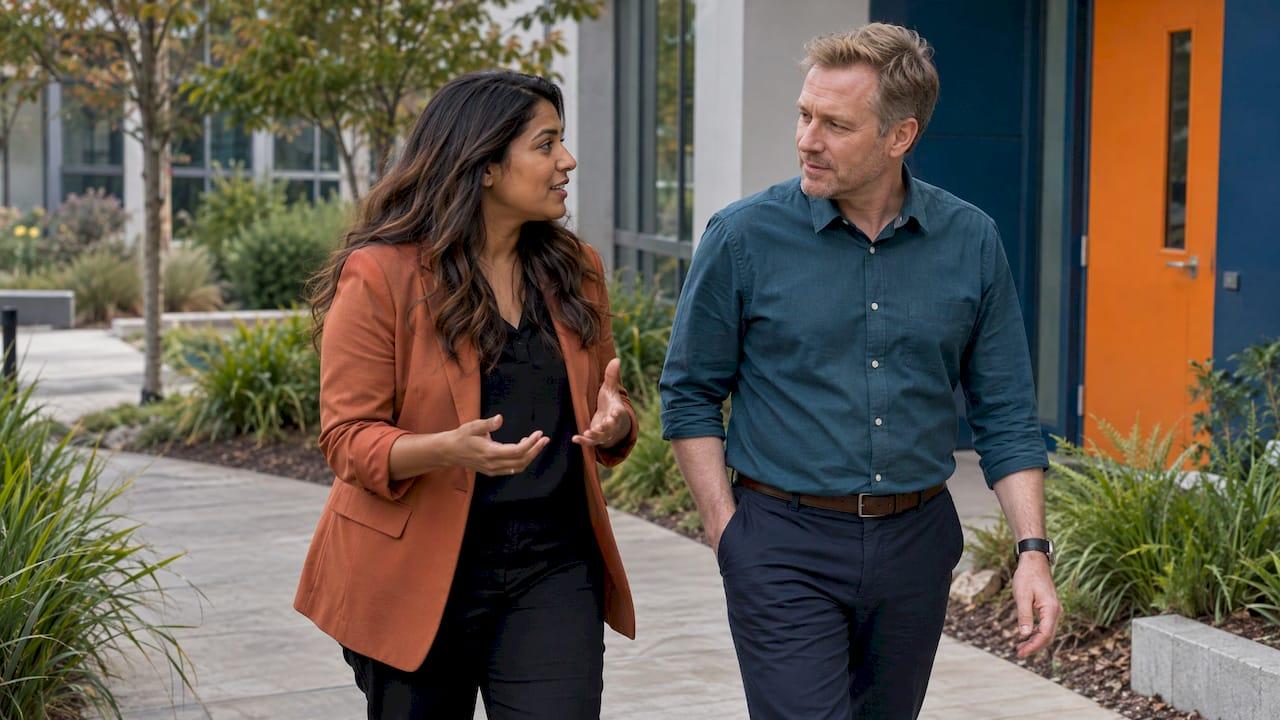
An effective one on one is a regular, private meeting where the employee sets much of the agenda, the manager listens first, and both leave with clear next steps. Hold it on a predictable cadence, prepare a short agenda in advance, and protect the time. Most of what goes wrong comes from skipped meetings, status updates that crowd out real conversation, and unclear expectations.
This guide gives you a structure, a manager agenda, sample questions, and a way to make the habit last across an entire organization.
TL;DR
- Meet weekly or biweekly for 30 to 60 minutes. Monthly is the floor, and weekly suits new hires, remote teams and periods of change.
- Send a short agenda about 24 hours ahead, ask the employee what they want to cover, and mix strategic, tactical and personal topics.
- Let the employee's topics lead. Use the meeting for roadblocks, growth and feedback, not only status.
- Close with documented action items and a note of appreciation, then follow up at the next meeting.
- Consistency is what builds trust. Organizations get the most from one on ones when every manager shares the same expectations and language.
Table of Contents
- What an effective one on one is for
- A one on one meeting structure that works
- A manager one on one agenda you can copy
- Questions that open real conversation
- How often to meet and for how long
- Make the habit stick: preparation and presence
- Why one on ones can feel uncomfortable, and how to fix it
- Perspective: effective one on ones are a culture system, not a calendar item
- Scaling effective one on ones across your organization
- How True Colors helps managers hold better conversations
- FAQ
- Sources
What an effective one on one is for
A one on one is not a status meeting and not a mini performance review. Asana's guide describes the purposes as building trust through honest, two-way dialogue, aligning personal objectives with team priorities, removing roadblocks and supporting growth. Baylor University's HR guide adds practical benefits: surfacing issues early, giving informal feedback, promoting engagement and retention, and creating time to follow up on earlier discussions.
Julia B. Austin, writing for Harvard Business School's Working Knowledge, calls the 1:1 the one forum for an honest, private conversation about what is really going on. She also notes that when 1:1s run constructively all year, review time can focus on goals and the year ahead rather than on feedback from the past.
For HR directors and L&D leaders, this is the point. The one on one is the most frequent place where culture is either reinforced or quietly undone. Culture is not what is said. It is what is repeated, and a manager's weekly conversation is repeated more than any town hall.
A one on one meeting structure that works
There is no single correct format, and the most successful meetings are dominated by topics the direct report cares about. Still, a repeatable shape helps managers who are short on time. Here is a structure for a 45 to 60 minute meeting that you can shorten for 30.
| Segment | Time (of 45 min) | Purpose |
|---|---|---|
| Opening and appreciation | 3 to 5 min | Set a positive tone, recognize something specific |
| Employee's topics | 15 to 20 min | Their priorities, questions, concerns |
| Manager's topics | 10 min | Alignment, context, feedback |
| Growth and development | 5 to 10 min | Skills, career, stretch opportunities |
| Actions and close | 3 to 5 min | Who does what by when, closing appreciation |
Two details come from published guidance. Harvard Business Review advises starting by complimenting the colleague on something she does well, and always closing with a note of appreciation. Austin recommends that if there are hard things to discuss, bookend them with two positive topics so the employee does not leave feeling down.
The Awareness, Advice, Action frame
If you want one simple lens for sorting topics, Atlassian suggests an Awareness, Advice and Action agenda. Awareness items are information being shared. Advice items are roadblocks where input is needed. Action items are commitments for both parties. It keeps status updates short and pushes the conversation toward decisions.
A manager one on one agenda you can copy
Austin's guidance is specific: about 24 hours before the meeting, email the employee a list of what you would like to cover, aim for a split between strategic, tactical and personal items, and always ask what they want to discuss. Harvard Business Review similarly suggests asking the direct report for a synopsis of what she would like to talk about before you meet.
Here is a template built on that guidance.
- Follow-ups from last time. Review the action items. Close the loop on anything either of you committed to.
- Employee's topics. Their list comes first. Ask, "What do you want to make sure we cover today?"
- Strategic. How their work connects to team and company priorities. What is changing, and what it means for them.
- Tactical. Current projects, deadlines, resources, and roadblocks.
- Personal. Workload, energy, how they are doing. Keep it genuine, not scripted.
- Feedback, both ways. One piece of specific feedback from you, and a request for feedback on how you can help more.
- Growth. Skills, stretch assignments, and career interests.
- Actions and appreciation. Restate who owns what, and end on something real you value.
After the meeting, write down the action items and share them. NACM News' checklist includes documenting and following up alongside discussing objectives, challenges, wins and next steps. A two-line note is enough.
Questions that open real conversation
Strong questions are open, specific and focused on the employee's experience. Northwestern University's HR department publishes a 1-on-1 prep planner for managers with prompts such as these:
- What interests you about the projects you are currently working on, and why?
- What do you like about your role, and what would you like to see change?
- What is the biggest challenge you are facing right now, and how can I help?
- What feedback do you have for me that can help me do better as a manager?
The last question matters most for culture. When a manager asks for feedback and then acts on it, employees learn that candor is safe. If you want to go deeper on that foundation, our guide to fostering emotional safety in your workplace and our 30 to 120 day roadmap for psychological safety show how leaders build it step by step.
A few more prompts that move beyond status:
- What is one thing that would make your week easier?
- Where do you feel your strengths are being used least?
- What did we decide recently that you are still unsure about?
- What would you like to learn in the next six months?
How often to meet and for how long
The published guidance converges on a range. Asana reports that most successful teams hold weekly or biweekly one on ones lasting 30 to 60 minutes, with weekly meetings recommended for new employees, remote or hybrid teams and high-change periods. The University of California, Irvine's Align guide recommends meeting with each direct report at least once a month and notes that research shows a less frequent cadence is much less effective and can hurt engagement.

The evidence on frequency is encouraging. In a Humu survey of 350 managers and individual contributors reported by MIT Sloan Management Review, employees who met with their managers at least weekly felt 20% less anxious, dreaded the meetings 17% less and felt 12% more successful at work. The same article notes that one in four people do not have regular one on ones with their managers at all.
A practical way to choose:
| Situation | Suggested cadence |
|---|---|
| New hire in the first months | Weekly, 30 to 45 min |
| Remote or hybrid team | Weekly or biweekly, 30 to 60 min |
| Team in a period of change | Weekly until things settle |
| Experienced, stable team | Biweekly, 30 to 45 min |
| Minimum for any direct report | Monthly |
Remote and distributed teams need extra intention, because casual hallway contact disappears. These corporate training tips for remote growth are a helpful companion when you are deciding how often leaders should meet with people working at a distance.
Make the habit stick: preparation and presence
Most ineffective one on ones fail on logistics before they fail on content. Harvard Business Review's advice is plain: schedule them as repeating calendar events, honor the slots by not canceling, and be present by turning off the phone and closing the door. A canceled meeting tells the employee where they rank.
Choose the setting to match the topic. The UCI Align guide suggests a conference room or office for sensitive topics, and a more relaxed setting such as a coffee shop or outdoor walk for lighter ones.
Feedback inside the meeting deserves the same care. The same guide describes effective feedback as setting up context, giving details about behaviors or outcomes to start, stop or continue, and agreeing on steps forward. Observable behavior, not personality labels, keeps the conversation fair and actionable.
For employees, preparation is simple: bring two or three topics, a recent win, one roadblock and one question about growth. Managers can say so explicitly, so that nobody has to guess what the meeting is for.

Why one on ones can feel uncomfortable, and how to fix it
Many people approach a meeting with their boss with some dread. Jessica Wisdom, in MIT Sloan Management Review, explains that anxiety and awkwardness often stem from a misalignment in expectations, and that a predictable cadence of connection points helps reduce fear.
That suggests three fixes any manager can apply now:
- State the purpose. Tell the employee what the meeting is for and what it is not for.
- Keep it predictable. Same day, same time, same rough structure.
- Separate the hard topics. Do not let a difficult conversation ambush a routine check-in. Flag it in the agenda, so nobody walks in surprised.
Candid, supportive conversations that reduce mistrust are also the subject of these steps toward a solution-oriented work environment, which pair well with the habits above.
Perspective: effective one on ones are a culture system, not a calendar item
We see the same pattern in organizations of every size. Leaders agree that one on ones matter, yet the quality varies from manager to manager. One leader runs a thoughtful weekly conversation. Another cancels three in a row. Employees notice, and they conclude that the culture is whatever their own manager makes it.
The gap is rarely motivation. It is a lack of shared language and reinforcement. A manager who understands how their own communication style lands, and how each direct report prefers to receive feedback, walks into a one on one with a very different level of awareness. That is the idea behind our approach: move people from personal awareness to aligned action, then reinforce it over time.
For HR and L&D leaders, we suggest treating the one on one as a behavior to be taught, modeled and measured, not a policy to be announced. Give managers a common agenda, practice the hard conversations in training, and check what employees are actually experiencing. When managers listen first, ask for feedback and follow through, trust grows. That is how a single weekly meeting turns into a stronger culture.
Theresa
Scaling effective one on ones across your organization
Individual managers can improve their meetings in a week. Organizations need a system. Here is a sequence we recommend for HR directors and L&D leaders.
- Define the standard. Agree on cadence, minimum length, a shared agenda template, and what gets documented.
- Train for the conversation, not just the format. Managers need practice in listening, giving behavior-based feedback and handling conflict. Our guide to the manager as coach outlines that shift, and our manager coaching program for HR leaders shows how to build and scale it.
- Give people a shared language. When managers and employees understand communication and personality styles, they can adapt faster and misread each other less.
- Listen at the organizational level. Aggregate patterns from one on ones and employee surveys reveal what is helping or hurting performance.
- Reinforce. Revisit the standard at 30, 60 and 90 days, and recognize managers who model it.
Team-level trust makes the individual meeting easier. Our piece on leadership team trust building practices is a good next read if your senior team sets the tone.
How True Colors helps managers hold better conversations
True Colors International helps organizations make culture actionable. Our practical, behavior-based system gives leaders and teams a shared language, so one on ones become consistent, candid and productive across every department rather than in a few strong pockets.
Our programs include communication training, team building, conflict navigation and personal awareness training, and our employee experience survey helps you see what employees experience day to day.
If you are ready to build a consistent one on one practice across your organization, explore our corporate consulting solutions or start from truecolorsintl.com.
FAQ
What is the goal of a one on one meeting?
The goal is to build trust and help the employee succeed. A good meeting aligns personal goals with team priorities, surfaces roadblocks, and supports growth through feedback and development guidance. It should never be only a status update.
How long should a one on one be?
Most successful teams hold them for 30 to 60 minutes, according to Asana's guide. If prep time is short, keep the meeting to 30 to 45 minutes and focus on the employee's topics first. A short meeting held consistently beats a long one that gets canceled.
What are good questions to ask in an employee check-in?
Ask what they like about their role, what they would change, what their biggest challenge is and how you can help. Then ask what feedback they have for you as a manager. Open, specific questions work better than "How is everything?"
How often should managers hold one on ones?
Weekly or biweekly works for most teams, and weekly is best for new employees, remote teams and times of change. UC Irvine's guide sets monthly as a minimum. Less frequent contact is much less effective.
Sources
- One on One Meeting Guide: Agenda, Questions + Template
- One on One Resources, Baylor University Human Resources
- Master the One-on-One Meeting, Harvard Business School Working Knowledge
- Get More Out of One-on-One Meetings with Your Direct Reports, Harvard Business Review
- Conducting a 1:1 Meeting: Agendas, Best Practices, & Tools, Atlassian
- One-on-ones: Best practices for meaningful conversations, NACM News
- 1-on-1 prep for managers, Northwestern University HR
- One-on-One Guide, UC Irvine Align
- Five Ways to Make Your One-on-One Meetings More Effective, MIT Sloan Management Review
- Top corporate training tips for boosting employee growth remotely
- Three Concrete Steps Toward a Solution-Oriented Work Environment