
Learning and development (L&D) is defined as the organizational function that translates values into observable behaviors through targeted learning initiatives. The role of L&D in culture change goes far beyond delivering training programs. It operationalizes culture by embedding desired behaviors into daily work, aligning skill development with organizational values, and creating the conditions for lasting change. When L&D functions as a strategic partner rather than a training vendor, it becomes the mechanism through which culture shifts from aspiration to reality. Frameworks like behavioral alignment, growth mindset cultivation, and leadership modeling are the tools that make this possible.
How does L&D reinforce organizational culture through learning programs?
L&D reinforces culture by making values concrete. Abstract commitments like “we value collaboration” or “we prioritize inclusion” mean nothing until they show up in how people actually work. L&D aligns the organizational “how” with the “what,” turning stated values into practiced behaviors. That alignment is the core mechanism of culture change.
Specific program designs make this happen:
-
Cross-functional training breaks down silos by putting people from different departments into shared learning experiences. When a finance analyst and a product manager solve a case study together, they build the relational habits that collaboration requires.
-
Social learning accelerates culture adoption. Peer coaching, communities of practice, and structured reflection sessions let employees see values modeled by colleagues, not just declared by executives.
-
Workshops on inclusion, innovation, and psychological safety give teams a shared language and a set of practiced skills. Language shapes behavior, and behavior shapes culture.
-
Growth mindset programs shift how employees relate to failure and feedback. Organizations that integrate innovation leadership into HR training see measurable gains in adaptability and engagement.
Pro Tip: Design learning experiences around the behaviors your culture requires, not just the skills your roles demand. A workshop on active listening builds culture. A compliance module does not.
Culture is not what is said. It is what is repeated. L&D creates the repetition. When learning programs consistently reinforce the same behaviors, those behaviors become the norm. That is how culture shifts from a stated value to a lived experience. Truecolorsintl builds this kind of culture-focused training by grounding programs in human behavior rather than generic competency frameworks.

What makes L&D-driven culture change fail?
Training alone does not change culture. This is the most common and costly misunderstanding leaders carry into culture initiatives. Culture change requires addressing structural layers first, including promotion criteria, performance incentives, and decision-making authority. Training amplifies structural change. It cannot substitute for it.
The concept of “organizational debt” explains why so many L&D programs underdeliver. Organizational debt accumulates when structural misalignments go unaddressed. Leaders promote people who do not model the stated values. Incentive systems reward individual performance while the culture claims to value teamwork. Over time, this debt compounds. When L&D arrives with a training program, it inherits it entirely.
Diagnosing organizational debt means separating transformational issues from transactional ones. Transformational issues include culture, leadership behavior, and incentive design. Transactional issues include skill gaps and tool adoption. Training fixes transactional problems. It cannot fix transformational ones without structural support.
The diagnostic step is non-negotiable. Before designing any culture-focused program, L&D leaders need to ask: Is this a skill problem or a system problem? Common signs that the system is the problem include:
-
Managers who complete inclusion training but still exclude certain voices in meetings
-
Teams that attend collaboration workshops but are still evaluated and rewarded individually
-
Leaders who endorse cultural values publicly but model contradictory behavior privately
Culture change holds when it is reinforced daily through incentives, leadership behavior, and observable actions. It does not hold up when treated as a program with a launch date and a completion certificate. Understanding why culture training loses impact is the first step toward designing programs that work.
How does L&D support organizational change management over time?
L&D and change management serve different but complementary functions. Change management addresses the “why” of change, building acceptance and reducing resistance. L&D addresses the “how,” building the skills and behaviors people need to operate in the new environment. Integrating both from the outset creates a far more effective engine for transformation than running them as separate workstreams.
Sustaining culture momentum requires four specific L&D practices:
-
Protect learning zones. L&D must safeguard minimum training periods before major changes go live. Rushing employees into new systems or behaviors without adequate practice time produces overwhelm, not adoption. Learning zones are non-negotiable buffers that allow practice and adaptation.
-
Build feedback loops. L&D is uniquely positioned to gather employee experience data during transitions and share those insights with leadership. This keeps leaders informed about where the culture is landing versus where they think it is.
-
Develop grassroots change agents. Equipping “tempered radicals” within the organization accelerates culture change from the bottom up. These are employees who believe in the direction but operate within existing constraints. When L&D equips them with the language and skills to influence peers, culture shifts faster than top-down mandates alone can.
-
Model learning at the leadership level. Leaders who transparently share their own learning create psychological safety for growth across the organization. When a senior leader says “I got this wrong and here is what I learned,” it signals that learning is valued, not just performance.
Pro Tip: Ask your L&D team to map every major change initiative to a corresponding learning zone. If the timeline does not include protected practice time, the change is being set up to fail.
Peer learning is one of the most underused tools in this phase. When employees teach each other, they reinforce their own understanding and build the relational trust that culture requires. Truecolorsintl supports this through peer-learning frameworks that connect individual behavior awareness to team-level culture habits.
How do you measure L&D’s impact on culture change?
Measurement is where L&D either earns its seat at the table or loses it. The most common mistake is measuring activity rather than impact. Completion rates and satisfaction scores tell you whether people attended. They do not tell you whether culture changed.
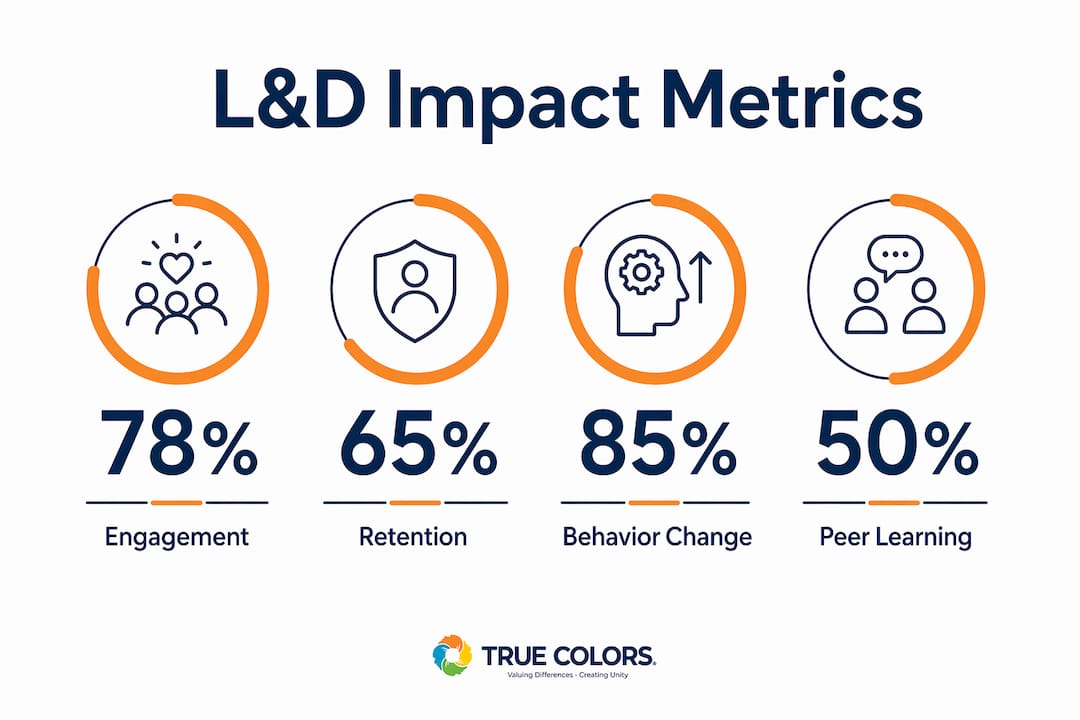
| Metric | What it signals |
|---|---|
| Employee engagement scores | Whether people feel connected to the organization’s values and direction |
| Voluntary turnover rate | About 60% of turnover links to a lack of development opportunities, making retention a direct L&D outcome |
| Behavior change observations | Manager and peer reports on whether trained behaviors appear in daily work |
| Internal promotion rates | Whether the organization promotes people who model the desired culture |
| Adaptability indicators | Speed and quality of response to new challenges are a signal of growth mindset adoption |
Qualitative signals matter as much as quantitative ones. Listen for language shifts. When employees start using the vocabulary of the cultural values in meetings and feedback conversations, that is evidence of internalization. When they do not, that is a diagnostic signal worth investigating.
Tying L&D metrics to organizational goals is what shifts the function from a cost center to a value driver. An employee experience survey gives leaders the baseline data they need to connect learning investments to culture outcomes. Without that baseline, measurement is guesswork.
Key Takeaways
L&D drives culture change by converting organizational values into practiced behaviors through targeted learning, structural diagnosis, and sustained leadership reinforcement.
| Point | Details |
|---|---|
| Values need behavioral translation | L&D turns abstract culture statements into practiced daily behaviors through deliberate program design. |
| Diagnose before designing | Separate transformational issues like incentive misalignment from transactional skill gaps before building any training program. |
| Protect learning zones | Rushing employees through change without practice time produces overwhelm, not adoption. |
| Grassroots agents accelerate change | Equipping peer influencers with language and skills drives culture shifts faster than top-down mandates alone. |
| Measure behavior, not activity | Completion rates do not signal culture change. Track behavior shifts, engagement, and retention instead. |
What I have learned about L&D and culture change
The most persistent mistake I see organizations make is treating culture change as a project with a finish line. They launch a program, run the workshops, celebrate the completion data, and then wonder why nothing changed six months later. Culture is not a project. It is a practice.
Before any training design conversation begins, the diagnostic question must come first: What is broken here? Is it a skill gap, or is it a system that rewards the wrong behaviors? I have seen organizations invest heavily in collaboration training while their performance review system still ranks employees against each other. The training did not stand a chance.
The leaders who get this right do something counterintuitive. They make their own learning visible. They share what they got wrong. They ask questions in public rather than projecting certainty. That behavior signals to the entire organization that learning is safe, and safety is the precondition for the kind of honest reflection that culture change requires.
L&D earns its influence when it stops asking “what training do you need?” and starts asking “what is preventing the behavior you want to see?” That shift in framing changes everything.
— Theresa Stairs
How Truecolorsintl supports L&D-driven culture change
Culture change requires more than a training calendar. It requires a system that connects individual behavior awareness to team dynamics, leadership alignment, and organizational reinforcement over time.

Truecolorsintl helps organizations build that system. Through leadership development programs grounded in behavioral science, Truecolorsintl equips leaders to model the culture they want to build. The corporate consulting practice works alongside HR and L&D teams to diagnose the drivers of culture gaps and design programs that address root causes, not symptoms. Whether your organization is navigating a major transformation or reinforcing an existing culture strategy, Truecolorsintl provides the practical tools and expert guidance to keep progress moving.
FAQ
What is L&D’s role in organizational culture change?
L&D translates organizational values into observable behaviors through targeted learning programs, social learning, and leadership development. It acts as the operational engine that makes culture change practical and measurable.
Why does training alone fail to change culture?
Training fails when structural misalignments, such as incentive systems or promotion criteria, contradict the behaviors being taught. Effective culture change requires diagnosing and addressing organizational debt before designing learning programs.
How does L&D support change management?
L&D and change management work together by pairing acceptance-building with skill development. Change management addresses the “why” of change, while L&D builds the “how,” ensuring employees have both the motivation and the capability to operate differently.
What metrics show L&D’s impact on culture?
Key indicators include voluntary turnover rates, employee engagement scores, behavior change observations, and internal promotion patterns. Tracking these over time shows whether learning investments are producing real cultural movement.
How long does L&D-driven culture change take?
Culture change is an ongoing practice, not a time-bound program. Meaningful behavioral shifts typically become visible over months, but sustaining them requires continuous reinforcement through leadership modeling, peer learning, and aligned incentive structures.