
A culture audit is a strategic diagnostic that reveals whether daily behaviors, leadership signals, and systems actually support your stated values, and that alignment materially affects engagement, retention, and business performance. Culture audits matter because they expose the gap between what leaders say and what employees experience, and that gap is where turnover, conduct risk, and lost performance all take root. ISACA's auditing guidance frames the audit as a way to find "stuck places" hidden from official statements, while MIT Sloan defines it plainly: does lived culture match stated values?
- Alignment: surfaces where mission statements and daily practice diverge
- Engagement and retention: data-driven insight into what keeps people or drives them out
- Risk reduction: flags toxic management, DEI gaps, and conduct exposure before they escalate
Key Takeaways
Culture audits matter because they expose the gap between stated values and daily behavior, and closing that gap drives measurable gains in engagement, retention, and revenue growth.
| Point | Details |
|---|---|
| Audits diagnose, surveys measure | A culture audit tests alignment between values and behavior; a pulse survey only captures sentiment at a moment in time. |
| Healthy culture correlates with growth | Executives reporting extremely healthy culture are 1.5 times more likely to see over 15% average revenue growth. |
| Combine hard and soft data | Blend policies and metrics with interviews and stories to avoid a surface-level diagnosis. |
| Governance determines follow-through | Assign clear owners and deadlines to action items, or findings stall after reporting. |
| Truecolorsintl converts findings into habits | Its behavior-first system pairs employee experience surveys with leadership training and reinforcement to sustain change. |
Where to Go Deeper on Culture Auditing
- ISACA's auditing guidance covers methodology and stuck-place diagnosis
- MIT Sloan's definition grounds the audit in leadership behavior theory
- The IIA's practice guide details integrated, targeted, and top-down audit approaches
- Oliver Wyman's measurement guide explains how to make findings actionable for executives
- NCBI's review of CVF and OCAI covers framework strengths and predictive limits
Table of Contents
- What Is a Culture Audit, and How Does It Differ From a Survey?
- Why Culture Audits Matter to the Bottom Line
- What Does a Culture Audit Actually Include?
- Which Frameworks Help Interpret Culture Audit Data?
- How Do You Actually Run a Culture Audit?
- What Derails a Culture Audit?
- How Does a Behavior-First System Sustain Culture Change?
- Frequently Asked Questions
- Sources
What Is a Culture Audit, and How Does It Differ From a Survey?
A culture audit is a diagnostic evaluation that measures whether an organization's values, mission, and goals actually show up in daily behavior. MIT Sloan describes it as the process of identifying misalignment between the culture a company claims and the culture people actually work inside. ISACA's guidance goes further, treating the audit as a tool for uncovering "stuck places," meaning barriers like toxic management, discrimination, or communication breakdowns that rarely appear in an employee handbook.
That's a different exercise than a pulse survey or a climate check. A pulse survey measures sentiment at a moment in time. A climate study looks at satisfaction trends. A culture audit is broader and evidence-driven, combining behavioral data, leadership review, and document analysis to test alignment itself.
- Enterprise-wide audit: used when leadership suspects systemic misalignment across departments
- Targeted audit: focused on one unit, function, or leadership layer showing warning signs
- Leadership-behavior audit: examines whether senior leaders model the values they publish
The IIA's practice guide on auditing culture recommends choosing the audit's scope based on where conduct risk actually concentrates, not where it's easiest to measure.
Why Culture Audits Matter to the Bottom Line
Culture audits matter because misalignment is expensive, and the cost shows up in places executives already track: turnover, revenue growth, and conduct risk. ISACA's research found that executives who describe their culture as extremely healthy are 1.5 times more likely to report average revenue growth over 15 percent across three years, alongside longer tenure and lower turnover. Becker's review of organizational culture audits reaches a similar conclusion: companies with strong, well-diagnosed cultures consistently report higher retention and better decision-making.
The business case breaks down into a few concrete outcomes:
- Retention gains from catching disengagement before it becomes attrition
- Revenue correlation tied to healthier, better-aligned cultures
- Reduced conduct risk, since audits catch the behaviors that trigger legal and reputational exposure
- Efficiency recovery, as audits often surface misaligned activities that quietly drain resources
Audits also pay for themselves in ways that rarely make the pitch deck. ISACA notes that audits frequently reveal efficiency opportunities that leaders can eliminate or restructure, turning a diagnostic exercise into a cost-saving one.
Pro Tip: Present audit findings to the board in risk language first, performance language second. Executives fund what threatens continuity faster than what merely improves morale.
What Does a Culture Audit Actually Include?
A credible audit blends quantitative and qualitative data, because either one alone tells an incomplete story. Wolters Kluwer's guidance on cultural audits warns that relying only on surveys or only on interviews produces surface-level diagnoses that miss the "unwritten rules" actually driving behavior.
A well-scoped audit typically draws on:
- Employee surveys with clearly defined response-rate targets
- Structured interviews across roles, tenure, and location
- Focus groups to surface shared narratives and unspoken norms
- Document review, including policies, onboarding materials, and performance criteria
- HR and operations metrics: turnover, promotion rates, exit interview themes
- DEI representation data and leadership 360 feedback
Stratified sampling matters here. If interviews cluster in one department or leadership tier, the findings will reflect that tier's reality, not the organization's. ISACA's guidance stresses that low response rates or identifiable interviews tend to suppress dissenting voices, which hides the exact problems the audit is meant to expose. Combining "hard" indicators like policy and metrics with "soft" indicators like stories and informal norms is what separates a genuine diagnosis from a checkbox exercise.
Which Frameworks Help Interpret Culture Audit Data?
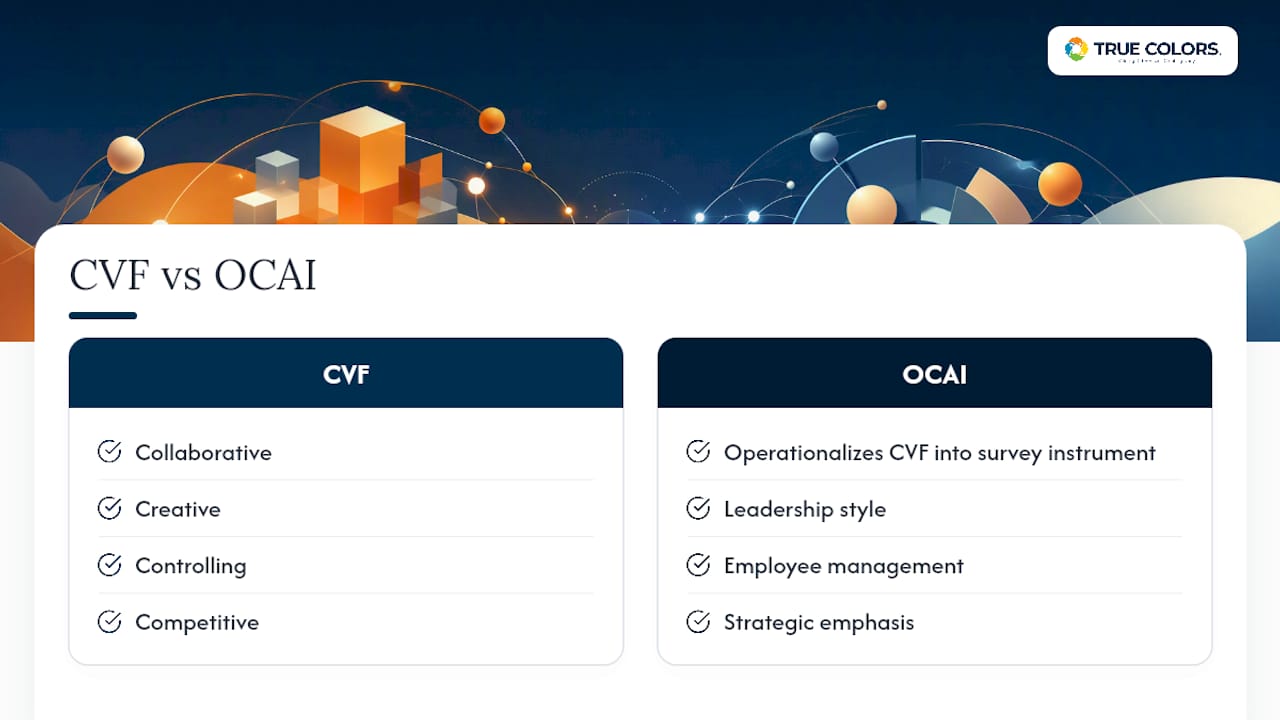
Raw interview transcripts and survey scores need an interpretive lens, and two tools dominate the field: the Competing Values Framework (CVF) and the Organizational Culture Assessment Instrument (OCAI). CVF maps culture across four competing orientations, collaborative, creative, controlling, and competitive, giving leaders a shared vocabulary for describing culture type. OCAI operationalizes that framework into a survey instrument, scoring domains like leadership style, employee management, strategic emphasis, and criteria for success.

Research compiled in academic reviews of organizational culture and leadership notes that both tools remain widely used, but their predictive validity is mixed. A single instrument can categorize culture without explaining why misalignment exists.
That's why frameworks work best alongside other data sources, not instead of them. Survey platforms and analytics tools can quantify patterns, but they still need interview and observational data to explain the mechanism behind the number.
Pro Tip: Never let one framework carry the whole diagnosis. Use OCAI to categorize, then triangulate with interviews to explain the "why" behind the score.
How Do You Actually Run a Culture Audit?
Running a credible audit follows a sequence, and skipping steps is what turns a diagnostic into a wasted exercise.
- Define scope and objectives. Decide whether this is an enterprise-wide, targeted, or leadership-focused audit, and name the specific risks or questions driving it.
- Secure stakeholder alignment. Get executive sponsorship before data collection starts. The IIA's practice guide identifies three main audit approaches, integrated, targeted, and top-down, and each requires a different sponsorship structure.
- Collect data. Combine surveys, interviews, focus groups, and document review, using stratified sampling to capture representative voices.
- Analyze findings. Layer quantitative scores against qualitative themes to identify where stated values and lived behavior diverge.
- Report to leadership. Present findings with clear ownership assigned to each recommendation, not a general list of observations.
- Build an action plan. Translate findings into specific behavior changes, starting with leadership modeling before broader system changes.
Timelines vary by scope. A targeted audit focused on one unit typically runs 6 to 8 weeks. An integrated or top-down enterprise audit, especially one tied to a leadership development initiative, usually takes 3 to 6 months. Internal teams can execute the survey and document-review pieces, but structured interviews and independent analysis often call for outside facilitation, since employees speak more candidly to a neutral party.
Track these KPIs before and after the engagement:
- Turnover rate by department and tenure band
- Employee Net Promoter Score (eNPS)
- Engagement survey scores
- Promotion rates and internal bench strength
- DEI representation across levels
- Conduct incident reports
Assign clear owners: HR leads data collection, executive sponsors own the action plan, and department managers own follow-through on their own team's findings.
What Derails a Culture Audit?
Most failed audits don't fail during data collection. They fail during follow-through. Treating the audit as a one-time survey rather than an ongoing diagnostic is the most common mistake, followed closely by weak anonymity protections that suppress honest feedback.
Watch for these red flags:
- Leadership defensiveness when findings surface uncomfortable patterns
- Survey participation below a credible threshold, which skews every downstream conclusion
- Action items with no assigned owner or deadline
- Reporting that stays siloed in HR instead of reaching the executive team and board
The fix starts with governance. Commit to a reporting cadence, name an executive owner for each recommendation, and communicate progress back to employees who participated. Silence after an audit is often worse than not auditing at all. It tells people their input didn't matter, which deepens the exact disengagement the audit was meant to catch. Building high performance culture after an audit requires the same discipline as the audit itself.
How Does a Behavior-First System Sustain Culture Change?
An audit tells you where alignment breaks down. What happens next determines whether that diagnosis leads to change or sits in a report nobody reopens. Truecolorsintl approaches this gap as a behavior problem, not a communications problem. Awareness alone rarely shifts how people work together; sustained change requires leadership development, team training, and reinforcement systems that keep new behaviors alive past the initial rollout.
That distinction shows up in how engagements are structured. Rather than delivering a survey and a slide deck, Truecolorsintl pairs employee experience insights with leadership-style workshops and ongoing reinforcement, so findings translate into habits leaders and teams actually practice.
- Leadership modeling comes first, since culture operates as a coordination signal that formal policy alone can't replicate
- Team training addresses communication patterns the audit flagged as unwritten rules
- Reinforcement systems keep progress moving after the initial engagement ends
Pro Tip: Sequence leadership behavior change before rolling out training organization-wide. Teams notice within weeks whether leaders are practicing what the audit recommended.
What Should HR Leaders Prioritize First?
Start with leadership modeling and one visible quick win before investing in systemic redesign. Boards fund what reduces risk, so frame findings in terms of turnover cost and conduct exposure, not just morale. A board slide should state plainly: what leaders need to change, why it reduces risk, and what metric proves it worked within two quarters. Executives respond to specificity, not aspiration.

Get a Clear Picture of Your Culture Before It Costs You
Truecolorsintl turns audit findings into a leadership-aligned roadmap instead of a report that gathers dust, because a diagnosis without a reinforcement system rarely outlasts the initial rollout.

If your organization needs a credible read on where values and behavior diverge, the Employee Experience Survey gives you a structured baseline, and the corporate consulting team can build the leadership development plan that follows it. Start with a discovery conversation to scope what your organization actually needs, not a generic package.
Frequently Asked Questions
Why do culture audits matter more now than a standard engagement survey? An engagement survey measures how people feel. A culture audit determines why, by testing whether leadership behavior and daily practice actually match stated values, which is where most turnover and conduct risk originate.
How long does a culture audit typically take? A targeted audit focused on one unit usually takes 6 to 8 weeks. An enterprise-wide or top-down audit tied to leadership development typically runs 3 to 6 months.
What's the difference between CVF and OCAI? The Competing Values Framework provides the conceptual map of culture types, while OCAI is the survey instrument that scores an organization against that map across leadership, management, and strategic domains.
Who should lead a culture audit inside a company? HR typically owns data collection, but an executive sponsor should own the resulting action plan. Structured interviews often benefit from outside facilitation, since employees speak more candidly to a neutral party.
What KPIs prove a culture audit worked? Track turnover, eNPS, engagement scores, promotion rates, DEI representation, and conduct incident reports before and after the engagement to benchmark real change.
Sources
- 2022 Volume 5 Auditing Your Organizational Culture
- What is a culture audit? (MIT Sloan)
- Auditing culture (The IIA practice guide)
- Organizational culture and leadership (excerpts on CVF and OCAI)
- Performing an organizational culture audit | Becker