
A culture that supports innovation is one where creativity, experimentation, and risk-taking are embedded as daily organizational practices, not reserved for annual strategy retreats. Business leaders who understand how culture supports innovation gain a measurable edge: research shows that cultural diversity expanded both the quantity and quality of patents in U.S. counties from 1850 to 1940 by increasing the pool of ideas available for recombination. That finding is not historical trivia. It is a blueprint. The same mechanism operates inside your organization today. When leaders build cultures that welcome diverse perspectives, tolerate failure, and reward experimentation, they create the conditions where new ideas survive long enough to become real products, processes, and revenue.
How culture supports innovation: the foundational link
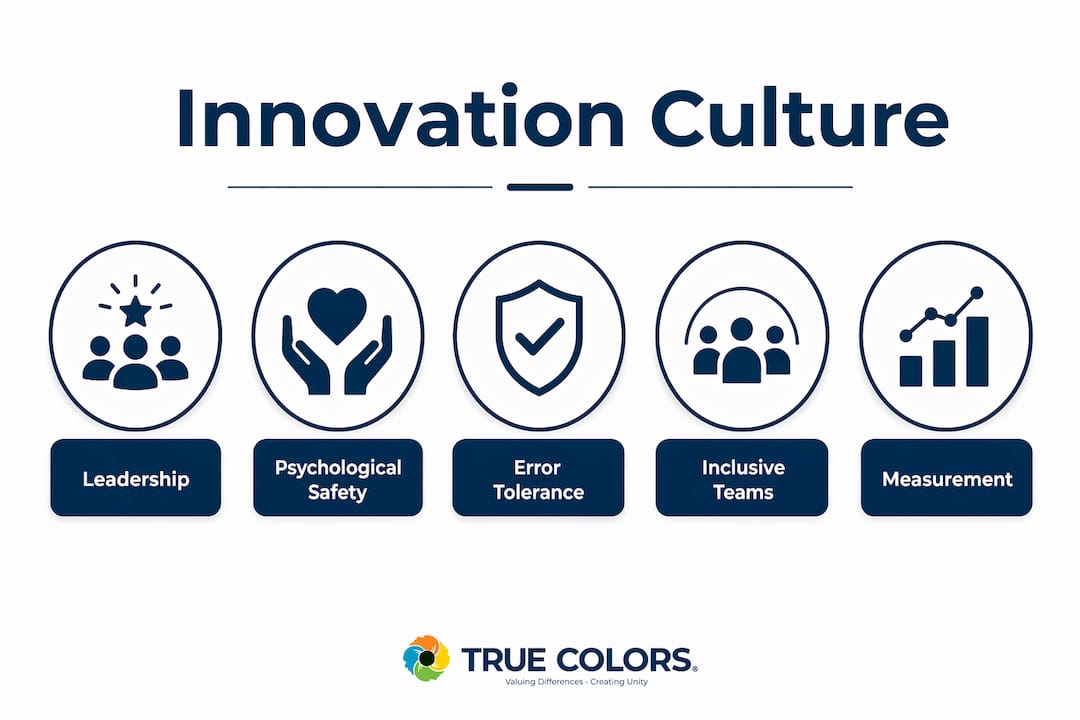
An innovation-supportive culture is defined by three embedded values: psychological safety, error tolerance, and leadership commitment. Psychological safety means team members speak up with half-formed ideas without fear of ridicule. Error tolerance means the organization treats failure as data, not as a career risk. Leadership commitment means executives model these behaviors consistently, not just endorse them in all-hands meetings.
The industry term for this concept is organizational innovation culture, and it differs from general workplace culture in one critical way. It is explicitly designed to produce new ideas and convert them into outcomes. IMD research confirms that companies integrating innovation into everyday workflows avoid “innovation theatre” and improve execution. Innovation theatre is the pattern of holding hackathons, naming a Chief Innovation Officer, and then returning to business as usual. Leaders who recognize this pattern are already ahead of most of their peers.

Culture is not what is said. It is what is repeated. The behaviors leaders reward, tolerate, and ignore every day define the actual culture, regardless of what the values poster on the wall says.
What does the evidence say about culture and innovation outcomes?
The empirical case for culture as an innovation driver is strong and spans multiple research disciplines.
Cultural diversity expands the idea pool
Historical analysis of U.S. patent data found that diversity increased idea recombination and the social interactions that accelerate idea sharing. This matters because most breakthrough innovations are recombinations of existing ideas from different domains. A team with narrow shared experience recombines from a small pool. A culturally diverse team draws from a much larger one.
Error management culture enables radical innovation
A 2026 study published in Nature found that error management culture moderates how leader passion translates into radical team innovation. High error tolerance supports creative deviance, meaning the willingness to try approaches that break from convention. Low error tolerance suppresses it. The implication is direct: organizations that punish mistakes do not just lose individual contributors. They lose the category of thinking that produces their most significant breakthroughs.
Universalism and inclusivity raise national and organizational innovativeness
Research published through Qeios found that universalism positively correlates with national innovativeness by expanding participation in innovation activities. Inclusive treatment of people outside the dominant in-group increases group diversity, which strengthens creative problem-solving capacity. This finding applies at the organizational level as well. Teams that practice impartiality generate more stable and productive environments for new ideas.
The pattern across all three research streams is consistent. Cultural factors in innovation are not soft variables. They are structural determinants of output quality and quantity.
How do leadership behaviors reinforce an innovation culture daily?
Leadership commitment is the single most important variable in whether an innovation culture takes hold or fades. Active leader support induces psychological safety and cross-functional collaboration. Both are prerequisites for sustained creative output.
The practical challenge is that most leaders support innovation in principle but undermine it in practice. They approve quarterly innovation reviews while cutting prototype budgets. They praise risk-taking in speeches while penalizing missed targets caused by experimentation. This gap between stated values and daily behavior is the most common reason innovation cultures fail.
Leaders who build genuine innovation cultures do the following consistently:
-
Protect time for experimentation. They carve out dedicated hours for teams to test ideas, not just discuss them.
-
Reward learning from failure. They publicly recognize teams that ran a disciplined experiment, even when the result was negative.
-
Connect innovation metrics to core workflows. They integrate innovation metrics into the same dashboards and reviews as revenue and delivery metrics.
-
Model curiosity. They ask questions in meetings rather than providing answers, signaling that exploration is valued.
-
Build cross-functional relationships. They create deliberate opportunities for people from different departments to work together on real problems.
Pro Tip: Link at least one innovation metric, such as experiments run or ideas submitted, to your team’s monthly performance review. When innovation appears alongside revenue in the same conversation, it stops being optional.
The CEO’s role in culture is not to generate ideas. It is to build and protect the conditions in which everyone can generate ideas.
What cultural factors block or enable innovation?
Cultural barriers to innovation are often invisible until they have already done significant damage.
The most common blockers follow a predictable pattern:
-
Low error tolerance. When teams fear blame for failed experiments, they stop experimenting. The result is incremental thinking dressed up as innovation.
-
In-group bias. Research confirms that in-group preferences suppress innovation by favoring familiar teams and practices over new perspectives. Organizations that hire and promote within tight social networks limit the diversity of thought that drives creative output.
-
Absence of measurement. Many organizations lack tools to assess whether their culture aligns with innovation goals. Without measurement, leaders cannot distinguish between a culture that talks about innovation and one that produces it.
-
Siloed structures. When departments do not share information or collaborate on problems, the cross-pollination that generates new ideas cannot happen.
-
Short-term performance pressure. Quarterly targets and innovation timelines operate on different clocks. When short-term pressure dominates, innovation gets deprioritized in every resource allocation decision.
The enablers are the mirror image of these blockers. Psychological safety, inclusive leadership, cross-functional collaboration, and a clear measurement framework each directly counter one of the barriers above.
Pro Tip: Run a simple culture audit before your next planning cycle. Ask teams to rate their comfort with sharing unfinished ideas and their confidence that failure will be treated as a learning opportunity. The gap between leadership assumptions and team reality is usually the most useful data point in the room.
Truecolorsintl works with organizations to measure organizational culture effectiveness and identify exactly which cultural factors are helping or hindering performance. That kind of diagnostic precision is what separates culture work that changes behavior from culture work that produces a report.
What strategies help leaders build a lasting culture of innovation?
Sustaining a culture that supports innovation requires deliberate, repeatable practices, not one-time initiatives. The following strategies are supported by the evidence.
Build diverse teams with intention
Cultural diversity combined with design thinking improves creativity, relevance, and market adaptability. Diversity does not happen by accident. Leaders must align talent acquisition with culture goals and develop hiring criteria that actively seek cognitive and experiential range.
Institutionalize error management
Innovation culture requires learning from failures rather than just celebrating successes. This means creating formal processes: post-project reviews that focus on what the team learned, not just what went wrong; failure budgets that give teams permission to run experiments that might not work; and recognition systems that reward disciplined experimentation.
Integrate innovation into core workflows
Separating innovation strategy from daily work leads to deprioritization. The fix is to embed innovation activities, such as prototyping time, idea reviews, and cross-team problem sessions, into existing operational rhythms. When innovation appears on the same agenda as delivery and finance, it receives the same attention.
Develop leaders who model the right behaviors
Leadership training focused on communication, psychological safety, and inclusive decision-making builds the daily behaviors that sustain an innovation culture. Truecolorsintl’s approach connects individual behavioral awareness to team-level alignment, giving leaders a practical system for reinforcing the right habits over time.
Measure culture and adjust
The organizations that sustain innovation cultures are the ones that treat culture as a measurable variable. Use employee experience surveys, behavioral assessments, and culture diagnostics to track whether your culture is moving in the direction you intend. Without data, culture improvement is guesswork.
| Strategy | What it addresses |
|---|---|
| Diverse team building | Expands the idea pool and improves creative problem-solving |
| Error management systems | Reduces fear of failure and enables creative risk-taking |
| Workflow integration | Prevents innovation from being deprioritized under operational pressure |
| Leadership behavior training | Aligns daily leader actions with innovation culture goals |
| Culture measurement | Identifies gaps between intended and actual cultural conditions |
Key takeaways
An innovation culture is built through consistent leadership behavior, error tolerance, and measurement, not through isolated programs or aspirational values statements.
| Point | Details |
|---|---|
| Culture is structural | Cultural factors like error tolerance and inclusivity directly determine innovation output quantity and quality. |
| Leadership behavior is the variable | Leaders who model curiosity, protect experimentation time, and reward learning from failure build cultures that produce results. |
| Measurement closes the gap | Organizations without culture diagnostics cannot distinguish between a culture that talks about innovation and one that produces it. |
| Diversity expands creative capacity | Culturally diverse teams draw from a larger pool of ideas, improving both the range and quality of solutions generated. |
| Integration beats isolation | Innovation embedded in daily workflows outlasts innovation treated as a separate initiative. |
The uncomfortable truth about innovation culture
I have worked with enough leadership teams to recognize a pattern that rarely gets named directly. Most organizations do not have an innovation problem. They have a consistency problem. Leaders say they want creativity, then reward compliance. They say they value risk-taking, then penalize the first team that fails publicly. The culture learns fast. It adjusts to what is rewarded, not what is stated.
The organizations I have seen build genuinely creative cultures share one trait: they treat error management as an operational discipline rather than a cultural aspiration. They build actual systems, post-project reviews, failure budgets, and learning forums that make it structurally safe to try things that might not work. That is not a soft intervention. It is an operational decision with measurable consequences.
The other thing I have noticed is that leaders underestimate how much their own daily behavior shapes the culture around them. A leader who asks questions in meetings rather than providing answers signals that exploration is valued. A leader who shares a recent mistake in a team meeting gives everyone else permission to do the same. These are not grand gestures. They are small, repeated behaviors that accumulate into culture over time.
Culture is not what is said. It is what is repeated. If you want to know what your innovation culture is, do not read your values statement. Watch what happens the next time someone on your team tries something new that does not work.
— Theresa Stairs
How Truecolorsintl helps leaders build cultures that produce results
Building a culture that consistently produces new ideas requires more than good intentions. It requires a practical system that connects individual behavior to team alignment and organizational outcomes.

Truecolorsintl helps business leaders make culture measurable and repeatable. Through leadership development programs focused on communication, behavioral alignment, and team dynamics, Truecolorsintl gives leaders the tools to build the daily habits that sustain an innovation culture. The employee experience survey provides the diagnostic data leaders need to identify exactly where culture is helping or limiting performance. For organizations ready to move from culture conversation to culture change, Truecolorsintl’s corporate consulting offers a structured path forward.
FAQ
What is an innovation-supportive organizational culture?
An innovation-supportive organizational culture embeds creativity, experimentation, and risk-taking into daily practices rather than treating them as occasional initiatives. It is defined by psychological safety, error tolerance, and consistent leadership commitment.
How does cultural diversity affect innovation outcomes?
Cultural diversity increases the range of ideas available for recombination and improves the quality of creative problem-solving. Historical patent research shows that diversity raised both the quantity and quality of innovation outputs in U.S. counties over a 90-year period.
What role does error tolerance play in innovation culture?
High error tolerance supports creative deviance and radical innovation by reducing the fear of failure. Research confirms that an error-management culture moderates the way leaders' passion translates into team-level breakthrough outcomes.
How can leaders measure whether their culture supports innovation?
Leaders can use employee experience surveys, behavioral assessments, and culture diagnostics to track alignment between stated values and actual team behavior. Many organizations lack measurement tools for this purpose, which is the primary barrier to realizing their innovation potential.
What is the biggest mistake leaders make with innovation culture?
The most common mistake is treating innovation as a separate initiative rather than integrating it into daily workflows. When innovation is disconnected from core operations, it gets deprioritized under normal performance pressure and never becomes a consistent organizational capability.